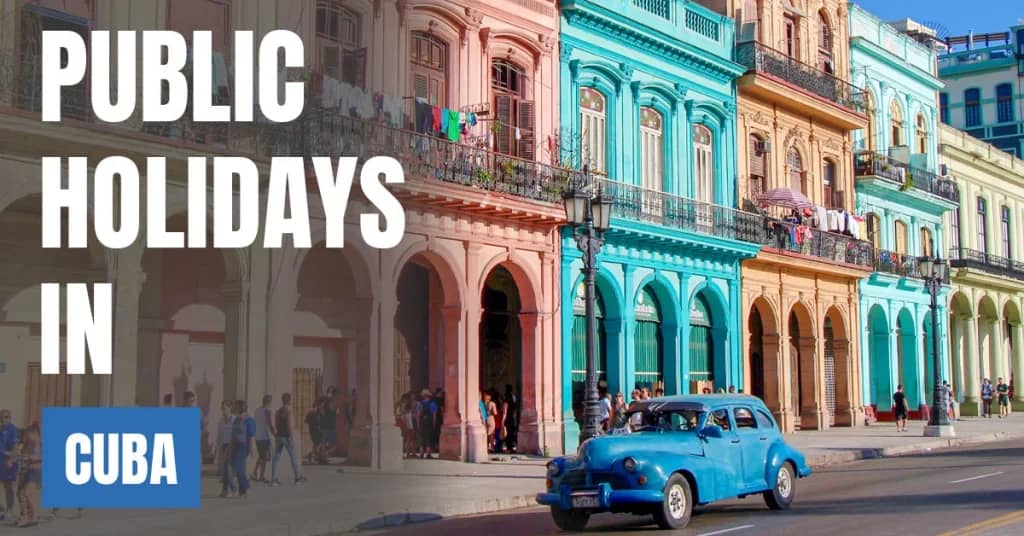
Cuba has 10 nationwide holiday and paid-rest dates in 2026, including the anniversary of the Cuban Revolution, International Workers' Day, National Rebellion Day, Good Friday and Christmas. Cuban labour legislation distinguishes national commemoration days, statutory holidays and additional paid work-rest days. This guide explains the official 2026 holiday calendar, important national celebrations, employment rules, weekend arrangements and practical information for residents and visitors.
On this pageTable of Content
Also Explore: Public Holiday in Cyprus
Next Public Holiday in Cuba
| Date | Day | Holiday | Status |
|---|---|---|---|
| December 25, 2026 | Friday | Christmas Day | Official Public Holiday |
Public Holidays in Cuba 2026
| Date | Day | Holiday | Status |
|---|---|---|---|
| January 1, 2026 | Thursday | Anniversary of the Cuban Revolution (Liberation Day) | Official Public Holiday |
| January 2, 2026 | Friday | New Year Holiday (Victory Day) | Official Public Holiday |
| April 3, 2026 | Friday | Good Friday | Confirmed – Paid Rest Day |
| May 1, 2026 | Friday | International Workers' Day (Labour Day) | Official Public Holiday |
| July 25, 2026 | Saturday | National Rebellion Day Holiday | Official Public Holiday |
| July 26, 2026 | Sunday | National Rebellion Day | Official Public Holiday |
| July 27, 2026 | Monday | National Rebellion Day Holiday | Official Public Holiday |
| October 10, 2026 | Saturday | Beginning of the Wars of Independence | Official Public Holiday |
| December 25, 2026 | Friday | Christmas Day | Official Public Holiday |
| December 31, 2026 | Thursday | New Year's Eve | Official Public Holiday |
Cuba's standard 2026 nationwide schedule contains nine national commemoration and statutory holiday dates, plus Good Friday as an additional paid work-rest day. Together, these provide 10 distinct dates in the VisaBoards holiday database.
The official holiday framework is described by Cuba's national tourism portal and the country's labour legislation.
All standard holiday dates are established in advance. Exceptional additional paid-rest days may also be declared by the competent authorities and require separate official confirmation.
How Public Holidays Work in Cuba
Cuba's holiday system distinguishes between national commemoration days (días de conmemoración nacional), statutory holidays (días feriados) and additional paid work-rest days (días de receso laboral retribuido).
National Commemoration Days
National commemoration days recognize major events in Cuban history. The four annually recognized dates are January 1, May 1, July 26 and October 10.
These dates are designated as days of work cessation for most employees, subject to legally established exceptions for essential activities and services.
Statutory Holidays
Cuban legislation identifies January 2, July 25, July 27, December 25 and December 31 as additional statutory holidays.
These dates supplement the main national commemorations, creating extended holiday periods around the Cuban Revolution anniversary and National Rebellion Day.
Additional Paid Work-Rest Days
Good Friday is separately recognized as an annual additional paid work-rest day. It is legally distinct from the ordinary statutory holidays but provides paid rest under the applicable employment rules.
The distinctions appear in Cuba's Labour Code, Law No. 189/2026, including Articles 232 to 234.
Major National Holidays in Cuba
Anniversary of the Cuban Revolution – January 1
January 1 commemorates the triumph of the Cuban Revolution in 1959 and the end of the government of Fulgencio Batista.
The occasion is commonly associated with Liberation Day and the anniversary of the Revolution. It is one of Cuba's principal national commemoration days.
January 2 is also a statutory holiday, allowing the national commemoration to extend into a two-day period.
International Workers' Day – May 1
International Workers' Day, known in Spanish as Día Internacional de los Trabajadores, is observed annually on May 1.
The holiday recognizes workers and the labour movement. Public gatherings, official activities and labour-related commemorations are traditionally associated with the date.
In 2026, May 1 falls on Friday, creating a three-day weekend for employees who normally have Saturdays and Sundays off.
National Rebellion Day – July 26
National Rebellion Day (Día de la Rebeldía Nacional) commemorates the July 26, 1953, attacks on the Moncada Barracks in Santiago de Cuba and the Carlos Manuel de Céspedes Barracks in Bayamo.
These events became important symbols of the revolutionary movement led by Fidel Castro.
Cuba recognizes three consecutive holiday dates associated with the commemoration: July 25, July 26 and July 27.
In 2026, July 26 falls on Sunday. The following Monday, July 27, is already an independently established statutory holiday rather than an additional substitute day.
Beginning of the Wars of Independence – October 10
October 10 commemorates the beginning of Cuba's wars of independence from Spanish colonial rule in 1868.
The date is associated with Carlos Manuel de Céspedes and the start of the Ten Years' War, an important stage in Cuba's struggle for independence.
In 2026, October 10 falls on Saturday and remains a recognized national commemoration day.
Religious Holidays in Cuba
Although most Cuban national holidays commemorate historical or political events, the country also recognizes Christian holidays through its statutory and labour arrangements.
Good Friday
Good Friday commemorates the crucifixion of Jesus Christ and falls on April 3 in 2026.
Under Cuban labour legislation, Good Friday is treated as an additional paid work-rest day rather than an ordinary statutory holiday.
Law No. 189/2026 expressly identifies Good Friday as an annual paid-rest day. Earlier regulations also addressed its treatment before the new Labour Code entered into force in September 2026.
The date changes each year because it is determined by the Christian Easter calendar.
Christmas Day
Christmas Day falls on December 25 and is an annually recognized statutory holiday in Cuba.
Christmas was restored as a national holiday in 1998. Religious services, family gatherings and festive meals may form part of celebrations.
In 2026, Christmas Day falls on Friday, offering a three-day weekend to employees with a typical Monday-to-Friday schedule.
New Year's Eve as a Public Holiday in Cuba
Unlike many countries where December 31 is only an observance or shortened working day, Cuba expressly recognizes New Year's Eve as a statutory holiday.
December 31 is identified among the annual holidays in the country's labour legislation and official tourism guidance.
The date leads directly into January 1, when Cuba commemorates the anniversary of the Revolution and the beginning of the new calendar year.
December 31 falls on Thursday in 2026.
Long Weekends in Cuba in 2026
Cuba's 2026 holiday calendar creates several opportunities for extended breaks. The examples below assume employees normally work Monday through Friday and have weekends off.
Revolution Anniversary – January 1 to January 4
January 1 falls on Thursday and January 2 on Friday. Together with the following weekend, these dates provide a potential four-day break.
Good Friday Weekend – April 3 to April 5
Good Friday falls on Friday, April 3. Employees entitled to the paid-rest day and normally off on weekends can enjoy a three-day break.
International Workers' Day – May 1 to May 3
May 1 falls on Friday, creating a three-day weekend for employees following a normal five-day working schedule.
National Rebellion Day – July 25 to July 27
Cuba's three-day National Rebellion Day holiday period runs from Saturday, July 25, through Monday, July 27.
The period includes the national commemoration on Sunday, July 26, with separately recognized statutory holidays on the surrounding dates.
Christmas Weekend – December 25 to December 27
Christmas Day falls on Friday, December 25, creating a potential three-day weekend through Sunday, December 27.
Actual time off depends on employees' work schedules and the rules governing their particular activities.
What Happens When a Public Holiday Falls on Sunday?
Cuba's weekend substitution rules depend on the type of holiday. The law does not automatically transfer every Sunday holiday to the following Monday.
Under Article 233 of Law No. 189/2026, when International Workers' Day or the October 10 national commemoration falls on Sunday, the Sunday rest day is transferred to the following Monday.
The same automatic transfer does not apply to January 1 or July 26 because those commemorations are already accompanied by separately designated holidays.
In 2026, July 26 falls on Sunday, but July 27 is already a statutory holiday. No additional nationwide substitute day is created solely because National Rebellion Day falls on Sunday.
Are Public Holidays Paid in Cuba?
Cuban labour legislation provides employment protections for national commemorations, statutory holidays and authorized paid-rest days.
Under the applicable labour framework, ordinary work activities cease on these dates except for legally recognized essential operations and other permitted services.
Good Friday is specifically designated as a paid work-rest day. The new Labour Code establishes rules for payment when eligible employees do not work on that date, subject to conditions concerning weekly rest, annual leave and other overlapping entitlements.
Employees required to work during designated holiday periods are subject to the applicable labour and compensation provisions. The exact treatment depends on the employee's working arrangements and legal classification.
Are Businesses and Essential Services Open on Public Holidays?
Public holidays in Cuba do not require every business or essential service to close.
According to Cuba's official tourism information, essential activities may continue during national commemorations and statutory holidays.
These include healthcare, transportation, pharmacies, funeral services, fuel supply, accommodation, tourism, communications and continuous-production industries.
Restaurants and Cafeterias
Restaurants, cafeterias and food-related services may operate during holidays according to schedules established by the relevant authorities and businesses.
Visitors should confirm opening hours directly, particularly during major national celebrations.
Hotels and Tourist Services
Hotels and certain tourism services generally continue operating during national holidays, although staffing, transport connections and individual attractions may follow special schedules.
Government Offices and Administrative Services
Government offices and administrative services may suspend ordinary operations during nationwide holidays.
Anyone arranging appointments, official documents or administrative procedures should check the relevant institution's working calendar.
Official Commemorations That Are Not Public Holidays
Cuba recognizes additional historical and commemorative dates that do not ordinarily create nationwide paid days off.
Examples include:
- January 28 – Birth anniversary of José Martí.
- February 24 – Grito de Baire.
- March 8 – International Women's Day.
- April 19 – Victory at Playa Girón.
- July 30 – Day of the Martyrs of the Revolution.
- October 8 – Day of the Heroic Guerrilla.
- December 2 – Anniversary of the Granma landing.
- December 7 – Commemoration of Antonio Maceo and fallen combatants.
These dates carry historical or national significance but are not automatically general work-rest holidays.
Some commemorations can affect particular public performances or activities under specific legal arrangements without becoming nationwide statutory holidays.
Can Cuba Declare Additional Special Holidays?
Yes. Cuban legislation permits the competent state and government authorities to authorize exceptional additional paid-rest days.
Under Article 234 of Law No. 189/2026, such measures may apply to a particular activity, territory or the entire country. Their purpose and duration must be established by the relevant legal instrument.
These exceptional arrangements should be distinguished from the standard annual holiday calendar. The 10 dates listed on this page represent the established nationwide holidays and Good Friday paid-rest day, rather than every possible special closure declared during 2026.
Frequently Asked Questions
What is the next public holiday in Cuba?
The next public holiday depends on the current date. The Next Public Holiday in Cuba section near the top of this page displays the upcoming holiday using the VisaBoards public holiday database.
What is Cuba's country code?
Cuba's ISO 3166-1 alpha-2 country code is CU.
How many public holidays are there in Cuba in 2026?
Cuba has 10 nationwide holiday and paid-rest dates in its standard 2026 calendar. This includes four national commemoration days, five statutory holidays and Good Friday as an additional paid work-rest day.
When is National Rebellion Day in Cuba in 2026?
National Rebellion Day falls on Sunday, July 26, 2026. The associated statutory holidays are Saturday, July 25, and Monday, July 27, creating a three-day national holiday period.
Is Good Friday a public holiday in Cuba?
Good Friday is a legally recognized additional paid work-rest day in Cuba. In 2026, it falls on Friday, April 3. It is treated separately from ordinary statutory holidays under Cuban labour legislation.
Is January 2 a public holiday in Cuba?
Yes. January 2 is an annual statutory holiday following the January 1 anniversary of the Cuban Revolution. In 2026, it falls on Friday.
Is Christmas Day a public holiday in Cuba?
Yes. Christmas Day, December 25, is an annually recognized statutory holiday. In 2026, it falls on Friday.
Is New Year's Eve a public holiday in Cuba?
Yes. December 31 is explicitly recognized as a statutory holiday in Cuba. In 2026, New Year's Eve falls on Thursday.
Does Cuba move public holidays that fall on Sunday?
Not automatically. Cuban law provides Sunday-rest transfers for certain national commemorations, including May 1 and October 10, but excludes automatic transfers for January 1 and July 26 because those dates are accompanied by other statutory holidays.
Are businesses open during public holidays in Cuba?
Some businesses and essential services continue operating during public holidays. Healthcare, transportation, accommodation, tourism, fuel supply and other authorized activities may remain available, while normal administrative operations may be suspended.
Official Sources for Public Holidays in Cuba
The following sources provide the legal framework, nationally recognized holiday dates and practical information about holiday operations in Cuba.
- Cuba Travel – National Commemorations and Holidays: Cuba's official tourism portal identifies annual national commemorations, statutory holidays, operational exceptions and Sunday-rest transfer rules.
- Cuban Labour Code – Law No. 189/2026: Reproduces the published Labour Code, including provisions for national commemorations, statutory holidays, Good Friday and exceptional paid-rest days.
- Official Gazette of the Republic of Cuba: Official publication platform for Cuban laws and regulations, including labour legislation and government measures.
- Cuba Travel – Havana Holidays and Working Hours: Provides additional official tourism information about national holidays, essential services and business operations.
Join the conversation
Have thoughts on this topic? Share them with others.
Ask questions, share experience, and learn from the Visaboards Community.