
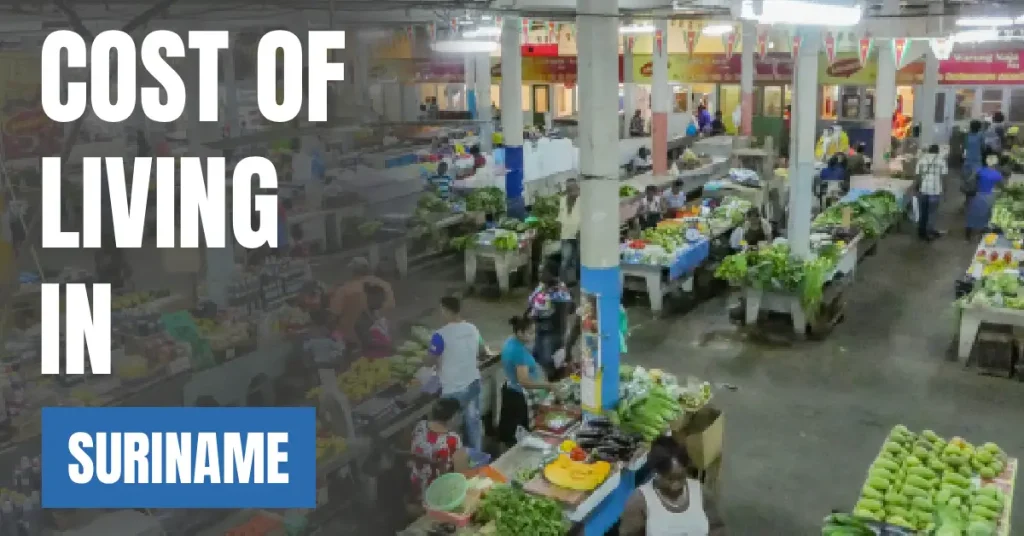
Cost of Living in Suriname 2026: Rent, Salaries and Monthly Expenses
The cost of living in Suriname in 2026 depends on housing, location, household size and whether you earn income locally or in a foreign currency. Paramaribo, the capital, offers the widest range of jobs, schools, healthcare facilities and rental accommodation, but everyday expenses can be difficult to manage on a typical local salary.
On this pageTable of Content
A single person renting privately in Paramaribo may need approximately SRD 35,000 to SRD 55,000 per month, including rent, groceries, utilities, transport and personal expenses. Someone sharing accommodation and following a modest budget may spend around SRD 25,000 to SRD 38,000. A family of four may require SRD 85,000 to SRD 135,000 or more, especially when private schooling or additional healthcare is necessary.
These are planning estimates rather than official national averages. Suriname has substantial differences between local household spending, expatriate-oriented accommodation and imported consumer goods. Its relatively small market also makes detailed price estimates less reliable than those available for larger countries.
The Surinamese dollar (SRD) is the country's official currency. The Central Bank of Suriname reported a September 2026 average US dollar selling rate of approximately SRD 37.90 for non-cash transactions. For convenient illustrations, this guide uses approximately SRD 38 per US dollar, not a guaranteed exchange rate.
One important change in 2026 is the minimum wage increase. From 1 July 2026, the legal minimum hourly wage rose to SRD 61.25, replacing SRD 52.47. Despite this increase, the minimum wage remains considerably below the spending level of a single person renting a private apartment in Paramaribo.
Cost of Living in Suriname at a Glance
Housing, groceries and imported products account for a significant portion of monthly spending. The following ranges represent broad 2026 budgeting estimates, primarily for people considering relocation to Paramaribo or nearby populated districts.
| Expense | Estimated Monthly Cost (SRD) |
|---|---|
| Single adult, excluding rent | SRD 17,000 to 30,000 |
| Single adult, including private rent | SRD 35,000 to 55,000 |
| Single adult in shared accommodation | SRD 25,000 to 38,000 |
| Couple, including rent | SRD 55,000 to 85,000 |
| Family of four, including rent | SRD 85,000 to 135,000+ |
| Room in shared accommodation | SRD 8,000 to 16,000 |
| One-bedroom apartment | SRD 10,000 to 29,000 |
| Three-bedroom apartment | SRD 15,000 to 45,000+ |
| Groceries, single adult | SRD 7,000 to 12,000 |
| Basic household utilities | SRD 1,500 to 5,000 |
| Internet and mobile | SRD 1,200 to 2,800 |
| Local transport | SRD 800 to 4,000 |
| Minimum hourly wage | SRD 61.25 gross per hour |
The rent figures represent possible market ranges rather than verified averages for every property. Shared rooms, inexpensive local housing and expatriate-oriented rentals can occupy very different price segments.
For comparison, the Wise Paramaribo cost-of-living database estimates a single person's expenses at approximately US$801 per month before rent, with a central one-bedroom apartment averaging about US$490 per month. The estimate therefore reaches approximately US$1,291 monthly including that apartment, or roughly SRD 49,000 using the guide's rounded exchange rate.
Such consumer databases may rely on contributed or aggregated prices and should not be interpreted as representative of every Surinamese household.
How Much Does It Cost to Live in Suriname Per Month?
A single adult renting independently in Paramaribo can plan for approximately SRD 35,000 to SRD 55,000 per month including rent. Individuals sharing accommodation can often reduce their costs, while households requiring larger homes, private schools or regular private healthcare may need substantially more.
Monthly expenses generally include accommodation, utilities, groceries, transport, internet, mobile services, healthcare allowances and personal spending.
Living costs can be lower when a household already owns its property, shares accommodation with relatives, grows some food or follows primarily local consumption patterns. A newcomer paying commercial rental rates may face significantly higher cash expenses.
Exchange-rate changes also matter. Imported groceries, electronics, medical supplies, vehicles and certain rental agreements can be sensitive to US dollar pricing. Residents paid entirely in SRD may therefore experience higher financial pressure when the currency weakens.
Housing and Rent Prices in Suriname
Accommodation is one of the largest expenses for people moving to Suriname. Paramaribo has the broadest selection of furnished apartments, houses, shared properties and expatriate-oriented accommodation.
How Much Is Rent in Paramaribo?
A basic one-bedroom apartment outside the centre may cost approximately SRD 8,000 to SRD 14,000 per month, while a comparable centrally located property may cost SRD 11,000 to SRD 29,000 or more.
The following comparison converts the price ranges reported by Wise into rounded SRD amounts at approximately SRD 38 per US dollar.
| Accommodation | Estimated Monthly Rent (SRD) |
|---|---|
| One bedroom, city centre | SRD 11,200 to 28,500 |
| One bedroom, outside centre | SRD 7,600 to 13,200 |
| Three bedrooms, city centre | SRD 26,600 to 95,000 |
| Three bedrooms, outside centre | SRD 15,200 to 32,500 |
The upper end of the central three-bedroom range reflects a small premium segment and is not a typical family rental requirement. Actual advertised rents should be checked directly before relocating.
Renting in Smaller Towns and Districts
Housing may be less expensive in parts of Wanica, Saramacca, Commewijne and Nickerie than in popular Paramaribo neighbourhoods. However, reliable rental listings are less plentiful outside the capital.
Lower rent does not always mean lower total expenditure. A resident working in Paramaribo may face additional transport costs, while remote communities may have higher prices for delivered goods and restricted access to medical services.
Rental Deposits and Contracts
Before renting, tenants should establish the deposit amount, accepted payment currency, maintenance obligations, electricity arrangements, water charges and notice requirements.
Some landlords advertise or negotiate rents in US dollars. Tenants earning SRD should clarify whether their rent is fixed in local currency or changes with the exchange rate.
Foreign newcomers may also need temporary accommodation while viewing properties and arranging utilities. These initial expenses are separate from regular monthly living costs.
Buying Property
Residential property prices vary widely by neighbourhood, land tenure, construction quality and legal status. Older online estimates of prices per square metre should not be used as substitutes for current property valuations.
Prospective buyers should obtain legal advice on title, land rights, registration and transaction expenses. Buying property does not automatically establish immigration residence rights.
Food and Grocery Costs in Suriname
A single person preparing most meals at home can budget approximately SRD 7,000 to SRD 12,000 per month for groceries. Couples and families generally spend more, although buying in larger quantities can lower the cost per person.
Local rice, vegetables, seasonal fruit and familiar staple foods can provide better value than imported packaged products. Suriname's diverse food culture includes Creole, Hindustani, Javanese, Chinese and Indigenous influences.
Typical Grocery Prices in 2026
| Item | Illustrative Price (SRD) |
|---|---|
| Milk, 1 litre | 45 to 95 |
| Fresh bread, approximately 500 g | 38 to 76 |
| Rice, 1 kg | 43 to 81 |
| Eggs, 12 | 91 to 158 |
| Chicken fillets, 1 kg | 87 to 380 |
| Beef, 1 kg | 107 to 609 |
| Bananas, 1 kg | 38 to 152 |
| Apples, 1 kg | 108 to 304 |
| Bottled water, 1.5 litres | 38 to 76 |
These rounded estimates use the consumer-price ranges in Wise's Paramaribo database and the approximate SRD 38 exchange-rate assumption. They illustrate possible retail prices rather than a nationwide supermarket survey. The broad meat and produce ranges partly reflect differences in product quality, availability and vendors.
Shopping at neighbourhood markets, buying seasonal produce and limiting imported brands can reduce household food spending.
Restaurants and Eating Out
Restaurant prices depend strongly on the type of establishment. Local takeaway stalls and neighbourhood eateries may be less expensive than sit-down restaurants serving international cuisine.
| Restaurant Expense | Estimated Price (SRD) |
|---|---|
| Inexpensive restaurant meal | 250 to 570 |
| Mid-range dinner for two | 1,500 to 3,500+ |
| Fast-food combination meal | 400 to 465 |
| Cappuccino | 55 to 235 |
| Soft drink | 35 to 80 |
Restaurants targeting visitors or affluent customers may exceed these estimates. In particular, Wise reports a very wide range for mid-range dining, indicating that a simple national restaurant price would be misleading.
For a person eating out occasionally, SRD 2,000 to SRD 5,000 monthly may be a reasonable planning allowance. Regular restaurant meals and deliveries can raise this significantly.
Utilities and Household Bills
A modest apartment may require approximately SRD 1,500 to SRD 5,000 monthly for basic utilities, depending on electricity consumption, water arrangements and the property's features.
Air conditioning is a particularly important expense because Suriname has a hot, humid tropical climate. Households using several air conditioners throughout the day can experience higher electricity consumption than those using fans and natural ventilation.
Wise's Paramaribo database reports basic utilities for an approximately 85-square-metre apartment at around US$38 per month. This is considerably lower than some expatriate-oriented budget estimates and may not represent air-conditioned households with heavy electricity use.
Before committing to a rental, request information about recent electricity bills, meter arrangements, water supply reliability and any generator or backup-power costs.
Internet and Mobile Phone Costs
Home internet and mobile communications may cost approximately SRD 1,200 to SRD 2,800 monthly combined, depending on provider, connection speed, data allowances and promotional terms.
Residents can compare available packages from telecommunications providers such as Telesur and Digicel. Prices and coverage depend on the neighbourhood and service type.
Fixed broadband is generally more practical in populated areas, while rural and interior locations may have fewer connectivity choices.
Remote workers should check actual speed, upload performance and connection reliability at the specific property before signing a long-term lease.
Transportation Costs in Suriname
Public transport can be inexpensive, but Suriname does not have the same level of frequent, scheduled urban transit available in many larger international cities. Buses, private minibuses, taxis and personal vehicles are important transport options.
How Much Does Public Transport Cost?
Local travel information published in October 2026 identifies a typical Paramaribo city minibus fare of SRD 14.50. Passengers generally pay cash, and many private minibuses leave when sufficiently full rather than according to a fixed timetable.
The Surinamese government also oversees state transport services, while the Nationaal Vervoer Bedrijf operates bus and certain boat connections.
These figures do not imply that all bus routes charge the same fare. Intercity and river transport costs depend on the route and operator.
Are Buses Free in Suriname?
No, ordinary public transport is not generally free for all passengers. Eligible groups may qualify for concessions or particular programmes, but fares and entitlements must be checked locally.
The original article's suggestion of a standard monthly transport pass should not be interpreted as evidence of a universal nationwide subscription scheme.
Taxi and Car Expenses
Taxis are useful where bus routes are inconvenient. Passengers should agree on the price in advance or use a service that provides a fare quotation.
Vehicle ownership adds fuel, maintenance, insurance, registration and potential financing expenses. Suriname drives on the left, which is another practical consideration for newcomers.
In October 2026, local travel information indicated petrol prices around SRD 48 per litre and diesel around SRD 53 per litre. Fuel prices can change.
Remote districts may require additional boat or domestic air transport, making travel costs substantially different from those in Paramaribo.
Healthcare Costs in Suriname
Suriname has public and private healthcare providers, including hospitals and clinics concentrated in Paramaribo. Access is not simply free for every resident or visitor.
Is Healthcare Free in Suriname?
No. Suriname has a national basic healthcare insurance framework, but insurance contributions, eligibility rules and coverage limitations are important.
The Surinamese government's basic healthcare insurance guidance explains that residents, including qualifying foreign nationals living in the country, are covered by the national basic healthcare insurance framework.
The government describes the scheme as requiring basic insurance coverage and premium contributions. It also states that employers are required to contribute at least 50% of applicable premiums for employees.
The government webpage includes historical premium examples, but these should not be treated as verified 2026 insurance quotations. Residents should obtain up-to-date rates directly from the insurer or responsible authority.
Private Healthcare and Insurance
Private consultations, specialist care, diagnostic services and insurance premiums vary considerably. An adult may set aside SRD 1,500 to SRD 4,000 or more monthly for insurance and healthcare-related expenses, depending on coverage and medical needs.
This is a household budgeting allowance, not a published statutory insurance premium.
Advanced treatments may not always be available locally, and some patients may require referrals or treatment abroad. Expatriates with complex healthcare needs should investigate specialist availability and medical evacuation coverage.
Education and Childcare Costs
Suriname has public and private education options. Dutch is the principal language of formal education, which may be an important consideration for children arriving from other countries.
Public Schools
Public schooling can be substantially less expensive than private or international education. However, families may still need to budget for uniforms, books, school supplies, transportation and other school-related costs.
Admission, language support and school availability should be checked with the relevant institution or education authority.
Private and International Schools
Private and international school fees depend on curriculum, age group and additional services. The original guide cited annual international-school costs of US$3,000 to US$7,000, but these should be regarded as indicative historical planning figures rather than verified 2026 tuition.
Families should contact their preferred schools for current tuition, registration fees, meals, transport and other compulsory charges.
Childcare
Nursery and private childcare costs depend on the number of hours, location, age of the child and provider. Reliable national 2026 fee averages are limited, so obtaining individual quotations is more appropriate than relying on one standard price.
Salaries and Minimum Wage in Suriname in 2026
Suriname's legal minimum wage is SRD 61.25 gross per hour from 1 July 2026. The rate applies across sectors and represents a 16.7% increase from the previous SRD 52.47 hourly minimum.
The government formally announced the increase on 22 July 2026, following the relevant ministerial decision and publication.
| Minimum Wage Calculation | Gross Amount (SRD) |
|---|---|
| Hourly rate | 61.25 |
| 8-hour working day | 490 |
| 40-hour working week | 2,450 |
| Average monthly equivalent at 40 hours per week | 10,617 |
| Annual equivalent at 2,080 hours | 127,400 |
The monthly calculation uses 52 weeks divided by 12 months. Actual monthly wages vary with hours worked and applicable employment arrangements.
The official announcement is available from the Government of Suriname.
What Salary Is Needed to Live Comfortably?
For an individual renting independently in Paramaribo, a take-home income of approximately SRD 40,000 to SRD 60,000 monthly may provide a more practical starting point than the statutory minimum wage.
A couple sharing expenses may need combined disposable income of around SRD 60,000 to SRD 90,000, while a family renting suitable accommodation may need SRD 90,000 to SRD 140,000 or more.
These figures are budget targets rather than measured national salaries. Local earnings, home ownership, family support, transport arrangements and consumer habits can result in significantly lower spending.
The difference between minimum pay and market rental costs is important: SRD 10,617 gross monthly at minimum wage is substantially below the estimated cost of renting and maintaining a private apartment in the capital.
Taxes and Everyday Affordability
Employment income in Suriname may be subject to wage tax and social contributions. For 2026, the reported monthly tax-free wage allowance is SRD 9,000, with progressive rates of 8%, 18%, 28% and 38% applied to subsequent taxable brackets.
A 2026 wage-tax summary outlines the SRD 9,000 allowance and associated progressive brackets. The employee's actual tax depends on eligible deductions, income and payroll circumstances.
Suriname also operates a value-added tax system, with different treatment depending on the goods or services involved. Imported purchases may be affected by exchange rates, duties, shipping and applicable taxes.
People receiving income from abroad should obtain advice on their potential Surinamese tax obligations rather than assuming that foreign-earned income is always exempt.
Realistic Sample Monthly Budgets for Suriname
The following examples show illustrative monthly expenses in SRD, including rent. They are constructed budgets rather than measured household averages.
The budget single person shares accommodation. The moderate single person rents privately. The couple rents one apartment without children. The family of four uses ordinary schooling and does not include expensive international school tuition.
| Expense | Budget Single | Moderate Single | Couple | Family of Four |
|---|---|---|---|---|
| Rent | 12,000 | 19,000 | 25,000 | 36,000 |
| Utilities | 2,500 | 4,000 | 5,500 | 8,000 |
| Groceries | 7,500 | 10,000 | 17,000 | 26,000 |
| Transport | 1,200 | 1,800 | 3,500 | 6,500 |
| Internet and mobile | 1,400 | 1,700 | 2,500 | 3,500 |
| Healthcare allowance | 1,500 | 2,500 | 4,500 | 8,500 |
| Dining and leisure | 2,500 | 5,000 | 7,500 | 11,000 |
| Other household expenses | 2,500 | 3,500 | 5,000 | 9,000 |
| Total Monthly Cost | 31,100 | 47,500 | 70,500 | 108,500 |
Budget Single Person: SRD 31,100
This example assumes shared accommodation, careful food spending, public transport and limited leisure expenses. It does not include private vehicle ownership or major healthcare costs.
Moderate Single Person: SRD 47,500
This budget includes a private apartment, reasonable food spending, utilities, communications and occasional restaurants. It is more appropriate for someone seeking independent accommodation in Paramaribo.
Couple: SRD 70,500
A couple can divide rent and other fixed bills, improving per-person affordability. This example assumes two adults without dependents or expensive private medical needs.
Family of Four: SRD 108,500
This family budget covers a larger rental property, household groceries, transport and basic personal expenses. Private international schooling, full-time childcare, major vehicle payments and substantial medical treatment are excluded.
All examples exclude major one-time relocation costs and any income taxes deducted before take-home pay.
Cost Differences Between Paramaribo and Other Areas
Suriname's regional cost differences are shaped by housing availability, road access, supply chains and access to public services.
| Location | General Cost Considerations |
|---|---|
| Paramaribo | Broadest rental market, jobs, retail and medical services |
| Wanica | Potential housing savings, commuting costs vary |
| Commewijne | Residential alternatives, transport connections matter |
| Nieuw Nickerie | Smaller rental market, different employment opportunities |
| Other coastal districts | Potentially cheaper housing but fewer services |
| Interior communities | Limited market data, expensive logistics and specialised transport |
There is insufficient consistent 2026 rental data to publish precise regional affordability rankings. Some rural areas may have lower housing expenses but higher costs for transport, imported goods and access to healthcare.
Is Suriname Cheaper Than Guyana, Brazil and Trinidad and Tobago?
Suriname may offer lower costs in certain everyday categories, but it is not reliably cheaper across all expenses or cities. Differences in income, housing markets and exchange rates make broad country-to-country conclusions unreliable.
Guyana's economic growth and housing demand affect affordability, particularly around Georgetown. Brazil has a much larger consumer market with significant differences between cities and states. Trinidad and Tobago has its own housing, transport and imported goods pricing structures.
For a useful comparison, examine equivalent rental properties, grocery baskets, transport arrangements and net salary in specific cities. Suriname's relatively small domestic market can make imported goods more expensive than expected.
Hidden Costs of Moving to Suriname
- Rental deposits: Initial housing payments can require substantial cash reserves.
- Exchange-rate changes: Dollar-linked rentals and imported products may rise in SRD terms.
- Furniture and appliances: Furnishing a property can involve costly imported items.
- Air conditioning: Heavy electricity use increases monthly bills.
- Healthcare: Insurance coverage and specialist availability require careful planning.
- Vehicle ownership: Fuel, maintenance, replacement parts and insurance may be expensive.
- Travel outside the capital: Boat journeys, long road trips and flights may add unexpected costs.
- Immigration documentation: Permit fees, translations, legalisation and supporting documents may be required.
- School-related expenses: Uniforms, transport, learning materials and private fees can accumulate.
- Connectivity: Reliable remote-working equipment and backup internet can add costs.
A separate emergency reserve is advisable, particularly for anyone dependent on imported medication, foreign-currency income or an expatriate rental agreement.
Cost of Living Versus Residency Financial Requirements
The amount of money needed for everyday living is not the same as the financial evidence required for a Surinamese residence permit.
According to the government's residence permit guidance, applicants may need to provide evidence showing how they will support themselves financially.
The official guidance also lists a residence application payment of US$150, or its SRD equivalent at the applicable Central Bank rate, for the described procedure. Applicants must confirm the current fee and applicable route before payment.
Some visa-required foreign nationals intending to remain longer than three months must obtain the relevant authorisation before travel, subject to their nationality and circumstances.
No universal monthly income threshold applicable to every foreign resident was established by the reviewed official guidance. Applicants should therefore avoid assuming that a general living-cost estimate satisfies immigration requirements.
Is Suriname Affordable for Expats, Students and Retirees?
Expats
Suriname may be financially attractive to expatriates with stable foreign-currency income, but housing, imported goods and healthcare should be evaluated carefully. Local salaries may not support the same lifestyle as foreign earnings.
Students
Shared housing and simple meals can reduce costs. Students should separately budget for tuition, materials, insurance, transport and any applicable residence requirements.
Retirees
Retirees may benefit from a lower-cost home outside premium urban neighbourhoods, but medical access, insurance and currency risks are particularly important.
Families
Families should prioritise the location of schools, healthcare services and workplaces when choosing accommodation. A cheaper house may offer limited savings if transportation and childcare costs rise substantially.
How to Reduce Your Cost of Living in Suriname
- Compare rental properties in multiple neighbourhoods before signing a contract.
- Check whether rent is fixed in SRD or linked to US dollars.
- Purchase local produce and use neighbourhood markets where practical.
- Limit expensive imported products and non-essential deliveries.
- Choose housing with efficient cooling and manageable electricity bills.
- Use public transport where routes and schedules suit your needs.
- Confirm healthcare coverage and required premiums before relocating.
- Get current school and childcare quotations instead of relying on national estimates.
- Keep emergency savings for currency movements and unexpected expenses.
Conclusion: How Much Money Do You Need to Live in Suriname?
Suriname can offer good lifestyle value for some newcomers, particularly those with secure incomes and modest housing needs. However, the country should not automatically be considered inexpensive simply because certain local goods and transport services cost less than in wealthier economies.
A practical 2026 budget for a single adult renting privately is approximately SRD 35,000 to SRD 55,000 per month including accommodation. A family of four may require SRD 85,000 to SRD 135,000 or more, depending on housing, schooling, healthcare and transport.
The increase in the legal minimum wage to SRD 61.25 hourly in July 2026 is important, but affordability remains difficult for households dependent on low local wages and commercial rental housing.
Before relocating, compare actual properties, clarify exchange-rate exposure, investigate health insurance and prepare a realistic budget with a separate emergency fund.
Sources and Methodology
This guide was reviewed on 10 November 2026. It uses Surinamese government publications, central bank exchange-rate data, consumer-price references, the original VisaBoards article and independent market estimates.
Official minimum-wage and immigration information was prioritised over general cost-of-living websites. Rental and consumer prices are approximate because detailed nationwide data is limited. Wise and similar databases provide useful indications but may have small or uneven respondent samples.
Illustrative conversions use approximately SRD 38 per US dollar. Exchange rates vary between banks, cash transactions and transaction dates. Sample household budgets are constructed estimates, not official statistical averages.
References
- Government of Suriname: Minimum Hourly Wage, July 2026
- Central Bank of Suriname: Monthly Average Exchange Rates
- General Bureau of Statistics: Consumer Price Index and Inflation Publications
- Wise: Cost of Living in Paramaribo
- Government of Suriname: National Basic Healthcare Insurance
- Government of Suriname: Residence Permits
- Fiscle Consultancy: Wage Tax Rules, October 2026
- Explore Suriname: Public Transport and Local Travel
- VisaBoards: Original Cost of Living in Suriname Guide
Frequently Asked Questions
How much does it cost to live in Suriname per month in 2026?
A single person renting privately in Paramaribo may need approximately SRD 35,000 to SRD 55,000 per month, including rent, groceries, utilities, transport and personal spending. Shared accommodation may reduce the monthly cost to around SRD 25,000 to SRD 38,000. Expenses vary significantly by location, housing choice and lifestyle. These amounts are planning estimates rather than official national averages.
Is Suriname expensive to live in?
Suriname can be affordable for residents with secure income and modest housing needs, but imported goods, private accommodation and healthcare may be expensive. Local prices also respond to exchange-rate movements. The country may feel relatively inexpensive to someone earning a strong foreign-currency salary, while households depending on lower local wages can face substantial financial pressure.
How much is rent in Paramaribo?
A one-bedroom apartment outside central Paramaribo may cost approximately SRD 7,600 to SRD 13,200 monthly, while a central apartment may cost SRD 11,200 to SRD 28,500. Larger or premium properties can be considerably more expensive. These figures are approximate conversions from market estimates and should be checked against current rental listings before making a financial commitment.
What is the minimum wage in Suriname in 2026?
Suriname's statutory minimum wage is SRD 61.25 gross per hour from 1 July 2026. For an illustrative 40-hour working week, this equals SRD 2,450 weekly or approximately SRD 10,617 gross monthly. The government increased the rate from SRD 52.47 hourly. Actual pay depends on hours worked, contractual arrangements and applicable deductions.
What salary is enough to live comfortably in Suriname?
A single person renting independently in Paramaribo may aim for approximately SRD 40,000 to SRD 60,000 in monthly take-home income. Couples or families generally require more, although sharing household costs can improve affordability. These are budgeting guidelines, not official salary standards. Housing, imported goods, transportation and healthcare are particularly important when calculating a suitable income.
Is healthcare free in Suriname?
Healthcare is not universally free. Suriname has a national basic healthcare insurance framework covering qualifying residents, including eligible foreign nationals, but premiums and coverage conditions apply. The government also describes employer contribution responsibilities. Public and private services may have different costs, while advanced medical treatment can be limited in some locations. Residents should verify current insurance terms before relocating.
How much does a family of four need in Suriname?
A family of four may require approximately SRD 85,000 to SRD 135,000 or more monthly, including rental accommodation and everyday living expenses. An illustrative moderate family budget is SRD 108,500 per month. This assumes ordinary schooling and excludes expensive international school tuition, major medical treatment and substantial vehicle financing. Family needs vary with location and children's ages.
Is public transportation free in Suriname?
No, regular public transport is not generally free. Local minibuses and state transport services charge fares, although certain concessions may apply. October 2026 local travel information indicated an urban minibus fare around SRD 14.50 in Paramaribo. Service patterns and fares vary by operator and route, and many private minibuses do not operate on fixed published schedules.
Is Paramaribo more expensive than other areas of Suriname?
Paramaribo generally has a broader selection of higher-priced commercial rentals, restaurants and services than smaller towns. However, less central locations can involve higher commuting costs or limited access to shops and medical facilities. Reliable regional price data is limited, so comparisons should focus on actual housing offers, transport requirements and available public services rather than assumed national rankings.
How much money do foreigners need for residency in Suriname?
Suriname's residence permit requirements depend on nationality and application category. Official guidance requires applicants to provide evidence explaining how they will support themselves financially and lists an application payment of US$150 for the described procedure. A universal monthly income threshold for every applicant was not established in the reviewed guidance. Applicants should verify current requirements with the responsible immigration authority.
Join the conversation
Have thoughts on this topic? Share them with others.
Ask questions, share experience, and learn from the Visaboards Community.