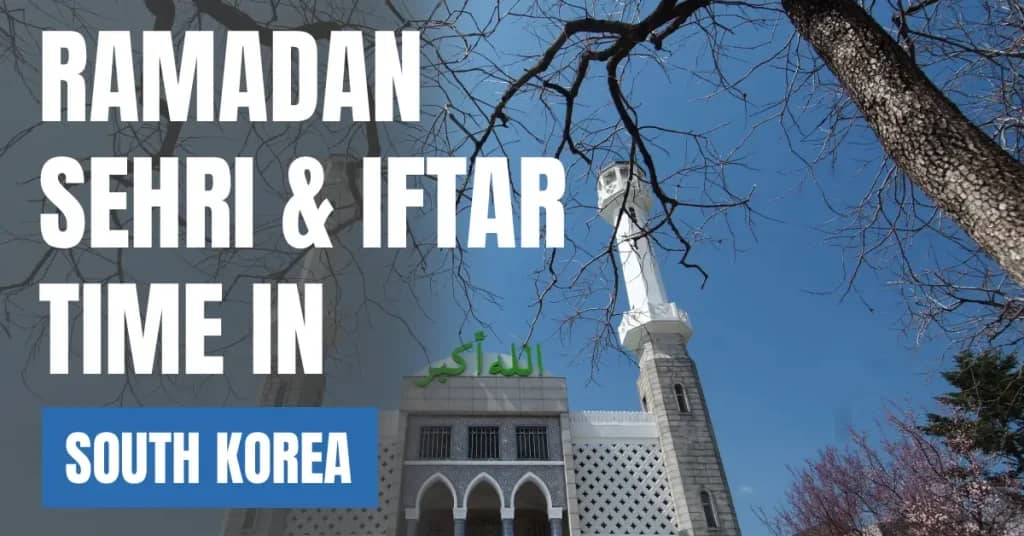
Ramadan in South Korea is observed by a growing Muslim community, including Korean Muslims, international students, and expatriates. Major cities such as Seoul, Busan, and Incheon have active Islamic centers that organize Ramadan schedules and gatherings.
On this pageTable of Content
This page provides today’s Sehri and Iftar time in Seoul along with the complete 30-day Ramadan calendar for South Korea. You’ll also find details about fasting duration, time zone information, and regional timing differences.
Today Sehri & Iftar Time in Seoul
(function() {
const config = {"city":"Capital City","country":"South Korea","mode":"today","school":"0"};
const container = document.getElementById('content-rc_6ab845a8375f1');
const loading = document.getElementById('loading-rc_6ab845a8375f1');
async function init() {
try {
const year = new Date().getFullYear();
const p = `city=${encodeURIComponent(config.city)}&country=${encodeURIComponent(config.country)}&method=2`;
const urls = [
`https://api.aladhan.com/v1/calendarByCity/${year}/2?${p}&school=1`,
`https://api.aladhan.com/v1/calendarByCity/${year}/3?${p}&school=1`,
`https://api.aladhan.com/v1/calendarByCity/${year}/2?${p}&school=0`,
`https://api.aladhan.com/v1/calendarByCity/${year}/3?${p}&school=0`
];
const res = await Promise.all(urls.map(u => fetch(u).then(r => r.json())));
const h = [...res[0].data, ...res[1].data].filter(d => parseInt(d.date.hijri.month.number) === 9);
const j = [...res[2].data, ...res[3].data].filter(d => parseInt(d.date.hijri.month.number) === 9);
render(h, j);
} catch (e) { loading.innerText = "Failed to load calendar."; }
}
function fmt(t) {
let [h, m] = t.split(' ')[0].split(':');
h = parseInt(h);
return `${(h % 12 || 12).toString().padStart(2,'0')}:${m} ${h >= 12 ? 'PM' : 'AM'}`;
}
function render(hanafi, jafria) {
loading.classList.add('hidden');
container.classList.remove('hidden');
const day = new Date().getDate().toString().padStart(2, '0');
const month = new Date().toLocaleString('en-GB', { month: 'long' });
const hT = hanafi.find(d => d.date.gregorian.day === day && d.date.gregorian.month.en === month) || hanafi[0];
const jT = jafria.find(d => d.date.gregorian.day === day && d.date.gregorian.month.en === month) || jafria[0];
const gDate = `${hT.date.gregorian.day} ${hT.date.gregorian.month.en} ${hT.date.gregorian.year}`;
if (config.mode === 'paragraph') {
container.innerHTML = `
${gDate} - ${hT.date.hijri.day} Ramadan for Hanafi ${config.city}: Sehr ${fmt(hT.timings.Fajr)}, Iftar ${fmt(hT.timings.Maghrib)}. For Jafri: Sehr ${fmt(jT.timings.Fajr)}, Iftar ${fmt(jT.timings.Maghrib)}.
`;
} else if (config.mode === 'table') {
const data = config.school === '1' ? jafria : hanafi;
const label = config.school === '1' ? 'Jafri (Shia)' : 'Hanafi (Sunni)';
let html = `
Today Hanafi (Sunni) Sehr And Iftar Time ${config.city}
Sehrسحور
${fmt(hT.timings.Fajr)}
${gDate}
Iftarإفطار
${fmt(hT.timings.Maghrib)}
${gDate}
Today Jafri (Shia) Sehr And Iftar Time ${config.city}
Sehrسحور
${fmt(jT.timings.Fajr)}
${gDate}
Iftarإفطار
${fmt(jT.timings.Maghrib)}
${gDate}
`;
}
}
init();
})();
30 Days Ramadan Calendar – South Korea
The Ramadan timetable below is based on Seoul, the capital and main reference city. While South Korea follows a single national time zone, sunrise and sunset times may vary slightly between northern and southern regions.
Residents in cities like Busan or Daegu should check local mosque announcements for precise daily timings.
(function() {
const config = {"city":"Capital City","country":"South Korea","mode":"table","school":"0"};
const container = document.getElementById('content-rc_6ab845a837606');
const loading = document.getElementById('loading-rc_6ab845a837606');
async function init() {
try {
const year = new Date().getFullYear();
const p = `city=${encodeURIComponent(config.city)}&country=${encodeURIComponent(config.country)}&method=2`;
const urls = [
`https://api.aladhan.com/v1/calendarByCity/${year}/2?${p}&school=1`,
`https://api.aladhan.com/v1/calendarByCity/${year}/3?${p}&school=1`,
`https://api.aladhan.com/v1/calendarByCity/${year}/2?${p}&school=0`,
`https://api.aladhan.com/v1/calendarByCity/${year}/3?${p}&school=0`
];
const res = await Promise.all(urls.map(u => fetch(u).then(r => r.json())));
const h = [...res[0].data, ...res[1].data].filter(d => parseInt(d.date.hijri.month.number) === 9);
const j = [...res[2].data, ...res[3].data].filter(d => parseInt(d.date.hijri.month.number) === 9);
render(h, j);
} catch (e) { loading.innerText = "Failed to load calendar."; }
}
function fmt(t) {
let [h, m] = t.split(' ')[0].split(':');
h = parseInt(h);
return `${(h % 12 || 12).toString().padStart(2,'0')}:${m} ${h >= 12 ? 'PM' : 'AM'}`;
}
function render(hanafi, jafria) {
loading.classList.add('hidden');
container.classList.remove('hidden');
const day = new Date().getDate().toString().padStart(2, '0');
const month = new Date().toLocaleString('en-GB', { month: 'long' });
const hT = hanafi.find(d => d.date.gregorian.day === day && d.date.gregorian.month.en === month) || hanafi[0];
const jT = jafria.find(d => d.date.gregorian.day === day && d.date.gregorian.month.en === month) || jafria[0];
const gDate = `${hT.date.gregorian.day} ${hT.date.gregorian.month.en} ${hT.date.gregorian.year}`;
if (config.mode === 'paragraph') {
container.innerHTML = `
${gDate} - ${hT.date.hijri.day} Ramadan for Hanafi ${config.city}: Sehr ${fmt(hT.timings.Fajr)}, Iftar ${fmt(hT.timings.Maghrib)}. For Jafri: Sehr ${fmt(jT.timings.Fajr)}, Iftar ${fmt(jT.timings.Maghrib)}.
`;
} else if (config.mode === 'table') {
const data = config.school === '1' ? jafria : hanafi;
const label = config.school === '1' ? 'Jafri (Shia)' : 'Hanafi (Sunni)';
let html = `
Today Hanafi (Sunni) Sehr And Iftar Time ${config.city}
Sehrسحور
${fmt(hT.timings.Fajr)}
${gDate}
Iftarإفطار
${fmt(hT.timings.Maghrib)}
${gDate}
Today Jafri (Shia) Sehr And Iftar Time ${config.city}
Sehrسحور
${fmt(jT.timings.Fajr)}
${gDate}
Iftarإفطار
${fmt(jT.timings.Maghrib)}
${gDate}
`;
}
}
init();
})();
(function() {
const config = {"city":"Capital City","country":"South Korea","mode":"table","school":"1"};
const container = document.getElementById('content-rc_6ab845a837610');
const loading = document.getElementById('loading-rc_6ab845a837610');
async function init() {
try {
const year = new Date().getFullYear();
const p = `city=${encodeURIComponent(config.city)}&country=${encodeURIComponent(config.country)}&method=2`;
const urls = [
`https://api.aladhan.com/v1/calendarByCity/${year}/2?${p}&school=1`,
`https://api.aladhan.com/v1/calendarByCity/${year}/3?${p}&school=1`,
`https://api.aladhan.com/v1/calendarByCity/${year}/2?${p}&school=0`,
`https://api.aladhan.com/v1/calendarByCity/${year}/3?${p}&school=0`
];
const res = await Promise.all(urls.map(u => fetch(u).then(r => r.json())));
const h = [...res[0].data, ...res[1].data].filter(d => parseInt(d.date.hijri.month.number) === 9);
const j = [...res[2].data, ...res[3].data].filter(d => parseInt(d.date.hijri.month.number) === 9);
render(h, j);
} catch (e) { loading.innerText = "Failed to load calendar."; }
}
function fmt(t) {
let [h, m] = t.split(' ')[0].split(':');
h = parseInt(h);
return `${(h % 12 || 12).toString().padStart(2,'0')}:${m} ${h >= 12 ? 'PM' : 'AM'}`;
}
function render(hanafi, jafria) {
loading.classList.add('hidden');
container.classList.remove('hidden');
const day = new Date().getDate().toString().padStart(2, '0');
const month = new Date().toLocaleString('en-GB', { month: 'long' });
const hT = hanafi.find(d => d.date.gregorian.day === day && d.date.gregorian.month.en === month) || hanafi[0];
const jT = jafria.find(d => d.date.gregorian.day === day && d.date.gregorian.month.en === month) || jafria[0];
const gDate = `${hT.date.gregorian.day} ${hT.date.gregorian.month.en} ${hT.date.gregorian.year}`;
if (config.mode === 'paragraph') {
container.innerHTML = `
${gDate} - ${hT.date.hijri.day} Ramadan for Hanafi ${config.city}: Sehr ${fmt(hT.timings.Fajr)}, Iftar ${fmt(hT.timings.Maghrib)}. For Jafri: Sehr ${fmt(jT.timings.Fajr)}, Iftar ${fmt(jT.timings.Maghrib)}.
`;
} else if (config.mode === 'table') {
const data = config.school === '1' ? jafria : hanafi;
const label = config.school === '1' ? 'Jafri (Shia)' : 'Hanafi (Sunni)';
let html = `
Today Hanafi (Sunni) Sehr And Iftar Time ${config.city}
Sehrسحور
${fmt(hT.timings.Fajr)}
${gDate}
Iftarإفطار
${fmt(hT.timings.Maghrib)}
${gDate}
Today Jafri (Shia) Sehr And Iftar Time ${config.city}
Sehrسحور
${fmt(jT.timings.Fajr)}
${gDate}
Iftarإفطار
${fmt(jT.timings.Maghrib)}
${gDate}
`;
}
}
init();
})();
Ramadan Fasting Hours in South Korea
Fasting hours in South Korea typically range between 13 and 15 hours, depending on the season Ramadan occurs in. When Ramadan falls in late spring or summer, longer daylight hours extend the fasting period.
Because South Korea lies in the northern hemisphere at a moderate latitude, seasonal daylight changes noticeably influence fasting duration.
Time Zone & Regional Sehri Iftar Differences
South Korea follows Korea Standard Time (KST), which is UTC+9, throughout the year. The country does not observe daylight saving time.
Although South Korea uses one national time zone, cities in the southern region such as Busan may experience sunset slightly earlier than northern cities, resulting in minor timing differences.
Ramadan Schedule & Daily Life in South Korea
During Ramadan, daily life continues normally in South Korea, as it is not a public holiday period. However, mosques such as the Seoul Central Mosque organize community Iftar meals and evening gatherings.
Halal restaurants in Itaewon and other multicultural districts often extend their hours during Ramadan to accommodate fasting individuals.
How Sehri & Iftar Times Are Calculated in South Korea
Ramadan timings in South Korea are calculated using astronomical sunrise and sunset data specific to each city. Official timetables are typically published by Islamic organizations and mosque authorities before Ramadan begins.
Sehri ends at dawn, and Iftar begins precisely at sunset according to verified calculations.
FAQ – Ramadan in South Korea
1. Is Ramadan a public holiday in South Korea?
No, Ramadan is not a public holiday, and normal business operations continue.
2. What is the reference city for Ramadan timings?
Seoul is used as the main reference city for the Ramadan calendar on this page.
3. How long is fasting in South Korea?
Fasting typically lasts between 13 and 15 hours depending on the season.
4. Does South Korea have multiple time zones?
No, the country follows Korea Standard Time (UTC+9) nationwide.
5. Where can Muslims gather for Iftar in South Korea?
Major mosques such as the Seoul Central Mosque and halal restaurants in districts like Itaewon host community gatherings.
Conclusion
Ramadan in South Korea is observed within a multicultural environment, supported by active Islamic centers and growing halal infrastructure. With a single national time zone and reliable astronomical calculations, fasting schedules remain accurate and consistent across the country.