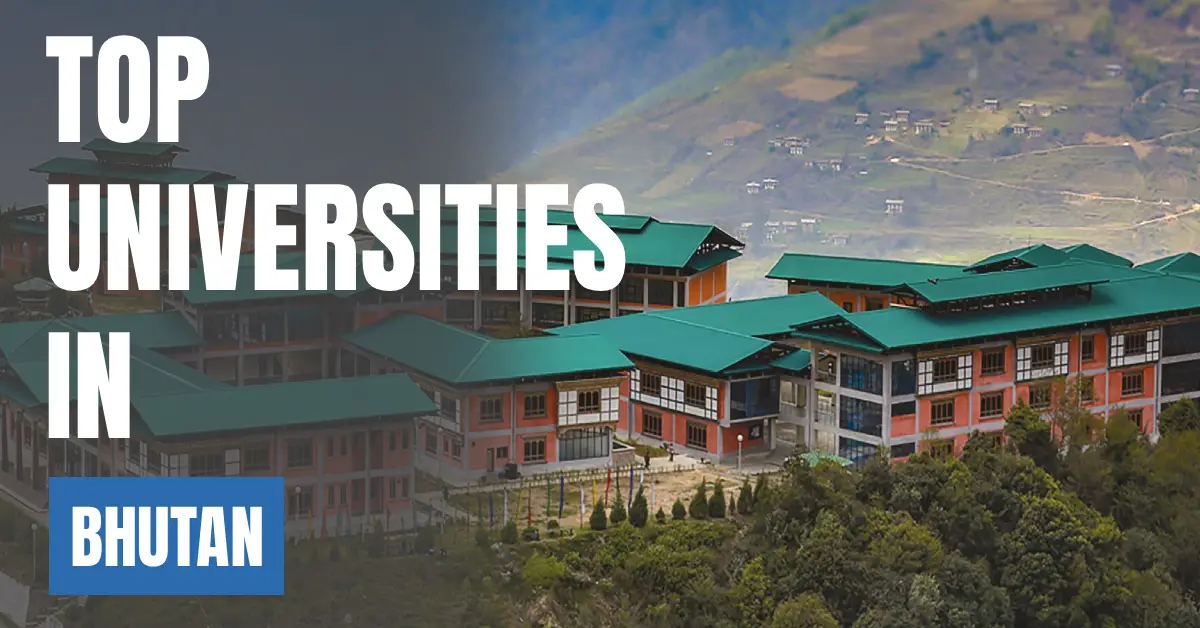
Top Universities in Bhutan 2026: Best Universities and Colleges by Subject, Accreditation and Cost
Choosing a university in Bhutan is different from choosing one in a large study destination with dozens of institutions in global rankings. Many of Bhutan’s strongest academic options are specialist colleges within the Royal University of Bhutan (RUB) rather than separate universities.
RUB was established in 2003 and reports nine constituent colleges and 9,296 enrolled students. Other important institutions include the Khesar Gyalpo University of Medical Sciences of Bhutan, Royal Thimphu College and Jigme Singye Wangchuck School of Law.
Because Bhutan has a relatively small and specialized higher-education system, a numbered “Top 10” ranking can be misleading. Engineering, medicine, business, computing, environmental studies and law each lead students toward different institutions.
This guide therefore compares universities and colleges according to subject fit, current accreditation, admission feasibility, international-student accessibility and verified costs, rather than treating one institution as universally best.
Quick Answer: Which Institutions Should You Consider?
| Student Goal | Institution to Consider | Why It Stands Out |
|---|---|---|
| Broadest university network | Royal University of Bhutan | Nine-college national university system |
| Medicine and health sciences | Khesar Gyalpo University of Medical Sciences of Bhutan | Specialist medical and health university |
| Broad engineering options | College of Science and Technology | Wide engineering and technology portfolio, BQPCA Grade A |
| Power, mechanical and geoinformatics engineering | Jigme Namgyel Engineering College | Distinct specialist engineering programmes |
| Computing and technology | Gyalpozhing College of Information Technology | Dedicated technology-focused college |
| Environment, climate and conservation | College of Natural Resources | Strong natural-resource and environmental specialization |
| Sciences, data and social sciences | Sherubtse College | Broad science, data and interdisciplinary offerings |
| Business and accounting | Gedu College of Business Studies | Business specialist, BQPCA Grade A+ |
| Transparent international study costs | Royal Thimphu College | Publishes clear international tuition and boarding costs |
| Law and environmental law | Jigme Singye Wangchuck School of Law | Specialist legal institution, BQPCA Grade A+ |
These are recommendations by student need, not a national academic ranking.
How Bhutan’s Higher Education System Works
The most important thing to understand is that the Royal University of Bhutan is a multi-college university system.
Its constituent colleges cover different academic areas, including engineering, computing, natural resources, business, science, languages and education. This means that a student normally gains more from comparing individual RUB colleges than from asking whether RUB as a whole is “best.”
For example:
- engineering students should compare the College of Science and Technology with Jigme Namgyel Engineering College;
- computing students should consider Gyalpozhing College of Information Technology;
- environmental and conservation students should look closely at the College of Natural Resources;
- business students should consider Gedu College of Business Studies;
- science and data students may find Sherubtse College more relevant.
Bhutan also has specialist institutions outside this simple subject structure. Khesar Gyalpo University of Medical Sciences of Bhutan focuses on medical and health education, while Jigme Singye Wangchuck School of Law provides specialist legal education.
How We Chose These Institutions
The recommendations in this guide are not based on a fabricated score or an average of unrelated ranking systems.
The research considered factors that materially affect a student’s decision in Bhutan:
- current institutional accreditation;
- subject specialization;
- programme availability;
- admission requirements;
- international-student accessibility;
- published tuition and related costs;
- professional recognition where relevant;
- meaningful differences between competing institutions.
Accreditation is particularly important.
Bhutan’s Higher Education Quality Council under the Bhutan Qualifications and Professionals Certification Authority (BQPCA) publishes accreditation grades and validity periods for higher-education institutions.
Its current framework categorizes institutions as:
- A+: Excellent
- A: Very Good
- B: Good
- C: Not Accredited
Students entering regulated professions should still verify recognition for their exact degree. An institution-level accreditation grade does not automatically prove that every medical, nursing, engineering, law or other professional programme meets all registration requirements.
Royal University of Bhutan
Why We Recommend It
The Royal University of Bhutan is the strongest starting point for students who want the broadest range of academic options within Bhutan.
Its nine-college structure allows students to choose specialist institutions for engineering, computing, business, natural resources, sciences and education instead of relying on one general campus.
Best For
Students who know their intended subject and want to compare several public university options within one national university system.
Important Consideration
Students should not treat “RUB” as a single academic choice.
An engineering applicant has a different decision from a business or environmental-science applicant. The strength of RUB for a particular student depends largely on the constituent college and degree programme.
College of Science and Technology
Why We Recommend It
The College of Science and Technology (CST) has one of Bhutan’s clearest cases for students wanting a broad range of engineering and technology programmes.
Its 2026 admissions information included programmes in:
- Civil Engineering
- Electrical Engineering
- Electronics and Communication Engineering
- Instrumentation and Control Engineering
- Engineering Geology
- Mechanical Engineering
- Information Technology
- Water Resources Engineering
- Software Engineering
- Architecture
BQPCA currently lists CST at Grade A, with accreditation valid until 9 December 2029.
Best For
Students who want several engineering and technology disciplines available within the same institution.
Admission Reality
Programme-specific subject prerequisites apply, and Architecture uses an aptitude assessment.
The standard 2026 admission information also states that applicants without a Bhutanese CID are not eligible through that route. International applicants should therefore confirm whether a separate application pathway exists before planning around the domestic admissions process.
CST vs JNEC
CST offers broader engineering coverage.
Jigme Namgyel Engineering College becomes particularly relevant when a student is specifically interested in power engineering, mechanical engineering or surveying and geoinformatics.
Jigme Namgyel Engineering College
Why We Recommend It
Jigme Namgyel Engineering College, or JNEC, offers a narrower but clearly differentiated engineering portfolio.
Its undergraduate options include:
- BE in Power Engineering;
- BE in Mechanical Engineering;
- BE in Surveying and Geoinformatics.
BQPCA lists JNEC at Grade A, valid until 7 January 2028.
Power Engineering has particular relevance in Bhutan because the programme includes hydropower technology, power systems and renewable-energy applications.
Best For
Students whose interests closely match power engineering, mechanical engineering or geospatial and surveying fields.
Important Consideration
The 2026 self-financed admissions information reviewed for this guide contained Bhutan-specific requirements including CID documentation and, for some programmes, Dzongkha.
International students should confirm eligibility directly instead of assuming those admission routes apply to them.
College of Natural Resources
Why We Recommend It
The College of Natural Resources (CNR) has one of the most distinctive specialist profiles in Bhutan.
It is particularly relevant for students interested in:
- natural resource management;
- conservation;
- climate studies;
- development;
- environmental sustainability.
BQPCA lists CNR at Grade A, valid until 6 June 2029.
Best For
Students considering postgraduate study in climate, conservation, development or natural-resource management.
International Postgraduate Costs
| Programme | Published Fee |
|---|---|
| Master in Development Practice | Nu 438,354 |
| MSc Natural Resource Management | Nu 513,284 |
| MSc Conservation Biology | Nu 513,284 |
| PhD Climate Studies | Nu 556,057 |
These figures exclude visa charges, accommodation and food.
This makes CNR easier to evaluate financially than institutions that publish only domestic or self-financed tuition.
Gyalpozhing College of Information Technology
Why We Recommend It
Gyalpozhing College of Information Technology, or GCIT, provides a focused academic environment for computing and digital-technology students.
BQPCA currently lists GCIT at Grade A, valid until 6 June 2029.
Its 2026 admission process included a Computational Thinking Test, followed by interviews for shortlisted applicants.
Best For
Students who want a more technology-focused institution rather than studying computing as one programme inside a broad multidisciplinary college.
Important Consideration
Current undergraduate admission information is strongly linked to Bhutan’s national admissions process.
International applicants should verify their eligibility and application route directly.
A 2026 institutional announcement also identifies GCIT at Kabesa, Thimphu, so students using older online guides should verify campus-location information before planning accommodation or travel.
Sherubtse College
Why We Recommend It
Sherubtse College offers one of the more varied academic portfolios among RUB colleges for students interested in sciences, data and interdisciplinary social sciences.
Its 2026 undergraduate intake included:
- BSc Chemistry;
- BSc Life Science;
- BSc Mathematics;
- BSc Physics;
- Bachelor of Data Science and Data Analytics;
- Bachelor of Economics and Political Science;
- Bachelor of Digital Communication and Project Management.
BQPCA lists Sherubtse at Grade A, valid until 6 June 2029.
Best For
Students interested in natural sciences, data, economics, politics or interdisciplinary communication-related study.
International Admissions
Sherubtse publishes a clearer international-applicant pathway than several other RUB colleges.
International students are expected to have completed recognized secondary education and demonstrate an appropriate academic record. English proficiency may also be required where previous education was not conducted in English.
International Tuition
For students outside SAARC, the research identified the following figures:
| Study Level | Arts and Humanities | Science |
|---|---|---|
| Undergraduate | Nu 316,324 | Nu 370,396 |
| Postgraduate Diploma/Certificate | Nu 434,946 | Nu 509,294 |
| Master’s | Nu 474,486 | Nu 555,594 |
| PhD | Nu 514,027 | Nu 601,893 |
SAARC students have a separate fee structure.
Applicants should confirm that the published amount applies to their nationality, programme and intake before budgeting.
Gedu College of Business Studies
Why We Recommend It
The Gedu College of Business Studies (GCBS) is one of the strongest specialist options for students focused specifically on business-related education within the RUB system.
BQPCA lists GCBS at Grade A+, valid until 9 December 2030.
Its academic areas include:
- management;
- marketing;
- finance and economics;
- banking and financial services;
- accounting;
- human capital management;
- business intelligence.
Best For
Students prioritizing business, finance, accounting or management.
Admission Reality
For several business programmes, GCBS uses a combination of academic performance and its own entrance assessment.
The research identified a selection model combining approximately 60% academic ability-rating points and 40% GCBS Entrance Test performance for relevant programmes.
Accounting Students
Accounting applicants should examine the professional-exemption information attached to their exact programme. GCBS publishes ACCA-related information for its accounting pathway, but students should verify the current exemptions and conditions before using them as a major reason to enrol.
Royal Thimphu College
Why We Recommend It
Royal Thimphu College (RTC) is particularly useful for international students because it publishes clearer international cost information than many other institutions in Bhutan.
BQPCA currently lists RTC at Grade A+, valid until 28 June 2028.
Its programmes span areas including business, social sciences, economics, communication, English and computing, while relevant health programmes are linked with KGUMSB.
Best For
International applicants who value transparent tuition and accommodation estimates before applying.
International Cost for 2026-27
RTC lists international full-degree tuition at:
USD 3,180 per semester
This equals:
USD 6,360 per academic year for a day scholar.
Published annual boarding totals are approximately:
| Accommodation | Approximate Annual Total |
|---|---|
| Quad room | USD 8,300 |
| Triple room | USD 8,480 |
| Double room | USD 8,700 |
RTC states that tuition may increase by approximately 3% to 6% annually.
Important Tradeoff
RTC’s international fee structure should not be directly compared with domestic self-financed tuition at a RUB college.
The student category and what is included in the quoted amount can be different.
Khesar Gyalpo University of Medical Sciences of Bhutan
Why We Recommend It
Students interested in medicine and healthcare should examine Khesar Gyalpo University of Medical Sciences of Bhutan (KGUMSB) before relying on an overall university ranking.
Its academic structure includes medical, postgraduate medical, nursing, public-health and traditional-medicine pathways.
Best For
Students pursuing medicine, nursing, public health and other health-related fields.
Accreditation Requires Extra Attention
Medical applicants should check accreditation at the faculty and programme level.
BQPCA’s current information lists the Faculty of Postgraduate Medicine at Grade C, with validity until 9 December 2026.
Under BQPCA’s framework, Grade C means Not Accredited.
This finding should not be generalized to every KGUMSB programme. Instead, it is a reason for students to verify the current status of the exact faculty and qualification before applying.
For health professions, this programme-level verification is more important than an internet ranking.
Jigme Singye Wangchuck School of Law
Why We Recommend It
Jigme Singye Wangchuck School of Law, or JSW Law, offers a clearly differentiated specialist option for legal education.
BQPCA lists the institution at Grade A+, valid until 6 June 2030.
Its postgraduate LLM and MLS in Climate Change and Environmental Law provide a particularly distinctive option for students interested in environmental governance and climate-related legal policy.
Best For
Law graduates and professionals interested in climate and environmental law.
International Postgraduate Cost
The research identified international tuition, room and board for the one-year LLM/MLS programme at:
USD 25,000
JSW Law also publishes tuition-assistance opportunities, including awards worth USD 10,000.
Scholarship availability and eligibility should be checked again for the student’s intended intake.
Undergraduate Admission Caveat
Current undergraduate admissions include Bhutan-specific elements such as Dzongkha assessments and the Bhutan-LSAT.
Separate information also refers to applicants holding Grade XII equivalents from foreign institutions.
Because those sources do not completely resolve international undergraduate eligibility, prospective international applicants should confirm their position directly with JSW Law before applying.
University Rankings in Bhutan: Why Ranking Alone Is Weak Evidence
Bhutan does not currently have the same representation in major global university rankings as large study destinations.
A 2026 uniRank table places:
- Royal University of Bhutan
- Khesar Gyalpo University of Medical Sciences of Bhutan
However, uniRank explicitly describes its ranking as non-academic and based on web metrics.
It should therefore not be interpreted as evidence that RUB is academically stronger than KGUMSB in medicine or that one RUB college is superior to another for engineering.
For students choosing a Bhutanese institution, the more useful hierarchy is usually:
subject fit → accreditation → eligibility → cost → practical feasibility
rather than a web-ranking position.
Best Institutions in Bhutan by Study Area
| Study Area | Institutions to Consider | Why |
|---|---|---|
| Engineering | CST, JNEC | CST offers broader engineering breadth; JNEC has distinct power, mechanical and geoinformatics pathways |
| Computing and IT | GCIT, CST | GCIT is technology-focused; CST combines IT/software with engineering disciplines |
| Business | GCBS, RTC | GCBS is a specialist RUB business college; RTC offers a broader private-college pathway |
| Medicine and health | KGUMSB, relevant RTC health programmes | KGUMSB is the specialist medical university, but programme accreditation must be checked |
| Environment and conservation | CNR | Strong specialist natural-resource and climate focus |
| Sciences and data | Sherubtse | Science, data analytics and interdisciplinary programmes |
| Law | JSW Law | Dedicated law institution with an environmental-law postgraduate specialization |
| Teacher education | Samtse College of Education | Relevant specialist education option, although international accessibility needs separate verification |
No universal “best” institution is assigned where the available evidence supports different strengths rather than one clear winner.
Tuition and Value for International Students
There is no defensible single average tuition figure for Bhutan’s universities and colleges.
Published fees differ according to:
- domestic or international status;
- SAARC or non-SAARC nationality;
- undergraduate or postgraduate level;
- programme;
- accommodation arrangements;
- whether room and food are included.
Examples from the research include:
| Institution/Programme | Published International Cost | Scope |
|---|---|---|
| RTC full-degree tuition | USD 6,360 per year | Tuition only for day scholar |
| RTC boarding | About USD 8,300-8,700 per year | Depends on room type |
| CNR Master in Development Practice | Nu 438,354 | Food, accommodation and visa excluded |
| CNR MSc programmes | Nu 513,284 | Food, accommodation and visa excluded |
| Sherubtse UG Arts/Humanities, non-SAARC | Nu 316,324 | International category |
| Sherubtse UG Science, non-SAARC | Nu 370,396 | International category |
| JSW Law LLM/MLS | USD 25,000 | Tuition, room and board |
Students should not rank these institutions from cheapest to most expensive without first checking what each figure includes.
[Internal link opportunity: Cost of Living in Bhutan]
Admission Requirements: What Actually Changes the Decision?
There is no single Bhutan-wide university admission threshold.
Different institutions and programmes use different methods.
- CST: subject prerequisites and programme-specific assessments;
- GCIT: Computational Thinking Test followed by interview;
- GCBS: academic performance plus its own entrance examination;
- Sherubtse: programme-specific academic requirements and tests for selected courses;
- JSW Law: academic results, Bhutan-LSAT, Dzongkha assessment and interview for the standard undergraduate pathway;
- KGUMSB: programme-specific academic criteria for health programmes.
Applicants should distinguish between minimum eligibility and actual selection requirements.
International students should pay particular attention where admissions pages require:
- Bhutanese CID;
- Dzongkha;
- a national entrance process.
Those conditions may indicate that the published route is intended mainly for Bhutanese applicants.
Reliable comparable acceptance rates were not established in the supplied research, so this guide does not publish estimated acceptance percentages.
Scholarships Worth Checking
Scholarships should be assessed individually rather than summarized with a claim that “many scholarships are available.”
The clearest international example in the supplied research comes from JSW Law’s LLM/MLS in Climate Change and Environmental Law.
The school publishes tuition-assistance awards worth USD 10,000, as well as other scholarship opportunities for eligible applicant groups.
Students should verify:
- whether the award is available for their intake;
- nationality or professional eligibility;
- whether a separate application is required;
- whether the award covers tuition only or additional costs.
Reliable comparable scholarship values were not available for every recommended institution.
Accreditation Matters More Than Ranking for Some Degrees
Accreditation is one of the most important decision factors in Bhutan.
Current BQPCA statuses identified in the research include:
| Institution | BQPCA Grade | Current Validity |
|---|---|---|
| Gedu College of Business Studies | A+ | 9 Dec 2030 |
| Jigme Singye Wangchuck School of Law | A+ | 6 Jun 2030 |
| Royal Institute of Management | A+ | 6 Jun 2030 |
| Royal Thimphu College | A+ | 28 Jun 2028 |
| College of Science and Technology | A | 9 Dec 2029 |
| College of Natural Resources | A | 6 Jun 2029 |
| Gyalpozhing College of Information Technology | A | 6 Jun 2029 |
| Sherubtse College | A | 6 Jun 2029 |
| Jigme Namgyel Engineering College | A | 7 Jan 2028 |
| Samtse College of Education | A | 6 Jun 2027 |
Students entering medicine, nursing, engineering, teaching, accounting, law or another regulated profession should also verify programme-specific professional recognition.
An institutional Grade A or A+ should not automatically be treated as proof that every degree meets registration requirements in Bhutan or another country.
Student Visa Requirements for Bhutan
Bhutan’s Visa/Entry Permit Guidelines for International Students 2026 took effect on 1 May 2026.
For study in Bhutan, the academic institution must be recognized by the Royal Government of Bhutan.
Required documentation can include:
- proof of enrolment;
- visa or entry-permit application;
- proof of means of subsistence;
- a student statement of purpose;
- passport or applicable identity documents.
The research indicates that applications should normally be submitted at least 15 working days before arrival, and complete applications are normally decided within seven working days.
International students should use the current Department of Immigration guidance when applying.
The supplied evidence does not establish a general rule allowing international university students to work a specific number of hours per week.
This article therefore does not publish an unverified student work-hour limit.
[Internal link opportunity: Student Visa for Bhutan]
Graduate Outcomes and Student Experience: Where the Evidence Is Limited
Comparable graduate-employment rates, graduate salaries and student-satisfaction scores were not available in sufficiently consistent evidence to rank Bhutanese institutions on these measures.
That limitation should be taken seriously.
A college having industry partnerships, practical coursework or clinical placements does not automatically establish a superior graduate-employment rate.
Similarly, individual student reviews are not strong enough to conclude that one institution has the “best campus life” or another has poor support services.
Until comparable outcome data becomes available, students can make more defensible decisions using:
- programme fit;
- accreditation;
- admissions;
- international accessibility;
- verified costs.
Which University or College in Bhutan Should You Choose?
Start with the Royal University of Bhutan system if you want the broadest range of subjects, but choose according to the specific college rather than the RUB name alone.
Choose CST as a strong starting point for broad engineering if its programme mix matches your interests and you qualify through the relevant admission route.
Compare JNEC with CST if your priority is power engineering, mechanical engineering or surveying and geoinformatics.
Consider GCIT for computing and technology if you prefer a specialist digital environment.
Consider CNR for natural resources, conservation or climate, particularly if you are looking at postgraduate study.
Consider Sherubtse for sciences, data and interdisciplinary social sciences, especially if you need a clearly stated international-admission pathway.
Consider GCBS for business, finance or accounting, supported by its current A+ institutional accreditation.
Consider RTC if you are an international student who needs clearer tuition and boarding information before deciding whether Bhutan fits your budget.
Consider KGUMSB for medicine and health sciences, but verify the accreditation and professional recognition of your exact faculty and programme before accepting an offer.
Consider JSW Law for specialist legal study, particularly postgraduate environmental and climate law.
For Bhutan, the strongest choice is rarely determined by one ranking number. A better shortlist starts with the degree you want, then checks accreditation, eligibility and total cost.
Frequently Asked Questions
What is the best university in Bhutan?
There is no evidence-supported single best university for every student. The Royal University of Bhutan provides the broadest academic network, while specialist choices such as KGUMSB for health, CST for engineering, CNR for natural resources and GCBS for business may be stronger depending on the subject.
Is the Royal University of Bhutan the number one university in Bhutan?
uniRank places the Royal University of Bhutan first in its 2026 Bhutan table, but uniRank explicitly describes its ranking as non-academic and based on web metrics. Students should not treat that position as proof that RUB is academically best for every subject.
Which university in Bhutan is best for engineering?
The College of Science and Technology is a strong starting point because it offers a broad range of engineering and technology programmes. Jigme Namgyel Engineering College is also worth comparing for power engineering, mechanical engineering and surveying and geoinformatics.
Which institution in Bhutan is best for medicine?
Khesar Gyalpo University of Medical Sciences of Bhutan is the country’s specialist medical and health-sciences university. Students should still verify the current accreditation and professional recognition of their exact faculty and programme before applying.
Can international students study in Bhutan?
Yes. International study routes exist at selected institutions. Royal Thimphu College, Sherubtse College, the College of Natural Resources and JSW Law publish particularly useful international-student information. Eligibility should still be confirmed for the exact programme.
How much does university cost in Bhutan for international students?
Costs vary significantly by institution and programme. Examples in the supplied research include USD 6,360 annual tuition at Royal Thimphu College for a full-degree international day scholar, Nu 438,354 for CNR’s Master in Development Practice and USD 25,000 including tuition, room and board for JSW Law’s LLM/MLS programme.
Are universities in Bhutan accredited?
Bhutan’s Higher Education Quality Council under BQPCA publishes institutional accreditation grades and validity periods. Current institutions in this guide include several A and A+ rated colleges, but students in regulated professions should also check programme-specific professional recognition.
Can international students work while studying in Bhutan?
The official international-student evidence reviewed for this guide did not establish a general permitted number of working hours for university students. Students should verify employment permission directly through current Bhutanese immigration rules before relying on part-time work.
Sources and Methodology
This guide was reviewed using research current to September 2026.
Recognition and Accreditation
Institutional accreditation was assessed using the Bhutan Qualifications and Professionals Certification Authority and Higher Education Quality Council.
BQPCA accreditation grades and validity dates were used where available.
University Structure and Programmes
Programme, tuition and admission evidence came from official institutional information published by:
- Royal University of Bhutan;
- College of Science and Technology;
- Jigme Namgyel Engineering College;
- College of Natural Resources;
- Gyalpozhing College of Information Technology;
- Sherubtse College;
- Gedu College of Business Studies;
- Royal Thimphu College;
- Khesar Gyalpo University of Medical Sciences of Bhutan;
- Jigme Singye Wangchuck School of Law.
Rankings
uniRank’s 2026 Bhutan table was reviewed only as a secondary reference. Because uniRank describes the ranking as non-academic and based on web metrics, it was not used to create an academic national ranking.
Immigration
International-student visa requirements were based on the Department of Immigration, Royal Government of Bhutan, including the Visa/Entry Permit Guidelines for International Students 2026.
Evidence Limitations
Reliable comparable evidence was not established for:
- university acceptance rates;
- graduate employment rates;
- graduate salaries;
- institution-wide student satisfaction;
- general international-student work-hour rights.
No figures were invented to fill these gaps.