Top Universities in Bolivia 2026: Rankings, Admissions and Costs
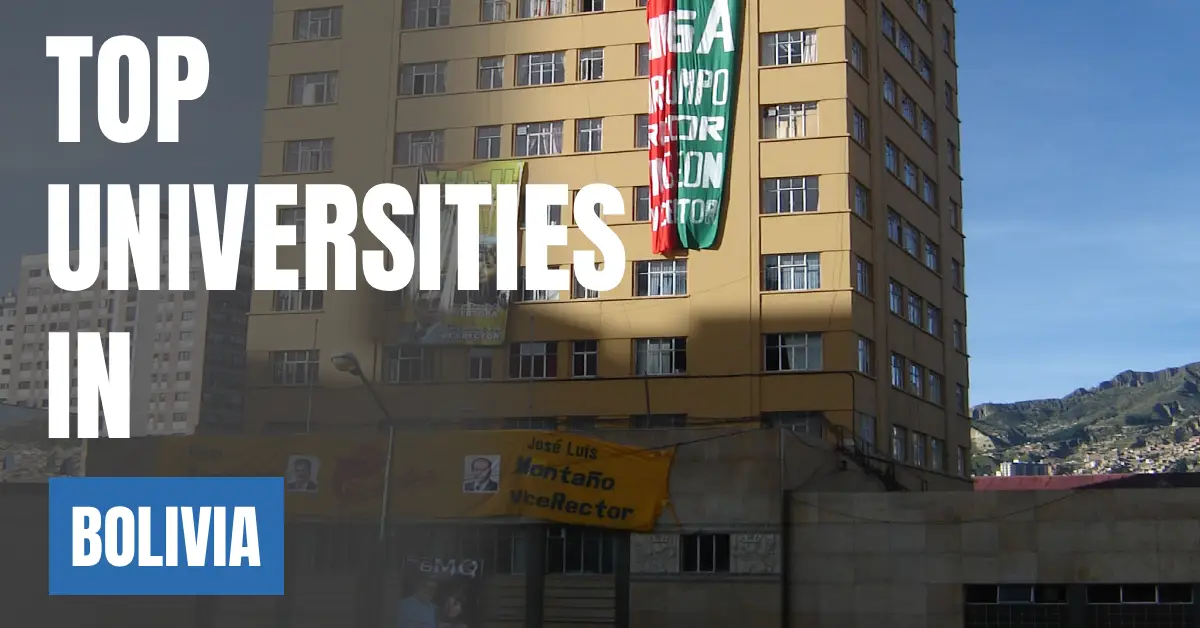
Bolivia’s university landscape cannot be reduced to a simple ranking list. Public autonomous universities and private universities operate under different structures, admission procedures and fee systems, while professional accreditation can matter more than an institution’s overall rank for degrees such as engineering.
For the current comparison, the primary ranking reference is the QS Latin America & the Caribbean University Rankings 2026, published on October 1, 2025. UMSA is Bolivia’s strongest-ranked institution in that table at 161-170, while UMSS and UPB are both in the 201-250 band. UCB is ranked 301-350.
Ranking alone should not decide the shortlist. UPB has particularly strong MBA evidence, UMSS publishes clear foreign-student admission guidance, and UAGRM’s Civil Engineering program received a new six-year ARCU-SUR accreditation in July 2026.
Quick Answer: Which Universities Should You Consider?
| University | Main Evidence | Particularly Relevant For | Key Consideration |
|---|---|---|---|
| Universidad Mayor de San Andrés (UMSA) | QS 2026: 161-170 | Students prioritizing Bolivia’s strongest current overall regional ranking | Program-level admission and cost information must still be checked |
| Universidad Mayor de San Simón (UMSS) | QS 2026: 201-250 | Public-university applicants wanting clearer international admission guidance | Admission methods vary by faculty |
| Universidad Privada Boliviana (UPB) | QS 2026: 201-250 | Private-university students and MBA candidates | Scholarship eligibility and costs require scheme-specific checking |
| Universidad Católica Boliviana “San Pablo” (UCB) | QS 2026: 301-350 | Students seeking a private option with published foreign-applicant requirements | Procedures and charges can vary by campus |
| Universidad Autónoma Gabriel René Moreno (UAGRM) | Civil Engineering: six-year ARCU-SUR accreditation in July 2026 | Civil Engineering students and students considering Santa Cruz | Accreditation applies to the specific program, not every degree |
How We Chose These Universities
The universities were not selected solely because they are famous, large or highly ranked.
The comparison uses evidence that materially affects student choice, including:
- current QS regional ranking;
- program-specific accreditation where available;
- official international admission procedures;
- named scholarships and published benefits where verifiable;
- current fee examples where their scope is clear;
- university type and regulatory structure;
- international-student visa requirements.
Comparable annual international tuition, university-by-university graduate employment rates and robust national student-satisfaction data could not be established for every institution. No estimates have been created to fill those gaps.
How Bolivia’s University System Affects Your Choice
Bolivia’s Education Law No. 070 recognizes several types of universities, including public autonomous universities, private universities, indigenous universities and universities of special regime.
For private universities, the law states that institutional operation requires authorization and academic programs are regulated by the Ministry of Education. It also states that private universities are not subsidized by the Bolivian state.
This makes the public versus private distinction relevant, but it still does not tell a student whether a particular professional degree is the right choice.
For regulated or professional study areas, students should investigate the specific degree’s accreditation as well as the university’s overall standing.
1. Universidad Mayor de San Andrés (UMSA)
Why We Recommend UMSA
UMSA is the strongest starting point for students who prioritize overall regional ranking.
The university is ranked 161-170 in the QS Latin America & the Caribbean University Rankings 2026, the highest position among the Bolivian institutions reviewed in this guide. QS also reports a citations-per-paper indicator of 98 and an academic reputation indicator of 31.2 for UMSA in that edition.
Best For
UMSA is particularly relevant for students who:
- want a major public university in La Paz;
- use current regional ranking as an important shortlist factor;
- are prepared to investigate admission requirements at faculty level.
What Students Should Consider
The ranking establishes UMSA’s comparative academic position, but it does not establish that UMSA is Bolivia’s best university for every subject.
It also does not provide a reliable university-wide annual tuition figure for every international student.
Students applying to professional degrees should therefore compare program requirements and accreditation separately rather than choosing solely on the 161-170 ranking band.
2. Universidad Mayor de San Simón (UMSS)
Why We Recommend UMSS
UMSS combines a strong public-university position with unusually useful official information for foreign applicants.
UMSS is ranked 201-250 in the QS Latin America & the Caribbean University Rankings 2026.
More importantly for international applicants, UMSS explicitly explains that foreign students pursuing a complete degree generally compete under the same academic conditions as Bolivian students.
International Admission at UMSS
UMSS states that each faculty controls its admission calendar and admission method.
Depending on the degree, an applicant may need to complete:
- an entrance examination; or
- a preparatory course.
UMSS specifically states that international status does not provide automatic direct admission unless a relevant agreement applies.
For degree-seeking foreign students, requirements can include:
- legalized or apostilled secondary-school diploma;
- legalized or apostilled birth certificate;
- student visa;
- valid passport or foreign identity document.
Best For
UMSS makes particular sense for students who want:
- a public university in Cochabamba;
- clearer information about the international admission process;
- an alternative to UMSA without moving into the private-university system.
Main Tradeoff
There is no single admission threshold that safely applies to all UMSS programs.
A requirement published by one faculty should not be presented as a requirement for the entire university.
3. Universidad Privada Boliviana (UPB)
Why We Recommend UPB
UPB is one of the strongest private-university options supported by the current evidence.
It is ranked 201-250 in the QS Latin America & the Caribbean University Rankings 2026, placing it in the same ranking band as UMSS.
UPB also operates campuses in Cochabamba, La Paz and Santa Cruz de la Sierra.
A Particularly Strong MBA Case
UPB has a clearer specialist differentiator at postgraduate business level.
The Olave School of Business and Economics at Universidad Privada Boliviana is tied at #8 in the QS Global MBA Rankings 2026 for Latin America.
This supports UPB as a serious option for MBA candidates.
It does not prove that every undergraduate business program at UPB is Bolivia’s best.
Undergraduate Admission
UPB’s undergraduate admission process includes an Academic Aptitude Test, or PAA, after the initial application process.
International applicants should verify the documentation and language requirements applying to their chosen program before applying.
Scholarships at UPB
UPB publishes several potentially significant scholarships.
Its 100 Scholarships for the Top 100 program offers tuition support ranging from approximately 40% to 100%, depending on performance in the relevant selection examination.
UPB also publishes other scholarship and financial-support categories, including social, work, sports and cultural awards.
International applicants should verify eligibility for their exact scholarship because foreign-student eligibility is not equally clear for every published scheme.
Best For
UPB is particularly worth considering for:
- students preferring a private university;
- students comparing a private university with UMSS despite their equal QS ranking band;
- MBA applicants;
- students interested in Cochabamba, La Paz or Santa Cruz.
Main Tradeoff
UPB has strong ranking and scholarship evidence, but a complete and comparable current international undergraduate tuition figure was not established across all degrees.
4. Universidad Católica Boliviana “San Pablo” (UCB)
Why We Recommend UCB
UCB provides another credible private-university pathway.
It is ranked 301-350 in the QS Latin America & the Caribbean University Rankings 2026.
That is lower than UMSA, UMSS and UPB in the same ranking edition, so there is no evidence-based reason to present UCB as Bolivia’s highest-ranked choice.
Its decision value comes instead from comparatively clear admissions information and campus-specific scholarship opportunities.
International Admission Example: UCB Sucre
UCB Sucre’s current admission information lists requirements for foreign students including:
- secondary-school qualification revalidated in Bolivia;
- passport with student visa;
- migration entry certificate;
- residence documentation;
- foreign identity card;
- apostilled birth certificate.
These requirements demonstrate why a generic international-application checklist is not sufficient.
Verified UCB Sucre 2026 Charges
For the 1-2026 intake, UCB Sucre publishes the following initial charges:
| Charge | Published Amount |
|---|---|
| Academic Rights | Bs 2,900 |
| Academic Sufficiency Test | Bs 450 |
| Pre-University Course | Bs 1,000 |
These are specifically published admission and academic charges for UCB Sucre. They should not be described as the university’s complete annual tuition.
Scholarship Evidence
UCB Tarija lists a specific scholarship category for students from abroad. However, the available information does not establish a sufficiently reliable award percentage for that scholarship.
Students should confirm its current benefit, eligibility and renewal conditions directly with the university before including it in their financial plan.
Best For
UCB can make sense for:
- students looking for a private-university alternative;
- applicants who value clearly published administrative requirements;
- students willing to compare individual UCB campuses rather than treating the institution as one uniform fee and admission system.
5. Universidad Autónoma Gabriel René Moreno (UAGRM)
Why We Recommend UAGRM
UAGRM is included for a specialist reason rather than because the evidence places it above Bolivia’s highest-ranked institutions overall.
On July 30, 2026, UAGRM announced that its Civil Engineering degree received ARCU-SUR accreditation for six years through Bolivia’s Comisión Nacional de Acreditación de Carreras Universitarias, or CNACU.
That is highly relevant for Civil Engineering applicants.
What ARCU-SUR Accreditation Means
ARCU-SUR accreditation evaluates individual undergraduate programs against agreed regional academic-quality standards.
Its accreditation framework generally uses a six-year validity period.
Bolivia’s national agency participating in the ARCU-SUR system is CNACU.
Best For
UAGRM deserves particular investigation from:
- Civil Engineering applicants;
- students who want to study in Santa Cruz;
- students who give professional accreditation more weight than overall university rank.
Main Tradeoff
The July 2026 accreditation applies to Civil Engineering.
It is not evidence that every degree offered by UAGRM has ARCU-SUR accreditation.
Ranking Does Not Tell the Whole Story
UMSA vs UMSS
UMSA has the stronger overall QS regional position at 161-170, compared with 201-250 for UMSS.
However, UMSS has particularly clear published procedures for international degree applicants.
A student may therefore prefer UMSS if admission transparency and Cochabamba are important, even though UMSA ranks higher overall.
UMSS vs UPB
UMSS and UPB occupy the same 201-250 QS regional band for 2026.
Their university models are different.
UMSS is a public autonomous institution with faculty-specific admission methods. UPB is private, operates in three major Bolivian cities, publishes significant scholarship programs and has specialist MBA ranking evidence.
The correct choice depends more on degree, budget and preferred university type than on their equal ranking band.
UMSA vs UAGRM for Civil Engineering
UMSA has the stronger overall regional ranking.
For Civil Engineering specifically, UAGRM has another piece of decision-relevant evidence: its current six-year ARCU-SUR accreditation.
This is a case where program accreditation may matter more to an applicant than overall university ranking.
International Student Admissions in Bolivia
International admission requirements are not standardized across every university.
The strongest recurring findings from official university information include:
- recognition, legalization or revalidation of foreign secondary-school qualifications;
- passport and student visa;
- apostilled or legalized civil documents;
- entrance examinations or preparatory courses for some programs;
- faculty-specific procedures.
UMSS explicitly requires international degree applicants to follow the relevant faculty’s admission process and states that foreign status does not automatically grant direct entry.
UCB Sucre requires revalidation of the foreign secondary-school qualification as well as immigration and identity documentation.
UPB’s undergraduate process includes an Academic Aptitude Test.
Students should therefore use university-wide information only as a starting point and then check the exact faculty or degree.
Tuition and Cost: What Can Actually Be Compared?
A reliable current table of complete annual international tuition for all five shortlisted universities could not be established using comparable official data.
That limitation matters.
A figure should not be described as “annual tuition” if it actually represents:
- an initial academic fee;
- an entrance examination;
- one semester;
- one campus;
- one degree;
- a preparatory program.
The strongest current example in the research is UCB Sucre’s Bs 2,900 Academic Rights charge for 1-2026, plus separate charges for its Academic Sufficiency Test and pre-university course.
International students should build their budget using separately verified components:
- tuition;
- mandatory academic charges;
- accommodation;
- food;
- local transport;
- visa and immigration costs;
- document legalization;
- program materials.
Until comparable current figures are available, it would be misleading to declare one of these universities the “cheapest” overall.
[Internal link opportunity: Cost of Living in Bolivia]
Scholarships Worth Checking
UPB 100 Scholarships for the Top 100
Benefit: approximately 40% to 100% of tuition costs, depending on performance in the relevant selection process.
UPB Social Scholarship
Benefit: up to 60% of tuition for qualifying students who meet the relevant academic and financial-need requirements.
UPB Work Scholarship
Benefit: up to 50% of tuition under the published scheme.
UCB Scholarship for Students from Abroad
UCB Tarija lists a scholarship category specifically for students from abroad, but the current available information does not provide enough evidence to publish a reliable award value.
International applicants should confirm:
- nationality eligibility;
- degree level;
- award amount or percentage;
- renewal rules;
- academic requirements;
- application deadline.
[Internal link opportunity: Scholarships in Bolivia]
Recognition and Accreditation
University recognition and program accreditation answer different questions.
Bolivia’s legal university framework is established under Education Law No. 070. Private-university academic programs are regulated by the Ministry of Education.
ARCU-SUR, by contrast, evaluates specific undergraduate programs against regional quality standards.
That distinction is particularly important for students considering:
- engineering;
- medicine;
- dentistry;
- architecture;
- nursing;
- other regulated professions.
Students who plan to work outside Bolivia should also check whether their specific qualification meets professional licensing or recognition rules in the country where they intend to practise.
Bolivia Student Visa: What University Applicants Need to Know
Bolivia’s Ministry of Foreign Affairs currently defines the student visa as authorization for foreign nationals entering Bolivia to study at primary, secondary or professional higher-education level.
The visa has a validity of up to 60 days and allows the student to apply to the Dirección General de Migración for one year of temporary student residence, renewable until completion of studies.
Published requirements include:
- visa application declaration;
- passport valid for at least six months;
- qualifying academic documentation;
- police, criminal or judicial record certificate where applicable;
- yellow-fever vaccination evidence where required;
- current photograph.
A sufficiently clear current official rule on general international-student employment rights was not established in the evidence used for this article.
Students should therefore verify work authorization separately rather than assuming that student residence automatically provides unrestricted employment rights.
[Internal link opportunity: Student Visa for Bolivia]
Which University Should You Choose?
Start with UMSA if overall academic ranking is your priority. Its 161-170 QS Latin America & the Caribbean position is the strongest current regional ranking among the Bolivian institutions reviewed.
Consider UMSS if you want a major public university and value clearly documented foreign-student admission procedures. It is also a serious academic option at 201-250 in QS 2026.
Consider UPB if you prefer a private institution or are particularly interested in postgraduate business. UPB shares UMSS’s 201-250 regional band, while the Olave School is tied at #8 in QS’s 2026 Latin America MBA ranking.
Consider UCB if you want a private university with comparatively detailed published admission information. Its Sucre campus provides specific foreign-student requirements and scoped 2026 charges.
Consider UAGRM for Civil Engineering in particular. Its six-year ARCU-SUR accreditation announced in July 2026 provides a program-specific reason to shortlist it.
The strongest university overall is not automatically the strongest university for a particular degree. For professional programs, accreditation, admissions and affordability should be checked alongside ranking.
Frequently Asked Questions
What is the highest-ranked university in Bolivia in 2026?
Universidad Mayor de San Andrés, or UMSA, is the highest-ranked Bolivian institution in the QS Latin America & the Caribbean University Rankings 2026 results reviewed for this guide. UMSA is placed in the 161-170 band.
Is Universidad Mayor de San Simón good for international students?
UMSS is a strong option to investigate because it ranks 201-250 in QS Latin America & the Caribbean 2026 and publishes detailed guidance for foreign applicants. International degree students generally follow the same academic admission standards as Bolivian applicants and may need an entrance examination or preparatory course.
Is UPB a good university for business students?
UPB has particularly strong evidence for MBA study. Its Olave School of Business and Economics is tied at #8 in the QS Global MBA Rankings 2026 for Latin America. This is MBA-specific evidence and should not automatically be applied to every undergraduate business program.
Which university in Bolivia should Civil Engineering students consider?
UAGRM is worth considering for Civil Engineering because the university announced in July 2026 that its Civil Engineering program had received six-year ARCU-SUR accreditation through CNACU. Students should still compare admission requirements, curriculum, costs and location before choosing.
Are scholarships available at universities in Bolivia?
Yes, but eligibility differs by university and scholarship. UPB publishes scholarships that can cover approximately 40% to 100% of tuition under its Top 100 program and up to 60% under its social scholarship. UCB Tarija also lists a scholarship category for students from abroad, although a reliable award value was not established from the available information.
What visa do international university students need for Bolivia?
Bolivia’s Ministry of Foreign Affairs provides a student visa for foreign nationals studying at qualifying educational institutions. The visa is valid for up to 60 days and enables an application for one-year temporary student residence through DIGEMIG, renewable until studies are completed.
Sources and Methodology
This guide was last reviewed in September 2026.
The QS Latin America & the Caribbean University Rankings 2026 were used as the primary independent ranking reference. The QS Global MBA Rankings 2026 for Latin America were used specifically where they materially affected the UPB recommendation.
Bolivia’s higher-education structure and recognition framework were checked against Bolivia’s Ministry of Education and Education Law No. 070.
Admission, scholarship and scoped cost information was based on current official material from UMSA, UMSS, UPB, UCB and UAGRM where available.
Professional accreditation evidence was assessed using ARCU-SUR documentation, CNACU information and UAGRM’s July 2026 Civil Engineering accreditation announcement.
Student-visa information was checked against Bolivia’s Ministry of Foreign Affairs.
Comparable university-wide international tuition figures, graduate-employment rates and a robust national student-satisfaction dataset could not be established across all shortlisted universities. Acceptance rates, salaries, employment percentages and review scores were not estimated.