
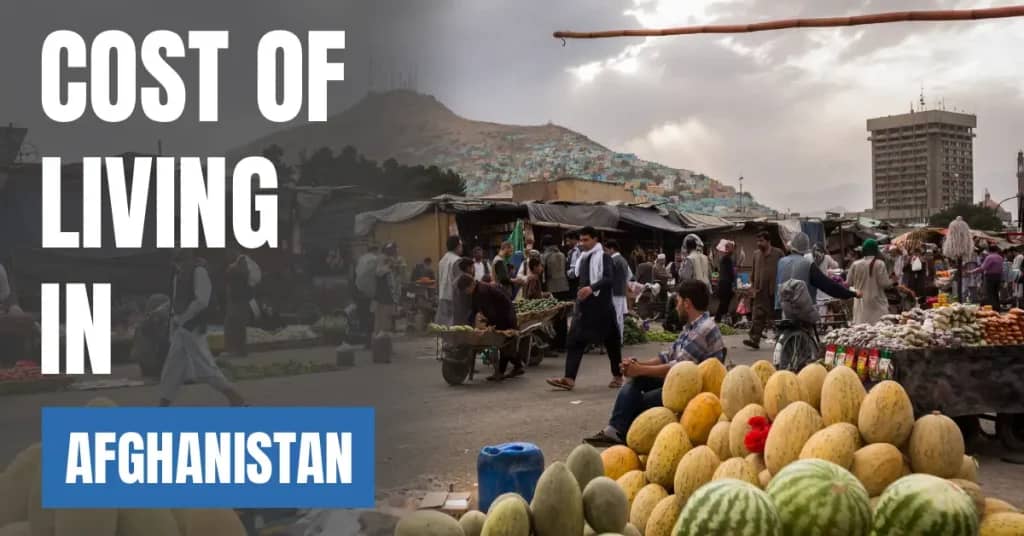
The cost of living in Afghanistan in 2026 can vary widely depending on the city, housing standard and lifestyle. As a practical planning estimate, a single person renting basic accommodation may need around AFN 21,000 to AFN 35,000 per month. A family of four may need roughly AFN 60,000 to AFN 80,000 per month before private education, premium housing or major security-related expenses.
On this pageTable of Content
These are budgeting ranges, not official national household averages. Afghanistan has limited current consumer-price data at city level, and many available price databases rely on relatively small samples. For that reason, this guide uses ranges, current market prices and transparent sample budgets rather than claiming that one monthly figure applies to everyone.
Prices have also been under pressure during 2026. Headline inflation was around 7.5% year on year in July, while housing, healthcare and transport costs were among the areas facing notable price pressure. Older cost-of-living estimates can therefore understate what households may currently spend.
All prices in this guide are primarily shown in Afghan afghani, abbreviated as AFN. On 6 September 2026, Da Afghanistan Bank listed a cash selling rate of approximately AFN 64.5 per US dollar. Dollar conversions below are therefore approximate and will change with the exchange rate.
Also Explore: Cost of Living in AlbaniaCost of Living in Afghanistan at a Glance
| Expense | Typical 2026 Cost | What It Means |
|---|---|---|
| Single person excluding rent | AFN 15,000 to AFN 25,000/month | Practical range for food, utilities, transport, mobile service, basic healthcare and personal expenses. |
| Single person including basic rent | AFN 21,000 to AFN 35,000/month | Planning range for a basic local or moderate lifestyle. |
| Family of four including rent | AFN 60,000 to AFN 80,000/month | Excludes private school fees, premium housing and major security expenses. |
| 1-bedroom apartment in city centre | About AFN 7,531/month | Numbeo crowdsourced national average. Reported range is AFN 3,500 to AFN 12,000. |
| 1-bedroom apartment outside centre | About AFN 5,858/month | Reported range is approximately AFN 2,500 to AFN 9,930. |
| Basic utilities for 85 m² apartment | About AFN 3,666/month | Actual bills depend heavily on season and electricity or heating arrangements. |
| Inexpensive restaurant meal | About AFN 150 | Crowdsourced market average. |
| Local one-way transport | About AFN 20 | Actual fares vary by city and transport type. |
| 10 GB mobile internet | About AFN 550 to AFN 600 | Current Afghan Wireless monthly package pricing varies by bundle. |
| Average reported net salary | About AFN 16,785/month | Numbeo crowdsourced figure, not an official national salary average. |
How Much Does It Cost to Live in Afghanistan Per Month?
A practical monthly budget is around AFN 21,000 to AFN 35,000 for one person renting basic accommodation and around AFN 60,000 to AFN 80,000 for a family of four.
A person sharing accommodation, buying mainly local food and using local transport may spend less. Someone who wants furnished housing, imported groceries, frequent taxis, private healthcare, reliable backup electricity or high-speed fixed internet can spend much more.
Livingcost’s June 2026 model estimates a one-person monthly cost including rent of about US$494, equal to roughly AFN 31,900 at the early September exchange rate. Its family-of-four estimate is approximately US$1,075, or around AFN 69,400.
However, Livingcost explains that its basket is designed around a moderate lifestyle similar to that found in developed countries. The spending pattern of a local Afghan household can therefore be very different. The figures are more useful as planning benchmarks than as official household statistics.
Housing and Rent in Afghanistan
Basic local rents can appear inexpensive in international terms, but actual housing costs depend heavily on the city, property condition, security, furnishings and lease arrangement.
| Apartment Type | Average Monthly Rent | Reported Range |
|---|---|---|
| 1 bedroom, city centre | AFN 7,531 | AFN 3,500 to AFN 12,000 |
| 1 bedroom, outside city centre | AFN 5,858 | AFN 2,500 to AFN 9,930 |
| 3 bedrooms, city centre | AFN 12,986 | AFN 7,500 to AFN 20,000 |
| 3 bedrooms, outside city centre | AFN 7,290 | AFN 4,000 to AFN 10,000 |
These figures come from Numbeo’s June 2026 Afghanistan dataset and should be treated as market indicators rather than guaranteed asking rents.
Accommodation aimed at foreign workers, NGOs or people looking for furnished and more secure housing can cost substantially more than the averages above.
Rent is also not the only housing expense. Tenants may need to budget for a security deposit, furniture, heating, electricity, water storage and backup power. Winter heating can make some months noticeably more expensive.
Grocery and Food Costs in Afghanistan
A single adult buying mainly local food can use around AFN 8,000 to AFN 12,000 per month as a reasonable grocery budget. Families will normally spend considerably more depending on household size, meat consumption and the use of imported products.
| Grocery Item | Approximate Average Price |
|---|---|
| Milk, 1 litre | AFN 52 |
| Fresh white bread, 500 g | AFN 16 |
| White rice, 1 kg | AFN 127 |
| Eggs, 12 | AFN 106 |
| Chicken fillets, 1 kg | AFN 243 |
| Beef, 1 kg | AFN 412 |
| Apples, 1 kg | AFN 36 |
| Bananas, 1 kg | AFN 66 |
| Tomatoes, 1 kg | AFN 36 |
| Potatoes, 1 kg | AFN 35 |
| Onions, 1 kg | AFN 29 |
| Bottled water, 1.5 litres | AFN 24 |
The prices above are based on Numbeo’s Afghanistan dataset, last updated in June 2026. That dataset contained 214 price entries from 24 contributors during the previous 12 months. It is therefore useful for understanding approximate market prices, but it is not a representative government household survey.
Imported foods, specialist products and international brands can be much more expensive than locally produced staples. Trade disruptions can also change food prices quickly.
Restaurant and Eating-Out Costs
Local restaurant meals can be inexpensive compared with many other countries, although premium and internationally oriented restaurants cost more.
| Restaurant Expense | Approximate Cost |
|---|---|
| Meal at an inexpensive restaurant | AFN 150 |
| Three-course meal for two at a mid-range restaurant | AFN 725 |
| Fast-food combination meal | AFN 250 |
| Cappuccino | AFN 61 |
| Small bottled water | AFN 11 |
Location makes a major difference. Restaurants serving foreign visitors, business customers or higher-income households may charge significantly more than the averages shown above.
Utilities in Afghanistan
Basic utilities for an apartment of around 85 square metres average approximately AFN 3,666 per month in current crowdsourced data. The reported range is roughly AFN 2,500 to AFN 5,500.
This can include electricity, heating, cooling, water and related household services, but actual bills can be very different from one property to another.
Heating is especially important when planning an annual budget. Colder areas and winter months can require significantly more spending. Electricity reliability can also make generators, batteries, solar systems or other backup arrangements an additional household cost.
Internet and Mobile Data Costs
Mobile internet is generally much cheaper than premium fixed broadband in Afghanistan.
Current Afghan Wireless packages show that monthly mobile-data plans can start below AFN 200 for small allowances. Around 10 GB of monthly mobile data is available for roughly AFN 550 to AFN 600 depending on the package, while larger bundles are available at higher prices.
For most budget-conscious residents, mobile data can therefore be more economical than high-speed fixed internet.
Fixed broadband prices are much harder to generalize. Numbeo’s small Afghanistan sample reports unusually high prices for 60 Mbps or faster unlimited broadband. Because coverage, technology and provider availability differ significantly by location, anyone who depends on reliable fixed internet for work should obtain a direct local quotation instead of relying on a national average.
Transportation Costs in Afghanistan
Public transport is not generally free in Afghanistan. Local fares are inexpensive in nominal terms, but fuel prices and frequent taxi use can add noticeably to a household budget.
| Transport Expense | Approximate Cost |
|---|---|
| One-way local transport fare | AFN 20 |
| Monthly public transport pass | AFN 950 |
| Taxi starting fare | AFN 95 |
| Taxi, 1 km | AFN 30 |
| Gasoline, 1 litre | About AFN 68 |
Transport expenses can change quickly because Afghanistan depends heavily on regional fuel and trade routes. People who rely on private cars or taxis should therefore leave more room in their budget than someone who mainly walks or uses local transport.
Healthcare Costs in Afghanistan
Healthcare should not be treated as universally free when preparing a cost-of-living budget for Afghanistan.
Public and humanitarian programmes provide important healthcare services, but access is uneven. Households can still face costs for medicines, diagnostic tests, transport, referrals and private treatment.
The healthcare system is also under significant pressure. The World Health Organization estimates that 14.4 million people will need health assistance in Afghanistan during 2026. Funding reductions during 2025 led to the closure of at least 422 primary healthcare facilities, reducing access for millions of people.
For this reason, the sample budgets in this guide include a basic monthly allowance for healthcare and medicines. Anyone who expects regular private treatment, specialist care or medical evacuation should plan for much higher costs.
Education and Childcare Costs
For families, education costs depend heavily on the type of schooling available and required. Access to education is also a major issue in Afghanistan, particularly for girls and women.
Numbeo’s small 2026 sample reports private full-day preschool or kindergarten costs of around AFN 1,696 per child per month. Its reported international primary-school figure is approximately AFN 85,000 per child per year.
Those figures should be verified directly with the relevant school because the number of price submissions is limited and education options can vary sharply by city.
Education cannot be discussed only as a financial issue. Afghanistan remains the only country where girls and women are excluded from formal secondary and higher education. UNICEF reported in August 2026 that more than 2.6 million girls had been denied secondary education since 2021.
Families should therefore research actual local school availability as well as tuition, transport, uniforms, supplies and other education expenses.
Average Salary in Afghanistan
Reported salaries are low compared with the moderate household budgets used in this guide.
Numbeo’s June 2026 Afghanistan dataset reports an average monthly net salary of approximately AFN 16,785. At an exchange rate of about AFN 64.5 per US dollar, this equals approximately US$260.
This should not be interpreted as an official national wage. It is based on crowdsourced submissions.
Livingcost’s model produces an even lower after-tax salary estimate of around US$127 per month. However, its salary and living-cost methodology is different from Numbeo’s, so the two figures should not be combined as if they measure exactly the same thing.
The important point for affordability is that reported local earnings can be significantly lower than the cost of maintaining a moderate rented lifestyle.
What Salary Is Needed to Live Comfortably in Afghanistan?
For a single person renting basic accommodation, around AFN 32,000 per month after tax is a reasonable moderate-budget starting point. A salary of roughly AFN 35,000 to AFN 45,000 provides more flexibility.
This is not an official salary requirement. It is a practical budgeting estimate based on rent, groceries, utilities, transportation, communications, healthcare and personal spending.
A person sharing accommodation and following a very local lifestyle may be able to live on less. Someone requiring premium housing, imported goods, fixed broadband, frequent taxis or private healthcare may need considerably more.
Minimum Wage in Afghanistan in 2026
Published minimum-wage references remain far below the moderate cost-of-living budget for a single renter.
WageIndicator’s Afghanistan database, marked valid for June 2026, lists AFN 5,500 per month for non-permanent private-sector workers and AFN 6,000 per month for permanent government workers.
These figures should not be confused with an average salary or a comfortable-income benchmark. Afghanistan’s wage system, employment arrangements and enforcement can vary by sector and type of employment.
Realistic Monthly Budgets for Afghanistan
The following examples make the assumptions behind the monthly totals clear. They are budgeting models, not official national spending statistics.
| Expense | Budget Single | Moderate Single | Couple | Family of Four |
|---|---|---|---|---|
| Rent | AFN 5,500 | AFN 7,500 | AFN 9,000 | AFN 13,000 |
| Utilities | AFN 2,500 | AFN 3,700 | AFN 4,000 | AFN 5,000 |
| Groceries | AFN 8,500 | AFN 10,000 | AFN 16,000 | AFN 25,000 |
| Transport | AFN 1,000 | AFN 2,000 | AFN 3,000 | AFN 5,000 |
| Internet and mobile | AFN 800 | AFN 1,200 | AFN 1,600 | AFN 2,000 |
| Healthcare and medicines | AFN 1,000 | AFN 1,500 | AFN 2,000 | AFN 3,000 |
| Dining and leisure | AFN 1,500 | AFN 3,000 | AFN 3,500 | AFN 4,000 |
| Household items and contingency | AFN 0 | AFN 3,000 | AFN 3,000 | AFN 5,000 |
| Estimated Monthly Total | AFN 20,800 | AFN 31,900 | AFN 42,100 | AFN 62,000 |
| Approximate USD Equivalent | US$322 | US$494 | US$653 | US$961 |
The budget-conscious single example assumes simple housing, local groceries, limited leisure spending and mainly local transport.
The moderate budget gives more room for transportation, personal expenses and unexpected costs.
The family-of-four figure does not include private or international school fees. Education alone can therefore increase the total noticeably.
Cost of Living by City in Afghanistan
Living costs vary across Afghanistan, and Kabul is not automatically the most expensive city in every available dataset.
Livingcost’s June 2026 model estimates the following monthly costs for one person including rent:
| City | Modelled Monthly Cost for One Person |
|---|---|
| Herat | About AFN 35,900 |
| Kabul | About AFN 32,500 |
| Kandahar | About AFN 30,500 |
| Jalalabad | About AFN 24,600 |
These numbers convert Livingcost’s June dollar estimates using an early September 2026 AFN exchange rate.
The ranking should be treated as directional rather than exact. Livingcost uses a standardized consumer basket and partly crowdsourced data. Actual rent and local spending habits can produce very different results.
Afghanistan vs Pakistan and Iran Cost of Living
Afghanistan is not automatically the cheapest country in the region. Using the same Livingcost methodology allows a broad comparison because the same model is applied to each country.
| Country | One Person Including Rent | Family of Four Including Rent |
|---|---|---|
| Pakistan | About US$401 | About US$958 |
| Afghanistan | About US$494 | About US$1,075 |
| Iran | About US$549 | About US$1,365 |
Under this particular model, Afghanistan is more expensive than Pakistan but cheaper than Iran. This does not mean every grocery item, apartment or city follows the same pattern.
Cross-country comparisons are especially sensitive to exchange rates, rent assumptions and the lifestyle basket being measured.
Extra Costs People Often Forget
- Housing deposits: the first month’s rent may not be the full move-in cost.
- Furniture and appliances: basic accommodation may not include everything a new resident needs.
- Winter heating: seasonal energy costs can be much higher than the annual average suggests.
- Backup electricity: batteries, generators or solar equipment may be necessary in some properties.
- Healthcare: medicines, diagnostics, transport and private care can increase monthly spending.
- Imported goods: imported food, electronics and specialist products can cost much more than local alternatives.
- Internet: reliable fixed broadband can be much more expensive than mobile data.
- Private education: school fees can substantially increase a family’s monthly budget.
- Transport volatility: fuel and logistics costs can change quickly when regional trade routes are disrupted.
- Security-related expenses: some foreign workers and organisations may face transport, accommodation or security costs that are not included in normal household budgets.
Cost of Living and Afghanistan Residence Visa Fees
Your monthly living budget is separate from the official cost of an Afghanistan residence visa.
The Afghanistan Ministry of Foreign Affairs states that residence visas can be issued for stays ranging from one month to one year. The published fee is US$50 for each month of residence.
At an exchange rate of around AFN 64.5 per US dollar, that equals approximately AFN 3,225 per month in visa fees.
This should be budgeted separately from rent, groceries, healthcare and other everyday living expenses. Visa eligibility and supporting-document requirements also depend on the applicant’s specific immigration category.
Is Afghanistan Cheap for Expats?
Afghanistan has low nominal prices for many local goods and basic rents, but it should not automatically be described as cheap for expatriates.
A foreign worker may have expenses that are not represented well in ordinary consumer-price databases, including furnished accommodation, secure transportation, private healthcare, imported food, international communications and organisation-specific security arrangements.
Affordability also depends on income. A household earning in US dollars or another strong foreign currency may experience local prices very differently from someone earning an Afghan salary.
Security must also be considered separately from cost. As of September 2026, the United States continues to classify Afghanistan as Level 4, Do Not Travel. The UK Foreign, Commonwealth and Development Office also advises against all travel to Afghanistan. Cost-of-living figures should therefore not be interpreted as a recommendation to relocate or travel.
Is Afghanistan Expensive to Live In?
In international currency terms, many everyday Afghan prices are low. Relative to local wages, however, Afghanistan can still be difficult to afford.
A moderate single-renter budget of around AFN 32,000 per month is almost twice Numbeo’s reported average net salary of AFN 16,785. Published minimum-wage references are much lower again.
This difference between prices and earnings is more useful for understanding affordability than simply converting Afghan prices into US dollars.
Conclusion
For 2026, a single person renting basic accommodation can use roughly AFN 21,000 to AFN 35,000 per month as a practical starting budget in Afghanistan. A family of four can use around AFN 60,000 to AFN 80,000 per month before private education, premium housing and major security-related expenses.
A moderate single-person example comes to approximately AFN 31,900 per month, while the sample family budget in this guide is AFN 62,000.
The amount you actually need will depend most heavily on housing, food choices, city, transport, healthcare, internet requirements and whether you follow a local or expat-oriented lifestyle.
Because Afghanistan has limited high-quality consumer-price data, readers should use these figures for planning rather than treating them as fixed national averages. Before making financial commitments, check current rent, connectivity, healthcare and visa costs directly in the city where you plan to live.
Sources and Methodology
This guide was reviewed and updated on 6 September 2026. Official and institutional sources were prioritised where available. Crowdsourced databases were used for categories where detailed current official retail-price data is limited.
Da Afghanistan Bank: current AFN exchange rates.
World Bank Afghanistan Economic Monitor: current inflation, economic conditions and household affordability context.
Numbeo Afghanistan: rent, groceries, restaurant prices, utilities, transportation, salary and education price estimates. The June 2026 dataset contained 214 entries from 24 contributors, so these values should be treated as market indicators rather than official national averages.
Livingcost: standardised cost-of-living estimates for Afghanistan and Afghan cities, plus comparison data for neighbouring countries. Its model uses a moderate lifestyle basket and can overstate the spending required by households following a strongly local lifestyle.
Afghan Wireless: current mobile internet package pricing.
World Health Organization and Afghanistan Health Cluster: current healthcare needs and health-system access.
UNICEF and UNESCO: current education access and restrictions.
WageIndicator: published Afghanistan minimum-wage references.
Afghanistan Ministry of Foreign Affairs: residence visa validity and fees.
U.S. Department of State and UK FCDO: current travel and security advisories.
Frequently Asked Questions
How much does it cost to live in Afghanistan per month?
A single renter can use around AFN 21,000 to AFN 35,000 per month as a practical 2026 planning range. A moderate sample budget is about AFN 31,900. A family of four may need roughly AFN 60,000 to AFN 80,000 per month before private school fees and premium housing.
How much is rent in Afghanistan in 2026?
Numbeo’s June 2026 Afghanistan data reports an average one-bedroom rent of approximately AFN 7,531 per month in a city centre and AFN 5,858 outside the centre. Actual rent varies significantly by city, condition, furnishings and security.
How much money does one person need to live in Afghanistan?
A budget-conscious renter may manage on around AFN 21,000 per month, while roughly AFN 30,000 to AFN 35,000 provides a more moderate budget covering rent, utilities, groceries, transport, mobile service, healthcare and some personal spending.
What salary is needed to live comfortably in Afghanistan?
For one person renting basic accommodation, approximately AFN 32,000 after tax is a reasonable moderate-budget starting point. Around AFN 35,000 to AFN 45,000 provides more flexibility, although this is a budgeting estimate rather than an official salary threshold.
What is the average salary in Afghanistan?
Numbeo’s June 2026 crowdsourced dataset reports an average net salary of around AFN 16,785 per month. This should be treated as a market estimate rather than an official national wage statistic.
What is the minimum wage in Afghanistan in 2026?
WageIndicator’s June 2026 Afghanistan database lists AFN 5,500 per month for non-permanent private-sector workers and AFN 6,000 for permanent government workers. These amounts should not be confused with the average salary or the income needed for a comfortable lifestyle.
How much does a family of four need in Afghanistan?
A practical family-of-four budget is roughly AFN 60,000 to AFN 80,000 per month including basic rent, utilities, groceries, transport, mobile connectivity and routine healthcare. Private education and premium accommodation can increase the total substantially.
How much do groceries cost in Afghanistan?
A single adult buying mainly local food can plan around AFN 8,000 to AFN 12,000 per month for groceries. Imported products and higher meat consumption can increase this amount.
Is Kabul the most expensive city in Afghanistan?
Not necessarily. Livingcost’s June 2026 model estimates one-person living costs including rent at about US$504 in Kabul, compared with US$556 in Herat. City rankings should be treated as approximate because the underlying data is partly crowdsourced.
Is healthcare free in Afghanistan?
No. Public and humanitarian programmes provide some healthcare, but households can still face costs for medicines, tests, referrals, transportation and private treatment. Access to healthcare also remains limited in many areas.
How much is mobile internet in Afghanistan?
Current Afghan Wireless packages show small monthly mobile-data plans starting below AFN 200, while around 10 GB can cost approximately AFN 550 to AFN 600 depending on the bundle. Larger packages are available at higher prices.
How much does an Afghanistan residence visa cost?
The Afghanistan Ministry of Foreign Affairs currently lists a residence visa fee of US$50 for each month, with residence periods ranging from one month to one year. This cost is separate from normal monthly living expenses.
Join the conversation
Have thoughts on this topic? Share them with others.
Ask questions, share experience, and learn from the Visaboards Community.