
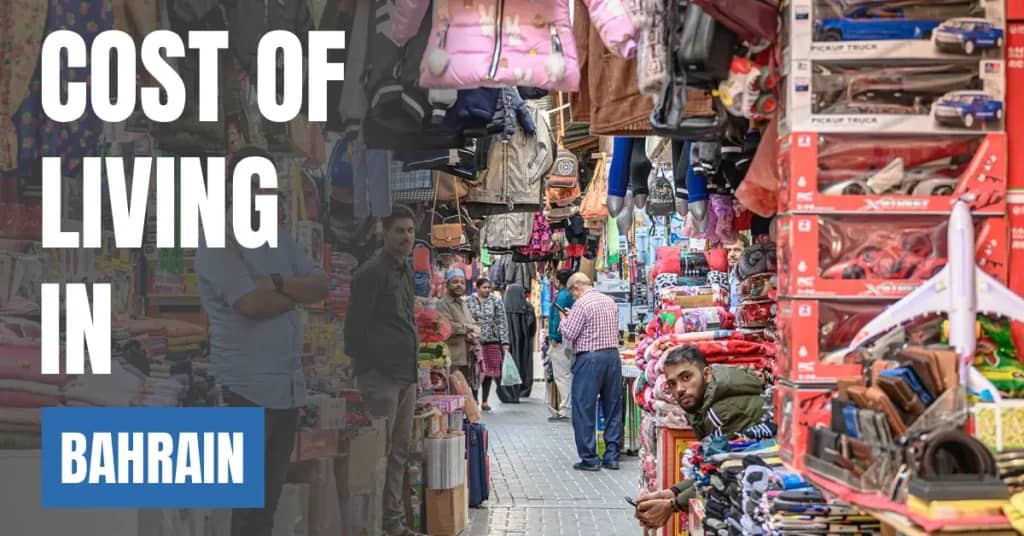
The cost of living in Bahrain in 2026 is relatively manageable by Gulf standards, but housing, schooling, transport choices and employment benefits make a major difference. A single person needs about BHD 290 per month for everyday expenses before rent according to current consumer-market estimates, while a family of four needs about BHD 1,000 before rent. Once accommodation is included, a realistic monthly budget is closer to BHD 500 to BHD 800 for a single renter and BHD 1,200 to BHD 1,600 for a family of four before international school fees.
On this pageTable of Content
Bahrain uses the Bahraini dinar (BHD). The Central Bank of Bahrain fixes the dinar against the US dollar at 1 BHD = 2.659 USD, but this guide uses BHD as the primary currency so residents can compare costs directly with salaries and local bills.
The figures below were reviewed in September 2026. Rental listings and consumer-price databases change frequently, so ranges are more useful than a single exact number. Government tariffs, tax rules, transport fares, salary statistics and residency thresholds are taken from official or primary sources wherever available.
Cost of Living in Bahrain at a Glance
A single renter should generally plan for BHD 500 to BHD 800 per month including rent. A couple may spend around BHD 850 to BHD 1,100, while a family of four can reasonably need BHD 1,200 to BHD 1,600 before private schooling. Families paying for two children at international schools can move closer to BHD 1,800 to BHD 2,200 or more.
| Expense | Typical 2026 Cost |
|---|---|
| Single person, excluding rent | About BHD 290 per month |
| Family of four, excluding rent | About BHD 1,000 per month |
| 1-bedroom apartment, city centre | About BHD 330 per month on broad market data |
| 1-bedroom apartment, outside centre | About BHD 230 per month |
| 3-bedroom apartment, city centre | About BHD 650 per month |
| 3-bedroom apartment, outside centre | About BHD 430 per month |
| Basic utilities for an 85 m² apartment | About BHD 49 on consumer-market data, but actual bills vary greatly |
| Home internet | About BHD 15 per month on market data |
| Inexpensive restaurant meal | BHD 1.5 to BHD 4 |
| Meal for two at a mid-range restaurant | BHD 10 to BHD 25 |
| Bus single trip with GO Card | BHD 0.275 |
| 28-day unlimited bus package | BHD 12 |
| International school tuition | Median about BHD 2,212 per year across 46 schools publishing fees |
The rent figures above translate current market data into BHD using Bahrain’s official dollar peg. Wise lists approximately USD 879 for a city-centre one-bedroom property and USD 618 outside the centre, equivalent to about BHD 331 and BHD 233 respectively. Its estimates should be treated as market indicators rather than guaranteed prices.
How Much Does It Cost to Live in Bahrain Per Month?
A realistic monthly cost for one independent renter is approximately BHD 500 to BHD 800 including housing. A lower-cost lifestyle is possible with cheaper accommodation, buses and home cooking, while central accommodation, frequent taxis, a car, restaurants and leisure can push spending much higher.
- Budget-conscious single person: around BHD 500 to BHD 600.
- Moderate single person: around BHD 750 to BHD 900.
- Couple: around BHD 850 to BHD 1,100.
- Family of four before school fees: around BHD 1,200 to BHD 1,600.
- Family of four with two children in international education: around BHD 1,800 to BHD 2,200 or more.
These totals include typical housing and daily living costs but are planning estimates rather than official minimum-income figures. Employer-provided housing, transport, healthcare or school allowances can reduce an expatriate household’s personal spending substantially.
Housing and Rent in Bahrain
Rent commonly starts around BHD 150 to BHD 250 for lower-cost apartments and can exceed BHD 500 for modern properties in premium locations. The largest difference is usually location, furnishing level and whether electricity, water and municipality charges are included.
Broad 2026 consumer-market data puts a one-bedroom apartment at about BHD 331 in a city centre and BHD 233 outside central areas. A three-bedroom apartment averages roughly BHD 653 centrally and BHD 429 outside central districts.
Current Rental Differences by Area
| Area | Current 1-Bedroom Asking Rent Snapshot | General Position |
|---|---|---|
| Juffair | Often around BHD 250 to BHD 350 | Large expat-oriented apartment market |
| Seef | Common listings around BHD 320 to BHD 500, with premium units higher | Premium business and shopping location |
| Amwaj Islands | Many current listings around BHD 315 to BHD 350 | Waterfront lifestyle, often furnished |
| Riffa | Lower-cost stock can be around BHD 150 to BHD 220 | Potentially cheaper than prime Manama districts |
| Saar | Roughly BHD 230 to BHD 400 for many listings, with premium options higher | Popular residential area for families |
These are snapshots of live asking prices, not official rental averages. Current Property Finder listings show one-bedroom units around BHD 270 to BHD 300 in Juffair, many Seef units between roughly BHD 320 and BHD 500, Amwaj listings around BHD 315 to BHD 350, lower-cost Riffa options from approximately BHD 150 to BHD 200, and a wider BHD 230 to BHD 400 range in Saar.
Always check whether an advertised rent is inclusive or exclusive. Many furnished apartments advertise an inclusive package but impose a monthly electricity and water allowance. Consumption above that allowance can still become the tenant’s responsibility.
Municipality Fees on Rented Housing
Municipality charges are an important cost that newcomers can overlook. Bahrain’s municipal regulations generally set the monthly charge for rented premises at 10% of the approved monthly rental value, with the occupant responsible unless an agreement states otherwise. Special rules apply to furnished properties. Where furnished rent includes electricity, water and municipality fees, a 7% rate can apply and the landlord pays it. If the tenant bears those charges, the furnished-property rate can be 7.5%.
This means a BHD 300 lease should not automatically be treated as a BHD 300 total housing cost. Read the contract to determine whether municipality fees and utilities are already included so they are not counted twice.
Groceries and Food Prices in Bahrain
A single adult can reasonably budget around BHD 80 to BHD 130 per month for groceries, while a family of four may spend around BHD 280 to BHD 400 or more. Imported brands, premium supermarkets, special diets and frequent convenience purchases can increase the total.
| Grocery Item | Typical Price Range |
|---|---|
| Milk, 1 litre | BHD 0.40 to BHD 0.95 |
| Fresh white bread, 500 g | BHD 0.20 to BHD 0.60 |
| White rice, 1 kg | BHD 0.52 to BHD 1.20 |
| Eggs, 12 | BHD 0.62 to BHD 2.00 |
| Chicken breast, 1 kg | BHD 1.50 to BHD 3.50 |
| Beef, 1 kg | BHD 2.45 to BHD 5.00 |
| Apples, 1 kg | BHD 0.52 to BHD 1.00 |
| Tomatoes, 1 kg | BHD 0.40 to BHD 0.83 |
| Potatoes, 1 kg | BHD 0.31 to BHD 0.60 |
| Bottled water, 1.5 litres | BHD 0.20 to BHD 0.50 |
These ranges come from RCSI Medical University of Bahrain’s local budgeting guide. RCSI specifically notes that prices differ by retailer, product and brand, so supermarket totals should be treated as estimates.
Restaurants and Eating Out
Eating out can be inexpensive at local restaurants, but regular café, delivery and mid-range restaurant spending quickly changes a monthly budget.
| Item | Typical Cost |
|---|---|
| Inexpensive restaurant meal | BHD 1.50 to BHD 4.00 |
| Three-course meal for two, mid-range restaurant | BHD 10 to BHD 25 |
| Fast-food combo | BHD 2 to BHD 3 |
| Regular cappuccino | BHD 1.40 to BHD 2.00 |
| Cinema ticket | BHD 3 to BHD 4 |
A person cooking most meals at home may keep dining and leisure near BHD 30 to BHD 50 monthly, while someone regularly visiting restaurants, cafés and entertainment venues could spend BHD 100 or considerably more.
Utilities in Bahrain
Utility costs vary substantially because expatriates and eligible Bahraini households do not pay the same electricity and water tariffs. This is one reason a simple national average can be misleading.
For eligible Bahraini citizens using one qualifying domestic account, electricity starts at 3 fils per kWh for the first 3,000 kWh, then rises through higher consumption bands. For non-Bahrainis and Bahrainis with multiple domestic accounts, the electricity tariff is 32 fils per kWh from the first unit.
| Customer Type | Electricity | Water |
|---|---|---|
| Eligible Bahraini primary domestic account | 3, 9, 16 and 32 fils/kWh by consumption band | 25, 80 and 775 fils/m³ by consumption band |
| Non-Bahraini domestic account | 32 fils/kWh from first unit | 775 fils/m³ from first unit |
The Electricity and Water Authority states that government tariff subsidies apply to eligible Bahraini citizens for one qualifying residential account. Non-Bahrainis pay the non-subsidised domestic tariffs.
Consumer-market data places basic utilities for an 85 m² apartment at roughly BHD 49 per month on average, but actual bills can be substantially different, especially during hot months when air conditioning is used heavily. Lease packages that include an EWA allowance can also make advertised rental costs difficult to compare directly.
Internet and Mobile Costs
A practical allowance of around BHD 20 to BHD 30 per month can cover basic home internet plus a mobile plan for one person. Consumer-market data places home broadband close to BHD 15 per month on average, although speed, contract length and mobile data requirements can change the total.
Shared accommodation or apartments with internet already included can reduce this expense, while households purchasing multiple mobile contracts and higher-speed broadband should budget more.
Transportation in Bahrain
Public buses are inexpensive, but many residents choose a private car or taxis because transport needs depend heavily on where they live and work.
Bahrain Public Transport Company currently charges 275 fils (BHD 0.275) for a single journey with a GO Card. The daily fare cap is BHD 0.700, a seven-day unlimited package costs BHD 3, and a 28-day unlimited package costs BHD 12. A paper single ticket is BHD 0.300.
| Public Transport Product | Current Fare |
|---|---|
| GO Card single journey | BHD 0.275 |
| Daily cap | BHD 0.700 |
| Paper single ticket | BHD 0.300 |
| 7-day unlimited package | BHD 3 |
| 28-day unlimited package | BHD 12 |
RCSI Bahrain’s local guide indicates taxi trips to nearby destinations can be around BHD 3 from its Busaiteen campus, but taxi and ride-hailing costs depend on distance and frequency. A resident relying on buses may spend only BHD 12 to BHD 25 per month on routine transport, while regular taxis or private-car ownership can raise monthly costs by BHD 80 to BHD 200 or substantially more.
Healthcare in Bahrain
Government healthcare is free for Bahraini citizens, while non-Bahrainis can access government care for a nominal fee and expatriate employees are covered through employer arrangements under the national health framework.
Bahrain’s National Portal states that healthcare at government hospitals and health centres is free for Bahraini citizens and available for a nominal fee to non-Bahrainis. Under the National Social Health Insurance Program, known as Sehati, Bahrainis and domestic workers receive government-funded coverage, while other expatriate employees are covered by employers.
For expatriates, the practical question is therefore not simply the price of one consultation. Before accepting a job, check the employer’s medical insurance or healthcare coverage, network restrictions, deductibles, medication coverage, dental benefits and whether dependants are included. Families may need additional private cover or out-of-pocket allowances for services outside their employer plan.
Education and Childcare Costs
Education can become one of the largest expenses for expatriate families, particularly when children attend international schools.
Bahrain’s Education Law states that basic and secondary education is free in Kingdom schools. Ministry registration and placement rules still apply, and expatriate families should verify eligibility, language, curriculum, location and available places instead of assuming that a particular government school will meet their needs.
For private and international education, a current dataset covering 46 Bahrain schools that publish tuition places median annual tuition at about BHD 2,212. The median is about BHD 2,400 for primary school, BHD 3,765 for secondary school and BHD 3,912 for sixth form. Curriculum also matters: the same dataset reports medians around BHD 2,182 for British schools, BHD 3,680 for IB schools, BHD 3,311 for American schools and BHD 662 for Indian-curriculum schools.
Tuition is not the whole education budget. Application fees, deposits, uniforms, books, school buses, meals, activities, examinations and trips may be charged separately. Families should obtain the full fee schedule from individual schools before relocating.
Salaries in Bahrain
Salary data in Bahrain varies dramatically by nationality, occupation and sector, so a single national average is a poor guide for evaluating an employment offer.
Official Social Insurance Organization statistics for Q2 2026 show Bahraini contributors earning an average monthly salary of BHD 936 across the public and private sectors, with a median of BHD 620. In the private sector specifically, the Bahraini average was BHD 919 and the median was BHD 500.
For non-Bahraini private-sector contributors, official data show an average salary of BHD 269 and a median of only BHD 110. About 70.9% of non-Bahraini contributors were recorded below BHD 200 per month. This reflects Bahrain’s broad migrant workforce, including many lower-paid occupations, so it should not be interpreted as a typical salary for a professional expatriate. Housing, food or transport may also form part of compensation packages for some lower-paid workers.
By comparison, consumer-market datasets show much higher salary estimates. Wise reports an average net salary equivalent to roughly BHD 860. The difference demonstrates why official insured-worker statistics and crowdsourced professional-consumer datasets should not be treated as measuring the same population.
What Salary Is Needed to Live Comfortably in Bahrain?
A single person paying their own rent may want roughly BHD 650 to BHD 900 per month for a reasonably comfortable lifestyle. A couple may target household income of around BHD 1,000 to BHD 1,200, while a family of four may need approximately BHD 1,500 to BHD 1,700 before private education and BHD 1,900 to BHD 2,300 or more when paying for two children at international schools.
These are affordability estimates based on the budgets in this guide, not legal salary requirements. A BHD 700 salary with housing, medical insurance and transport supplied by an employer can provide more disposable income than a BHD 900 salary where the employee pays all of those costs personally.
Minimum Wage in Bahrain
Bahrain does not have a single universal statutory private-sector minimum wage applying to all workers. Article 37 of the current private-sector Labour Law states that a worker’s wage is determined through the individual employment contract, collective agreement or establishment rules. Where none specifies the wage, comparable pay, professional custom or ultimately the competent court is used.
US State Department labour reporting has also described Bahrain as having no national private-sector minimum wage law. Government pay scales, Bahrainisation-related wage programs and other employment policies should therefore not be confused with a universal legal minimum wage covering every private-sector worker.
Taxes and Social Insurance
Bahrain has no personal income tax regime, but residents still face VAT, social insurance deductions where applicable and housing-related municipality charges.
PwC’s Bahrain tax summary, reviewed in July 2026, confirms there is no personal income tax regime. Current Social Insurance Organization contribution rates reported by PwC are 26% for local employees, comprising 18% from the employer and 8% from the employee, and 4% for expatriate employees, comprising 3% from the employer and 1% from the employee. GCC nationals working in Bahrain are subject to relevant GCC home-country insurance arrangements.
Bahrain’s standard VAT rate is 10%. The National Bureau for Revenue’s current VAT calculator applies the 10% rate, although individual goods or services may be zero-rated or exempt under Bahrain’s VAT rules.
For everyday affordability, this means describing Bahrain as having no personal income tax is more accurate than calling daily life completely tax-free.
Realistic Monthly Budgets in Bahrain
The following examples show actual budget calculations. They assume the household pays its own rent and that a standard 10% municipality charge is passed to the occupant and is not already included in the advertised rent. Furnished or inclusive contracts can be treated differently, so check the lease before using the municipality line.
Budget-Conscious Single Person
| Expense | Estimated Monthly Cost |
|---|---|
| Rent outside central premium districts | BHD 235 |
| Municipality allowance | BHD 24 |
| Utilities | BHD 50 |
| Groceries | BHD 100 |
| Public transport | BHD 12 |
| Internet and mobile | BHD 25 |
| Healthcare extras | BHD 15 |
| Dining and leisure | BHD 40 |
| Estimated Total | BHD 501 |
This budget assumes a modest one-bedroom apartment, regular home cooking and heavy use of the public bus network.
Moderate Single Person
| Expense | Estimated Monthly Cost |
|---|---|
| Central or higher-quality one-bedroom rent | BHD 340 |
| Municipality allowance | BHD 34 |
| Utilities | BHD 60 |
| Groceries | BHD 120 |
| Transport | BHD 90 |
| Internet and mobile | BHD 25 |
| Healthcare extras | BHD 20 |
| Dining and leisure | BHD 100 |
| Estimated Total | BHD 789 |
This example allows for better-located accommodation, more taxis or private transport and more frequent leisure spending.
Couple
| Expense | Estimated Monthly Cost |
|---|---|
| Rent | BHD 350 |
| Municipality allowance | BHD 35 |
| Utilities | BHD 70 |
| Groceries | BHD 190 |
| Transport | BHD 100 |
| Internet and mobile | BHD 35 |
| Healthcare extras | BHD 30 |
| Dining and leisure | BHD 110 |
| Estimated Total | BHD 920 |
Family of Four
| Expense | Estimated Monthly Cost |
|---|---|
| 3-bedroom rent outside prime centre | BHD 430 |
| Municipality allowance | BHD 43 |
| Utilities | BHD 100 |
| Groceries | BHD 330 |
| Transport | BHD 150 |
| Internet and mobile | BHD 40 |
| Healthcare extras | BHD 40 |
| Dining and leisure | BHD 120 |
| Total Before School Fees | BHD 1,253 |
| International school allowance for two children | BHD 600 |
| Estimated Total With Schooling | BHD 1,853 |
The BHD 600 school allowance equals BHD 3,600 per child per year for two children. It is an illustrative planning figure rather than a market average. Current published tuition varies widely by curriculum and age, with the median across 46 schools around BHD 2,212 annually and some premium schools costing far more.
These sample budgets do not include international flights, major medical bills, furniture purchases, loan payments, domestic help, large car-finance payments, luxury entertainment or emergency savings.
Which Areas of Bahrain Are More or Less Expensive?
Prime expat locations such as Seef, Bahrain Bay, Reef Island and higher-end Juffair developments generally cost more than older or less central neighbourhoods. Riffa can provide significantly cheaper apartment options, while Saar and Janabiya have a broad range aimed partly at families. Amwaj Islands often sits in the middle-to-premium range, particularly for furnished waterfront units. Current live listings show substantial variation even within the same area.
The cheapest property is not always the cheapest overall lifestyle choice. Living far from work or school can increase car, taxi and commuting costs enough to offset some of the rent saving.
Is Bahrain Expensive Compared With Other Gulf Countries?
Bahrain is generally less expensive than the UAE and Qatar in broad consumer cost comparisons, particularly once rent is considered, while Saudi Arabia and Oman can be cheaper on some measures.
Numbeo’s 2026 Western Asia country index places Bahrain below the UAE and Qatar on its combined cost-of-living-plus-rent measure, but above Saudi Arabia and Oman. These are crowdsourced indices rather than official government price statistics, so they are best used for broad regional comparison rather than precise household budgeting.
Bahrain’s relatively moderate rents are an advantage compared with some premium Gulf markets, but international school fees, unsubsidised expat electricity and water tariffs, car dependence and imported consumer goods can still make family life expensive.
Costs New Residents Often Overlook
- Municipality fees: standard rented accommodation can attract a charge equal to 10% of monthly rental value, unless different furnished-property rules or contractual arrangements apply.
- EWA differences: expatriates pay non-subsidised electricity and water tariffs, which can make summer cooling more expensive than national averages suggest.
- Utility caps: an apartment described as inclusive may only include EWA up to a stated limit.
- School extras: published tuition may exclude registration, deposits, uniforms, buses, meals, examinations and activities.
- Transport: choosing a cheap home far from work or school may create a larger car or taxi bill.
- Housing deposits and furnishing: moving into an unfurnished property can create significant one-off costs.
- Healthcare gaps: employer coverage may not include every dependant, provider, treatment, medication or dental service.
- Annual travel: expatriates who regularly travel to their home country should add flights to their annual rather than monthly budget.
Cost of Living Versus Bahrain Residency Financial Requirements
The amount needed to live in Bahrain is not the same as the financial threshold required for a residency category. Immigration thresholds are legal eligibility rules and should never be presented as estimates of normal household spending.
Bahrain Golden Residency
| Category | Current Financial or Work Requirement |
|---|---|
| Professional working in Bahrain | At least 5 years in Bahrain and average monthly basic salary over BHD 2,000 during the previous 5 years, continuously insured at that level through SIO |
| Property owner | Personal property share value of at least BHD 130,000 at the time of purchase |
| Resident retiree | At least 15 years of work in Bahrain and average pension of BHD 2,000 or more |
| Non-resident retiree | Average pension of BHD 4,000 or more |
Bahrain’s official Golden Residency portal currently lists BHD 130,000 as the property-owner threshold. This is important because older government and media material may still show BHD 200,000. The threshold was officially reduced from BHD 200,000 to BHD 130,000 on 26 November 2025.
The Golden Residency application fee is BHD 5 and, if approved, the residency issuance fee is BHD 300. Applicants also need supporting documents, including a valid Bahrain health insurance certificate and a recent six-month bank statement.
Property-Owner Self-Sponsorship
Bahrain also has a separate self-sponsorship residence route for qualifying foreign property owners. The government service currently requires property with a value of at least BHD 50,000, evidence of stable income of at least BHD 500, and valid medical insurance issued in Bahrain. The listed residence fees are BHD 200 for two years, BHD 400 for five years and BHD 600 for ten years, plus the application fee.
These BHD 50,000, BHD 130,000, BHD 500 and BHD 2,000 figures are immigration eligibility requirements for particular routes. They do not tell a household how much it will actually spend each month.
Is Bahrain Affordable for Expats?
Bahrain can be affordable for expatriates with a suitable salary and a strong employment package, but affordability depends more on benefits than the headline salary alone.
A professional earning BHD 800 with housing and medical insurance supplied by an employer may have a stronger personal budget than someone earning BHD 1,000 while paying BHD 350 rent, municipality charges, utilities, transport and healthcare independently. Families should pay particular attention to school allowances because tuition can change the budget by hundreds of dinars per month.
Lower-paid migrant workers represent a significant part of Bahrain’s labour market, and official salary statistics show many non-Bahraini workers earning far below the independent-renter budgets in this guide. In such cases, employer accommodation, food, transport or other benefits can be critical to affordability.
Conclusion
Bahrain remains one of the more accessible Gulf locations for many expatriates, particularly because rent can be lower than in some competing regional hubs and there is no personal income tax. A careful single renter can plan around BHD 500 to BHD 600 per month, while a moderate independent lifestyle is more likely to require BHD 750 to BHD 900.
For families, housing and education are the major variables. A family of four may manage around BHD 1,200 to BHD 1,600 before school fees, but two international-school places can move the practical monthly requirement toward BHD 1,800 to BHD 2,200 or more.
Before moving, compare the complete employment package, not just salary. Confirm whether rent, municipality fees, EWA, insurance, school fees and transport are included. These details often make a larger difference to real disposable income than small differences in grocery or restaurant prices.
Sources and Methodology
This guide was reviewed on 14 September 2026. Official Bahrain government and regulatory sources were prioritised for utilities, public transport, salaries, labour law, healthcare, education, taxes and residency rules. Current market sources were used for rents, groceries, restaurant prices, internet and private-school fees.
Rental listings and consumer prices can change at any time. Property listings represent advertised asking prices rather than completed rental transactions. Consumer and crowdsourced databases are estimates and may represent different income groups or sample sizes. For this reason, the article uses ranges and compares multiple sources instead of presenting every figure as a fixed national price.
- Electricity and Water Authority, Bahrain Tariffs.
- Bahrain Public Transport Company, Fares.
- Bahrain National Portal, Health Services.
- Social Insurance Organization, Q2 2026 Statistical Report.
- Legislation and Legal Opinion Commission, Labour Law No. 36 of 2012.
- Legislation and Legal Opinion Commission, Education Law No. 27 of 2005.
- National Bureau for Revenue, VAT Information.
- PwC Bahrain, Personal Income Tax Summary.
- PwC Bahrain, Social Insurance and Other Taxes.
- Central Bank of Bahrain, Exchange Rate Information.
- Bahrain Golden Residency, Eligibility Criteria.
- Bahrain Golden Residency, Property Threshold Update.
- Bahrain National Portal, Property Owner Self-Sponsorship.
- Bahrain National Portal, Address Certificate and Municipality Fee Information.
- Bahrain Municipal Regulations.
- Wise, Cost of Living in Bahrain 2026.
- RCSI Medical University of Bahrain, Budgeting and Banking Guide.
- Doris, International School Fees in Bahrain 2026.
- Property Finder Bahrain, Current Residential Rental Listings.
Frequently Asked Questions
How much does it cost to live in Bahrain per month?
A single person renting independently can realistically spend about BHD 500 to BHD 800 per month including rent. A couple may need around BHD 850 to BHD 1,100. A family of four can spend roughly BHD 1,200 to BHD 1,600 before private-school fees, while international schooling for two children can push the total toward BHD 1,800 to BHD 2,200 or more.
Is Bahrain expensive to live in?
Bahrain is moderately priced for the Gulf region. Rent can be lower than in premium markets such as Dubai or Doha, and public buses are inexpensive. However, international schooling, private-car use, imported products, municipality fees and non-subsidised electricity and water tariffs can make life considerably more expensive for expatriate families.
How much is rent in Bahrain in 2026?
Broad 2026 market data places a one-bedroom apartment around BHD 330 in central locations and BHD 230 outside the centre. Live listings vary widely: lower-cost Riffa units can start around BHD 150 to BHD 200, while many Juffair, Seef, Saar and Amwaj apartments range from roughly BHD 250 to BHD 500 or more depending on quality and inclusions.
What salary is enough to live comfortably in Bahrain?
A single person paying all of their own expenses may want around BHD 650 to BHD 900 per month. A couple may target household income of BHD 1,000 to BHD 1,200. A family with two children may need BHD 1,900 to BHD 2,300 or more if paying for international schooling. Employer-paid housing, insurance or transport can reduce these requirements significantly.
Does Bahrain have a minimum wage?
Bahrain does not have one universal statutory private-sector minimum wage covering all employees. The private-sector Labour Law states that wages are normally set through an employment contract, collective agreement or establishment rules. Government salary scales and Bahrainisation-related wage initiatives should not be confused with a single national legal minimum wage applying to every private-sector worker.
Is healthcare free in Bahrain?
Government healthcare is free for Bahraini citizens at government hospitals and health centres. Non-Bahrainis can access government healthcare for a nominal fee. Under Bahrain’s Sehati framework, other expatriate employees are covered through employers. Expats should still check exactly what their employer coverage includes, particularly for dependants, medications, dental treatment and private providers.
How much does public transport cost in Bahrain?
Bahrain’s public bus system is inexpensive. A single journey using a GO Card costs BHD 0.275, with a daily cap of BHD 0.700. A seven-day unlimited package costs BHD 3 and a 28-day unlimited package costs BHD 12. Residents relying mainly on buses can therefore keep routine transport costs very low compared with regular taxi or private-car use.
How much does a family of four need in Bahrain?
A family of four may need around BHD 1,200 to BHD 1,600 per month for housing, utilities, groceries, transport and normal household spending before private education. With two children in international schools, a practical budget can rise to around BHD 1,800 to BHD 2,200 or more. Premium schools, larger homes and multiple cars can increase the total further.
How much do international schools cost in Bahrain?
A current dataset covering 46 international schools that publish fees reports median annual tuition of about BHD 2,212. Primary-school tuition has a median around BHD 2,400 and secondary around BHD 3,765. Fees vary significantly by curriculum and school, and families should also budget for registration, deposits, uniforms, transport, meals, examinations and extracurricular activities.
Is Bahrain cheaper than the UAE or Qatar?
Bahrain is generally cheaper than the UAE and Qatar in broad consumer cost comparisons, especially when housing is included. However, comparisons depend on the city and lifestyle. Bahrain may still be more expensive than parts of Saudi Arabia or Oman, and expat households with international-school fees or heavy car use can face substantial monthly costs despite comparatively moderate rent.
How much money is required for Bahrain Golden Residency?
The requirement depends on the category. Property owners currently need qualifying property shares worth at least BHD 130,000. Professionals working in Bahrain generally need at least five years of employment and an average basic salary above BHD 2,000 over that period. Resident retirees need a BHD 2,000 average pension, while qualifying non-resident retirees need BHD 4,000.
Join the conversation
Have thoughts on this topic? Share them with others.
Ask questions, share experience, and learn from the Visaboards Community.