
INFORMATION
Cost of Living in Belgium 2026: Rent, Food, Salaries and Monthly Expenses
Post Date · Modified · Country · Belgium
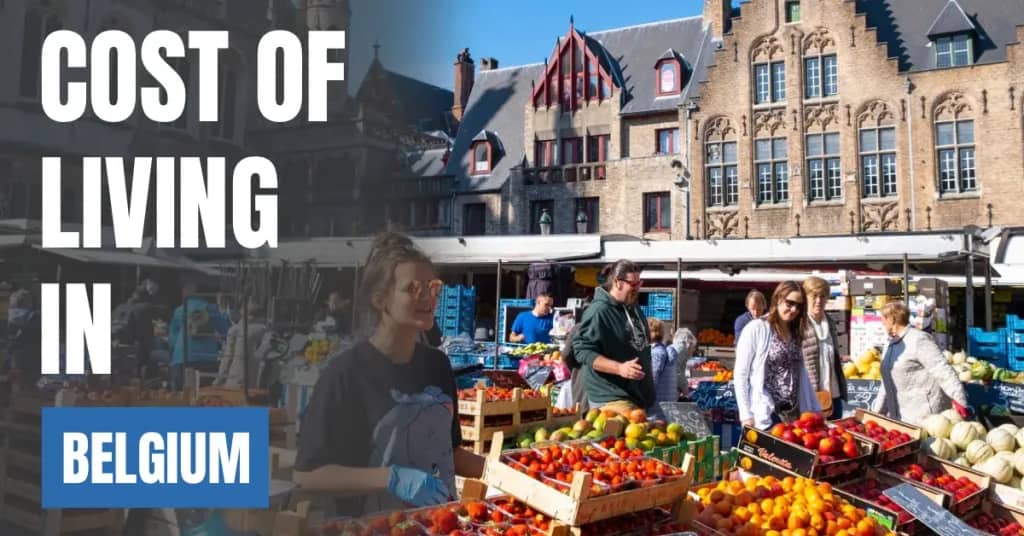
The cost of living in Belgium in 2026 is relatively high by European standards, but actual monthly spending varies significantly by city, housing choice, household size and lifestyle. Brussels generally requires a larger housing budget than many other Belgian cities, while smaller cities and locations outside major urban centres can be more affordable.
On this pageTable of Content
For a single renter, a realistic monthly budget is roughly €1,300 to €2,000 including rent. A couple may spend around €2,300 to €3,000, while a family of four can easily require €3,500 to €4,500 or more, particularly when childcare, a larger home or international schooling is involved. These are planning ranges rather than official minimums.
Belgium’s official statistics also show that living costs continue to change. Statbel’s August 2026 consumer price data showed the rent index at 103.41 on a 2025=100 basis, while services were at 105.76, illustrating why old fixed-price estimates can quickly become outdated.
Cost of Living in Belgium at a Glance
| Expense | Typical 2026 Cost |
|---|---|
| Single person, including rent | About €1,300 to €2,000 per month |
| Couple, including rent | About €2,300 to €3,000 per month |
| Family of four, including rent | About €3,500 to €4,500+ per month |
| 1-bedroom apartment, city centre | About €700 to €1,200, national market range |
| 1-bedroom apartment, outside centre | About €600 to €1,000 |
| Basic utilities, 85 m² apartment | About €136 to €332 per month |
| Groceries, single adult | About €250 to €400 per month |
| Inexpensive restaurant meal | About €14 to €35 |
| Regular public transport pass | Roughly €35 to €68+, depending on network |
| Internet | About €35 to €70 per month |
| Mobile plan | About €10 to €40 per month |
Consumer-price figures above use current market estimates as planning guidance. Numbeo’s Belgium dataset, last updated in June 2026, reported a national average of €872.66 for a one-bedroom city-centre apartment, €769.97 outside city centres, and €204.57 for basic utilities in an 85 m² home. Because the dataset is crowdsourced, its ranges are more useful than treating individual averages as guaranteed prices.
How Much Does It Cost to Live in Belgium Per Month?
A single person who rents independently should generally plan for around €1,300 to €2,000 per month including housing. Someone sharing accommodation and cooking most meals can spend less, while a resident renting a desirable apartment in central Brussels, eating out frequently or owning a car can spend considerably more.
The largest variable is usually housing. Utilities, groceries, transport and communications are relatively predictable once lifestyle is established, but rent can change the total budget by several hundred euros each month.
Housing and Rent in Belgium
A one-bedroom apartment commonly costs approximately €600 to €1,200 per month, depending on the city and neighbourhood. National crowdsourced data from June 2026 put the average at about €873 in city centres and €770 outside them. Three-bedroom apartments averaged around €1,336 in central areas and €1,102 outside centres, although individual listings can be considerably higher.
Brussels generally has greater rental pressure than much of Belgium. September 2026 Numbeo city data gave Brussels a rent index of 32.31, compared with 22.33 for Antwerp and 25.06 for Ghent. The figures are indexes rather than euro rent quotations, but they illustrate the meaningful geographical difference in housing costs.
Tenants should also budget for expenses beyond monthly rent. Depending on the property and lease, these can include a rental deposit, communal building charges, utilities, insurance, moving expenses and furniture. A low advertised rent therefore does not necessarily represent the full housing cost.
Typical Rent Planning Ranges
| Housing Type | Estimated Monthly Rent |
|---|---|
| Room or shared accommodation | €450 to €750 |
| 1-bedroom apartment outside centre | €600 to €1,000 |
| 1-bedroom apartment in central area | €700 to €1,200+ |
| 3-bedroom apartment outside centre | €850 to €1,800 |
| 3-bedroom apartment in central area | €1,000 to €2,250+ |
These ranges reflect market estimates rather than regulated rent schedules and should be checked against live listings before signing a lease.
Groceries and Food Costs
A single adult can reasonably budget around €250 to €400 per month for groceries. Households that rely on discount supermarkets, cook regularly and buy fewer imported or premium products may stay near the lower end.
June 2026 market data put milk at about €1.13 per litre, a 500 g loaf of fresh white bread at €2.25, 12 eggs at €3.59, chicken fillets at €10.70 per kg, beef at €17.64 per kg, apples at €2.46 per kg and potatoes at €2.11 per kg.
| Grocery Item | Typical Price |
|---|---|
| Milk, 1 litre | About €0.80 to €1.60 |
| White bread, 500 g | About €1.20 to €4.00 |
| Rice, 1 kg | About €1.00 to €3.00 |
| Eggs, 12 | About €2.20 to €6.00 |
| Chicken fillets, 1 kg | About €7 to €13 |
| Beef, 1 kg | About €10 to €30 |
| Apples, 1 kg | About €1.30 to €3.50 |
| Potatoes, 1 kg | About €1 to €3 |
Belgium’s food-price index has fluctuated during 2026, which is another reason to use ranges instead of assuming supermarket prices will remain fixed throughout the year.
Restaurants and Eating Out
An inexpensive restaurant meal generally costs about €14 to €35, while a three-course mid-range meal for two is commonly around €60 to €126 before drinks. A fast-food combination meal averages around €12 and a cappuccino around €3.70.
A resident eating at restaurants several times each week can therefore add hundreds of euros to a monthly budget. Cooking at home is one of the easiest ways to reduce everyday expenses.
Utilities
Basic utilities for an 85 m² apartment can reasonably fall between roughly €136 and €332 per month. Numbeo’s June 2026 national average for electricity, heating, cooling, water and waste was approximately €204.57 per month.
Actual bills depend on home size, insulation, heating technology, energy contract, household behaviour and whether some charges are included in the rent. Energy-intensive homes can cost considerably more during colder months.
Internet and Mobile Phone Costs
Expect approximately €35 to €70 per month for broadband and €10 to €40 for a mobile plan. Current market data put average broadband service at about €48.86 and a mobile package with calls and at least 10 GB of data at about €20.49 per month.
Bundles may reduce the combined cost, although promotional prices can change after an introductory period.
Transportation Costs in Belgium
Public transport is practical in major Belgian cities, but prices depend on the operator, region, age and type of pass. A normal single local journey is commonly around €2.30 to €3.00 based on national consumer-price estimates.
In Brussels, a standard STIB-MIVB subscription costs €56 per month or €560 per year in 2026. A Brupass covering STIB-MIVB plus SNCB-NMBS, TEC and De Lijn services within the Brussels zone costs €68 per month or €680 annually.
| Transport Expense | Typical Cost |
|---|---|
| Single local ticket | About €2.30 to €3.00 |
| STIB-MIVB monthly Brussels pass | €56 |
| Brupass monthly pass | €68 |
| Taxi, 1 km | About €2 to €3 |
| Petrol, 1 litre | Approximately €1.58 to €1.97 in the referenced 2026 market dataset |
Students, younger residents and certain employee groups may qualify for reduced fares or employer-funded commuting arrangements, so the full standard price is not necessarily what every resident pays.
Healthcare Costs in Belgium
Healthcare in Belgium is not simply free at the point of use. Residents covered by the mandatory healthcare system generally join an insurance organisation or mutual health fund. Eligible medical costs can then be reimbursed partly under the compulsory insurance system.
Patients may still have a personal contribution, and extra charges can arise when a doctor does not follow the agreed official fee schedule. Belgium’s federal information portal specifically notes that reimbursement remains based on the applicable insurance rules even when a non-contracted doctor charges an additional fee, meaning that extra amount may remain entirely payable by the patient.
Healthcare should therefore be budgeted differently from a simple fixed consultation price. A practical household budget may reserve approximately €30 to €100 or more per month for patient contributions, medicines and supplementary cover, but actual spending varies substantially by health needs.
A March 2026 Federal Public Service Social Security analysis reported that households directly financed 21.5% of total Belgian healthcare expenditure in 2023, indicating that out-of-pocket costs remain relevant despite the broad insurance system.
Education and Childcare Costs
Public education can be relatively inexpensive, but childcare and international schooling can substantially increase a family’s budget. The exact rules vary among Belgium’s language communities.
For example, in Flemish primary education the maximum school invoice for the 2026-2027 academic year is €55 for nursery education and €110 for primary education for activities covered by that maximum. Other costs and certain trips can fall outside these limits.
Childcare is more complicated because Belgium uses different funding and tariff arrangements. In Flanders, some recognised childcare charges according to household income, while other recognised fixed-price childcare can qualify eligible families for a childcare allowance. The Flemish government currently lists the fixed childcare allowance at €3.78 per full childcare day for eligible cases.
Private and international education is far more expensive. Crowdsourced 2026 data show an extremely broad range for international primary-school fees, which means families should obtain fees directly from the particular school rather than rely on a national average.
Salaries in Belgium
Belgian salaries are relatively high in gross terms, but taxes and social contributions make gross salary a poor substitute for take-home income. The latest detailed Statbel earnings survey available in the sources reports an average full-time gross monthly salary of €4,076 and a median of €3,728 for 2022. Because these figures describe 2022 earnings, they should not be presented as a current 2026 national salary average.
More current crowdsourced consumer data estimated average net monthly salary after tax at approximately €2,619 in June 2026, but this is a market estimate rather than an official wage statistic.
What Is the Minimum Wage in Belgium in 2026?
The national guaranteed average minimum monthly income is €2,233.61 as of July 2026. This is the guaranteed average minimum monthly income framework, commonly referred to as the RMMMG or GGMMI. It should not always be interpreted as a simple universal hourly wage because Belgian sectoral collective agreements can establish their own pay scales.
The amount rose during 2026. It was €2,154.11 early in the year and increased after the planned April 2026 structural adjustment. Subsequent indexation lifted it again to the current €2,233.61 level.
Taxes and Everyday Affordability
Belgium has a progressive personal income-tax system with relatively high marginal rates. For income earned in 2026, the federal brackets are 25% on taxable income up to €16,720, 40% from €16,720 to €29,510, 45% from €29,510 to €51,070, and 50% above €51,070. The basic tax-exempt amount for income year 2026 is €11,180, subject to the applicable tax rules and personal circumstances.
These are marginal rates, not a single percentage applied to an entire salary. Actual take-home pay also depends on social-security contributions, deductions, household circumstances, local surcharges and other factors. OECD analysis likewise highlights the importance of taxation and social contributions when comparing Belgian gross and net pay.
Realistic Monthly Budgets in Belgium
The following examples are planning budgets rather than official cost-of-living thresholds. They combine current rent, utility, grocery, transport and consumer-price evidence with realistic household assumptions.
Budget-Conscious Single Person
| Expense | Estimated Monthly Cost |
|---|---|
| Shared housing or inexpensive rent | €650 |
| Utilities | €120 |
| Groceries | €260 |
| Transport | €50 |
| Internet and mobile | €55 |
| Healthcare | €35 |
| Dining, clothing and leisure | €120 |
| Estimated Total | €1,290 per month |
This budget assumes shared or inexpensive housing, limited restaurant spending, no private car and careful grocery shopping.
Moderate Single Person
| Expense | Estimated Monthly Cost |
|---|---|
| Rent | €950 |
| Utilities | €205 |
| Groceries | €350 |
| Transport | €56 |
| Internet and mobile | €70 |
| Healthcare | €45 |
| Dining and leisure | €250 |
| Estimated Total | €1,926 per month |
Couple
| Expense | Estimated Monthly Cost |
|---|---|
| Rent | €1,150 |
| Utilities | €240 |
| Groceries | €600 |
| Transport | €112 |
| Internet and mobile | €90 |
| Healthcare | €80 |
| Dining and leisure | €350 |
| Estimated Total | €2,622 per month |
Family of Four
| Expense | Estimated Monthly Cost |
|---|---|
| Rent | €1,600 |
| Utilities | €300 |
| Groceries | €950 |
| Transport | €160 |
| Internet and mobile | €110 |
| Healthcare | €120 |
| Childcare or school-related costs | €500 |
| Dining, clothing and leisure | €450 |
| Estimated Total | €4,190 per month |
The family example does not include expensive international-school tuition or full-time unsubsidised private childcare. Either can push the monthly total substantially higher.
Which Belgian Cities Are More Expensive?
Brussels generally stands out for housing, while Antwerp, Ghent and Leuven can also be expensive depending on neighbourhood and housing demand. September 2026 crowdsourced indexes showed a cost-of-living-plus-rent index of 54.21 for Brussels, 49.75 for Ghent, 48.55 for Antwerp and 46.76 for Leuven.
National averages therefore should not be treated as city-specific budgets. Someone relocating to Brussels should research Brussels rents, while someone moving to Liège, Charleroi, Namur or a smaller town should use local listings and local transport costs.
Belgium Compared With Nearby Countries
Belgium sits close to Germany and France in broad consumer-cost comparisons but is generally below the Netherlands when rent is included. Numbeo’s 2026 European index gave Belgium a cost-of-living index of 68.6 and cost-of-living-plus-rent index of 48.6. Germany scored 68.7 and 49.0, France 67.7 and 47.5, while the Netherlands was higher at 73.4 and 57.9.
These indexes are useful for relative comparison, not for predicting a particular household’s euro spending. Housing choice, salary, tax position and city can matter more than the small difference between national index scores.
Costs New Residents Often Overlook
- Rental deposits and moving expenses.
- Building or communal service charges not included in advertised rent.
- Furniture for an unfurnished property.
- Home and liability insurance.
- Healthcare patient contributions and supplementary insurance.
- Municipal or household-specific charges.
- Initial residence, registration or administrative expenses where applicable.
- Parking, car insurance, fuel and maintenance if owning a vehicle.
- Childcare and school-related extras.
- Seasonal increases in heating or electricity consumption.
Cost of Living Versus Belgian Residence Financial Requirements
A Belgian immigration proof-of-funds figure is not the same thing as a realistic cost-of-living budget. The amount required depends on the immigration route and should always be checked against the current official rules for the specific application.
For example, non-EEA students for the 2026-2027 academic year are required to demonstrate at least €1,062 net per month in sufficient means of subsistence, equivalent to €12,744 over 12 months. Belgian higher-education sources implementing the official requirement explicitly warn that this amount may not cover every real expense, especially initial housing costs and tuition.
A student may therefore satisfy an immigration financial threshold while still needing additional savings for a rental deposit, registration fees, furnishings, travel and unexpected expenses.
Is Belgium Affordable for Expats and New Residents?
Belgium can be manageable on a stable professional income, but affordability depends heavily on housing and household composition. A single person earning around the national minimum income may find independent accommodation in an expensive part of Brussels financially restrictive once rent, utilities and food are deducted. Sharing housing or living outside expensive districts can materially improve affordability.
Higher earners should also compare gross salary offers on a net basis because Belgium’s progressive taxation and social contributions substantially affect take-home income.
Families should investigate childcare and education before relocating. Public education can keep costs relatively low, while full-time private childcare or international schooling can become one of the household’s largest expenses.
Conclusion
The cost of living in Belgium in 2026 is best understood as a range rather than a single national figure. A budget-conscious single resident may manage on around €1,300 per month including inexpensive housing, while a more typical independent renter may need closer to €1,700 to €2,000. Couples commonly require around €2,300 to €3,000, and families may need €3,500 to €4,500 or more.
Housing is the most important variable, followed by utilities, groceries and family-related expenses. Belgium’s healthcare and education systems can reduce some costs for eligible residents, but neither should be described simply as universally free. Newcomers should also distinguish everyday living expenses from immigration proof-of-funds requirements.
Sources and Methodology
This guide was reviewed in September 2026. Priority was given to Belgian government departments, official statistical agencies, healthcare authorities, transport operators and other public bodies. Current consumer-price estimates were also compared with crowdsourced market databases where no single official retail-price dataset provided the required household-level detail.
Rental and consumer prices can change quickly and vary significantly between cities and properties. Crowdsourced figures are estimates based on contributed observations and should not be interpreted as guaranteed market prices. Official salary datasets may also be published with a time lag, which is why the year of each wage statistic is stated explicitly.
- Statbel, Belgian consumer price index and earnings statistics.
- FPS Finance, Belgian personal income tax rates for income year 2026.
- FPS Employment and National Labour Council, minimum-income framework.
- Brussels Economy and Employment, current guaranteed minimum monthly income reference.
- Belgium.be and FPS Social Security, mandatory health insurance and patient costs.
- STIB-MIVB and SNCB-NMBS, Brussels public transport prices.
- Flanders.be, education and childcare information.
- Belgian higher-education and immigration-related sources for 2026-2027 student means of subsistence.
- Numbeo, Belgium consumer-price and rent estimates, used as crowdsourced market guidance.
Frequently Asked Questions
How much does it cost to live in Belgium per month?
A single renter should generally budget around €1,300 to €2,000 per month including rent. A couple may need around €2,300 to €3,000, while a family of four can spend roughly €3,500 to €4,500 or more. Housing location, childcare, car ownership and lifestyle can move these totals substantially.
How much is rent in Belgium in 2026?
A one-bedroom apartment commonly costs around €600 to €1,200 per month, depending on city and location. June 2026 crowdsourced data showed averages of about €873 in city centres and €770 outside city centres. Brussels can be considerably more expensive than lower-cost areas.
What salary do you need to live comfortably in Belgium?
There is no universal comfortable salary because housing and household size vary. For a single renter, net income of roughly €2,000 to €2,500 per month provides more flexibility than a minimum-income budget in many cities. Families generally require substantially more, particularly if they pay for childcare or a larger home.
What is the minimum wage in Belgium in 2026?
Belgium’s guaranteed average minimum monthly income is €2,233.61 as of July 2026. It is a national minimum-income framework rather than a simple universal hourly wage, and sector-specific collective labour agreements can establish higher minimum pay levels.
Is healthcare free in Belgium?
No. Belgium operates a compulsory health-insurance system for eligible residents. Members of a recognised insurance organisation or mutual health fund can receive reimbursement for covered medical care, but patients may still pay personal contributions, medicines, supplementary insurance and additional fees charged by some providers.
Is public transport free in Belgium?
No, public transport is generally paid, although discounts and special schemes exist for certain age groups, students, employees and other eligible passengers. In Brussels, a standard STIB-MIVB monthly subscription costs €56 in 2026, while a broader Brupass costs €68 per month.
How much does a family of four need in Belgium?
A family of four should generally plan for around €3,500 to €4,500 or more per month including rent. A sample moderate budget in this guide totals about €4,190. International-school tuition, unsubsidised childcare, a car or expensive housing can push the figure much higher.
Is Belgium more expensive than France, Germany or the Netherlands?
Broad 2026 consumer-cost indexes place Belgium close to Germany and France. The Netherlands is generally more expensive when rent is included. These national comparisons should be treated as general indicators because city-level housing costs and individual spending habits can outweigh small differences between country indexes.
How much money must an international student show for Belgium in 2026?
For the 2026-2027 academic year, a non-EEA student generally needs to demonstrate at least €1,062 net per month in sufficient means of subsistence, equivalent to €12,744 for 12 months. This is an immigration requirement, not a guarantee that the amount will cover tuition, deposits and every real living expense.
What are the biggest living expenses in Belgium?
Housing is usually the largest household expense, followed by utilities, groceries and transport. For families, childcare or private education can become major additional costs. New residents should also budget for rental deposits, insurance, healthcare contributions, furnishing and administrative expenses.
Still exploring?
Still not satisfied with the answer? Let’s discuss your future.
Ask follow-up questions, share your case, and get perspectives from others in the Visaboards Community.