
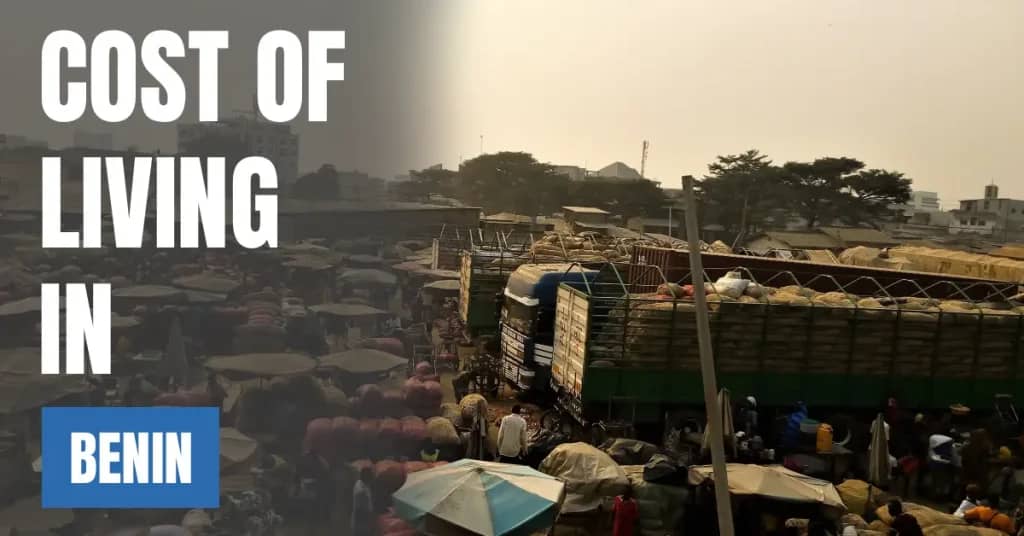
The cost of living in Benin remains relatively manageable for people who use local housing, markets and transport, but costs rise quickly for newcomers who want furnished accommodation, air conditioning, imported groceries, private healthcare or international schooling. Cotonou is generally the most expensive major urban market, while housing can be cheaper outside the economic capital.
On this pageTable of Content
For a single person renting modest accommodation, a practical monthly budget is roughly 190,000 to 320,000 FCFA on a tight local-style budget, or around 325,000 to 540,000 FCFA for a more comfortable lifestyle. A family of four may need around 805,000 to 1,360,000 FCFA per month before international school fees or full-time private childcare.
These figures should be treated as planning ranges rather than fixed national averages. Reliable consumer-price coverage for Benin is limited, and crowdsourced Cotonou datasets have relatively small samples. Housing, imported products, electricity consumption and schooling can create particularly large differences between households.
Cost of Living in Benin at a Glance
A modest renter can live on substantially less than an internationally oriented expatriate household. Rent, electricity, imported food, private education and personal transport are the main expenses capable of changing a monthly budget significantly.
| Expense | Typical 2026 Cost |
|---|---|
| 1-bedroom apartment in central Cotonou | About 65,000 to 150,000 FCFA per month |
| 1-bedroom outside central Cotonou | About 45,000 to 150,000 FCFA per month |
| 3-bedroom apartment in central Cotonou | About 250,000 to 400,000 FCFA per month |
| 3-bedroom outside central Cotonou | About 180,000 to 300,000 FCFA per month |
| Inexpensive restaurant meal | About 3,000 to 3,500 FCFA |
| Meal for two at a mid-range restaurant | About 15,000 to 25,000 FCFA |
| Basic apartment utilities | Often about 50,000 to 150,000 FCFA for a larger apartment, depending heavily on electricity use |
| Home internet | Roughly 15,000 to 35,000 FCFA for many practical plans |
| Zem motorcycle taxi | Often about 200 to 1,500 FCFA depending on distance and time |
| Minimum wage, SMIG | 52,000 FCFA per month |
How Much Does It Cost to Live in Benin Per Month?
A budget-conscious single renter may spend approximately 190,000 to 320,000 FCFA per month including rent. A more moderate single-person budget may reach 325,000 to 540,000 FCFA. Couples may spend approximately 530,000 to 860,000 FCFA, while a family of four can require about 805,000 to 1,360,000 FCFA before expensive private or international education.
The range is wide because Benin does not have one representative national consumer basket for expatriates. Someone renting outside central Cotonou, eating local foods and using motorcycle taxis may spend much less than someone living in a large air-conditioned home, driving a private vehicle and buying imported groceries.
Housing and Rent in Benin
Housing is one of the biggest variables in a Benin budget. Current crowdsourced Cotonou data places a one-bedroom apartment at roughly 65,000 to 150,000 FCFA per month in central areas and approximately 45,000 to 150,000 FCFA outside the centre.
A three-bedroom apartment is considerably more expensive. Recent Cotonou estimates indicate approximately 250,000 to 400,000 FCFA in central locations and around 180,000 to 300,000 FCFA outside the centre.
These ranges should not be interpreted as official rent statistics. Cotonou price databases have a limited number of contributors, while furnished properties aimed at expatriates can cost much more than locally marketed unfurnished housing.
Where Is Housing Most Expensive?
Cotonou generally has the strongest demand because it is Benin’s commercial centre and contains many international organisations, companies, services and diplomatic facilities. Desirable districts, furnished units, modern security, backup power and proximity to major employment areas can add substantially to rent.
Porto-Novo, Parakou and smaller towns can offer lower housing costs, although exact comparisons are difficult because current rental datasets outside Cotonou are limited.
Upfront Housing Costs
New residents should budget for more than the first month’s rent. Depending on the landlord and property, tenants may face deposits, advance rent, agency charges, utility setup, furniture, appliances, internet installation and backup-power equipment. These costs are not consistently captured by standard monthly cost-of-living databases.
Grocery Costs in Benin
Local staples and produce can be inexpensive, while imported food can substantially increase the grocery bill. Local markets are usually more economical than supermarkets catering to higher-income or expatriate customers.
| Food Item | Indicative Cost |
|---|---|
| Local rice, 1 kg | About 400 to 600 FCFA |
| Imported rice, 1 kg | About 500 to 800 FCFA |
| Beans, 1 kg | About 500 to 800 FCFA |
| Yam, 1 kg | About 200 to 500 FCFA |
| Fresh fish, 1 kg | About 1,000 to 2,500 FCFA |
| Beef, 1 kg | About 1,500 to 2,500 FCFA in local-market estimates |
| 30 eggs | About 1,800 to 2,200 FCFA |
| Tomatoes, 1 kg | About 300 to 800 FCFA at local markets, with seasonal variation |
| Vegetable oil, 1 litre | About 800 to 1,200 FCFA |
| UHT milk, 1 litre | About 700 to 900 FCFA in some local-market estimates |
Crowdsourced Cotonou supermarket-style prices can be considerably higher for some products. This explains why two sources may give very different figures for milk, rice, meat, tomatoes or bread. The shopping location and whether products are local or imported matter significantly.
Monthly Grocery Budget
A single person relying mainly on local food may reasonably budget around 70,000 to 150,000 FCFA per month. A couple may need around 180,000 to 260,000 FCFA, while a family of four could spend roughly 300,000 to 450,000 FCFA or more.
Imported dairy products, Western-style packaged food, specialty diets and frequent supermarket shopping can push spending considerably above these ranges.
Restaurants and Eating Out
Eating locally can be inexpensive, but formal restaurants and international-style cafés are much more costly. Recent Cotonou data puts a meal at an inexpensive restaurant at about 3,000 to 3,500 FCFA.
| Restaurant Expense | Indicative Cost |
|---|---|
| Inexpensive restaurant meal | 3,000 to 3,500 FCFA |
| Three-course meal for two | 15,000 to 25,000 FCFA |
| Fast-food style combo | About 5,000 to 6,000 FCFA |
| Cappuccino | About 2,000 to 5,000 FCFA |
| Soft drink | About 300 to 1,000 FCFA |
Street food and neighbourhood eateries can be cheaper than these formal restaurant estimates.
Utilities in Benin
Electricity can be a significant expense, especially for households using air conditioning. Benin’s electricity provider, SBEE, publishes residential tariffs based on consumption.
For postpaid low-voltage residential customers, the social tranche below 20 kWh is priced at 88 FCFA per kWh, plus a fixed charge. The standard tranche up to 250 kWh is 125 FCFA per kWh, while consumption above 250 kWh is charged at 148 FCFA per kWh. Prepaid low-voltage supply is listed at 125 FCFA per kWh, with the applicable fixed capacity charge.
As a result, a household using fans and basic appliances can spend far less than one running several air conditioners. Crowdsourced estimates for electricity, cooling, water and waste in an approximately 85-square-metre Cotonou apartment range from roughly 50,000 to 150,000 FCFA per month.
Water Costs
SONEB applies tiered water tariffs. The social consumption level is priced around 198 FCFA per cubic metre for the first 5 cubic metres over 30 days. Higher consumption bands rise to approximately 453 FCFA per cubic metre and 658 FCFA per cubic metre, subject to the applicable tax treatment and meter charges.
Water itself can therefore be inexpensive compared with electricity, but connection costs, storage tanks, pumping equipment or alternative water supply may add to household expenses in some properties.
Internet and Mobile Costs
Mobile internet is widely used in Benin, and actual spending depends heavily on data consumption. Moov Africa’s published offers show plans ranging from small daily bundles to larger monthly packages.
Examples include approximately 1,000 FCFA for 1.62 GB valid for seven days and around 2,500 FCFA for 4 GB valid for 15 days. Larger monthly internet offers can cost around 15,100 FCFA to 30,000 FCFA for different volume and speed combinations, with much higher-priced plans available for heavy users.
Crowdsourced Cotonou data places fixed home internet around 25,000 to 35,000 FCFA per month for common higher-speed connections. A household combining home internet and several mobile lines should therefore budget more.
Transportation Costs in Benin
There is no conventional metro or tram system in Cotonou, and motorcycle taxis, known as zemidjans or zems, remain an important form of everyday urban transport. A conventional monthly public-transport pass is therefore not a useful basis for estimating normal Cotonou transport costs.
Current 2026 local guides report short zem trips of roughly 200 to 350 FCFA, medium journeys around 400 to 600 FCFA, and longer trips across Cotonou around 800 to 1,500 FCFA. Night journeys may cost more.
App-based motorcycle and car services are also available, while traditional taxis and private drivers provide alternatives. Someone making several zem trips each working day might spend around 15,000 to 40,000 FCFA per month, although commuting distance can push this higher.
Fuel and Private Cars
Recent Cotonou consumer data has placed petrol around 680 to 725 FCFA per litre. Vehicle ownership adds insurance, servicing, repairs, registration-related expenses, parking and depreciation. Imported vehicles and parts can also create substantial one-off costs.
Healthcare Costs and Health Insurance
Healthcare in Benin is not simply free for everyone. Public and private facilities coexist, while households still pay an important share of health expenses directly.
Benin is expanding compulsory health-insurance arrangements through the national social-protection framework. The National Agency for Social Protection states that qualifying non-vulnerable groups can subscribe to health insurance where they do not already have coverage for the basic package. Employers are required to cover at least 80% of the premium for the basic package for covered employees under the applicable scheme.
The World Health Organization reports that out-of-pocket spending accounted for about 42.5% of health expenditure in 2022, down from 57.94% in 2016. This indicates improving financial protection, but it also shows why households should maintain a medical reserve rather than assuming all treatment will be covered.
Private clinics, specialist care, diagnostics, medicines and treatment not covered by a basic insurance package may result in extra costs. New residents should verify exactly what an employer or private insurance policy covers before relying on a low monthly healthcare estimate.
Education and Childcare Costs
Public and private education costs differ dramatically. Benin law guarantees free public maternal and primary education, while additional household costs such as supplies, transport, uniforms and optional activities can still occur.
For the 2026-2027 school year, the government also introduced free tuition in public general and technical secondary education for girls nationwide. This is an important change that older cost-of-living guides may not reflect.
Private education is much more expensive. Recent Cotonou crowdsourced data estimates full-day private preschool at approximately 70,000 to 83,000 FCFA per month. International primary schooling has been reported at around 3,000,000 to 3,500,000 FCFA per year per child.
International school fees can therefore add roughly 250,000 to 292,000 FCFA per month per child when annual tuition is spread across twelve months, before enrolment charges, transport, meals, uniforms or activities.
Salaries in Benin
Salaries vary considerably between informal work, local companies, government positions and international employers. Cotonou crowdsourced data has recently estimated an average monthly net salary of around 150,000 FCFA, but this figure is based on limited reporting and should not be treated as an official national average.
What Is the Minimum Wage in Benin?
The official minimum interprofessional guaranteed wage, known as the SMIG, is 52,000 FCFA per month. The increase from 40,000 FCFA took effect on 1 January 2023. Government and labour sources continued to reference this 52,000 FCFA level in subsequent official documentation.
This matters for affordability. Even a modest independent rental budget can exceed several times the minimum wage. Households earning near the statutory minimum are therefore unlikely to follow expatriate-style budgets and may depend on shared housing, extended-family arrangements, informal transport and tightly controlled food spending.
What Salary Is Needed to Live Comfortably in Benin?
There is no official comfortable-salary threshold. For a single renter in Cotonou, approximately 325,000 to 540,000 FCFA net per month provides a more realistic moderate-budget range based on current housing and household-cost estimates.
A salary below this level can still support a local lifestyle, especially with inexpensive housing, but the budget becomes more sensitive to medical costs, electricity use, transport and unexpected expenses.
A couple may need roughly 530,000 to 860,000 FCFA for a moderate combined household budget. Families using international schools may require considerably more than one million FCFA per month.
Taxes and Take-Home Pay
Employees should compare gross salary offers with take-home pay rather than treating gross income as fully disposable. Benin applies progressive taxation to employment income.
The published tax schedule applies rates of 0% up to 60,000 FCFA, 10% from 60,001 to 150,000 FCFA, 15% from 150,001 to 250,000 FCFA, 19% from 250,001 to 500,000 FCFA, and 30% above 500,000 FCFA, subject to the tax code’s rules on the taxable base, exemptions and other applicable deductions or charges.
Individual tax situations can differ, so employees and expatriates should obtain current payroll or professional tax advice before calculating exact net income.
Sample Monthly Budgets for Benin
Budget-Conscious Single Person
This example assumes modest housing, mostly local groceries, regular zem transport and limited dining out.
| Expense | Estimated Monthly Cost |
|---|---|
| Rent | 60,000 to 100,000 FCFA |
| Utilities | 20,000 to 35,000 FCFA |
| Groceries | 70,000 to 100,000 FCFA |
| Transport | 15,000 to 30,000 FCFA |
| Internet and mobile | 12,000 to 20,000 FCFA |
| Healthcare reserve | 5,000 to 15,000 FCFA |
| Dining and leisure | 10,000 to 20,000 FCFA |
| Estimated Total Including Rent | 192,000 to 320,000 FCFA |
Moderate Single Person
This budget allows for better housing, more electricity use, stronger connectivity and more frequent restaurant spending.
| Expense | Estimated Monthly Cost |
|---|---|
| Rent | 100,000 to 150,000 FCFA |
| Utilities | 40,000 to 70,000 FCFA |
| Groceries | 100,000 to 150,000 FCFA |
| Transport | 25,000 to 50,000 FCFA |
| Internet and mobile | 20,000 to 35,000 FCFA |
| Healthcare reserve | 10,000 to 25,000 FCFA |
| Dining and leisure | 30,000 to 60,000 FCFA |
| Estimated Total Including Rent | 325,000 to 540,000 FCFA |
Couple
| Expense | Estimated Monthly Cost |
|---|---|
| Rent | 150,000 to 250,000 FCFA |
| Utilities | 60,000 to 100,000 FCFA |
| Groceries | 180,000 to 260,000 FCFA |
| Transport | 50,000 to 80,000 FCFA |
| Internet and mobile | 30,000 to 50,000 FCFA |
| Healthcare reserve | 20,000 to 40,000 FCFA |
| Dining and leisure | 40,000 to 80,000 FCFA |
| Estimated Total Including Rent | 530,000 to 860,000 FCFA |
Family of Four
This baseline family budget excludes international school tuition and full-time private childcare because those expenses vary too widely to combine meaningfully with ordinary household costs.
| Expense | Estimated Monthly Cost |
|---|---|
| Rent | 240,000 to 400,000 FCFA |
| Utilities | 80,000 to 150,000 FCFA |
| Groceries | 300,000 to 450,000 FCFA |
| Transport | 70,000 to 120,000 FCFA |
| Internet and mobile | 35,000 to 60,000 FCFA |
| Healthcare reserve | 30,000 to 80,000 FCFA |
| Dining and leisure | 50,000 to 100,000 FCFA |
| Estimated Total Including Rent | 805,000 to 1,360,000 FCFA |
If one child attends an international primary school, tuition alone can add the equivalent of roughly 250,000 to 292,000 FCFA per month. Families should therefore calculate schooling separately.
Cost Differences Between Cotonou and Other Areas
Cotonou generally has the widest selection of modern apartments, international products, private services and restaurants, which can make it more expensive than smaller cities. Porto-Novo, Parakou, Abomey, Natitingou and smaller communities may offer cheaper local housing and everyday services.
However, national comparisons should be approached carefully because current detailed price datasets are concentrated heavily in Cotonou. It would be misleading to publish precise city rankings without comparable samples.
How Does Benin Compare With Nearby Countries?
Reliable country-level comparison is limited because Benin itself is missing from some major 2026 African crowdsourced indexes. City data suggests that Cotonou housing can be relatively affordable for modest local apartments, but this does not prove that Benin is categorically cheaper than every neighbouring country.
For example, recent data for Lomé in neighbouring Togo reported a one-bedroom central apartment around 70,000 FCFA and an outside-centre apartment around 45,000 FCFA, while Cotonou estimates are generally higher. Certain restaurant prices in Lomé are also lower than current Cotonou figures.
Regional comparisons should therefore be made category by category rather than using broad claims such as “Benin is cheaper than Nigeria, Ghana or Senegal” without matching current datasets.
Costs New Residents Often Overlook
- Advance rent and deposits: Moving into a property may require substantial cash before the first month begins.
- Air conditioning: Frequent use can make electricity one of the largest recurring household expenses.
- Backup electricity: Depending on the property, batteries, generators or other backup solutions may add purchase and running costs.
- Imported groceries: International products can cost far more than local substitutes.
- Private healthcare: Consultations are only part of the cost. Medicines, laboratory tests, imaging and hospitalization can matter more.
- Private and international schools: Education can transform an otherwise moderate family budget.
- Vehicle costs: Insurance, fuel, maintenance, parts and repairs should be budgeted separately.
- Visa and residence fees: Immigration expenses are separate from the cost of everyday living.
- Furnishing: An inexpensive unfurnished apartment may require a considerable initial investment in furniture and appliances.
Cost of Living Versus Residency Financial Requirements
A monthly cost-of-living estimate is not the same as an immigration financial requirement. Benin’s 2026 residence rules require an applicant for an ordinary resident card to show employment, an income-generating activity, a promise of employment, sufficient means of subsistence, or a third-party guarantee of support.
The current rules do not specify one universal monthly income amount equivalent to the budgets in this guide. Applicants should therefore not assume that showing 300,000, 500,000 or any other monthly living-cost estimate automatically satisfies immigration requirements.
The Directorate of Emigration and Immigration lists the ordinary three-year resident-card fee at 50,000 FCFA for nationals of ECOWAS countries and 250,000 FCFA for non-ECOWAS nationals. Other categories have different fees and conditions.
These immigration charges are administrative costs and should not be included as ordinary monthly living expenses.
Is Benin Affordable for Expats and New Residents?
Benin can be affordable for people who are comfortable with local housing, local food and motorcycle-taxi transport. However, an expatriate lifestyle with modern furnished accommodation, substantial air-conditioning, a private car, imported groceries, private medical care and international education can cost several times more than a local budget.
The affordability gap is particularly clear when compared with the official 52,000 FCFA monthly minimum wage. Even low-cost independent rental budgets can be several times that figure.
Economic conditions have recently been comparatively stable at the headline level. World Bank data reports consumer-price inflation of approximately 1.1% in 2025, although food inflation was higher at about 3.4%. Low headline inflation does not mean every household expense stayed unchanged.
Practical Conclusion
A realistic 2026 budget for Benin depends much more on lifestyle than on any single national average. A budget-conscious single renter may manage on approximately 190,000 to 320,000 FCFA per month including rent. A moderate single renter may need around 325,000 to 540,000 FCFA. Couples may require approximately 530,000 to 860,000 FCFA, and a family of four may spend roughly 805,000 to 1,360,000 FCFA before international schooling.
Cotonou usually requires the largest housing budget. Electricity consumption, private schooling, imported goods and healthcare choices can be more important than small differences in grocery or transport prices.
Anyone planning a move should obtain current rental quotes in the intended neighbourhood, estimate electricity based on expected air-conditioning use, verify health-insurance coverage and calculate school fees separately. Those steps will produce a far more accurate budget than relying on a single generic cost-of-living figure.
Sources and Methodology
This guide was reviewed in September 2026. It prioritizes official Beninese government, labour, utility, immigration and social-protection information, supplemented by the World Health Organization, World Bank and current consumer-price databases. Crowdsourced Cotonou figures were compared with local market information where possible.
Rental and consumer prices can change rapidly. Cotonou crowdsourced datasets currently have a relatively small contributor base, so figures are presented as estimates and practical ranges rather than absolute national averages. Local-market prices and internationally oriented retail prices can differ substantially.
- Government of Benin and Secretariat-General of the Government, minimum wage and 2026 education policy updates.
- Benin Ministry of Labour and Public Service, SMIG information.
- Directorate of Emigration and Immigration, 2026 resident-card conditions and fees.
- National Agency for Social Protection, compulsory health-insurance information.
- SBEE, residential electricity tariffs.
- SONEB, official water tariffs.
- Moov Africa Benin, mobile and internet packages.
- Benin General Tax Code, employment-income tax brackets.
- World Health Organization, Benin health-financing and universal-health-coverage information.
- World Bank, Benin economic and inflation data.
- Numbeo, Cotonou consumer prices and rents, updated August 2026.
- Current local Benin market and transport guides, used as supplementary estimates where official consumer-price data was unavailable.
Frequently Asked Questions
How much does it cost to live in Benin per month?
A budget-conscious single renter may spend around 190,000 to 320,000 FCFA per month including rent. A more moderate single-person budget is roughly 325,000 to 540,000 FCFA. Actual spending depends heavily on housing, air-conditioning, imported food, transport and healthcare choices.
How much is rent in Cotonou in 2026?
A one-bedroom apartment in Cotonou is commonly estimated at around 65,000 to 150,000 FCFA per month in central areas and 45,000 to 150,000 FCFA outside the centre. Three-bedroom properties can range from roughly 180,000 to 400,000 FCFA depending on location and quality.
What salary is needed to live comfortably in Benin?
There is no official comfortable-salary threshold. For a single renter in Cotonou, approximately 325,000 to 540,000 FCFA net per month provides a practical moderate budget. A person using cheaper housing and local food can live on less, while an expatriate lifestyle can require substantially more.
What is the minimum wage in Benin in 2026?
Benin’s official minimum interprofessional guaranteed wage, the SMIG, is 52,000 FCFA per month. It increased from 40,000 FCFA effective 1 January 2023. This amount is well below the budget generally required for an independent expatriate-style household in Cotonou.
Is healthcare free in Benin?
No. Benin is expanding compulsory health-insurance coverage, but households still face direct healthcare spending. WHO reported that out-of-pocket payments represented about 42.5% of health expenditure in 2022. Insurance coverage, employer contributions and the services included in the basic package should be checked individually.
Is public transport free in Benin?
No. Cotonou relies heavily on paid motorcycle taxis known as zemidjans rather than a conventional free public-transit network. Short trips may cost about 200 to 350 FCFA, while longer journeys across the city can reach around 800 to 1,500 FCFA, with higher prices possible at night.
How much does a family of four need in Benin?
A family of four may need approximately 805,000 to 1,360,000 FCFA per month including rent but excluding international school tuition and full-time private childcare. International primary school alone can cost roughly 3,000,000 to 3,500,000 FCFA per child annually.
How expensive are groceries in Benin?
Local groceries can be affordable, especially rice, beans, yam, cassava, seasonal vegetables and locally sourced meat or fish. A single person might budget around 70,000 to 150,000 FCFA monthly. Imported food and supermarket shopping can push the total considerably higher.
Is Cotonou more expensive than other parts of Benin?
Cotonou generally has higher-demand housing and more internationally oriented services, so newcomers commonly face higher expenses there. Smaller cities can offer cheaper accommodation, but detailed current price data outside Cotonou is limited, so precise city-by-city cost rankings should be treated cautiously.
Does Benin require a specific monthly income for residency?
The 2026 residence rules require evidence of employment, income-generating activity, means of subsistence or third-party financial support, but they do not establish one universal monthly income figure matching cost-of-living budgets. Immigration eligibility and everyday living expenses should therefore be calculated separately.
Join the conversation
Have thoughts on this topic? Share them with others.
Ask questions, share experience, and learn from the Visaboards Community.