
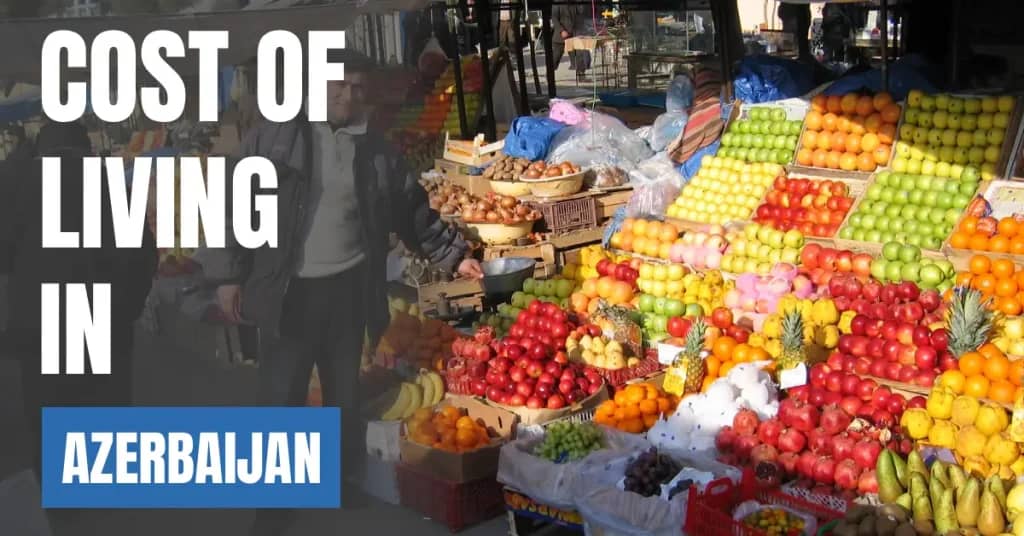
The cost of living in Azerbaijan in 2026 remains moderate by international standards, but calling the country simply “very cheap” can be misleading. Housing, especially in Baku, takes a large share of local income. Current nationwide market data place a one-bedroom apartment at about 733 AZN per month in a city centre and about 443 AZN outside the centre, while the official average monthly nominal salary reached 1,176.7 AZN in January to July 2026.
On this pageTable of Content
For practical planning, a budget-conscious single renter may need roughly 950 to 1,400 AZN per month including lower-cost housing, while a moderate single person living in Baku may need around 1,450 to 1,900 AZN. A couple can reasonably plan for around 1,900 to 2,600 AZN, while a family of four using public education may need approximately 2,500 to 3,500 AZN. Private childcare or international schooling can increase a family’s budget substantially.
Azerbaijan uses the Azerbaijani manat (AZN). On 9 September 2026, the Central Bank listed 1 US dollar at 1.7000 AZN. AZN is used as the primary currency throughout this guide because residents pay most everyday expenses in manat.
Also Explore: Cost of Living in AustriaCost of Living in Azerbaijan at a Glance
A single person’s everyday expenses excluding rent can often fall around 550 to 850 AZN per month, depending on food habits, transport, healthcare needs and leisure spending. Rent is the largest variable and can add roughly 250 to 1,000 AZN or more for a one-bedroom property, depending on city and location.
| Expense | Typical 2026 Cost | Notes |
|---|---|---|
| 1-bedroom apartment, city centre | 733 AZN/month average | Current nationwide range about 400 to 1,000 AZN |
| 1-bedroom apartment, outside centre | 443 AZN/month average | Current nationwide range about 250 to 700 AZN |
| 3-bedroom apartment, outside centre | 748 AZN/month average | Current nationwide range about 400 to 1,200 AZN |
| Basic utilities | 104 AZN/month average | For an apartment of roughly 85 square metres |
| Home internet | 26 AZN/month average | 60 Mbps or faster broadband |
| Mobile plan | 21 AZN/month average | Typical plan with calls and 10GB or more data |
| Inexpensive restaurant meal | 15 AZN | Typical nationwide market estimate |
| Meal for two, mid-range restaurant | 65 AZN | Three courses, excluding drinks |
| Local public transport trip | About 0.50 to 0.60 AZN | Baku Metro fare is officially 0.60 AZN |
| Private preschool | 470 AZN/month average | Current national range about 250 to 900 AZN per child |
| International primary school | 11,417 AZN/year average | Current national range about 8,000 to 20,000 AZN |
| Official average nominal salary | 1,176.7 AZN/month | January to July 2026, gross nominal average |
| Minimum monthly wage | 400 AZN | Current official 2026 social indicator |
Consumer-price estimates above use the current September 2026 Azerbaijan dataset from Numbeo, which contained 1,511 entries from 174 contributors in the previous 12 months. These figures are useful market estimates, not official regulated prices.
How Much Does It Cost to Live in Azerbaijan Per Month?
A practical 2026 budget is around 950 to 1,400 AZN per month for a budget-conscious single renter using cheaper housing, and around 1,450 to 1,900 AZN for a moderate single renter in Baku. Couples may need roughly 1,900 to 2,600 AZN, while a family of four using public schooling can reasonably plan for 2,500 to 3,500 AZN before major private education costs.
These totals include rent. Someone who already owns accommodation, lives with family or shares housing can spend substantially less. Without rent, a single person’s routine food, utilities, connectivity, transport, healthcare contingency and modest leisure spending can often be planned at around 550 to 850 AZN monthly.
Inflation also matters when using older Azerbaijan cost guides. The State Statistical Committee’s latest macroeconomic indicators show consumer-price inflation of 5.7 percent, while the Central Bank reported annual inflation of 5.8 percent for July 2026. Budgets based on early 2025 or early 2026 prices can therefore understate current spending.
Housing and Rent in Azerbaijan
Housing is the biggest affordability issue for many independent renters, particularly in Baku. Nationwide September 2026 market estimates put a one-bedroom apartment at about 733 AZN in a city centre and 443 AZN outside central areas. A three-bedroom property averages roughly 1,434 AZN centrally and 748 AZN outside the centre.
| Property Type | Average Monthly Rent | Reported Range |
|---|---|---|
| 1-bedroom, city centre | 733 AZN | 400 to 1,000 AZN |
| 1-bedroom, outside centre | 443 AZN | 250 to 700 AZN |
| 3-bedroom, city centre | 1,434 AZN | 600 to 2,000 AZN |
| 3-bedroom, outside centre | 748 AZN | 400 to 1,200 AZN |
Baku is more expensive than the national average. A June 2026 Baku sample placed a one-bedroom apartment at about 909 AZN in the centre and 539 AZN outside it. Three-bedroom properties averaged approximately 1,750 AZN centrally and 921 AZN outside the centre. The sample contained 1,233 entries from 143 contributors.
For anyone earning a local salary, this distinction matters. Living alone in a central Baku apartment can consume much of one salary. Sharing accommodation, living outside central districts or choosing a regional city can reduce monthly costs considerably.
Grocery Costs in Azerbaijan
A single adult cooking mostly at home can reasonably budget around 250 to 350 AZN per month for groceries, with higher spending for imported goods, premium meat, convenience food or specialised diets. Numbeo’s food model estimated a minimum of about 9.51 AZN per day for a 2,400-calorie Western-style food basket, equivalent to roughly 295 AZN over 31 days.
| Grocery Item | Approximate Current Price |
|---|---|
| Milk, 1 litre | 2.45 AZN |
| Fresh white bread, about 454 g | 0.71 AZN |
| Rice, 1 kg | About 3.59 AZN |
| Eggs, 12 | 2.92 AZN |
| Chicken fillets, 1 kg | About 7.85 AZN |
| Beef, 1 kg | About 18.20 AZN |
| Apples, 1 kg | About 1.94 AZN |
| Tomatoes, 1 kg | About 2.78 AZN |
| Potatoes, 1 kg | About 1.15 AZN |
| Bottled water, about 1.5 litres | About 1.10 AZN |
Local produce and staple foods remain relatively inexpensive, while imported packaged food can raise the bill. Families that cook regularly can usually control food spending much more easily than households that rely heavily on restaurants or delivery.
Restaurants and Eating Out
Restaurant prices remain accessible for many foreign earners, although regular dining can become significant relative to local wages. Current national data put an inexpensive restaurant meal at about 15 AZN, a fast-food combo at about 13 AZN and a three-course mid-range meal for two at around 65 AZN.
A regular cappuccino averages roughly 5.43 AZN. A person eating out several times each week should therefore allow an additional 150 to 300 AZN or more each month, depending on restaurant choice and delivery use.
Utilities
Basic electricity, heating, cooling, water and waste charges for an apartment of about 85 square metres average around 104 AZN per month, with a current reported range of approximately 60 to 170 AZN. Actual bills depend on property size, insulation, household size and seasonal heating or air-conditioning use.
Utility costs should not be treated as a fixed monthly figure. Baku summers can increase electricity use through air conditioning, while winter heating requirements can change the household energy mix.
Internet and Mobile Costs
Home internet is relatively inexpensive. Current nationwide market data show broadband of at least 60 Mbps at around 26 AZN per month, typically within a 25 to 40 AZN range. A mobile plan with calls and at least 10GB of data averages about 21 AZN, with reported plans generally ranging from 12 to 27 AZN.
A single person can therefore budget about 40 to 55 AZN monthly for home internet and mobile service combined, depending on provider and package.
Transportation Costs in Azerbaijan
Public transport is inexpensive, but older guides showing metro fares of 0.20 to 0.40 AZN are outdated. The official Baku Metro fare increased to 0.60 AZN per trip from 1 October 2025. Modern-standard city, inter-settlement and suburban buses that meet specified requirements and use exclusively cashless payments have a minimum fare of 0.60 AZN, with some fares varying by distance.
The fare change initially applied to qualifying routes rather than every bus in the network, so passengers can still encounter route-dependent pricing. Current nationwide market data report a typical local trip at about 0.50 to 0.60 AZN and estimated monthly public-transport spending of around 25 to 45 AZN.
| Transport Expense | Typical Cost |
|---|---|
| Baku Metro, one trip | 0.60 AZN |
| Typical local transport trip | 0.50 to 0.60 AZN |
| Monthly public transport estimate | 25 to 45 AZN |
| Taxi starting fare | About 3 AZN |
| Gasoline, 1 litre | About 1.12 AZN |
Healthcare in Azerbaijan
Healthcare is not simply a fixed “doctor visit” expense. Azerbaijan operates a nationwide mandatory health insurance system, and eligible insured people can receive services included in the official Services Package through participating public facilities and, where applicable, referred private providers.
Foreigners should not assume they automatically receive the same coverage as citizens. The State Agency for Mandatory Health Insurance states that foreigners who are temporarily staying, temporarily resident or permanently resident and who pay mandatory health-insurance contributions can use the scheme with the appropriate residence permit card. Foreigners earning official Azerbaijan-source income can be subject to mandatory health-insurance contributions.
Directly visiting a contracted private medical facility without the required referral can mean paying the full cost yourself. Certain outpatient MRI and CT examinations also involve 20 percent co-financing. Private insurance, dental care, medicines outside covered circumstances and services outside the package should therefore be considered separately.
There is also an important 2026 payroll update. The health-insurance agency FAQ, last updated in June 2025, still shows the previous 8,000 AZN threshold in one contribution explanation. The State Tax Service’s newer 2026 rules state that employees and employers in the private non-oil and gas sector each contribute 2 percent on the portion of monthly salary up to 2,500 AZN and 0.5 percent on the portion above 2,500 AZN. For 2026 payroll calculations, the newer tax guidance is the more current reference.
Education and Childcare
General education at state educational institutions is free under Azerbaijan’s Education Law. Families considering public schools should still investigate local enrolment procedures, teaching language, catchment availability, uniforms, activities and other school-related costs.
The financial picture changes significantly for families choosing private or international education. Nationwide September 2026 market data put private full-day preschool at about 470 AZN per month on average, with a broad reported range of 250 to 900 AZN. International primary-school tuition averages about 11,417 AZN annually, with a reported range from approximately 8,000 to 20,000 AZN per child.
This means international schooling can add roughly 667 to 1,667 AZN per month per child when annual tuition is spread across 12 months. Families should therefore calculate school costs separately rather than assuming a general family budget automatically includes private education.
Salaries and Minimum Wage in Azerbaijan
The official average monthly nominal salary in Azerbaijan was 1,176.7 AZN for January to July 2026, up 7.2 percent year on year. This is a gross nominal statistic and should not be confused with take-home pay.
The current official minimum monthly wage is 400 AZN. Azerbaijan’s 2026 social indicators also set the national subsistence minimum at 300 AZN, including 317 AZN for the working-age population, 245 AZN for pensioners and 260 AZN for children.
Market-reported after-tax salary data are lower than the official gross salary figure. Numbeo’s 10 September 2026 Azerbaijan sample reports an average net salary of about 734 AZN. The two figures should not be treated as contradictory because one is an official gross national measure while the other is a crowdsourced after-tax estimate drawn from a smaller sample.
What Salary Is Needed to Live Comfortably in Azerbaijan?
A practical target for a single renter is around 1,500 to 2,000 AZN net per month for a moderate lifestyle in Baku. Someone living outside central Baku, sharing accommodation or living in a regional city may manage reasonably on approximately 1,100 to 1,400 AZN. A couple may prefer combined net income of roughly 2,200 to 2,800 AZN, while a family of four using public schools may want about 3,000 to 3,800 AZN or more.
These are planning estimates rather than official salary thresholds. The 400 AZN minimum wage is below the current average cost of a one-bedroom rental outside a city centre, so independently renting and covering all normal expenses on minimum wage alone is generally unrealistic without shared, family-owned or otherwise subsidised housing.
Taxes and Payroll Deductions
Take-home salary depends on employment sector and mandatory contributions. From 1 January 2026 to 1 January 2027, employees in Azerbaijan’s private non-oil and gas sector face income tax of 3 percent on taxable monthly income up to 2,500 AZN. The rate is 75 AZN plus 10 percent of the amount between 2,500 and 8,000 AZN, and 625 AZN plus 14 percent of income above 8,000 AZN.
For a main place of employment, the existing 200 AZN income-tax exemption continues where monthly income does not exceed 2,500 AZN. Employees can also have social insurance, mandatory health insurance and unemployment insurance deducted. The unemployment-insurance employee contribution is 0.5 percent, with another 0.5 percent paid by the employer.
Because payroll rules vary by sector and employment structure, people comparing a job offer with living costs should use net expected pay rather than the headline gross salary.
Realistic Monthly Budgets for Azerbaijan
The following budgets are planning examples built from current rent, utilities, grocery, transport, internet, childcare and consumer-price evidence. They are not official government household budgets. The family example assumes public education and does not include international-school tuition.
| Expense | Budget Single | Moderate Single | Couple | Family of Four |
|---|---|---|---|---|
| Rent | 400 AZN | 750 AZN | 900 AZN | 900 AZN |
| Utilities | 80 AZN | 110 AZN | 120 AZN | 150 AZN |
| Groceries | 275 AZN | 340 AZN | 550 AZN | 900 AZN |
| Transport | 35 AZN | 45 AZN | 90 AZN | 140 AZN |
| Internet and mobile | 45 AZN | 50 AZN | 70 AZN | 95 AZN |
| Healthcare or insurance contingency | 40 AZN | 75 AZN | 120 AZN | 200 AZN |
| Dining, leisure and household extras | 100 AZN | 200 AZN | 250 AZN | 350 AZN |
| Public-school related incidentals | 0 AZN | 0 AZN | 0 AZN | 100 AZN |
| Estimated Total | 975 AZN | 1,570 AZN | 2,100 AZN | 2,835 AZN |
The budget-conscious single example assumes lower-cost accommodation rather than a prime central Baku apartment. The moderate single and couple examples assume a larger housing allowance. The family budget uses public schooling. One international-school child can add roughly 8,000 to 20,000 AZN per year based on current market data.
Cost Differences Between Baku and Other Cities
Baku is generally the most expensive housing market for renters. In the June 2026 Baku sample, a one-bedroom central apartment averaged about 909 AZN and one outside the centre about 539 AZN. By comparison, May 2026 data for Sumqayit placed the same categories at approximately 550 AZN and 413 AZN.
| Location | 1-Bedroom Centre | 1-Bedroom Outside Centre | 3-Bedroom Outside Centre |
|---|---|---|---|
| Baku, June 2026 sample | 909 AZN | 539 AZN | 921 AZN |
| Azerbaijan, September 2026 national sample | 733 AZN | 443 AZN | 748 AZN |
| Sumqayit, May 2026 sample | 550 AZN | 413 AZN | 600 AZN |
Sumqayit data should be treated cautiously because its sample contained only 86 entries from 11 contributors. Reliable current consumer-price samples for smaller Azerbaijani cities are limited, so precise city-by-city budgets outside Baku should be confirmed with current local rental listings before moving.
How Does Azerbaijan Compare With Nearby Countries?
Azerbaijan is competitive on some everyday costs, but affordability also depends on local earnings. Mid-2026 Numbeo comparisons showed Azerbaijan’s nationwide one-bedroom city-centre rent about 12.6 percent below Georgia’s equivalent, while outside-centre one-bedroom rent was about 21.3 percent lower. However, Azerbaijan’s reported average net salary was also about 19 percent lower in the same comparison.
Against Armenia, inexpensive and mid-range restaurant meals in the comparison were about 23 percent more expensive in Armenia, but Armenia’s reported net salary was substantially higher. Against Turkey, inexpensive restaurant meals were almost the same price, while a mid-range meal for two was about 22.6 percent more expensive in Turkey.
The practical conclusion is that Azerbaijan can look inexpensive to someone earning a foreign salary, but the same prices can feel much less affordable to a household relying entirely on local wages.
Costs New Residents Often Overlook
- Rental setup costs: Deposits, agency charges and initial household purchases can make the first month much more expensive than a normal month.
- Seasonal energy use: Air conditioning and heating can move utility bills away from annual averages.
- Private healthcare: Direct private treatment without the required insurance referral can be paid fully out of pocket.
- Dental and uncovered treatment: Not every service is included in mandatory health-insurance coverage.
- International education: Tuition can exceed ordinary rent and grocery spending for a family.
- Imported products: Imported food, electronics, clothing and speciality products can cost noticeably more than local alternatives.
- Residence administration: Permit fees, document translation, notarisation and related formalities are separate from normal monthly living expenses.
- Commuting trade-offs: Cheaper accommodation farther from central Baku can reduce rent but increase travel time and taxi use.
Cost of Living Versus Azerbaijan Residency Financial Requirements
Monthly living expenses should not be confused with Azerbaijan’s immigration financial requirements. The State Migration Service requires permanent-residence applicants, unless an exception applies, to provide evidence of sufficient funds to meet their own minimum needs and those of accompanying family members. Its public permanent-residence checklist does not provide one universal monthly cost-of-living figure that can simply be substituted for this requirement.
Some residence routes also have specific asset or investment thresholds. Current State Migration Service information lists temporary-residence grounds that include investing at least 500,000 AZN in the economy, owning qualifying real estate worth at least 100,000 AZN, or placing at least 100,000 AZN in a qualifying fixed-term bank deposit. Permanent-residence investment and asset grounds can use higher thresholds, including 200,000 AZN for certain property, bank deposit or securities routes.
These figures are immigration eligibility thresholds for particular legal routes, not estimates of what a person needs to spend each month. Applicants should check the State Migration Service’s current rules for their exact residence basis before making financial decisions.
Is Azerbaijan Affordable for Expats and New Residents?
Azerbaijan can be affordable for expats paid in stronger foreign currencies, remote workers and households with above-average local income. Public transport, internet and many local foods are relatively inexpensive. Housing is the main expense that can change the picture, especially for someone wanting a modern apartment in central Baku.
Affordability is more difficult at the bottom of the local wage scale. The official minimum wage is 400 AZN, while current nationwide market rent for a one-bedroom apartment outside a city centre averages about 443 AZN. Even before food, utilities or transport, independent market-rate housing can therefore exceed a minimum-wage worker’s monthly earnings.
Conclusion
A realistic 2026 cost-of-living estimate for Azerbaijan is about 950 to 1,400 AZN per month for a budget-conscious single renter, around 1,450 to 1,900 AZN for a moderate single person in Baku, 1,900 to 2,600 AZN for a couple and roughly 2,500 to 3,500 AZN for a family of four using public education.
Baku housing deserves the most attention when planning a move. Public transport and connectivity remain inexpensive, but rent, private healthcare choices and international education can quickly raise the total. Anyone moving for employment should compare expenses with expected net salary rather than gross salary, while residence-permit financial rules should be assessed separately from ordinary household costs.
Sources and Methodology
This guide was reviewed on 10 September 2026. Government and public-authority sources were prioritised for salaries, minimum wage, inflation, exchange rates, taxation, transport fares, healthcare, education and immigration rules. Current consumer and rental estimates were cross-checked against Numbeo data.
Consumer prices and rents can change quickly. Numbeo is crowdsourced, so its figures should be treated as market estimates rather than fixed official prices. Its Azerbaijan dataset was updated on 10 September 2026 and contained 1,511 entries from 174 contributors. Baku and Sumqayit city samples were older and, particularly for Sumqayit, smaller. Where official gross salary and crowdsourced net salary figures differ, this article keeps them separate rather than treating them as directly comparable.
- State Statistical Committee of Azerbaijan, Monthly Macroeconomic Indicators
- Ministry of Labour and Social Protection, 2026 Social Indicators
- President of Azerbaijan, Minimum Wage Decree
- Central Bank of Azerbaijan
- Ministry of Digital Development and Transport, Public Transport Fare Update
- State Agency for Mandatory Health Insurance, Frequently Asked Questions
- Ministry of Science and Education, Education Law
- State Tax Service, 2026 Income Tax and Health Insurance Changes
- State Migration Service, Residence Information
- State Migration Service, Residence Questions and Answers
- Numbeo, Cost of Living in Azerbaijan
- Numbeo, Cost of Living in Baku
- Numbeo, Cost of Living in Sumqayit
Frequently Asked Questions
How much does it cost to live in Azerbaijan per month?
A budget-conscious single renter may need about 950 to 1,400 AZN per month including cheaper housing, while a moderate single renter in Baku may need around 1,450 to 1,900 AZN. A couple can plan for roughly 1,900 to 2,600 AZN. A family of four using public education may need approximately 2,500 to 3,500 AZN, excluding major private-school costs.
How much is rent in Baku in 2026?
June 2026 market data placed a one-bedroom apartment in central Baku at about 909 AZN per month on average, with an outside-centre apartment around 539 AZN. A three-bedroom apartment averaged about 1,750 AZN in the centre and 921 AZN outside it. Actual rent varies considerably by district, building age, condition, furnishing and proximity to central areas.
What salary is enough to live comfortably in Azerbaijan?
For a moderate single lifestyle in Baku, around 1,500 to 2,000 AZN net per month is a reasonable planning target. Someone living more cheaply outside central Baku may manage on roughly 1,100 to 1,400 AZN. Couples may prefer combined net income of about 2,200 to 2,800 AZN, while families usually need more, particularly when paying for private education.
What is the minimum wage in Azerbaijan in 2026?
The official minimum monthly wage in Azerbaijan is 400 AZN in 2026. The official average monthly nominal salary was much higher at 1,176.7 AZN for January to July 2026. Because average market rent for even a one-bedroom apartment outside a city centre can exceed 400 AZN, living independently on the minimum wage alone is difficult without shared or subsidised housing.
Is healthcare free in Azerbaijan for foreigners?
Not automatically for every foreigner. Foreigners who are temporarily staying, temporarily resident or permanently resident and who pay mandatory health-insurance contributions can access eligible services under the system using the appropriate residence permit. Foreigners earning official Azerbaijan-source income may pay contributions. Tourists and uninsured residents should not assume full coverage, and private treatment without the required referral can be paid out of pocket.
How much does public transport cost in Baku?
A single Baku Metro journey costs 0.60 AZN following the fare change effective from 1 October 2025. Qualifying modern-standard cashless bus routes also have a minimum fare of 0.60 AZN, although bus prices can vary by route and distance. Current market data place typical monthly public-transport spending at about 25 to 45 AZN for regular users.
How much does a family of four need in Azerbaijan?
A family of four using public schooling can reasonably plan for around 2,500 to 3,500 AZN per month including rent, groceries, utilities, transport and routine household expenses. Private education changes the calculation considerably. Current international primary-school fees are reported at roughly 8,000 to 20,000 AZN per child annually, while private preschool can cost around 250 to 900 AZN per month.
How much do groceries cost in Azerbaijan?
A single adult who mainly cooks at home can reasonably budget about 250 to 350 AZN per month for groceries. Current prices include roughly 2.45 AZN for a litre of milk, 2.92 AZN for 12 eggs, about 7.85 AZN per kilogram of chicken and around 18.20 AZN per kilogram of beef. Imported and speciality products can increase the total.
Is Azerbaijan cheaper than Georgia?
Azerbaijan is cheaper in some important categories but not universally. Mid-2026 comparison data put a nationwide one-bedroom city-centre apartment in Azerbaijan about 12.6 percent below Georgia’s equivalent and an outside-centre apartment about 21.3 percent lower. However, Azerbaijan’s reported average net salary was also lower, so lower prices do not automatically mean stronger affordability for someone earning a local salary.
What financial proof is needed for Azerbaijan residence permits?
Financial requirements depend on the residence route. Permanent-residence applicants may need evidence of sufficient funds to meet their own minimum needs and those of accompanying family members unless an exception applies. Some temporary-residence routes use specific thresholds, such as qualifying property or bank deposits of at least 100,000 AZN or investment of at least 500,000 AZN. These are immigration requirements, not monthly living-cost estimates.
Join the conversation
Have thoughts on this topic? Share them with others.
Ask questions, share experience, and learn from the Visaboards Community.