
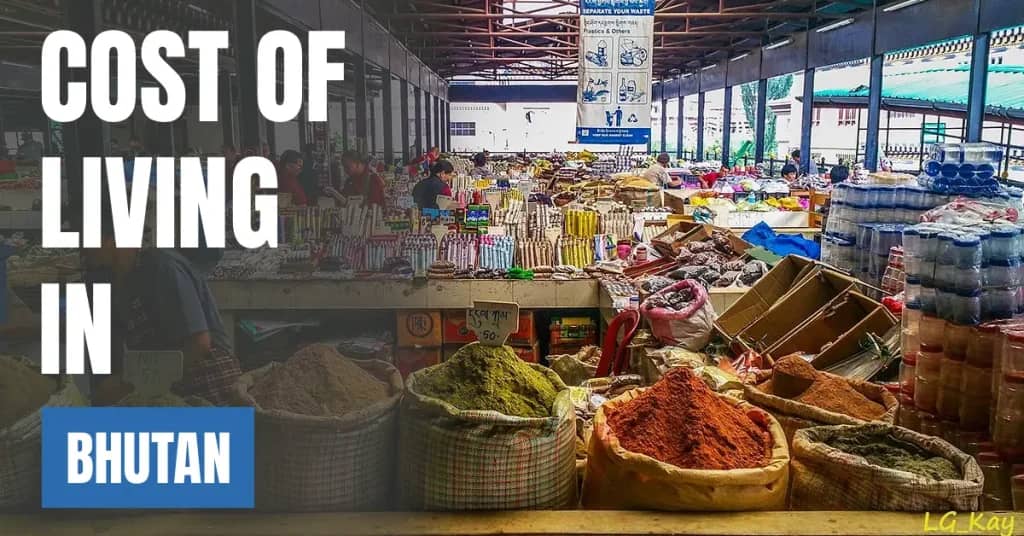
The cost of living in Bhutan in 2026 can be relatively affordable for people earning an international salary, but affordability is very different for households relying on local wages. Official household data show mean monthly consumption expenditure of Nu. 54,387 per household nationwide and Nu. 67,616 for urban households. On a per-person basis, average spending was Nu. 17,434 nationally and Nu. 22,168 in urban areas. These figures are based on 2024 expenditure collected in Bhutan’s 2025 Household Consumption and Expenditure Survey. :chatgpt-content-reference{index=”0″}
On this pageTable of Content
Prices are also rising. Bhutan’s National Statistics Bureau reported food inflation of 5.66% and non-food inflation of 8.16% in July 2026, so older cost estimates can understate what residents currently pay. Housing, transport, imported products and communications can have a particularly noticeable effect on urban budgets. :chatgpt-content-reference{index=”1″}
Bhutan uses the Bhutanese ngultrum (Nu. or BTN). The Royal Monetary Authority maintains the ngultrum at parity with the Indian rupee, meaning Nu. 1 equals INR 1 under the official peg. :chatgpt-content-reference{index=”2″}
Cost of Living in Bhutan at a Glance
A practical 2026 budget for a single renter may range from roughly Nu. 25,000 to Nu. 55,000 per month including rent, depending on location, housing quality, transport and lifestyle. Couples and families should budget more, particularly when renting larger homes, using taxis frequently, buying imported food or paying for private or international education.
| Expense | Typical 2026 Estimate |
|---|---|
| 1-bedroom apartment | About Nu. 7,500 to Nu. 19,000 per month |
| 3-bedroom apartment | About Nu. 9,500 to Nu. 24,000+, with wider variation in some markets |
| Groceries, single person | About Nu. 7,000 to Nu. 12,000 per month |
| Inexpensive restaurant meal | About Nu. 250 |
| Meal for two at a mid-range restaurant | About Nu. 1,350 |
| Basic household utilities | About Nu. 2,000 to Nu. 3,500+ per month |
| Home internet | About Nu. 1,000 to Nu. 3,300 per month in current market datasets |
| Official urban taxi rate | About Nu. 25.81 per km for a 5 to 6 seat vehicle under the latest 2026 revision |
| Average labour income | Nu. 26,196 per month in Q1 2026 |
| Median labour income | Nu. 20,000 per month in Q1 2026 |
Consumer price estimates should be treated as ranges rather than fixed tariffs. Numbeo’s Bhutan dataset had only 58 entries from five contributors during the 12 months preceding its May 2026 update, so individual rents, utility bills and retail prices can vary substantially. :chatgpt-content-reference{index=”3″}
How Much Does It Cost to Live in Bhutan Per Month?
A budget-conscious single renter may be able to live on approximately Nu. 25,000 to Nu. 35,000 per month including modest housing. A more comfortable urban lifestyle may require about Nu. 38,000 to Nu. 55,000 or more. A couple may reasonably plan for Nu. 50,000 to Nu. 75,000, while a family of four could spend roughly Nu. 75,000 to Nu. 110,000 or considerably more if private schooling, frequent travel or premium housing is included.
Official data provide useful context. Bhutan’s 2025 household expenditure survey found mean household spending of Nu. 54,387 nationally. Urban households averaged Nu. 67,616, compared with Nu. 46,331 in rural areas. The survey also found that urban per-capita consumption was more than Nu. 22,000 per month. :chatgpt-content-reference{index=”4″}
These official figures represent Bhutanese household consumption rather than a dedicated expatriate budget. Foreign residents may face different spending patterns, especially for furnished accommodation, imported food, international travel and private education.
Housing and Rent in Bhutan
Rent is usually one of the largest expenses for someone relocating to Bhutan, especially in Thimphu. Current crowdsourced data place a one-bedroom apartment at roughly Nu. 8,000 to Nu. 12,000 on average, with individual listings ranging from about Nu. 5,500 to Nu. 19,000 depending on location. A three-bedroom home commonly costs approximately Nu. 14,000 to Nu. 18,000 on average, although available units can be substantially more expensive. :chatgpt-content-reference{index=”5″}
Rent in Thimphu
Thimphu generally has the strongest housing demand. Numbeo data updated in May 2026 estimated a one-bedroom apartment at approximately Nu. 12,258 in the city centre and Nu. 8,307 outside the centre. A three-bedroom apartment averaged about Nu. 18,352 in the centre and Nu. 14,986 outside it. The Thimphu sample contained only 27 entries from six contributors, so these figures should be treated as market indicators rather than guaranteed rents. :chatgpt-content-reference{index=”6″}
Official household data also support the conclusion that Thimphu is a higher-cost location. Average household consumption expenditure in Thimphu reached Nu. 73,632 per month, the highest among Bhutan’s dzongkhags in the 2025 household survey. :chatgpt-content-reference{index=”7″}
Urban and Rural Housing Differences
Housing conditions differ significantly between urban and rural Bhutan. About 66.9% of urban households lived in apartments, while standalone houses were much more common in rural areas. Home ownership was 75.8% among rural households but only 16% among urban households. :chatgpt-content-reference{index=”8″}
New residents should therefore avoid assuming that a national average accurately represents Thimphu, Paro or another specific town.
Groceries and Food Costs in Bhutan
Food remains a major part of household spending. Bhutan’s official household survey found that food represented 40.5% of average consumption expenditure, equal to about Nu. 7,069 per person per month nationally. Urban food expenditure averaged Nu. 9,126 per person, while rural expenditure averaged Nu. 5,816. :chatgpt-content-reference{index=”9″}
For a single urban resident buying most food rather than producing it at home, a practical grocery budget of approximately Nu. 7,000 to Nu. 12,000 per month is reasonable. Imported products and specialty food can increase that amount substantially.
| Grocery Item | Approximate Price |
|---|---|
| Milk, 1 litre | Nu. 72 |
| White bread, 500 g | Nu. 64 |
| Rice, 1 kg | Nu. 71 |
| Eggs, 12 | Nu. 164 |
| Chicken fillets, 1 kg | Nu. 348 |
| Local cheese, 1 kg | Nu. 287 |
| Potatoes, 1 kg | Nu. 54 |
| Tomatoes, 1 kg | Nu. 86 |
| Apples, 1 kg | Nu. 240 |
| Bottled water, 1.5 litres | Nu. 31 |
The table uses May 2026 crowdsourced market averages and should be read alongside official inflation data because retail prices can change quickly. :chatgpt-content-reference{index=”10″}
Restaurants and Eating Out
Eating at local restaurants is generally inexpensive compared with many international destinations. A basic restaurant meal averages around Nu. 250, while a three-course meal for two at a mid-range restaurant is approximately Nu. 1,350. A regular cappuccino is around Nu. 130. :chatgpt-content-reference{index=”11″}
Residents eating local food can therefore dine out regularly without creating an extremely large budget. Imported cuisine, hotel restaurants and premium dining establishments can cost considerably more.
Utilities in Bhutan
Household utilities are relatively moderate for many apartments, although bills depend on property size and energy use. Current market data estimate approximately Nu. 3,309 per month for electricity, heating or cooling, water and waste services for an 85 square metre apartment. :chatgpt-content-reference{index=”12″}
Bhutan’s official household expenditure data show that housing, utilities and fuel form one of the largest non-food spending categories, particularly for households outside the highest expenditure group. :chatgpt-content-reference{index=”13″}
Internet and Mobile Costs
Internet and communication expenses can be more significant than newcomers expect. Crowdsourced 2026 estimates put home broadband around Nu. 1,000 to Nu. 3,300 per month, depending on plan and provider. Current datasets for mobile service show unusually wide ranges, so checking Bhutan Telecom and TashiCell directly before selecting a plan is more reliable than relying on a single national average. :chatgpt-content-reference{index=”14″}
Transportation Costs in Bhutan
Public transport and shared taxis can keep transport expenses low, but fares vary according to distance, vehicle type and whether the ride is shared or reserved. Bhutan’s transport regulator reviewed bus and taxi fares again in 2026. :chatgpt-content-reference{index=”15″}
Under the latest fare information reported in September 2026, a 5 to 6 seat taxi is officially priced at about Nu. 25.81 per kilometre for the whole vehicle within a city and Nu. 23.31 per kilometre between districts. When passengers share a taxi, the fare should be divided between them. :chatgpt-content-reference{index=”16″}
Actual taxi charges can differ from regulated rates. Recent reports from Thimphu and Samtse documented cases where passengers said drivers charged lump-sum fares above official distance-based rates. New residents should therefore confirm the fare before departure. :chatgpt-content-reference{index=”17″}
Healthcare in Bhutan
Bhutan operates a predominantly government-financed healthcare system. Its Constitution requires the state to provide free access to basic public health services in modern and traditional medicine, and the Ministry of Health describes free healthcare as a central national commitment. :chatgpt-content-reference{index=”18″}
Bhutan’s healthcare system operates through primary facilities, district and general hospitals, and referral hospitals. Private healthcare participation remains limited compared with many countries. :chatgpt-content-reference{index=”19″}
Is Healthcare Free for Foreigners in Bhutan?
Foreign residents and tourists should not assume that every medical service will be free simply because Bhutan has a publicly funded healthcare system. Bhutanese citizens receive extensive state-supported services, but foreign visitors may face medical, evacuation or other charges depending on their status and treatment. For example, current Australian travel advice specifically warns tourists that they may need to pay for healthcare and evacuation. :chatgpt-content-reference{index=”20″}
Foreign residents should therefore confirm their healthcare entitlement with their employer, educational institution or immigration sponsor and maintain suitable medical or travel insurance where appropriate.
Education and Childcare
Bhutan has a large public education system. As of August 2026, the Ministry of Education and Skills Development reported 517 public schools and 30 private schools, serving more than 146,000 students in public institutions and about 8,500 in private institutions. :chatgpt-content-reference{index=”21″}
Foreign families should check admission eligibility and fees directly with individual schools. Private and international education can materially change a family’s monthly budget, and nationwide crowdsourced tuition estimates are based on very limited observations.
Bhutan also expanded its international education options in 2026. The Ministry of Education announced that EtonHouse Bhutan International School in Thimphu would begin operating in August 2026, initially serving nursery through primary levels before developing a broader K-12 pathway. :chatgpt-content-reference{index=”22″}
Salaries in Bhutan
The average monthly labour income in Bhutan was Nu. 26,196 in the first quarter of 2026, while the median was Nu. 20,000. The median is particularly important because it means half of employed people reported labour income below Nu. 20,000. :chatgpt-content-reference{index=”23″}
Urban earnings were higher. In Q1 2026, mean labour income was Nu. 33,179 in urban areas and Nu. 20,822 in rural areas. Male workers averaged Nu. 28,752 nationally, while female workers averaged Nu. 21,637. :chatgpt-content-reference{index=”24″}
The 2025 annual labour survey showed a similar pattern. Mean monthly income was Nu. 24,909 and median income was Nu. 20,000 nationally. Urban workers averaged Nu. 30,708, compared with Nu. 20,554 in rural areas. :chatgpt-content-reference{index=”25″}
What Is the Minimum Wage in Bhutan?
Bhutan’s national minimum wage remains very low compared with typical urban living costs. The Ministry of Industry, Commerce and Employment still publishes the Revised National Minimum Wage 2013 among its current labour regulations and guidance. WageIndicator lists the national minimum at Nu. 3,750 per month as valid in June 2026. :chatgpt-content-reference{index=”26″}
This national minimum wage should not be confused with the separate National Work Force wage rates used for certain Bhutanese workers employed directly by government agencies. For example, the revised government workforce schedule introduced an unskilled rate of Nu. 215 per day in 2015, but that schedule explicitly applies to specified government project employment rather than being the universal national minimum wage. :chatgpt-content-reference{index=”27″}
In practical terms, the statutory minimum wage is far below contemporary average urban expenditure, so it is not a useful benchmark for the income an independent renter would need to live comfortably in Thimphu.
Taxes and Everyday Affordability
Bhutan introduced a revised income tax structure through the Income Tax Act 2025. Taxable annual income up to Nu. 300,000 is taxed at 0%. Income from Nu. 300,000 to Nu. 500,000 is taxed at 5% on the portion above Nu. 300,000, followed by progressively higher rates for higher income brackets. :chatgpt-content-reference{index=”28″}
The reforms also changed tax deductions at source from January 2026 and were intended to increase take-home income for many taxpayers. :chatgpt-content-reference{index=”29″}
Foreign employees earning Bhutan-source income should obtain individual advice on their tax residence and filing obligations rather than assuming that the same treatment applies in every employment situation.
Realistic Monthly Budgets for Bhutan
The following budgets are planning estimates for 2026 rather than official minimum requirements. They combine current rent and market prices with official household expenditure patterns. Private school tuition, international travel, major medical expenses and vehicle purchases are excluded.
| Expense | Budget Single | Moderate Single | Couple | Family of Four |
|---|---|---|---|---|
| Rent | Nu. 8,000 | Nu. 12,000 | Nu. 15,000 | Nu. 20,000 |
| Utilities | Nu. 2,000 | Nu. 3,000 | Nu. 3,500 | Nu. 5,000 |
| Groceries | Nu. 7,000 | Nu. 10,000 | Nu. 16,000 | Nu. 25,000 |
| Transport | Nu. 2,000 | Nu. 4,000 | Nu. 6,000 | Nu. 10,000 |
| Internet and mobile | Nu. 2,000 | Nu. 3,000 | Nu. 4,000 | Nu. 5,000 |
| Healthcare or insurance | Nu. 1,000 | Nu. 1,500 | Nu. 2,500 | Nu. 5,000 |
| Dining, leisure and miscellaneous | Nu. 4,000 | Nu. 8,000 | Nu. 12,000 | Nu. 20,000 |
| Estimated Total | Nu. 26,000 | Nu. 41,500 | Nu. 59,000 | Nu. 90,000 |
The family estimate is broadly consistent with official evidence showing average urban household consumption of Nu. 67,616, while higher-income households averaged substantially more. The official survey’s highest expenditure quintile spent an average of Nu. 96,998 per household per month. :chatgpt-content-reference{index=”30″}
Cost Differences Between Thimphu, Paro and Other Areas
Living costs are not uniform across Bhutan. Thimphu recorded the country’s highest average household expenditure at Nu. 73,632 per month in the HCES 2025. Paro recorded the highest per-capita expenditure at Nu. 24,403 per month, narrowly above Thimphu at Nu. 24,228. By comparison, Trashi Yangtse recorded only Nu. 9,025 per person. :chatgpt-content-reference{index=”31″}
Income also varies geographically. Bhutan’s 2025 labour survey reported mean monthly income of Nu. 31,997 in Paro, compared with a national mean of Nu. 24,909. :chatgpt-content-reference{index=”32″}
In general, Thimphu and Paro require larger budgets because of higher urban consumption, rental demand, transport needs and access to premium services. Rural areas can be cheaper in cash terms, although product choice, transportation and access to specialized services may be more limited.
Bhutan Compared With Nearby Countries
Direct international comparisons should be treated cautiously because Bhutan has a small consumer-price sample and a different housing and immigration environment from neighboring countries. Crowdsourced comparisons indicate that Bhutanese wages can be higher than those reported in Nepal, while individual consumer and housing costs vary by category. :chatgpt-content-reference{index=”33″}
For someone considering relocation, the more meaningful comparison is disposable income after rent, food and transport rather than simply converting headline prices into US dollars.
Costs New Residents Often Overlook
- Furnished housing premiums: Apartments aimed at international workers can cost substantially more than basic local rentals.
- Imported food: Specialty groceries, packaged products and foreign brands can push food expenditure above local household averages.
- Taxis: Regular reserved taxi use can become expensive, particularly when actual fares exceed regulated rates.
- Internet and communication: Connectivity can form a noticeable portion of a modest local salary.
- Private education: Families requiring international or private schooling should budget separately.
- Flights and international travel: Bhutan’s geography makes overseas and regional travel an important additional expense for many expatriates.
- Insurance and evacuation: Foreign residents and visitors should not assume that every health-related expense is covered by Bhutan’s public system.
Cost of Living Versus Bhutan’s Immigration Requirements
Normal monthly living costs should not be confused with the amount required to enter or legally remain in Bhutan. Bhutan does not operate as a simple open-ended digital-nomad or retirement destination. Foreign nationals normally require a specific immigration basis such as employment, study, dependent status, investment or another approved non-tourist category. The Department of Immigration administers work permits, dependent permits, student permits, immigration cards and investor cards. :chatgpt-content-reference{index=”34″}
Employment visas require Department of Labour approval, a valid passport and the appropriate immigration application. A work permit also requires employer and employee documentation and, where applicable, medical and qualification records. :chatgpt-content-reference{index=”35″}
Tourism costs are different from residency costs. Tourists from most countries currently pay a Sustainable Development Fee of USD 100 per adult per night, while Indian nationals pay Nu. 1,200 per person per night. This is a tourism charge and should not be added to the monthly living budget of a foreigner legally residing under a qualifying non-tourist permit. :chatgpt-content-reference{index=”36″}
Is Bhutan Expensive for Expats and New Residents?
Bhutan can be inexpensive for a foreign employee with a strong international salary, particularly if housing is provided by an employer. It can feel much less affordable on a local salary. The Q1 2026 average labour income of Nu. 26,196 is close to the lower end of a realistic independent renter’s monthly budget, while the national median income is only Nu. 20,000. :chatgpt-content-reference{index=”37″}
The biggest affordability gap is therefore not necessarily that Bhutan has exceptionally high prices. It is that rent, transport, communications and urban household costs can consume a large proportion of typical domestic earnings.
Conclusion
For 2026, a single person renting modest accommodation in Bhutan should consider a starting budget of roughly Nu. 25,000 to Nu. 35,000 per month, while Nu. 40,000 to Nu. 55,000 provides more room for a comfortable urban lifestyle. Couples may need about Nu. 50,000 to Nu. 75,000, and families can easily reach Nu. 75,000 to Nu. 110,000 or more.
Thimphu and Paro tend to require larger budgets than many rural areas. Housing, transport, imported goods and private education are among the main variables. Official statistics also show meaningful inflation in 2026, so anyone relocating should obtain current rental quotations and service prices immediately before moving. :chatgpt-content-reference{index=”38″}
Bhutan’s low statutory minimum wage should not be used as an estimate of what a new resident needs to live independently. Current salary data, urban expenditure statistics and real rental prices provide a much more realistic affordability benchmark.
Sources and Methodology
This guide was reviewed in September 2026. It prioritizes Bhutanese government agencies and official statistics, including the National Statistics Bureau, Ministry of Finance, Department of Revenue and Customs, Ministry of Health, Ministry of Education and Skills Development, Department of Immigration, Bhutan Construction and Transport Authority and Royal Monetary Authority.
The analysis also uses current crowdsourced consumer-price databases where official retail or rental price series are unavailable. These sources have limited samples in Bhutan, so their individual prices are presented as estimates rather than absolute market rates. Official household expenditure and labour income data are used wherever possible to provide a stronger affordability benchmark.
- National Statistics Bureau of Bhutan
- Household Consumption and Expenditure Survey 2025
- Bhutan Monthly Consumer Price Index
- National Statistics Bureau Labour Force Reports
- Royal Monetary Authority Monetary Policy
- Ministry of Finance
- Department of Revenue and Customs
- Ministry of Health
- Ministry of Education and Skills Development
- Department of Immigration
- Bhutan Construction and Transport Authority
- Bhutan Department of Tourism
- Numbeo Bhutan Cost of Living Database
Frequently Asked Questions
How much does it cost to live in Bhutan per month?
A budget-conscious single renter may need approximately Nu. 25,000 to Nu. 35,000 per month including rent. A moderate urban lifestyle may cost Nu. 38,000 to Nu. 55,000 or more. Official data show average urban household consumption of Nu. 67,616 per month, although household size and lifestyle vary significantly.
How much is rent in Bhutan?
A one-bedroom apartment commonly costs roughly Nu. 7,500 to Nu. 19,000 per month based on current market observations. In Thimphu, recent data place the average around Nu. 12,000 in the centre and Nu. 8,000 outside it. Furnished or premium accommodation can cost considerably more.
What salary do you need to live comfortably in Bhutan?
A single renter in an urban area may find approximately Nu. 40,000 to Nu. 55,000 per month more comfortable than the typical local wage, especially when paying market rent. Bhutan’s average labour income was Nu. 26,196 in Q1 2026 and the median was Nu. 20,000, showing why independent urban living can consume a large share of local earnings.
What is the minimum wage in Bhutan in 2026?
The published national minimum wage remains Nu. 3,750 per month. This is separate from National Work Force wage schedules applicable to certain Bhutanese government project workers. The minimum wage is far below typical independent urban living expenses and should not be treated as a realistic comfortable-living budget.
Is healthcare free in Bhutan?
Bhutan has a government-funded health system and constitutionally guarantees free access to basic public health services. Bhutanese citizens receive extensive state-supported care. Foreign residents and tourists should confirm their entitlement because some medical services, insurance, evacuation or treatment costs may still fall on the individual.
Is public transport expensive in Bhutan?
Shared transport can be inexpensive, but costs depend on route and vehicle type. Under September 2026 fare information, a standard 5 to 6 seat taxi is regulated at about Nu. 25.81 per kilometre for the entire vehicle within a city. Shared passengers divide the fare, while reserved rides can cost considerably more.
How much does a family of four need in Bhutan?
A family of four may reasonably budget around Nu. 75,000 to Nu. 110,000 per month including housing, groceries, utilities, transport and everyday leisure. Private or international school tuition can increase this substantially, so families requiring private education should calculate school fees separately.
Is Thimphu more expensive than the rest of Bhutan?
Generally, yes. Bhutan’s official household survey found mean monthly household consumption of Nu. 73,632 in Thimphu, the highest among the country’s dzongkhags. Thimphu also has stronger demand for rental apartments, services and premium consumer goods, although individual household spending can differ considerably.
Do expats have to pay Bhutan’s tourist Sustainable Development Fee every month?
Not necessarily. The Sustainable Development Fee applies to tourists and is currently USD 100 per adult per night for most nationalities, with a separate rate for Indian visitors. Foreigners legally residing under employment, student, dependent, investor or another qualifying non-tourist status follow different immigration arrangements.
Is Bhutan affordable for expats?
Bhutan can be affordable for an expatriate earning an international salary, particularly if an employer provides housing. It is less affordable relative to local salaries. Rent, transport, communication services and imported goods are the main budget pressures, while local food and basic restaurant meals can remain comparatively inexpensive.
Join the conversation
Have thoughts on this topic? Share them with others.
Ask questions, share experience, and learn from the Visaboards Community.