
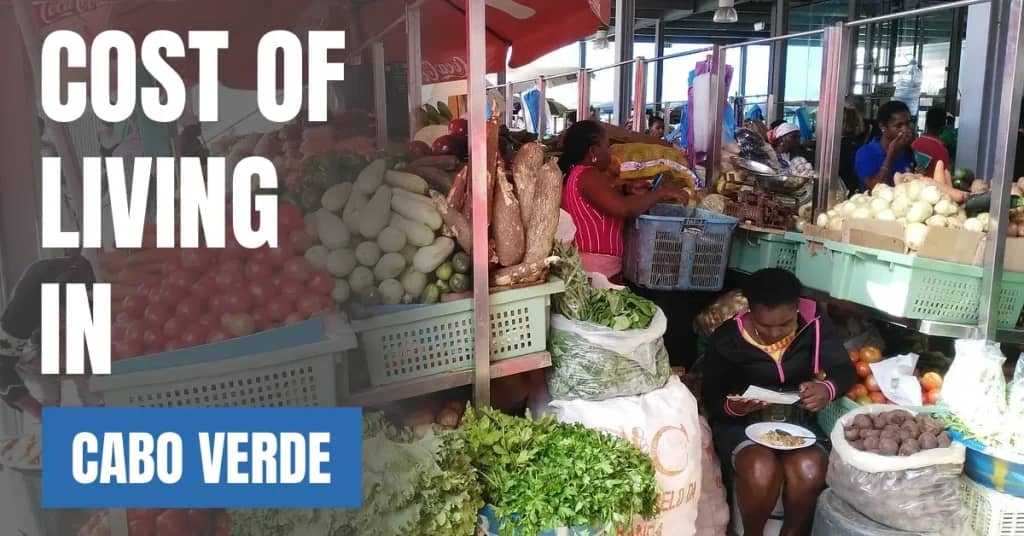
Cost of Living in Cabo Verde in 2026: Rent, Salaries and Monthly Expenses
The cost of living in Cabo Verde in 2026 depends heavily on housing, island location and whether you earn a local salary or receive income from abroad. A single person renting a modest apartment can use approximately CVE 65,000 to CVE 110,000 per month as a practical starting budget, while a family of four may need CVE 140,000 to CVE 250,000 or more, particularly when paying for private education.
On this pageTable of Content
Cabo Verde, also known as Cape Verde, is an Atlantic island country off West Africa. Its capital, Praia, is on Santiago, while Mindelo on São Vicente and the tourism centres of Sal and Boa Vista offer different housing markets and lifestyles.
Although local transport and some everyday services can be relatively inexpensive, imported groceries, electricity, accommodation and travel between islands can make living costs surprisingly high. Housing is especially important because prices for modern furnished apartments can be far above those for basic local accommodation.
All monetary figures in this guide use the Cabo Verdean escudo (CVE). The escudo is pegged to the euro at EUR 1 = CVE 110.265. Prices and sample budgets were reviewed in October 2026 and should be treated as planning estimates rather than guaranteed quotations.
Cost of Living in Cabo Verde at a Glance
A single renter should generally plan for CVE 65,000 to CVE 110,000 monthly, including rent, basic bills, groceries and normal local transport. Higher-end accommodation, imported products and regular restaurant dining can increase that amount significantly.
| Expense | Estimated Cost in CVE | What the Estimate Covers |
|---|---|---|
| Single person's monthly budget | 65,000-110,000 | Includes modest rent and everyday expenses |
| Couple's monthly budget | 90,000-160,000 | Includes shared accommodation |
| Family of four monthly budget | 140,000-250,000+ | Includes rent, household costs and basic family needs; private schooling may raise costs |
| One-bedroom apartment outside central Praia | 20,000-35,000 | Monthly rent |
| One-bedroom apartment in central Praia | 30,000-80,000 | Monthly rent |
| Three-bedroom apartment in central Praia | 50,000-150,000 | Monthly rent |
| Groceries for one person | 15,000-30,000 | Monthly food shopping |
| Basic household utilities | 6,000-20,000 | Monthly electricity, water and related charges, depending on property and usage |
| Home broadband | 4,000-6,500 | Monthly internet service |
| Local public transport ticket | 50-200 | Approximate one-way fare, depending on service |
| Inexpensive restaurant meal | 350-1,100 | One person |
| Private preschool | Around 20,000 | Monthly fee per child in a sampled Praia listing |
The rental, grocery, restaurant and household-price estimates draw mainly on 2026 market observations published by Numbeo and its Cabo Verde country database. These are crowdsourced figures, not government-controlled prices. They are most useful as reference points for constructing a realistic personal budget.
How Much Does It Cost to Live in Cabo Verde Per Month?
A budget-conscious single adult might spend approximately CVE 65,000 per month including rent, while a moderate lifestyle in a convenient urban location can require CVE 100,000 or more. Living with relatives, sharing accommodation or renting outside expensive neighbourhoods can substantially reduce expenses.
For comparison, a renter paying CVE 30,000 for accommodation and CVE 35,000 for other monthly needs spends CVE 65,000 in total. The same person renting a CVE 65,000 furnished apartment may spend CVE 100,000 or more without changing their everyday lifestyle.
The distinction between costs excluding rent and including rent is essential. Household expenditure figures excluding housing cannot be used as a complete monthly living budget.
Students sharing a residence may manage a lower budget, while retirees who need comprehensive medical insurance and foreign professionals seeking modern furnished accommodation may spend considerably more. A car, private education or regular inter-island travel creates additional costs that are not necessarily included in standard estimates.
Housing and Rent Prices in Cabo Verde
Rent is frequently the largest monthly expense for newcomers. In Praia, a one-bedroom apartment outside the city centre has been listed at approximately CVE 20,000 to CVE 35,000 monthly, compared with CVE 30,000 to CVE 80,000 in central locations.
Average Apartment Rent in Praia
| Apartment Type | Indicative Monthly Rent |
|---|---|
| One bedroom, city centre | CVE 30,000-80,000 |
| One bedroom, outside centre | CVE 20,000-35,000 |
| Three bedrooms, city centre | CVE 50,000-150,000 |
| Three bedrooms, outside centre | CVE 25,000-80,000 |
These ranges come from sampled Praia listings and user contributions, rather than a complete survey of available rentals. Furnished condition, building quality, outdoor space, air conditioning, proximity to employment and lease duration can make a substantial difference.
Where Is Housing More Expensive?
Praia offers a broad housing market, with popular neighbourhoods including Palmarejo and Achada Santo António. Mindelo offers another urban option, while Santa Maria on Sal and tourist-oriented areas of Boa Vista can be influenced by short-term rental demand and holiday accommodation.
It would be misleading to assume that Mindelo is always substantially cheaper than Praia. An October 2026 Expatistan comparison found broadly similar living costs, but its comparison used only 45 submitted prices from fewer than five contributors. Such a small sample is insufficient for a reliable citywide ranking.
New residents should compare actual long-term leases rather than nightly holiday-rental prices. Confirm whether electricity, water, internet, condominium fees and furniture are included. Initial deposits and agency charges, where applicable, may also affect the amount of cash needed before moving in.
Buying Property
Property prices vary substantially by island and neighbourhood. Praia market submissions have indicated apartment purchase prices near CVE 97,000 to CVE 125,000 per square metre for sampled locations, but these figures are too limited to serve as reliable nationwide property valuations.
Foreign buyers should obtain independent legal advice and budget for title checks, property registration, applicable taxes, transaction charges and maintenance. Buying property should not be assumed to provide automatic immigration rights.
Food and Grocery Costs in Cabo Verde
A single adult who mainly cooks at home may budget CVE 15,000 to CVE 30,000 monthly for groceries. A family of four can use approximately CVE 35,000 to CVE 60,000 or more, depending on household preferences and the share of imported foods.
Cabo Verde depends on imported supplies for many products. This can make supermarket prices relatively high compared with some mainland African markets. Local fish, seasonal produce and shopping at municipal markets can help reduce food expenditure, although availability differs by island.
Typical Grocery Prices
| Grocery Item | Indicative Price in CVE |
|---|---|
| Milk, 1 litre | 120-160 |
| White bread, 500 g | 100-300 |
| Rice, 1 kg | 180-500 |
| Eggs, 12 | 190-275 |
| Potatoes, 1 kg | 120-180 |
| Bananas, 1 kg | 200-400 |
| Tomatoes, 1 kg | 100-1,000 |
| Bottled water, 1.5 litres | 90-150 |
These indicative ranges reflect 2026 submissions to Numbeo's Praia market database. Wide ranges for some produce reflect variation in retailer, product quality and the small or uneven number of observations.
Imported cheese, beef, packaged snacks and specialist dietary products can make a grocery budget considerably more expensive. Households should also allow for drinking-water purchases where they do not use an appropriate water-treatment solution.
Restaurant and Eating-Out Costs
An inexpensive restaurant meal commonly costs approximately CVE 350 to CVE 1,100, while a mid-range three-course meal for two may cost around CVE 3,000 to CVE 6,900 in sampled Praia establishments.
| Restaurant Expense | Indicative Price in CVE |
|---|---|
| Inexpensive meal | 350-1,100 |
| Mid-range restaurant for two | 3,000-6,900 |
| Fast-food-style combo | 600-800 |
| Cappuccino | 80-440 |
| Soft drink | 120-300, with higher tourist-area prices possible |
Local cafés and neighbourhood restaurants can be considerably more economical than restaurants targeting international tourists. Dining costs on Sal and Boa Vista may differ from those in residential districts of Praia or Mindelo.
Someone purchasing lunch outside five days a week should budget separately for those meals rather than assuming that a grocery allowance covers them. Restaurant dining can quickly add CVE 10,000 to CVE 20,000 or more to monthly expenditure.
Electricity, Water and Utility Costs
Basic utilities for a home may cost roughly CVE 6,000 to CVE 20,000 monthly, with larger or heavily air-conditioned properties potentially exceeding that range. In Praia, sampled bills for an 85-square-metre apartment have approached the upper part of this estimate.
Electricity is an important affordability consideration in an island economy. Air conditioning, water heating, refrigeration and frequent appliance use can increase bills. Water arrangements also vary by building and location.
Before agreeing to a lease, ask for recent electricity and water bills, confirm the metering arrangements and check whether water-storage facilities or additional water deliveries are necessary. A cheap apartment with high utility consumption may not be inexpensive overall.
Internet and Mobile Phone Costs
Home broadband may cost approximately CVE 4,000 to CVE 6,500 monthly for commonly advertised or sampled packages, while mobile services can range from around CVE 600 to CVE 3,000 depending on data allowance and service conditions.
Internet quality, speed and reliability should be checked at the exact property, especially by remote workers. Residents should compare fixed broadband with mobile-data alternatives, check any installation charges and confirm whether an advertised package has usage restrictions.
For someone working online, a backup mobile connection may be a practical additional expense rather than an optional luxury.
Transportation Costs in Cabo Verde
Local transport can be relatively inexpensive, but regular taxis, private vehicles and travel between islands can change a monthly budget substantially. A sampled local one-way fare in Praia is approximately CVE 50 to CVE 200, while ordinary monthly pass estimates are around CVE 2,750 to CVE 3,000.
Buses, Minibuses and Taxis
Praia has urban bus services, while shared minibuses, often called hiaces or yasis, operate on various routes. Service frequency, operating hours and availability vary by island and locality.
| Transport Expense | Indicative Cost in CVE |
|---|---|
| Local single journey | 50-200 |
| Monthly public transport pass | 2,750-3,000 |
| Taxi starting charge | 150-250 |
| Taxi fare per kilometre | Varies by locality and tariff; agree the fare or confirm the meter |
| Petrol, 1 litre | Approximately 140-175 in recent sampled prices |
These are indicative market observations, not a verified national fare schedule. There is no basis for treating public transport as universally free. Travellers should check current operator tariffs, applicable concessions and the precise route before relying on a published fare.
Inter-Island Ferries and Flights
Inter-island transport deserves its own budget. Ferries and domestic flights connect different islands, but schedules, seasonal demand, weather and route availability affect both prices and journey planning.
The earlier version of this guide suggested ferry tickets of USD 15 to USD 40 and domestic flights of USD 60 to USD 120. These are not sufficiently verified as current route-specific fares and should not be treated as reliable 2026 quotations.
Anyone needing frequent travel between islands should obtain current operator prices and allow for accommodation or schedule changes when connections are disrupted.
Healthcare Costs and Medical Insurance
Healthcare in Cabo Verde is not universally free for every resident or visitor. The country has a public healthcare network and a social protection system, but eligibility, contributions, patient charges and access to particular services depend on individual circumstances.
Public facilities include health centres and hospitals, with more specialised services concentrated in major population centres such as Praia and Mindelo. Smaller islands may have more limited access to advanced diagnostics or specialist treatment.
Residents participating in the applicable social insurance arrangements should verify their eligibility, benefits, referrals and cost-sharing requirements. Foreign residents, visitors and people without appropriate coverage should not assume that consultations, emergency treatment or hospital care will be provided at no charge.
Private consultations and insurance costs vary considerably. The earlier article's very low flat estimates for consultations and medicines do not adequately describe the cost of healthcare and should not be used as a comprehensive medical budget.
Before relocating, check available public healthcare entitlements with the relevant authorities and confirm that any private health insurance covers the required treatments, emergency care and medical evacuation. A remote island location can make emergency transport and specialist care especially important.
Education and Childcare Costs
Public schooling in Cabo Verde is substantially more affordable than private or international education. Official rules for the 2026/2027 academic year prohibit registration, attendance and certification fees for basic education in years 1 to 8, and exempt pupils at public secondary schools in years 9 to 12 from registration and attendance tuition charges.
These rules are established in Despacho No. 81/2026. Free public-school tuition does not necessarily eliminate all household costs, including uniforms, materials, meals and transport, although qualifying families may receive support.
Private Schools and Childcare
Private education can substantially increase family expenditure. A sampled private full-day preschool fee in Praia was approximately CVE 20,000 per child per month. International primary-school tuition observations ranged from approximately CVE 108,000 to CVE 500,000 per year.
These private-school figures are based on a limited market sample and should not be treated as official fees. Parents should obtain current fee schedules and confirm registration charges, language of instruction, meals, transport, examination costs and eligibility for admission.
Higher-education tuition also differs by institution, programme and student status. Students should contact their chosen university rather than applying a single nationwide tuition estimate.
Salaries and Minimum Wage in Cabo Verde in 2026
Local wages are an important reason why Cabo Verde may feel considerably more expensive to residents than to newcomers earning foreign income.
What Is the Minimum Wage in Cabo Verde?
According to the government's January 16, 2026 resolution, the minimum monthly wage then in force was CVE 17,000 in the private sector and CVE 19,000 in the public sector.
Resolution No. 4/2026 also established a tripartite commission to support the government's planned increase of the national minimum wage to CVE 25,000 in 2027. The proposed 2027 amount should not be presented as the 2026 minimum wage.
| Minimum Wage Measure | Monthly Amount | Status |
|---|---|---|
| Private-sector minimum | CVE 17,000 | Confirmed by January 2026 government resolution |
| Public-sector minimum | CVE 19,000 | Confirmed by January 2026 government resolution |
| Government target for 2027 | CVE 25,000 | Planned increase, subject to implementation |
A worker receiving CVE 17,000 monthly would not be able to afford a typical independently rented one-bedroom apartment in central Praia without additional income or substantial support. Even the lower end of the observed rental market can exceed that salary.
Average Salaries and Comfortable Income
Crowdsourced Praia salary observations have ranged considerably, with some 2026 submissions indicating net monthly pay around CVE 20,000. This is not an official nationwide earnings average and does not establish the median wage or earnings in every profession.
For a single adult independently renting a moderate apartment, approximately CVE 80,000 to CVE 120,000 in reliable monthly take-home income can provide a more workable planning target. A couple or family will require more, particularly with children or private-school expenses.
These suggested income levels are derived from estimated household expenses, not from a government definition of a comfortable salary.
Taxes and Their Effect on Affordability
Take-home income is more useful than gross salary when deciding whether a move to Cabo Verde is affordable. Employees and self-employed residents may face different tax and social contribution arrangements.
According to PwC's May 2026 Cabo Verde tax summary, personal income taxation under the declarative method uses rates of 16.5%, 23.1% and 27.5% across the relevant taxable-income bands. A tax exemption applies to qualifying net annual income up to CVE 220,000.
Different withholding and assessment rules can apply depending on the income category. Tax residents may have reporting obligations involving foreign income, while non-residents are generally taxed on Cabo Verde-source income under applicable rules.
Foreign remote workers and retirees should seek individual advice about tax residence, overseas earnings, pensions and possible treaty treatment. A large nominal salary is not necessarily equivalent to the same amount of monthly disposable income.
Sample Monthly Budgets for Living in Cabo Verde
The following four examples show how a complete monthly budget can be constructed. They are illustrative planning scenarios, not statistical averages or quotations from individual households. Each example includes accommodation and the expenses shown in its table.
Budget-Conscious Single Person
This example assumes a modest rental or shared housing arrangement, home cooking, ordinary local transport and limited leisure spending.
| Expense | Monthly Cost |
|---|---|
| Rent | CVE 22,000 |
| Utilities | CVE 6,000 |
| Groceries | CVE 18,000 |
| Transport | CVE 3,000 |
| Internet and mobile | CVE 5,000 |
| Healthcare provision | CVE 3,000 |
| Dining, leisure and miscellaneous | CVE 8,000 |
| Total Including Rent | CVE 65,000 |
The example total excluding rent is CVE 43,000. The healthcare amount is only a provisional monthly allowance, not a verified comprehensive private insurance premium.
Moderate Single Person
This example assumes a furnished one-bedroom apartment, moderate discretionary spending and a larger allowance for utilities and communication services.
| Expense | Monthly Cost |
|---|---|
| Rent | CVE 45,000 |
| Utilities | CVE 12,000 |
| Groceries | CVE 22,000 |
| Transport | CVE 5,000 |
| Internet and mobile | CVE 6,000 |
| Healthcare provision | CVE 5,000 |
| Dining, leisure and miscellaneous | CVE 15,000 |
| Total Including Rent | CVE 110,000 |
The total excluding rent is CVE 65,000. Actual spending will depend especially on accommodation quality, personal healthcare arrangements and dining habits.
Couple Sharing an Apartment
This example assumes two adults sharing accommodation, cooking regularly and using mainly local transport.
| Expense | Monthly Cost |
|---|---|
| Rent | CVE 50,000 |
| Utilities | CVE 14,000 |
| Groceries | CVE 32,000 |
| Transport | CVE 7,000 |
| Internet and mobile | CVE 7,000 |
| Healthcare provision | CVE 8,000 |
| Dining, leisure and miscellaneous | CVE 17,000 |
| Total Including Rent | CVE 135,000 |
The estimated cost excluding rent is CVE 85,000. Two adults sharing housing may spend less per person than two adults renting separate apartments.
Family of Four
This example assumes two adults and two children, a three-bedroom rental, regular household expenditure and a limited allowance for children's education-related costs. It does not assume full international-school tuition for two children.
| Expense | Monthly Cost |
|---|---|
| Rent | CVE 75,000 |
| Utilities | CVE 18,000 |
| Groceries | CVE 50,000 |
| Transport | CVE 12,000 |
| Internet and mobile | CVE 8,000 |
| Healthcare provision | CVE 12,000 |
| Education and childcare allowance | CVE 15,000 |
| Dining, clothing, leisure and miscellaneous | CVE 25,000 |
| Total Including Rent | CVE 215,000 |
The total excluding rent is CVE 140,000. Private or international schooling, car ownership, comprehensive insurance and frequent air travel can push expenditure well beyond this example.
Cost of Living Differences Between Cabo Verde's Islands
There is no single cost of living that accurately describes every island. Housing availability, tourist demand, transport connections, employment opportunities and the availability of imported goods all affect household budgets.
Praia, Santiago
Praia is the capital and offers government services, employment opportunities, schools, hospitals and a comparatively diverse rental market. Accommodation varies from modest local units to more expensive furnished apartments in established residential areas.
Mindelo, São Vicente
Mindelo is an important cultural and commercial centre. Its prices can be comparable with Praia in some categories, and limited crowdsourced comparisons do not support a definitive claim that the entire city is much cheaper.
Sal and Boa Vista
Tourism influences accommodation prices and everyday consumption in destinations such as Santa Maria and Sal Rei. Holiday properties, foreign demand and tourist restaurants can increase costs. Long-term residents should distinguish local neighbourhood prices from resort-oriented quotations.
Other Islands and Rural Areas
Some smaller communities may offer lower rents, but housing options, employment, specialist healthcare and regular transport can be more limited. Savings on accommodation may be offset by additional journeys or the need to purchase goods elsewhere.
How Does Cabo Verde Compare With Nearby Countries?
Cabo Verde should not automatically be described as cheaper than Senegal, Portugal or the Canary Islands in every spending category. The comparison changes according to the city, housing standard, exchange rate, transport needs and household income.
Portugal and the Canary Islands may have higher rental prices in particular urban or tourist markets, but they can also offer different transport infrastructure, healthcare entitlements and retail competition. Senegal has a different domestic supply structure and cost profile, while Cabo Verde's island geography creates additional imported-goods and transport costs.
Without a consistent, adequately sampled and date-matched comparison for the particular cities involved, numerical claims that one country is a fixed percentage cheaper would be misleading. People choosing between destinations should compare actual rental quotations, food baskets, health coverage and after-tax earnings.
Costs New Residents Often Overlook
A monthly rent and grocery estimate rarely captures the full financial requirements of relocation. Residents should plan separately for one-time costs and irregular expenditure.
- Housing setup: rental deposits, furniture, appliances, initial utility charges and possible agency fees.
- Medical protection: private insurance, prescription medicines, specialist consultations and possible emergency evacuation.
- Inter-island travel: ferries, flights, overnight accommodation and unexpected schedule changes.
- Imported products: electronics, replacement parts, certain foods and specialist household goods.
- Water and power: higher seasonal utility bills and any necessary water-storage arrangements.
- Immigration administration: document preparation, translations, legalisation, permit fees and travel for appointments.
- Children's expenses: uniforms, school transport, materials, meals and private-school registration.
- Banking and currency: international transfer charges, card fees and foreign-exchange margins outside the official euro peg.
Holding an emergency reserve is particularly useful for new arrivals who do not yet know their exact household bills or access to local support services.
Cost of Living Versus Residency Financial Requirements
The amount needed to live comfortably in Cabo Verde is not the same as the amount required to qualify for a residence permit.
Cabo Verde's immigration authority requires residence applicants to provide evidence of adequate and sufficient economic resources for their subsistence, along with other documents relevant to the application. The requirements are described by the Alta Autoridade para a Imigração.
The official guidance reviewed does not establish one universal monthly income threshold applicable to every residence category and household. Applicants should therefore not treat any sample budget in this guide as a legally sufficient amount.
Requirements can depend on the type of residence, reason for staying, family circumstances and supporting documents. Verify the applicable rules with the immigration authority or an authorised consular office before making financial commitments.
Is Cabo Verde Affordable for Expats, Retirees and Remote Workers?
Cabo Verde may be financially manageable for residents with stable overseas income, particularly when they select a long-term rental and adapt their spending to local markets. It can be much less affordable for workers relying solely on low local wages.
Remote workers should account for reliable internet access, backup connectivity, tax treatment and suitable accommodation for working from home. Retirees should consider ongoing healthcare needs and the possibility of treatment outside their island or country of residence.
Students may reduce spending through shared housing and home cooking, but must still account for tuition, transportation, learning materials and personal health coverage.
New residents should ideally research accommodation, healthcare and transport on the specific island where they intend to live before committing to a relocation.
Conclusion: Is Living in Cabo Verde Worth the Cost?
Cabo Verde offers an attractive island lifestyle, but affordability depends less on general claims that the country is inexpensive and more on the combination of income, rental costs and household needs.
For an independently renting single adult, a starting budget of CVE 65,000 to CVE 110,000 monthly is more useful than an unqualified national average. Families often require substantially more, especially where private schooling, a vehicle or comprehensive healthcare coverage is involved.
Housing is the most important expense to investigate first. Check actual long-term rental availability, obtain utility estimates and determine your eligibility for healthcare and education services. Anyone earning a local wage should compare after-tax income directly with the cost of suitable accommodation.
With careful planning and realistic expectations, Cabo Verde can be a practical long-term destination, but newcomers should retain a financial buffer for island transport, medical needs and unexpected expenses.
Sources and Methodology
This guide was reviewed on October 19, 2026. It combines Cabo Verde government legislation, education and immigration information, international institutional material, tax guidance and crowdsourced consumer-price databases.
Government publications were prioritised for legal and policy information. Numbeo and Expatistan supplied indicative market prices, while sample budgets were constructed from published expense categories and explicitly stated assumptions. Crowdsourced samples are incomplete and may not represent the full population or every island. Their observations may change as contributors update prices.
Importantly, the available data cannot establish a precise national average household budget, nationally representative average rent or official average salary. Consequently, the article uses ranges and illustrative calculations rather than presenting unreliable precision as verified fact.
- Government of Cabo Verde, Resolution No. 4/2026, minimum-wage implementation commission
- Government of Cabo Verde, Despacho No. 81/2026, school year 2026/2027
- Alta Autoridade para a Imigração, residence-authorisation requirements
- Banco de Cabo Verde, monetary policy and fixed exchange-rate regime
- International Monetary Fund, Cabo Verde exchange-rate framework
- PwC, Cabo Verde personal income taxes, reviewed May 2026
- Numbeo, cost of living in Praia
- Numbeo Portugal-language dataset, Praia, October 2026
- Numbeo, cost of living in Cabo Verde
- Expatistan, Praia and Mindelo comparison, October 2026
Frequently Asked Questions
How much does it cost to live in Cabo Verde per month?
A single person renting modest accommodation can use approximately CVE 65,000 to CVE 110,000 per month as a planning range, including rent, groceries, utilities and local transportation. Sharing accommodation can reduce expenses, while premium furnished housing or frequent dining out can raise them. These are illustrative budgets, not nationally representative averages. Exact spending depends on the island, housing choice and lifestyle.
Is Cabo Verde expensive to live in?
Cabo Verde can be expensive relative to local earnings, even though some everyday services are reasonably priced. Rent, electricity, imported food and inter-island transport are important costs. People receiving reliable income from abroad may find it more manageable than residents earning the minimum wage. Affordability also varies substantially between neighbourhoods and between local residential areas and tourist destinations.
How much is monthly rent in Cabo Verde?
In sampled Praia market data, one-bedroom apartments outside the centre ranged from approximately CVE 20,000 to CVE 35,000 monthly, while central one-bedroom apartments ranged from CVE 30,000 to CVE 80,000. Larger properties and resort-oriented accommodation can cost considerably more. These figures are not nationwide rental averages, and prospective tenants should check current long-term listings and any additional utility charges.
What salary is needed to live comfortably in Cabo Verde?
For a single adult renting independently, approximately CVE 80,000 to CVE 120,000 in reliable monthly take-home income is a useful planning target for a moderate lifestyle. The amount is not an official salary benchmark. Shared housing or a modest local apartment may allow lower spending, whereas private healthcare, imported goods and high-end accommodation increase the income needed.
What is the minimum wage in Cabo Verde in 2026?
A January 2026 government resolution identified the minimum wage then in force as CVE 17,000 per month in the private sector and CVE 19,000 in the public sector. It also described a government objective of increasing the national minimum wage to CVE 25,000 in 2027. The planned 2027 rate should not be confused with the amounts confirmed for 2026.
How much does a family of four need in Cabo Verde?
A family of four can use approximately CVE 140,000 to CVE 250,000 or more per month as an initial planning range including accommodation. An illustrative budget of CVE 215,000 covers rent, groceries, utilities, transport and basic child-related expenses. Private or international schooling, car ownership and comprehensive health insurance can increase costs significantly. The family's actual needs depend on its island and housing arrangements.
Is healthcare free in Cabo Verde?
Healthcare is not automatically free for every person in Cabo Verde. Public facilities and social protection arrangements exist, but access, charges and covered services depend on eligibility and individual circumstances. Foreign residents and visitors should verify their entitlement to public services and whether additional private medical insurance is necessary. Specialist treatment and emergency evacuation may create substantial expenses, especially on smaller islands.
Is public transportation free in Cabo Verde?
Public transport is not universally free in Cabo Verde. Sampled fares in Praia suggest approximately CVE 50 to CVE 200 for local single journeys and around CVE 2,750 to CVE 3,000 for an ordinary monthly pass. These are market observations rather than official universal tariffs. Available concessions, routes and payment arrangements must be checked with the relevant operator. Inter-island ferries and flights are separate expenses.
Are public schools free in Cabo Verde?
Official 2026/2027 education rules prohibit registration, attendance and certification fees in basic education, covering years 1 to 8. Public secondary-school students in years 9 to 12 are also exempt from registration and attendance tuition. Families may still need to pay for materials, transport or other expenses, although support programmes exist. Private and international schools charge their own fees.
Is Praia cheaper than Mindelo?
There is insufficient reliable evidence to say that Praia is consistently cheaper or more expensive than Mindelo in every category. An October 2026 Expatistan comparison suggested broadly similar overall costs, but it relied on very few contributors. Individual rents, utility bills and grocery prices can differ considerably. Comparing actual apartments and household shopping needs is more reliable than relying on a citywide ranking.
Is Cabo Verde cheaper than Portugal?
Cabo Verde may offer lower rents and certain service costs than some Portuguese cities, but this does not apply universally. Imported goods, electricity and island travel can be costly, and local wages differ substantially. A meaningful comparison should use the specific Portuguese and Cabo Verdean locations, equivalent accommodation standards, healthcare arrangements and take-home income. Broad claims that one country is always cheaper can be misleading.
How much money is required to obtain residence in Cabo Verde?
Cabo Verde's immigration authority requires evidence of adequate economic resources for residence applications, but the official guidance reviewed does not establish one universal monthly amount for all applicants. Financial requirements may vary by residence category and family circumstances. The sample living budgets in this guide are not immigration thresholds. Applicants should verify the correct requirements, supporting documents and applicable fees with the immigration authority.
Join the conversation
Have thoughts on this topic? Share them with others.
Ask questions, share experience, and learn from the Visaboards Community.