
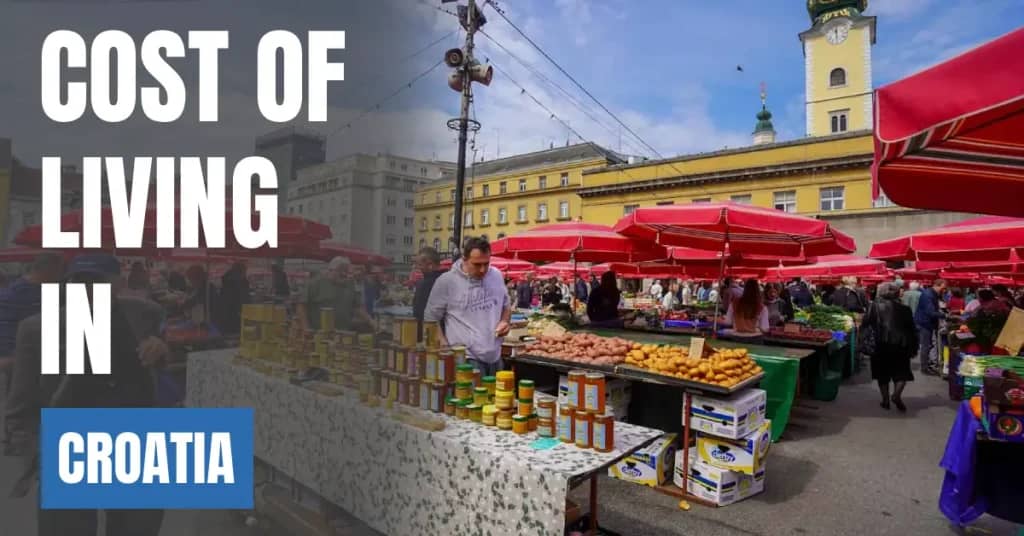
Cost of Living in Croatia 2026: Rent, Salaries and Monthly Expenses
The cost of living in Croatia in 2026 depends mainly on housing, location, household size and lifestyle. Zagreb offers employment opportunities and year-round services, while coastal destinations such as Split, Dubrovnik and Zadar can become considerably more expensive during the tourist season. Smaller inland cities may provide more affordable alternatives.
On this pageTable of Content
A single person renting a modest apartment should generally plan around €1,100 to €1,700 per month, including housing and routine expenses. A couple may need approximately €1,700 to €2,600, while a family of four could require €2,800 to €4,300 or more. These are illustrative planning ranges, not official household expenditure averages.
Croatia has used the euro (€) since 1 January 2023. The Croatian kuna (HRK) is no longer the country's official currency. All prices in this guide are therefore presented in euros.
Housing is the main affordability challenge for many new residents. Coastal tourism, seasonal rental restrictions and growing demand for desirable properties can make accommodation significantly more expensive than everyday groceries or public transportation.
Cost of Living in Croatia at a Glance
The following table combines observed consumer prices from June 2026 with illustrative monthly budget ranges. Household budgets include rent unless otherwise indicated.
| Expense | Estimated Cost in EUR | Details |
|---|---|---|
| Single person, excluding rent | €550–€850/month | Groceries, utilities, transport and routine spending |
| Single person, including rent | €1,100–€1,700/month | Modest independent accommodation |
| Couple, including rent | €1,700–€2,600/month | Shared accommodation and household expenses |
| Family of four, including rent | €2,800–€4,300+/month | Excludes substantial international-school tuition |
| One-bedroom apartment, city centre | €450–€900/month | National crowdsourced observed range |
| One-bedroom apartment, outside centre | €350–€650/month | National crowdsourced observed range |
| Monthly groceries, one person | €220–€350 | Home cooking with limited restaurant meals |
| Basic utilities, 85 m² apartment | €115–€250/month | Electricity, heating, cooling, water and waste |
| Broadband internet | €22–€45/month | Typical surveyed plans |
| Regular monthly public transport pass | €30–€53/month | Depends on city and operator |
| Inexpensive restaurant meal | €7–€20 | Typical observed range |
Source: Numbeo Croatia, updated 12 June 2026. The dataset contained 3,464 price entries from 286 contributors over the previous 12 months. Actual accommodation offers and consumer prices may differ.
How Much Does It Cost to Live in Croatia Per Month?
A single renter in Croatia may need approximately €1,100 to €1,700 monthly, including rent, utilities, groceries, transportation, communications and moderate personal spending. People sharing accommodation may spend less, while residents in expensive coastal neighbourhoods may need substantially more.
Excluding rent, an individual might allocate €550 to €850 for ordinary monthly expenses. However, this amount does not cover substantial private health insurance, frequent travel, significant debt payments or major unexpected bills.
Families face additional spending on larger apartments, childcare, school-related expenses and transportation. The most reliable budget is one based on actual rental offers and the specific services required by the household.
Housing and Rent Prices in Croatia
Rent is often the largest monthly expense in Croatia. Property prices depend on city, proximity to the centre or coastline, apartment quality, rental duration and availability during tourist season.
How Much Is Rent in Croatia in 2026?
According to June 2026 national crowdsourced observations, a one-bedroom apartment outside the city centre averaged approximately €492 monthly, while a central one-bedroom apartment averaged around €638. These national figures should not be interpreted as guaranteed prices in Zagreb, Split or Dubrovnik.
| Accommodation Type | Observed Monthly Range | Observed Average |
|---|---|---|
| One-bedroom apartment, city centre | €450–€900 | €638 |
| One-bedroom apartment, outside centre | €350–€650 | €492 |
| Three-bedroom apartment, city centre | €750–€1,800 | €1,067 |
| Three-bedroom apartment, outside centre | €550–€1,200 | €810 |
Source: Numbeo Croatia, June 2026.
Rental asking prices in high-demand locations can exceed these ranges, particularly for well-furnished apartments and properties suitable for year-round occupation.
Rent in Zagreb
Zagreb provides a broad selection of residential neighbourhoods and relatively established long-term rental markets. Areas close to the city centre, tram connections, universities and business districts generally command stronger demand.
For prospective residents, comparing rents by neighbourhood and commuting time is more useful than relying solely on a national average. Confirm whether utilities, building maintenance and parking are included in the advertised price.
Rent in Split, Dubrovnik and Coastal Cities
Coastal cities face additional housing pressure from short-term tourist accommodation. Some landlords prefer seasonal rentals or require tenants to leave before the summer tourist period.
Split, Dubrovnik, Zadar and popular island destinations may therefore be more expensive than inland locations, especially for residents needing stable accommodation throughout the year.
When searching for housing, request a written 12-month agreement and confirm whether the rental price stays unchanged during summer.
Renting Versus Buying Property
The June 2026 national dataset reported average apartment purchase prices of approximately €3,779 per square metre in city centres and €2,907 outside central areas.
These are market observations rather than official property valuations. Purchase prices differ substantially between Zagreb, coastal cities, islands and inland municipalities.
Foreign nationals should verify applicable property-purchase conditions before committing to a transaction. Buying property does not automatically grant residence rights.
Food and Grocery Costs in Croatia
Groceries are generally more predictable than housing expenses. Major supermarkets offer domestic and imported products, while local markets can be useful for seasonal vegetables, fruit and other fresh food.
Households that prepare most meals at home may find grocery expenses manageable. Imported speciality products, premium meat and convenience food can increase the total.
Average Grocery Prices in 2026
| Grocery Item | Approximate Price | Observed Range |
|---|---|---|
| Milk, 1 litre | €1.08 | €0.80–€2.00 |
| White bread, 500 g | €1.41 | €0.94–€2.40 |
| Rice, 1 kg | €2.65 | €1.50–€4.30 |
| Eggs, 12 | €3.35 | €2.40–€4.20 |
| Chicken fillets, 1 kg | €8.47 | €4.50–€12.00 |
| Beef, 1 kg | €11.92 | €8.00–€20.00 |
| Apples, 1 kg | €1.68 | €1.00–€3.00 |
| Bananas, 1 kg | €1.53 | €1.20–€2.00 |
| Tomatoes, 1 kg | €2.19 | €1.00–€3.00 |
| Potatoes, 1 kg | €1.19 | €0.70–€2.00 |
| Bottled water, 1.5 litres | €1.10 | €0.75–€1.60 |
Source: Numbeo Croatia consumer prices, June 2026.
A practical monthly grocery allowance is approximately €220 to €350 for one person and €500 to €800 for a family of four, depending on dietary preferences and shopping habits. These are planning estimates, not official household food expenditure figures.
Restaurants and Eating Out in Croatia
An inexpensive restaurant meal in Croatia typically cost around €12 in the June 2026 national dataset, with an observed range of €7 to €20.
| Food or Drink | Typical Price |
|---|---|
| Inexpensive restaurant meal | €12.00 |
| Three-course meal for two, mid-range restaurant | €60.00 |
| Fast-food combination meal | €8.30 |
| Cappuccino | €2.21 |
| Soft drink, 330 ml | €2.73 |
| Bottled water at restaurant, 330 ml | €2.20 |
Tourist-oriented establishments near major attractions may charge considerably more, especially during summer. Restaurants away from busy tourist areas and local lunch specials can offer better value.
Residents who eat out several times each week should create a separate dining allowance rather than include restaurant meals within their basic grocery budget.
Utilities: Electricity, Water, Heating and Waste
Basic utilities for an approximately 85-square-metre apartment averaged €174 per month in the June 2026 Croatia dataset. The observed range was approximately €115 to €250.
The figure includes common expenses such as electricity, heating, cooling, water and waste collection. Actual bills depend on building insulation, household size, heating technology and season.
Winter heating can add considerable expense in Zagreb and colder inland locations. Air conditioning can increase summer electricity consumption, particularly in coastal areas.
Before renting, ask whether building maintenance fees and communal charges are included. Request recent utility bills where possible, especially for older apartments with inefficient heating.
Internet and Mobile Phone Costs
Broadband internet typically cost around €33 monthly in the June 2026 dataset, while a mobile plan with calls and at least 10 GB of data averaged approximately €19.
| Service | Observed Monthly Average | Observed Range |
|---|---|---|
| Fixed broadband internet | €33.25 | €22–€44.96 |
| Mobile phone plan | €19.35 | €11–€30 |
Connection availability, contract terms and mobile data allowances differ between providers and regions. People working remotely should verify the actual service available at an address rather than relying on national coverage claims.
Transportation Costs in Croatia
Public transport is an affordable option in several Croatian cities, particularly Zagreb, where trams and buses serve many residential and commercial areas.
The national June 2026 dataset reported an average local one-way ticket of €1.25 and a regular monthly pass of approximately €42.50. However, local fares differ significantly by operator.
How Much Does Public Transport Cost in Zagreb?
According to the official Zagreb Electric Tram (ZET) fare list, a 30-minute daytime ticket purchased in advance costs €0.53, a 60-minute ticket costs €0.93, and a 90-minute ticket costs €1.33.
| Zagreb Public Transport Ticket | Official Fare |
|---|---|
| 30-minute daytime ticket | €0.53 |
| 60-minute daytime ticket | €0.93 |
| 90-minute daytime ticket | €1.33 |
| 30-minute ticket bought from driver | €0.80 |
| Daily ticket | €3.98 |
| Three-day ticket | €9.29 |
| Seven-day ticket | €19.91 |
| Thirty-day ticket | €53.09 |
Source: ZET Official Fares.
Special fares and concessions may be available for eligible groups. Residents should check current qualification requirements rather than assume free or discounted travel applies to everyone.
Cars, Fuel and Taxis
The June 2026 national price dataset recorded petrol at approximately €1.54 per litre, a standard taxi starting fare of €3.32 and a taxi charge of approximately €1.30 per kilometre.
Car owners must also budget for registration, compulsory insurance, maintenance, parking and toll roads. Intercity bus services, rail travel and ferries should be budgeted separately for frequent travel across Croatia.
Healthcare Costs: Is Healthcare Free in Croatia?
Healthcare in Croatia is not universally free at the point of use. The country operates a compulsory health insurance system administered by the Croatian Health Insurance Fund (HZZO), with access determined by insurance status and applicable eligibility rules.
Compulsory coverage provides access to primary care, specialist services, hospital treatment and medicines subject to the relevant rules. Some services require patient participation payments.
According to HZZO's official health insurance guidance, the minimum participation amount for relevant services is €1.32 and the maximum under the stated rules is €530.88 per invoice.
Supplementary health insurance can cover eligible participation charges. Private medical consultations, dental services outside covered entitlements and other elective services may carry additional expenses.
Healthcare for Foreign Residents
Foreign residents are not automatically entitled to unrestricted free healthcare merely because they live in Croatia. Insurance obligations and rights depend on nationality, employment, residence status, international agreements and other legal conditions.
EU and EEA insured visitors may be able to use their European Health Insurance Card for medically necessary care during temporary stays. Longer-term residents may need to register with HZZO or demonstrate other valid insurance coverage.
New residents should verify their insurance status with HZZO and avoid relying on generic estimates for individual doctor visits. A consultation price alone does not represent the cost of participating in Croatia's healthcare system.
Education and Childcare Costs in Croatia
Public primary and secondary education is generally available without tuition fees under Croatia's education system, subject to applicable enrolment and eligibility requirements. Families still need to budget for supplies, meals, transport and extracurricular activities.
Private schools, international schools and childcare centres may charge substantial fees.
In the June 2026 national crowdsourced dataset, full-day private preschool or kindergarten averaged approximately €297 per month per child, with reported prices ranging from €100 to €708.
International primary-school tuition averaged approximately €8,791 per year, with observations from €4,428 to €17,000.
These prices are not government fee schedules. Parents should verify availability, language of instruction, registration charges, meals and additional fees directly with schools and childcare providers.
Salaries and Average Income in Croatia in 2026
The Croatian Bureau of Statistics reported an average monthly net salary of €1,540 for July 2026. The median net salary was €1,346, indicating that half of the employees represented in the distribution earned no more than that amount.
The same report recorded an average gross monthly salary of €2,164.
| Official Salary Indicator | Amount |
|---|---|
| Average monthly net salary, July 2026 | €1,540 |
| Median monthly net salary, July 2026 | €1,346 |
| Average monthly gross salary, July 2026 | €2,164 |
| Average net salary, first half of 2026 | €1,542 |
Source: Croatian Bureau of Statistics, July 2026 Earnings Report and First Half of 2026 Earnings Report.
These are official earnings statistics for employees in legal entities, not guaranteed salaries in every profession. Income varies by industry, region, experience and contract conditions.
What Is the Minimum Wage in Croatia in 2026?
The statutory minimum wage in Croatia is €1,050 gross per month for the period from 1 January to 31 December 2026.
This rate was established by the Croatian Government through its minimum wage regulation published in Official Gazette No. 132/2025.
Source: Official Gazette: Minimum Wage Regulation for 2026.
The €1,050 amount is gross pay, not the amount necessarily received after pension contributions and applicable income tax. Net earnings depend on relevant tax and payroll circumstances.
For someone renting independently, the statutory minimum wage can be insufficient to cover housing and routine living expenses without shared accommodation, household support or other sources of income.
What Salary Do You Need to Live Comfortably in Croatia?
A single person may want approximately €1,500 to €2,000 monthly after tax to rent independently and maintain a moderate lifestyle, depending on location. In more expensive coastal areas or for residents requiring a car, the necessary income can be higher.
Couples sharing housing expenses may find a combined net income of €2,500 to €3,500 more flexible, while families with children and private education requirements may need considerably more.
These figures are practical planning targets, not government income standards. They should be compared with actual rental offers and household obligations.
Taxes and Everyday Affordability
Croatia has a standard value-added tax (VAT) rate of 25%, with reduced rates applying to qualifying products and services. VAT is normally incorporated into displayed consumer prices.
Employment income may also be subject to pension contributions and personal income tax. Personal income tax rates depend on the applicable local government rules and an individual's taxable income and allowances.
Consequently, employees should compare net salaries rather than gross salary offers when deciding whether employment income is sufficient for rent and living expenses.
Self-employed individuals and remote workers should obtain advice about tax residence, contributions and possible double-taxation obligations before establishing a long-term base in Croatia.
Realistic Sample Monthly Budgets for Croatia
The following examples show how expenses can add up for different households. They are illustrative calculations intended for year-round living, not official averages.
| Monthly Expense | Budget Single | Moderate Single | Couple | Family of Four |
|---|---|---|---|---|
| Rent | €450 | €650 | €850 | €1,200 |
| Utilities | €110 | €150 | €200 | €260 |
| Groceries | €220 | €300 | €480 | €750 |
| Transport | €40 | €60 | €110 | €220 |
| Internet and mobile | €40 | €55 | €70 | €85 |
| Healthcare or insurance provision | €30 | €45 | €80 | €140 |
| Dining, leisure and miscellaneous | €110 | €240 | €360 | €450 |
| Childcare or school provision | €0 | €0 | €0 | €350 |
| Total Including Rent | €1,000 | €1,500 | €2,150 | €3,455 |
| Total Excluding Rent | €550 | €850 | €1,300 | €2,255 |
Budget assumptions: The budget-conscious single person rents a modest apartment in a relatively affordable location, cooks at home and primarily uses public transport. The moderate single person pays more for housing and personal spending. The couple shares one household. The family budget includes a larger home and a limited childcare or school provision.
These examples do not include full international-school tuition, major private medical treatment, vehicle purchases, substantial loan repayments or unusually expensive summer coastal accommodation.
Cost of Living Differences by City and Region
Zagreb
Zagreb offers established year-round housing, public transport, universities and employment opportunities. Although central accommodation can be expensive, residents may save money by choosing neighbourhoods with good tram connections rather than living in the city centre.
Split
Split's coastal location and tourism industry can increase housing and restaurant prices. The June 2026 Numbeo city index placed Split at 58.0 for the cost-of-living index, compared with Zagreb's 54.7. This supports treating Split as potentially more expensive for the basket of items surveyed.
Dubrovnik
Dubrovnik has strong seasonal tourism demand and limited desirable long-term accommodation in central locations. Prospective residents should prioritise written year-round rental agreements and carefully assess commuting from surrounding communities.
Rijeka
Rijeka provides a coastal urban environment with a different housing market from major tourist destinations. The June 2026 city dataset assigned it a cost-of-living index of 53.7, below both Split and Zagreb, although individual prices still vary.
Zadar, Osijek and Smaller Inland Cities
Zadar can experience seasonal housing pressure, while Osijek and some smaller inland municipalities may provide more affordable residential options. However, comparable 2026 market evidence is not sufficiently comprehensive to guarantee that every smaller city is cheaper for all expenses.
Residents should compare housing, employment opportunities, transportation and healthcare access together.
How Does Croatia Compare With Italy, Slovenia and Other Countries?
Croatia may be less expensive than certain Western European destinations for several consumer expenses, but comparisons depend on the product or service.
In June 2026 crowdsourced comparisons, an inexpensive restaurant meal averaged €12 in Croatia compared with €17 in Italy. However, a regular cappuccino averaged approximately €2.21 in Croatia compared with €1.76 in Italy.
This shows why broad statements that Croatia is cheaper than Italy for every expense are misleading.
Housing comparisons with Slovenia, Italy, Austria or Greece also depend on the cities selected. Comparing Zagreb with central Milan, for example, is not equivalent to comparing a small Croatian inland town with a rural Italian location.
Sources: Numbeo Italy and Croatia Comparison and Numbeo Greece and Croatia Comparison.
Hidden Living Expenses New Residents Often Overlook
Beyond rent and food, residents should allow for expenses that may not appear in standard online cost-of-living estimates.
- Rental deposits: Initial accommodation payments can require additional savings.
- Agency fees: Some rental arrangements involve intermediary fees.
- Tourist-season housing: Short-term rental demand can disrupt or increase the cost of year-round accommodation.
- Winter energy bills: Heating costs can be higher in older or poorly insulated buildings.
- Health insurance: Supplementary coverage, participation charges and private medical services may require additional spending.
- Residence administration: Applications, documentation, translations and permits can create one-time costs.
- Transport: Parking, tolls, vehicle registration and ferries may add to monthly expenses.
- Family services: Childcare, school activities and extracurricular programmes may increase household costs.
Keeping a separate relocation fund and emergency reserve reduces the risk of underestimating the cost of establishing a household.
Cost of Living Versus Residency Financial Requirements
Everyday living expenses and immigration financial requirements are different. A household may be able to live on €1,500 per month but still fail to meet the income or savings evidence required for a particular residence category.
Financial Requirements for Croatia's Digital Nomad Residence
According to the Croatian Ministry of the Interior's official guidance, applicants for temporary stay as digital nomads must demonstrate financial means corresponding to at least 2.5 times the previous year's average monthly net salary, with an additional amount for qualifying family members.
The Ministry's published guidance states a current minimum of €3,622.50 per month for an individual applicant.
Alternatively, it lists:
- €43,470 in available funds for a planned 12-month stay.
- €65,205 in available funds for a planned 18-month stay.
The requirement increases for qualifying accompanying family members. Applicants must also satisfy other applicable conditions.
Source: Croatian Ministry of the Interior: Temporary Stay of Digital Nomads.
These are immigration financial thresholds rather than estimates of how much a person actually spends each month. Other residence categories may have different rules, so applicants should verify their specific eligibility before applying.
Is Croatia Affordable for Expats, Students and Retirees?
Croatia can offer a manageable lifestyle for residents with stable income and realistic housing expectations. However, affordability varies considerably by household type.
Expats and Remote Workers
Expats with net monthly income of €1,500 to €2,000 may be able to support a moderate single-person lifestyle in suitable locations. Higher earnings provide more flexibility in sought-after coastal areas.
Remote workers should separately consider income taxes, health insurance, internet reliability and the financial conditions of their residence authorisation.
International Students
Students sharing apartments or accessing eligible student accommodation may keep expenses below those of independent renters. Housing availability, especially near universities, is important.
Food, local transportation, textbooks, tuition where applicable and residence costs should be budgeted separately. A student with subsidised accommodation may spend much less than one renting a private apartment independently.
Retirees
Retirees may find smaller towns attractive if they prioritise lower housing costs and a slower pace of life. However, medical access, insurance eligibility, transport connections and long-term residence rules should be considered before choosing a location.
Families
Families face additional costs for larger accommodation, childcare and schooling. Households using public education may spend substantially less than families choosing international schools.
Conclusion: Is Croatia Expensive to Live in During 2026?
Croatia offers varied living costs rather than a single national price level. Groceries, communications and public transport can be manageable, but rent is a major consideration, particularly in popular coastal destinations.
A single renter should generally start with a budget of approximately €1,100 to €1,700 monthly, including housing, while families may need €2,800 to €4,300 or more depending on accommodation and education choices.
The official average net monthly salary of €1,540 in July 2026 demonstrates that housing can absorb a substantial share of ordinary employment income. The €1,050 gross minimum wage makes independent renting especially challenging in more expensive areas.
Before relocating, compare actual year-round rental offers, estimate after-tax income, verify healthcare eligibility and confirm applicable residence requirements. These steps provide a more realistic assessment than a generic national cost-of-living average.
Sources and Methodology
This article was reviewed on 20 October 2026. It updates the original Visaboards guide using published Croatian government regulations, official salary statistics, public transport fares, health insurance guidance, immigration rules and June 2026 crowdsourced consumer-price observations.
Official government sources were prioritised for legal rules and salaries. Consumer prices and rental estimates use market observations, which are not guaranteed quotations and may change because of inflation, seasonality and local demand.
The national Numbeo dataset included 3,464 entries from 286 contributors in the 12 months before its June 2026 update. Although useful for comparison, crowdsourced prices are not a replacement for an official representative household expenditure survey. The sample budgets are constructed planning examples rather than official statistical averages.
- Visaboards: Original Croatia Cost of Living Guide
- Numbeo: Croatia Consumer Prices, June 2026
- Numbeo: Zagreb Consumer Prices
- Croatian Bureau of Statistics: July 2026 Earnings
- Croatian Bureau of Statistics: First-Half 2026 Earnings
- Official Gazette: 2026 Minimum Wage Regulation
- ZET: Official Zagreb Transport Fares
- Croatian Health Insurance Fund: Insurance and Healthcare Rights
- Ministry of the Interior: Digital Nomad Temporary Stay
- Numbeo: Italy and Croatia Cost Comparison
Frequently Asked Questions
How much does it cost to live in Croatia per month in 2026?
A single person renting independently may need approximately €1,100 to €1,700 per month, including rent, groceries, utilities, transport and routine spending. A person sharing accommodation may spend less. These are illustrative budgets rather than official national averages. Living in central Zagreb or popular coastal areas, especially during the tourist season, can increase housing costs considerably.
How much is rent in Croatia in 2026?
June 2026 crowdsourced data recorded average monthly rents of approximately €492 for a one-bedroom apartment outside city centres and €638 for one in central locations. Observed ranges were €350 to €650 outside centres and €450 to €900 centrally. Actual prices differ by location, property quality and rental duration, with some desirable coastal apartments costing substantially more.
What is the minimum wage in Croatia in 2026?
Croatia's statutory minimum wage is €1,050 gross per month from 1 January through 31 December 2026. The rate was established by the government's regulation published in Official Gazette No. 132/2025. This amount is before relevant payroll deductions, so take-home pay will be lower. Residents should compare their actual net income with housing and other living expenses.
What is the average salary in Croatia in 2026?
The Croatian Bureau of Statistics reported an average monthly net salary of €1,540 for July 2026 and an average gross salary of €2,164. The median monthly net salary was €1,346. These figures describe employees in legal entities and should not be interpreted as guaranteed earnings. Pay depends on occupation, region, qualifications and employment arrangements.
How much salary do you need to live comfortably in Croatia?
A single person may want around €1,500 to €2,000 monthly after tax for a moderate lifestyle that includes independent renting. Couples and families need larger combined household budgets. The exact amount depends on accommodation, commuting, childcare and other obligations. Residents in expensive coastal neighbourhoods may require higher earnings than people living in smaller inland cities.
Is healthcare free in Croatia for foreigners?
Healthcare is not automatically free for every foreign visitor or resident. Croatia operates compulsory health insurance through HZZO, and eligibility depends on factors including residence, employment and international agreements. Covered patients may still pay participation charges for certain services unless supplementary insurance or an applicable exemption covers them. Foreign residents should verify insurance obligations before relocating.
Is public transport cheap in Croatia?
Public transportation can be affordable, particularly in Zagreb. The official Zagreb transport operator charges €0.53 for a standard 30-minute daytime ticket purchased in advance, while its listed 30-day ticket costs €53.09. Other cities have different fares and services. Public transport can reduce living expenses for residents who would otherwise need a car, parking and fuel.
How much does a family of four need per month in Croatia?
A family of four might plan for approximately €2,800 to €4,300 or more monthly, including rent, groceries, utilities and routine family expenses. An illustrative moderate household calculation is €3,455. International schooling, expensive coastal accommodation and private transport can substantially increase costs. Families should obtain actual housing and education quotations before setting their final budget.
Is Croatia cheaper than Italy?
Croatia can be cheaper for some expenses, but not every product or service. June 2026 crowdsourced comparisons showed an inexpensive restaurant meal averaging €12 in Croatia versus €17 in Italy. However, cappuccino prices were higher in Croatia in that comparison. Housing costs also depend heavily on the cities selected, so countrywide generalisations should be treated cautiously.
How much money is required for Croatia's digital nomad residence?
The Croatian Ministry of the Interior's published guidance states a minimum financial means requirement of €3,622.50 monthly for an individual digital nomad applicant. Alternatively, it lists €43,470 in available funds for a 12-month stay or €65,205 for 18 months. Additional amounts apply for qualifying family members. These are immigration requirements, not estimates of actual monthly living expenses.
Join the conversation
Have thoughts on this topic? Share them with others.
Ask questions, share experience, and learn from the Visaboards Community.