
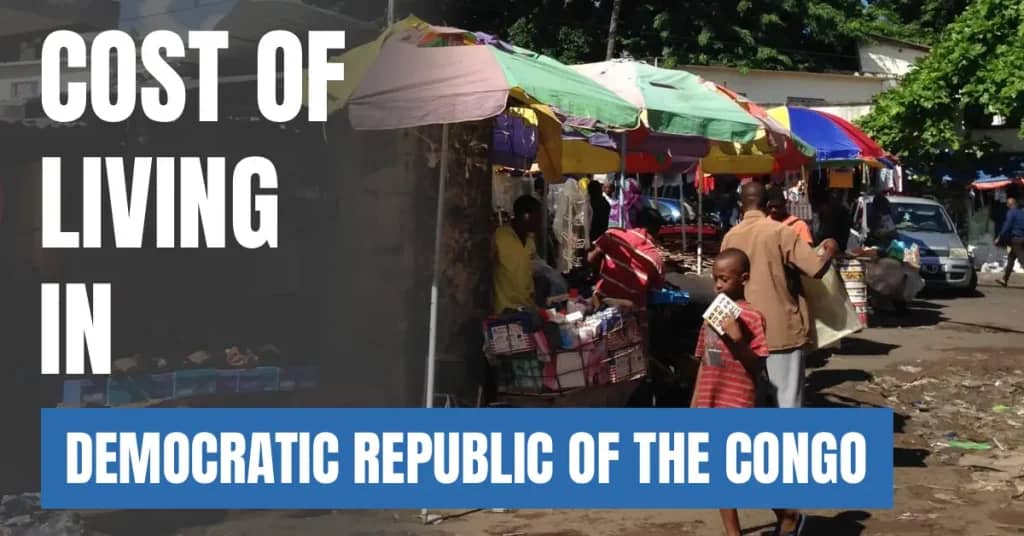
Cost of Living in Democratic Republic of the Congo 2026: Rent, Salaries and Monthly Expenses
The cost of living in the Democratic Republic of the Congo (DRC) varies considerably between Kinshasa, Lubumbashi, smaller cities and rural areas. Local food and shared transportation can be relatively affordable, but secure housing, imported groceries, private healthcare, reliable electricity and international education can make urban living expensive.
On this pageTable of Content
For a single person renting modest accommodation, a practical planning budget is approximately CDF 1.9 million to CDF 3.3 million per month (about USD 850 to USD 1,450), including rent. Expatriates choosing furnished accommodation in central Kinshasa may need substantially more. These are illustrative household budgets, not official nationwide averages.
The country's official currency is the Congolese franc (CDF). US dollars are also commonly used to quote major expenses, particularly property rentals. For consistency, this guide uses a reference exchange rate of approximately CDF 2,265 per USD, close to the Banque Centrale du Congo's published rate of CDF 2,265.04 on 14 October 2026. Conversions are rounded and will change with exchange rates.
Cost of Living in Democratic Republic of the Congo at a Glance
The following estimates provide a starting point for someone planning to live in the DRC in 2026. They are not a single national price survey. Urban market observations are strongest for Kinshasa, while costs elsewhere may differ substantially.
| Expense | Estimated Cost in CDF | Approximate USD Equivalent |
|---|---|---|
| Budget-conscious single person, including rent | 1,925,000/month | $850/month |
| Moderate single person, including rent | 3,285,000/month | $1,450/month |
| Couple, including rent | 4,757,000/month | $2,100/month |
| Family of four, including rent and a school provision | 8,381,000/month | $3,700/month |
| One-bedroom apartment outside central Kinshasa | 793,000–1,925,000/month | $350–$850/month |
| One-bedroom apartment in central Kinshasa | 3,624,000–18,120,000/month | $1,600–$8,000/month |
| Basic utilities for an apartment | 91,000–301,000/month | $40–$133/month |
| Fixed broadband internet | 113,000–680,000/month | $50–$300/month |
| Local transport, one-way journey | Approximately 1,130 | Approximately $0.50 |
| Inexpensive restaurant meal in surveyed Kinshasa establishments | 11,300–83,800 | $5–$37 |
The budget figures are calculated planning examples. Rental, restaurant, utility and communications estimates draw primarily on the Numbeo Kinshasa price dataset, last updated on 9 April 2026. Its observations are crowdsourced and should not be treated as guaranteed market prices.
How Much Does It Cost to Live in the DRC Per Month?
A single person may need approximately CDF 1.9 million to CDF 3.3 million per month, including modest rent, groceries, utilities, transportation, communications and basic discretionary spending. A couple might plan around CDF 4.8 million, while a family with private schooling can require CDF 8.4 million or more.
These examples represent different lifestyles rather than a statistical average. A person living with relatives or sharing accommodation may spend considerably less. Someone paying for a serviced apartment, private transport and international medical insurance may spend several times more.
Excluding rent, a budget-conscious single person might allocate approximately CDF 1.1 million per month to the everyday expenses shown in the sample budget below. Rent changes the overall calculation dramatically, especially in Kinshasa.
Housing and Rent Prices in the DRC
Housing is one of the largest and most unpredictable living expenses. Secure housing in sought-after areas of Kinshasa can cost substantially more than ordinary accommodation outside the city centre.
How Much Is Rent in Kinshasa?
In the April 2026 Numbeo observations, a one-bedroom apartment outside central Kinshasa was reported at approximately $350 to $850 per month. A central one-bedroom apartment had a much wider observed range, approximately $1,600 to $8,000.
| Accommodation | Approximate Monthly Rent (CDF) | USD Reference Range |
|---|---|---|
| One bedroom, outside city centre | 793,000–1,925,000 | $350–$850 |
| One bedroom, city centre | 3,624,000–18,120,000 | $1,600–$8,000 |
| Three bedrooms, outside city centre | 1,812,000–5,663,000 | $800–$2,500 |
| Three bedrooms, city centre | 5,663,000–13,590,000 | $2,500–$6,000 |
These relatively high Kinshasa observations should not be presented as typical nationwide rental prices. They are drawn from a limited, largely formal urban market dataset, and the very wide central-apartment range reflects major differences in property standards and location.
Renting in Other Cities
Lubumbashi is an important mining and commercial centre where demand for well-equipped accommodation can also be strong. Kolwezi may have specialised mining-sector housing demand. Kisangani and smaller urban centres offer different housing markets, but reliable comparable 2026 rental datasets are limited.
In Goma, Bukavu and other conflict-affected eastern locations, rental planning requires more than a price comparison. Insecurity, displacement, transport disruption and changes in access to essential services can affect both housing availability and suitability.
Prospective residents should request current property quotations rather than assume that a cheaper advertised rent means the location is practical or safe.
Extra Costs When Renting
- Security deposits and possible advance rent.
- Real estate agency fees and contract costs.
- Security guards, controlled access or building security charges.
- Generators, backup batteries, fuel and water storage.
- Air conditioning and associated electricity expenses.
- Furniture, appliances and repairs.
- Commuting costs from less expensive residential areas.
Before signing, clarify whether the rental price is in CDF or USD, how exchange-rate changes are handled, which utilities are included and which party pays for major repairs.
Food and Grocery Costs in the DRC
Groceries can be manageable when households rely on seasonal local produce and traditional staples. Imported packaged food, dairy products and premium meat can be considerably more expensive, particularly in formal urban supermarkets.
Typical Grocery Prices in Kinshasa
| Product | Approximate Price (CDF) | USD Reference |
|---|---|---|
| Milk, 1 litre | 6,200 | $2.73 |
| White bread, 500 g | 4,100 | $1.82 |
| Rice, 1 kg | 6,800 | $3.00 |
| Eggs, 12 | 8,400 | $3.69 |
| Chicken fillets, 1 kg | 31,700 | $14.00 |
| Beef, 1 kg | 26,600 | $11.75 |
| Bananas, 1 kg | 6,900 | $3.03 |
| Tomatoes, 1 kg | 6,500 | $2.88 |
| Potatoes, 1 kg | 6,700 | $2.96 |
| Bottled water, 1.5 litres | 2,000 | $0.88 |
These are rounded conversions of April 2026 Kinshasa market observations, not official controlled prices. Local informal markets may offer different products and lower prices than supermarkets surveyed by international cost-of-living contributors.
For budgeting, a single person could provision roughly CDF 500,000 to CDF 680,000 monthly for predominantly home-cooked meals. A larger household may need substantially more. Actual spending depends on diet, household size and how frequently imported products are purchased.
Restaurants and Eating Out
Restaurant prices vary widely between neighbourhood eateries and establishments catering to international customers.
In the April 2026 Kinshasa survey, an inexpensive restaurant meal was reported at a typical value of approximately CDF 40,800 ($18), with observations from approximately CDF 11,300 to CDF 83,800. A three-course meal for two at a mid-range restaurant was reported at around CDF 192,500 ($85).
Fast-food combinations in surveyed establishments were around CDF 34,000 ($15), while a regular cappuccino averaged approximately CDF 15,100 ($6.67).
These figures particularly reflect establishments represented in the urban dataset. They should not be interpreted as the price of all Congolese street food or neighbourhood restaurants, where meals can cost considerably less.
Cooking at home, eating seasonal produce and limiting imported beverages can significantly reduce monthly food spending.
Utilities: Electricity, Water and Household Energy
Basic apartment utilities in surveyed Kinshasa properties were approximately CDF 91,000 to CDF 301,000 per month ($40 to $133), with a typical reported figure around CDF 196,000 ($86).
These estimates cover ordinary utility categories and do not guarantee reliable service. Electricity outages, insufficient water supply and the use of independent power or water systems can make the effective cost of maintaining a home much higher.
When comparing apartments, residents should ask whether the property has a functioning generator, backup power, a water tank and dependable supply arrangements. Fuel, maintenance and equipment replacement can materially increase costs.
Internet and Mobile Phone Costs
Fixed broadband in Kinshasa was reported at a typical monthly price of approximately CDF 158,100 ($69.80) in the April 2026 Numbeo dataset, with observed prices ranging from about CDF 113,000 to CDF 680,000 ($50 to $300).
A mobile plan including calls and a substantial data allowance had a typical reported cost of approximately CDF 62,300 ($27.50), with observed prices ranging from around CDF 34,000 to CDF 113,000.
Costs vary by network, data allowance, connection technology and location. Mobile internet may be more practical than fixed broadband in some areas, while a household needing uninterrupted work connectivity may require a second mobile connection or backup service.
Transportation Costs in the DRC
Shared transportation can be inexpensive, but commuting expenses depend heavily on location, traffic, safety, journey length and whether the household needs private transport.
Kinshasa's April 2026 reported local transport fare was approximately CDF 1,130 ($0.50) for a one-way journey. A monthly transport-pass observation was around CDF 49,200 ($21.74), although residents should not assume that a unified, universally available monthly-pass system covers all local transport operators.
| Transport Expense | Approximate Cost in CDF | USD Reference |
|---|---|---|
| One-way local transport | 1,130 | $0.50 |
| Reported monthly pass price | 49,200 | $21.74 |
| Taxi starting fare | 12,500 | $5.50 |
| Taxi, additional kilometre | 2,900 | $1.28 |
| Petrol, 1 litre | 4,000 | $1.75 |
Shared minibuses and taxis operate in many areas. However, these are not necessarily governed by uniform fares across the country. Travellers should confirm prices and routes locally.
For people driving private vehicles, petrol is only one expense. Vehicle maintenance, insurance, parking, repairs, security and travel time can significantly increase the monthly total.
Healthcare Costs: Is Healthcare Free in the DRC?
Healthcare is not universally free for every treatment or resident in the Democratic Republic of the Congo. Public and private facilities may charge for consultations, diagnostics, medicines, hospitalisation and specialist care. The final cost depends on the facility and whether the patient qualifies for a publicly financed programme.
An important exception is the government's programme covering maternity and newborn healthcare at participating facilities. According to the Ministry of Health's December 2025 programme review, more than 2.6 million free deliveries were recorded in 14 provinces, and expansion to all 26 provinces was planned for 2026.
This announcement does not establish that every health facility nationwide was providing every maternity service free of charge by October 2026. Residents should confirm the eligibility rules, covered services and implementation status at their chosen facility.
For routine care, the previously published Visaboards guide suggested approximately $10 to $40 for consultations and specialist visits. These figures are broad historical planning references rather than a verified national 2026 fee schedule.
Residents may also need to budget for medical tests, prescription medicines, emergency transportation, private health insurance and medical evacuation coverage. Health infrastructure and access can be particularly constrained in conflict-affected regions.
People relocating for employment should establish exactly which costs are covered by their employer's health plan, including dependants, hospitalisation and emergency treatment.
Education and Childcare Costs
Public primary education in the DRC is officially free under the government's education reform. However, family expenses may still include uniforms, supplies, travel and other practical costs.
The Ministry of National Education's March 2026 statement confirms that free public primary schooling has been expanded and that government funding supports school operating expenses.
Private schools, international schools and childcare providers have separate fee structures. In the April 2026 Kinshasa market observations:
- Private full-day preschool averaged around CDF 1.28 million ($567) per child per month, with a reported range of approximately CDF 453,000 to CDF 1.81 million.
- International primary schooling averaged approximately CDF 19.48 million ($8,600) annually per child, with reported fees ranging from approximately CDF 3.40 million to CDF 45.30 million per year.
These school figures are limited market observations and not official national fee averages. Families should request complete written quotations covering tuition, registration, transport, meals, uniforms and other compulsory charges.
Salaries and Minimum Wage in the DRC in 2026
The statutory base minimum wage for an ordinary unskilled worker is CDF 21,500 per day from the January 2026 payroll, equivalent to CDF 559,000 per month using the legally specified 26-day monthly conversion.
This level follows Decree No. 25/22 of 30 May 2025, which introduced a staged increase from CDF 14,500 per day starting with the May 2025 payroll to CDF 21,500 from January 2026.
The legislation establishes occupational classifications and associated rates. Therefore, CDF 21,500 is the base daily SMIG, not a universal salary for every occupation. For details, consult the published text of Decree No. 25/22.
| Minimum-Wage Reference | Amount |
|---|---|
| Base daily SMIG, January 2026 onward | CDF 21,500 |
| Monthly equivalent, 26 days | CDF 559,000 |
| Approximate monthly USD equivalent at reference rate | $247 |
The minimum wage is not a measure of the cost of living. At the reference exchange rate, the base monthly amount is substantially below the estimated cost of independently renting even a modest Kinshasa apartment and covering other living expenses.
What Is the Average Salary in the DRC?
A reliable, representative nationwide average monthly take-home salary for 2026 was not established from the available sources.
Numbeo's April 2026 Kinshasa dataset reported a monthly net salary around $350, equivalent to approximately CDF 793,000. This figure is crowdsourced and must not be treated as an official national wage average.
Salaries differ considerably between informal work, public administration, local private employment, international organisations and mining or specialist professional jobs.
What Salary Is Needed to Live Comfortably?
For a single renter seeking a moderate rather than luxury lifestyle, a practical starting budget is approximately CDF 3.3 million per month after tax, including rent. This is roughly $1,450 at the reference exchange rate.
Higher salaries may be necessary for secure central housing, private vehicles, international healthcare coverage or dependants. The salary required should be calculated from the actual location and household requirements rather than a national average.
Taxes and Their Impact on Take-Home Pay
Employment income in the DRC is subject to personal income tax, commonly called Impôt Professionnel sur les Rémunérations (IPR).
According to PwC's DRC individual tax summary reviewed in April 2026, the progressive annual employment-income bands are:
| Annual Taxable Income Band | Rate |
|---|---|
| Up to CDF 1,944,000 | 3% |
| CDF 1,944,001–21,600,000 | 15% |
| CDF 21,600,001–43,200,000 | 30% |
| Above CDF 43,200,000 | 40% |
The same summary states that IPR cannot exceed 30% of taxable salary. These are marginal tax bands, and the highest marginal rate should not be confused with the effective rate paid on an entire salary.
Employers hiring expatriates may face an additional employer-borne expatriate remuneration tax. Employees should ask for a written net-pay calculation, including applicable deductions, before accepting an offer.
Realistic Sample Monthly Budgets in the DRC
These calculations illustrate four possible household situations. They include rent and everyday spending, but do not assume luxury accommodation or a full international benefits package. All amounts are rounded planning allowances in CDF.
| Expense | Budget Single | Moderate Single | Couple | Family of Four |
|---|---|---|---|---|
| Rent | 793,000 | 1,359,000 | 2,039,000 | 2,945,000 |
| Utilities | 181,000 | 249,000 | 317,000 | 430,000 |
| Groceries | 498,000 | 680,000 | 1,019,000 | 1,699,000 |
| Transport | 79,000 | 227,000 | 317,000 | 521,000 |
| Internet and mobile | 147,000 | 227,000 | 260,000 | 340,000 |
| Healthcare provision | 91,000 | 181,000 | 294,000 | 544,000 |
| Dining, leisure and miscellaneous | 136,000 | 362,000 | 511,000 | 770,000 |
| Private education provision | 0 | 0 | 0 | 1,132,000 |
| Total Including Rent | 1,925,000 | 3,285,000 | 4,757,000 | 8,381,000 |
| Approximate USD equivalent | $850 | $1,450 | $2,100 | $3,700 |
Assumptions: The budget single uses inexpensive accommodation outside the centre, cooks most meals and relies on economical transport. The moderate single rents a better-equipped apartment and allows more personal spending. The couple shares accommodation and household services. The family budget assumes four people, a larger rental, and a limited allowance toward private schooling.
These budgets are illustrative calculations rather than surveyed household averages. They do not include major emergency treatment, international medical evacuation, an expensive international school, a vehicle purchase, large generator installation costs or substantial relocation expenses. Households choosing these services should increase their allowance accordingly.
Cost Differences Between Kinshasa, Lubumbashi and Other Areas
Kinshasa
Kinshasa offers a broad range of jobs, services, private schools and international-standard accommodation. However, traffic, high rents in desirable areas, private security and imported goods can push household costs upward.
Lubumbashi and Kolwezi
These commercially important mining-sector locations can have significant demand for suitable professional housing. Living expenses depend on whether accommodation, transport, medical coverage or schooling are provided by an employer.
Kisangani and Smaller Cities
Some smaller locations may offer less expensive local accommodation, but imported goods, specialist healthcare, reliable internet and long-distance travel can carry higher logistical costs. Comprehensive comparable 2026 pricing is limited.
Goma, Bukavu and Conflict-Affected Eastern Areas
Security and access to essential services are central concerns in parts of eastern DRC. The International Organization for Migration's 2026 displacement assessment documents large-scale displacement linked to conflict and insecurity.
These areas cannot be compared meaningfully using rent or grocery costs alone. The cost of safe accommodation, emergency travel, medical support and disrupted supplies may outweigh any apparent savings.
How Does the DRC Compare With Other African Countries?
The 2026 Numbeo Africa country index assigns the DRC a cost-of-living index of 50.2, a rent index of 32.8 and a combined cost-of-living-plus-rent index of 42.4.
The same dataset places Senegal at 48.5 for the cost-of-living index and Angola at 42.3. These figures suggest that the particular goods and services represented in the DRC's dataset are comparatively expensive.
However, these are crowdsourced comparative indicators, not official national household expenditure surveys. Differences in contributor coverage and urban housing samples limit conclusions about which country is cheapest for a typical local resident.
Comparing the DRC with Kenya, Tanzania, Angola or the Republic of the Congo should therefore be based on a specific city, comparable housing standard and household lifestyle, rather than a general claim that one entire country is cheaper.
Source: Numbeo Africa Cost of Living Index 2026.
Hidden and Overlooked Living Expenses
New residents sometimes underestimate the cost of maintaining a dependable living environment.
- Power backup: Generator fuel, inverters, batteries and maintenance.
- Water reliability: Storage tanks, delivery charges, filtration and bottled drinking water.
- Security: Guards, secure compounds and property security measures.
- Healthcare: Insurance exclusions, hospital deposits, medicines and medical evacuation.
- Schooling: Registration, transport, uniforms, books and international-school tuition.
- Currency risk: Rent quoted in USD while earnings or savings are held in CDF.
- Travel: Domestic flights, vehicle repairs and long-distance logistics.
- Relocation: Visas, residence documents, shipment, customs and temporary accommodation.
Keeping an emergency reserve is especially important when income is uncertain or regular access to banking, healthcare or transport cannot be assumed.
Cost of Living Versus Residency Financial Requirements
A monthly living budget is not the same as an immigration authority's financial requirement. Being able to cover rent, food and transport does not automatically establish eligibility to live or work in the DRC.
Foreign nationals may need appropriate visas, residence authorisation, employment permission or employer sponsorship, depending on nationality and purpose of stay.
No single verified 2026 minimum bank-balance requirement applicable to every prospective resident was established during this review. Applicants should confirm the current conditions, required documents, fees and financial evidence with the relevant Congolese immigration authority or diplomatic mission.
Work arrangements should also clarify who pays for permits, insurance, accommodation, relocation and dependent family members.
Is the DRC Affordable for Expats and New Residents?
The DRC can be affordable for people with suitable accommodation arrangements, local spending habits and dependable income. However, the country should not automatically be considered a low-cost relocation destination, particularly for expatriates seeking internationally comparable housing and services.
Housing costs, private schooling and imported products can be high relative to local earnings. A 2026 monthly base minimum wage of CDF 559,000 is far below the illustrated independent renter budgets.
Employment packages that provide housing, transport, healthcare and schooling can therefore have much greater practical value than salary alone suggests.
Residents should also consider the security and healthcare situation in their intended province. Affordability is only one part of relocation suitability.
Conclusion: Planning a Realistic Budget for the DRC in 2026
The most important cost-of-living decision in the Democratic Republic of the Congo is often where and how to live. Local groceries and shared transport can be relatively economical, but accommodation, power backup, medical care, education and security can quickly increase household expenses.
A modest single renter might plan for approximately CDF 1.9 million monthly, while a more comfortable independent lifestyle may require CDF 3.3 million or more. Families choosing private education and larger homes should expect substantially higher budgets.
Before relocating, obtain current housing quotations, confirm employer benefits, calculate after-tax income and assess the availability of essential services. This provides a much more reliable financial picture than relying on a single national average.
Sources and Methodology
This article was reviewed on 20 October 2026. It uses the existing Visaboards article as a starting point and updates relevant information using central-bank data, government announcements, the applicable minimum-wage decree, international institutional reports, tax references and crowdsourced urban market observations.
Price observations primarily represent Kinshasa and are not a representative nationwide household price survey. The Numbeo city dataset reported 144 price entries from 12 contributors during the preceding 12 months at its April 2026 update. Such a limited contributor pool can create considerable uncertainty, especially for rents and salaries.
The sample monthly budgets are constructed estimates, not official statistical averages. USD amounts are converted using an approximate reference rate of CDF 2,265 per dollar. Consumer prices, rental contracts and exchange rates may change significantly.
- Visaboards: Original DRC Cost of Living Guide
- Banque Centrale du Congo: Official Exchange Rates
- Numbeo: Kinshasa Cost of Living
- Numbeo: Africa Cost of Living Index 2026
- DRC Government: Council of Ministers, Minimum Wage Deliberations
- Decree No. 25/22: Minimum Wage Rules
- DRC Ministry of Education: 2026 Education Policy
- DRC Ministry of Health: Maternity and Newborn Healthcare Programme
- PwC: DRC Individual Income Tax Summary
- World Bank: Democratic Republic of the Congo
- IOM: DRC Internal Displacement Overview 2026
Frequently Asked Questions
How much does it cost to live in the Democratic Republic of the Congo per month?
A single person renting modest accommodation might budget CDF 1.9 million to CDF 3.3 million per month, including housing and routine expenses. This is approximately $850 to $1,450 at the reference exchange rate. It is an illustrative budget rather than an official national average. Central Kinshasa housing, private transport and international services can increase costs substantially.
How much is rent in Kinshasa in 2026?
April 2026 crowdsourced observations placed a one-bedroom apartment outside central Kinshasa at approximately CDF 793,000 to CDF 1.93 million monthly ($350 to $850). Central one-bedroom properties showed a much wider reported range, approximately CDF 3.62 million to CDF 18.12 million. These figures reflect a limited urban sample, so actual quotations should be checked before renting.
What is the minimum wage in the DRC in 2026?
The base statutory minimum wage for an ordinary unskilled worker is CDF 21,500 per day from the January 2026 payroll under Decree No. 25/22. Using the decree's 26-day monthly conversion, this equals CDF 559,000 per month. Occupational classifications may have different rates. This legal minimum should not be confused with the amount required to independently rent a home and meet living expenses.
What salary is enough to live comfortably in the DRC?
A single person seeking a moderate lifestyle might plan around CDF 3.3 million per month after tax, including rent and ordinary expenses. The amount required could be much higher for central Kinshasa accommodation, private transport or substantial insurance expenses. Couples and families should calculate a household-specific budget and account for any housing, transport, healthcare or education benefits provided by an employer.
Is healthcare free in the Democratic Republic of the Congo?
No, healthcare is not universally free for all residents and treatments. Patients may face charges for consultations, medicines, tests and hospital services. The government has introduced a programme covering maternity and newborn care at participating facilities, with further expansion planned in 2026. Availability and eligibility must be verified locally. Private insurance and emergency medical provisions remain important considerations for many relocating households.
How much do groceries cost in the DRC?
Grocery spending depends on household size, location and preference for local or imported products. In the April 2026 Kinshasa dataset, one kilogram of rice was around CDF 6,800 and twelve eggs around CDF 8,400. A budget-conscious single person might provision roughly CDF 500,000 to CDF 680,000 monthly for groceries. Local markets may offer different prices from urban supermarkets.
Is public transport cheap in Kinshasa?
Shared local transport can be inexpensive compared with private taxis. The April 2026 Kinshasa dataset recorded an approximate one-way fare of CDF 1,130 ($0.50). However, the cost and availability of transport differ by route and operator. Residents should also account for traffic, journey time, safety and the possibility of needing private transport for some trips.
How much does a family of four need per month in the DRC?
An illustrative family-of-four budget is approximately CDF 8.4 million ($3,700) monthly, including rent, groceries, transport, utilities, healthcare provisions and a limited private-school allowance. A family using public education may spend less, while one choosing international schools, a premium home and private transport may spend considerably more. Housing and school quotations should be obtained before committing to relocation.
Is the DRC cheaper than Kenya or Angola?
There is no reliable universal answer for every household. In Numbeo's 2026 Africa index, the DRC scored 50.2 for cost of living compared with Angola's 42.3, suggesting higher prices for the particular market basket represented. However, crowdsourced datasets have different coverage and samples. A meaningful comparison with Kenya or Angola should use specific cities, similar housing standards and matching lifestyle expenses.
Do foreigners need a minimum bank balance to live in the DRC?
No universally applicable 2026 minimum bank-balance amount was independently verified for every foreign resident category. Immigration requirements may depend on nationality, visa type, employment arrangements and intended length of stay. The amount needed to support everyday living is separate from any financial evidence required for immigration. Applicants should confirm current rules and documentation with the appropriate Congolese immigration authority or diplomatic mission.
Join the conversation
Have thoughts on this topic? Share them with others.
Ask questions, share experience, and learn from the Visaboards Community.