
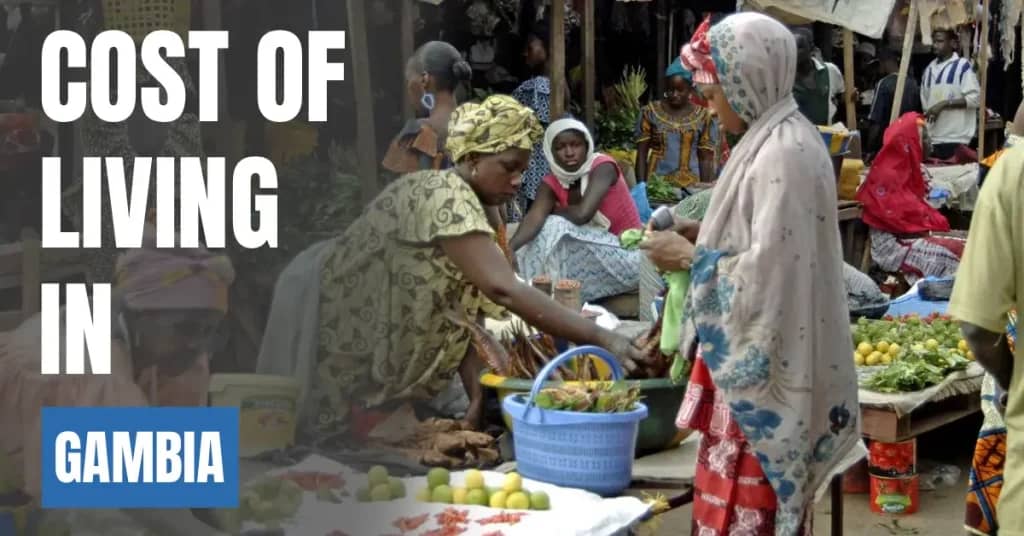
Cost of Living in The Gambia 2026: Rent, Food, Salaries and Monthly Expenses
The cost of living in The Gambia in 2026 can be relatively affordable for people who use local transport, buy locally produced food and rent modest accommodation. However, housing in popular coastal areas, imported groceries, electricity, private healthcare and international schooling can make life considerably more expensive.
On this pageTable of Content
A single person renting independently should consider an estimated monthly budget of D20,000 to D45,000, including rent. A couple may need approximately D30,000 to D65,000, while a family of four may require D45,000 to D100,000 or more, depending on their accommodation and lifestyle.
These are illustrative planning ranges rather than official national averages. Residents sharing accommodation or living in smaller towns may spend less. Expats expecting furnished housing, air conditioning, reliable backup electricity and private services may spend significantly more.
The Gambia's official currency is the Gambian dalasi (GMD), represented by D. This guide uses dalasi as the primary currency. As a currency reference, the Central Bank of The Gambia published a US dollar valuation of approximately D72.16 on October 21, 2026. Exchange rates change, and bank or money-transfer charges may affect the amount received.
Cost of Living in The Gambia at a Glance
A practical starting budget for one person is approximately D12,000 to D25,000 per month excluding rent. With private accommodation, a broader planning range of D20,000 to D45,000 is more appropriate for many newcomers.
| Expense | Estimated Cost in 2026 |
|---|---|
| Single person, excluding rent | D12,000–D25,000 per month |
| Single person, including rent | D20,000–D45,000 per month |
| Couple, including rent | D30,000–D65,000 per month |
| Family of four, including rent | D45,000–D100,000+ per month |
| One-bedroom apartment, Banjul area | Approximately D6,000–D10,000 per month in limited reported market data |
| Three-bedroom apartment, Banjul area | Approximately D10,000–D20,000 per month in limited reported market data |
| Groceries, single person | D6,000–D12,000 per month |
| Basic apartment utilities | D1,500–D3,000 per month in reported observations; heavy cooling can cost more |
| Home broadband internet | D2,500–D5,000 per month in limited reported observations |
| Mobile plan with substantial data | D600–D1,500 per month |
| Local public transport journey | Approximately D10–D25 |
| Inexpensive restaurant meal | Approximately D300–D680 in surveyed outlets |
These estimates combine 2026 crowdsourced price observations with example household budgets. Local markets, basic accommodation and shared services may cost less than the quoted survey categories. Furnished tourist-area properties and imported products may cost substantially more.
Inflation remains important when planning living expenses. The Gambia Bureau of Statistics reported annual inflation of 6.1% in September 2026, while the International Monetary Fund projected average inflation of 7.5% for 2026. These figures measure different periods and should not be treated as contradictory.
Sources: Gambia Bureau of Statistics, IMF 2026 Article IV Consultation and Numbeo Gambia.
How Much Does It Cost to Live in The Gambia Per Month?
A single renter can begin planning around D20,000 to D45,000 monthly, including rent, food, utilities, communications, transport and everyday personal expenses. However, income level, housing expectations and access to local services create large differences between households.
For example, a modest single-person budget might include D8,000 in rent, D2,500 in utilities, D8,000 for groceries, D1,500 for transport, D1,000 for communications and D3,000 for personal expenses. This totals D24,000 per month before any additional medical or insurance expenses.
A foreign professional choosing an air-conditioned furnished apartment near the coast, international groceries and frequent private taxis could need considerably more.
For families, the cost of schooling, larger accommodation, transport and medical care deserves particular attention. Many residents use significantly more economical local arrangements than those typically marketed to international newcomers.
Housing and Rent Prices in The Gambia
Housing is one of the largest and most variable expenses in The Gambia. Rent depends on location, property condition, furnishing, access to electricity and water, security arrangements and proximity to employment or coastal tourist areas.
Monthly Apartment Rent in Banjul and Surrounding Areas
| Property Type | Indicative Monthly Rent |
|---|---|
| One-bedroom, central Banjul | Approximately D7,500 |
| One-bedroom, outside central Banjul | Approximately D6,000 |
| Three-bedroom, central Banjul | Approximately D16,000 |
| Three-bedroom, outside central Banjul | Approximately D10,000 |
| Countrywide one-bedroom, outside centre | D6,000–D10,000 in reported observations |
| Countrywide three-bedroom, central area | D16,000–D20,000 in reported observations |
These are indicative crowdsourced observations from June 2026, not verified nationwide rental averages. Data coverage is particularly limited. Numbeo recorded only 73 countrywide entries from 14 contributors over the preceding 12 months, including 59 Banjul entries from 11 contributors.
Some reported averages are also inconsistent, including cases where an outside-centre apartment appears more expensive than a central one. This reflects limited samples and differing property characteristics, not a reliable rule about the rental market.
New residents should compare current listings and visit properties instead of treating any single average as a guaranteed rental price.
Source: Numbeo Banjul.
Renting in Coastal and Tourist Areas
Popular areas such as Kololi, Kotu, Bakau and parts of the wider coastal urban region attract international residents and visitors. Furnished apartments and houses designed for short stays can carry substantially higher prices than basic long-term local rentals.
Listings may quote prices in foreign currency, especially for tourist-oriented properties. Exchange-rate movements can therefore affect what renters actually pay in dalasi.
Before signing a contract, verify whether electricity, water, cleaning, security, internet access and generator fuel are included. Ask how rent is paid and whether the property is available for a genuine long-term tenancy.
Rental Deposits and Upfront Housing Costs
Tenants should allow for a security deposit, any advance rent permitted by the agreed contract and applicable law, and the cost of connecting utilities or purchasing furnishings.
Some properties require additional spending on water storage, mosquito protection, cooling equipment or backup electricity. These features can have a larger impact on living costs than the advertised rent suggests.
Buying Property in The Gambia
Property prices vary widely across established urban areas, developing communities and coastal locations. Foreign buyers should obtain independent legal advice and verify the land title, leasehold conditions, survey boundaries and all applicable approvals before making a payment.
Ownership and land tenure arrangements should not be assumed to match those in European or North American markets. A low advertised price does not eliminate legal, infrastructure or development risks.
Food and Grocery Prices in The Gambia
A single adult may budget approximately D6,000 to D12,000 per month for groceries, depending on their diet and shopping habits. Locally produced food, seasonal vegetables and staple grains can be more economical than imported packaged foods.
Rice, vegetables, fish and locally available ingredients are important components of many household diets. Imported dairy products, breakfast cereals and speciality products can increase costs.
Typical Grocery Prices in 2026
| Grocery Item | Approximate Price |
|---|---|
| Milk, 1 litre | D80–D180 |
| Fresh bread, approximately 450 g | D23–D90 |
| White rice, 1 kg | D50–D125 |
| Eggs, 12 | D116–D180 |
| Chicken fillets, 1 kg | D200–D1,200 |
| Beef, 1 kg | D325–D450 |
| Bananas, 1 kg | D75–D150 |
| Tomatoes, 1 kg | D50–D150 |
| Potatoes, 1 kg | D50–D80 |
| Bottled water, approximately 1.5 litres | D25–D100 |
These are approximate ranges derived from reported market observations. Some figures are converted from prices originally recorded per pound, so the rounded kilogram values should not be interpreted as precise shop quotations. Product types, retailers and sample sizes vary.
Chicken illustrates the limits of the data: reported countrywide prices have a particularly broad range. The price of local poultry may differ considerably from imported or packaged fillets.
How to Reduce Grocery Spending
Shopping at local markets, buying seasonal produce and cooking at home can reduce food expenses. Residents should also compare the price of imported products with locally available alternatives.
Inflation is an additional concern. According to the Gambia Bureau of Statistics, food and non-alcoholic beverages carried substantial weight in the national consumer price index, meaning food-price changes have a significant effect on household purchasing power.
Source: Gambia Bureau of Statistics Consumer Price Index.
Restaurant and Eating-Out Costs
Eating out in The Gambia can be inexpensive at simple local establishments, but tourist-oriented and international restaurants may be considerably more expensive.
In the limited 2026 market data, an inexpensive restaurant meal typically appears between D300 and D680, while a three-course meal for two at a mid-range restaurant ranges from approximately D4,200 to D7,500.
| Restaurant Expense | Indicative Cost |
|---|---|
| Inexpensive restaurant meal | D300–D680 |
| Mid-range three-course meal for two | D4,200–D7,500 |
| Fast-food-style combo meal | D580–D680 |
| Cappuccino | D150–D600 |
| Soft drink in a restaurant | D60–D250 |
These surveyed restaurant categories should not be taken as typical prices for all Gambian street food or neighbourhood eating places. They may disproportionately reflect businesses serving international customers.
A person relying mainly on home cooking will usually have a lower monthly food budget than someone frequently eating at coastal restaurants.
Utility Costs: Electricity, Water and Cooling
Basic utilities for an apartment may cost around D1,500 to D3,000 monthly in limited reported observations. However, electricity consumption, the use of air conditioning, property size and backup power arrangements can result in significantly higher costs.
Numbeo's 2026 Banjul observations reported approximately D2,250 monthly for basic utilities in an 85-square-metre apartment, covering categories such as electricity, cooling, water and waste services.
This estimate should not be treated as a published tariff from the National Water and Electricity Company (NAWEC). Actual bills depend on metered consumption and applicable utility tariffs.
Electricity and Backup Power
Residents should ask whether electricity supply at the property is sufficiently reliable for their needs. Generators, inverters, batteries and backup solar systems can create substantial upfront or recurring expenses.
Running air conditioning for long periods can increase electricity bills, particularly during hot weather. Before renting, request examples of bills from occupants with comparable usage.
Water Supply and Storage
Water-related costs can include utility charges, stored water, pumping equipment or bottled drinking water. Availability and the need for supplementary storage depend on the property and neighbourhood.
For a household that needs uninterrupted water and power for remote work, healthcare equipment or business activity, reliability may matter as much as the headline utility price.
Internet and Mobile Phone Costs
Home broadband internet in the limited Banjul price observations costs approximately D2,500 to D5,000 monthly for higher-speed unlimited packages. Mobile plans with substantial data allowances were reported around D600 to D1,500 monthly.
Actual offers vary by provider, coverage area, data allowance, network technology and contract terms. These amounts should not be taken as universal minimum prices.
For people working remotely, the cheapest advertised package may not deliver the required speed or reliability at their actual address.
Budget-conscious residents may use mobile data instead of a separate broadband connection, while professionals working online may need both a primary connection and backup access.
Check installation fees, data limits, service availability and power requirements before subscribing.
Transportation Costs in The Gambia
Local minibuses, shared taxis and other road transport services are important for everyday commuting. A local journey may cost approximately D10 to D25, although fares depend on route, distance and transport type.
Unlike a fixed-price urban rail network, local transport spending can vary because a journey may require several separate vehicles or connections.
Public Transport and Shared Taxis
For regular commuters using inexpensive local transport, an illustrative monthly allowance of D500 to D2,000 may cover many journeys. However, actual spending depends on how frequently the person travels, the routes used and the number of transfers required.
There is no verified nationwide free-public-transport entitlement that should be assumed for residents or visitors.
Private Taxis
Private taxis are generally more expensive than shared services. Agree on the fare before travelling when using a vehicle without a clearly applicable meter or published fixed price.
Airport transfers, evening journeys and trips to tourist destinations may cost significantly more than short local commutes.
Fuel and Car Ownership
Fuel observations from 2026 placed petrol around D75 to D82 per litre. These are market observations rather than a guarantee of the current pump price.
Owning a vehicle also involves maintenance, insurance, registration, tyres and repairs. Road conditions and travel requirements can increase maintenance costs, particularly outside major urban routes.
Someone planning to commute by car should create a separate fuel and vehicle budget rather than relying on the relatively inexpensive public transport estimates.
Healthcare Costs in The Gambia
Healthcare is not universally free for all residents and foreign visitors. The Gambia has public and private healthcare facilities, but patients may still face charges for consultations, medicines, tests, procedures and services not covered by public programmes.
Costs and available treatment vary between facilities and regions. Access to specialised care can be more limited outside the main urban areas.
Public Healthcare
Public facilities provide essential services, but service availability, waiting periods, medical supplies and financial arrangements may differ between locations and treatment types.
Some public health programmes may provide specific services without direct charges to eligible groups. This should not be interpreted as a guarantee that all healthcare services are free.
Private Clinics and Hospitals
Private healthcare may offer a different range of services, but consultation charges alone do not indicate the total cost of treatment. Diagnostic testing, medicines, admission, procedures and specialist care can substantially increase the final bill.
Published market-wide private consultation prices are not sufficiently reliable to provide one representative 2026 rate for the country. Patients should request an itemised quotation from the actual facility.
Health Insurance and Financial Protection
The World Health Organization's Gambia Health Observatory reports out-of-pocket expenditure accounting for approximately 29.8% of total health expenditure in its displayed dataset. This demonstrates the importance of personal financial protection, although the figure should not be interpreted as the share every individual patient pays.
The Gambia has pursued reforms to improve healthcare financing and universal health coverage, but the existence of these initiatives does not establish that every resident has comprehensive insurance coverage.
Foreign residents should check whether their health policy covers emergency treatment, hospitalisation, prescription medicines and medical evacuation if specialist care is unavailable locally.
Source: WHO African Health Observatory.
Education and Childcare Costs
Public education in The Gambia is generally more affordable than private or international schooling. However, families should distinguish tuition policies from additional school-related expenses.
Public Schools
Government education policy abolished formal fees and levies in public basic and secondary education and introduced School Improvement Grants to help schools meet operating costs.
Households may still have expenses for uniforms, stationery, transport and other school-related needs.
The 2026 government budget allocated D5.9 billion to the Ministry of Basic and Secondary Education, including D352.4 million for School Improvement Grants and D230.9 million for examination fees.
These allocations support public education but do not mean every possible educational expense is covered for every child.
Source: Ministry of Finance and Economic Affairs, 2026 Education Budget.
Private and International Schools
Private and international school tuition depends heavily on the institution, curriculum, year group and facilities. School fees may also be accompanied by registration charges, uniforms, books, examinations, meals and transport.
Although crowdsourced data contain some very low reported school-cost figures, the limited samples are not sufficient to establish a dependable national international-school tuition average.
Families relocating with school-age children should obtain current written fee schedules directly from shortlisted schools.
Childcare and Preschool
Childcare costs depend on the availability of family support, nursery services, location and hours of care. Private full-day childcare should be budgeted separately from basic household spending.
Reliable nationwide childcare price information is limited, so a local quotation is more useful than an unverified national average.
Salaries and Employment Income in The Gambia
Salary levels in The Gambia vary considerably between occupations, employers and industries. Income from local informal employment may differ substantially from salaries paid by international organisations, NGOs and foreign businesses.
Reliable current national average and median monthly wage figures were not established from the reviewed sources. Consequently, this guide does not present a single crowdsourced salary figure as an official national benchmark.
Numbeo's limited 2026 country observations listed an average after-tax monthly salary of approximately D4,333. This figure is based on a small contributor pool and cannot be assumed to represent the national workforce.
It is nevertheless useful as an affordability warning: a private apartment costing D8,000 monthly could be beyond the means of a worker earning D4,333 net per month.
The country's lower nominal consumer prices should therefore be considered alongside the earnings actually available to residents.
What Is the Minimum Wage in The Gambia in 2026?
The Gambia does not have a single verified nationwide minimum wage amount that applies uniformly to every occupation. WageIndicator's June 2026 information identifies minimum wage arrangements negotiated at Joint Industrial Council level rather than a universal national wage figure.
This distinction matters because some older internet summaries present a single low daily rate without clearly explaining its legal scope, effective date or applicable industry.
Workers and employers should check the applicable employment agreement, industry arrangement and current labour requirements before relying on a minimum wage quotation.
Even where an applicable minimum rate exists, it should not be confused with the income needed to rent independent accommodation and support a household.
Source: WageIndicator, Minimum Wage in The Gambia.
Income Taxes and Everyday Affordability
Employment income may be subject to Pay As You Earn (PAYE) tax, while other personal or business income can be subject to different rules. The amount remaining after deductions is more relevant to a household budget than gross salary.
The Gambia Revenue Authority explains that personal income tax obligations vary according to the source and nature of income. It also distinguishes employment taxation from business-income arrangements.
Foreign workers should verify residency status, taxable income, payroll deductions and any applicable tax obligations before accepting an employment package.
Imported goods and services may also carry taxes and charges that influence retail prices. For practical budgeting, compare the final consumer price rather than assuming a low import or wholesale price will be available locally.
Source: Gambia Revenue Authority, Domestic Taxes FAQs.
Realistic Monthly Budget Examples for The Gambia
The following budgets are illustrative examples built from the expense categories discussed in this guide. They include rent and assume long-term accommodation rather than hotels or holiday rentals.
They are not official household expenditure statistics. They exclude major emergencies, international school tuition, large immigration fees and significant upfront relocation costs.
Budget-Conscious Single Person
This example assumes shared or inexpensive local accommodation, mainly home-prepared meals and regular use of local public transport.
| Expense | Monthly Cost |
|---|---|
| Rent | D5,000 |
| Utilities | D1,000 |
| Groceries | D6,000 |
| Transport | D800 |
| Internet and mobile | D700 |
| Healthcare allowance | D500 |
| Dining, clothing and personal spending | D2,000 |
| Total Including Rent | D16,000 |
Expenses excluding rent total D11,000. This lean budget depends on low-cost housing, economical food choices and avoiding frequent private services. It is not a suitable assumption for every expat or private renter.
Moderate Single Person
This example assumes a modest private apartment, regular grocery shopping, basic communications and a reasonable personal spending allowance.
| Expense | Monthly Cost |
|---|---|
| Rent | D9,000 |
| Utilities | D2,500 |
| Groceries | D9,000 |
| Transport | D2,000 |
| Internet and mobile | D3,000 |
| Healthcare allowance | D1,500 |
| Dining, clothing and leisure | D4,000 |
| Total Including Rent | D31,000 |
Expenses excluding rent total D22,000. The healthcare figure is a savings allowance, not a verified insurance premium. Heavy use of air conditioning or private taxis could increase spending.
Couple Sharing Accommodation
This example assumes two adults sharing a private home, one home internet connection and moderate grocery and personal spending.
| Expense | Monthly Cost |
|---|---|
| Rent | D12,000 |
| Utilities | D3,500 |
| Groceries | D15,000 |
| Transport | D3,000 |
| Internet and mobile | D3,500 |
| Healthcare allowance | D2,000 |
| Dining, clothing and leisure | D6,000 |
| Total Including Rent | D45,000 |
Expenses excluding rent total D33,000. The couple can save on accommodation and shared services compared with two separate households.
Family of Four
This example assumes two adults and two children, a larger rented home, public schooling where appropriate and moderate household consumption. It excludes private international-school tuition.
| Expense | Monthly Cost |
|---|---|
| Rent | D20,000 |
| Utilities | D5,000 |
| Groceries | D24,000 |
| Transport | D5,000 |
| Internet and mobile | D4,000 |
| Healthcare allowance | D3,000 |
| School supplies and childcare | D4,000 |
| Clothing, dining and leisure | D8,000 |
| Total Including Rent | D73,000 |
Expenses excluding rent total D53,000. Private schooling, additional childcare, owning a vehicle or renting higher-end coastal housing could raise the monthly total considerably.
Cost of Living by City and Area in The Gambia
The greatest differences between Gambian locations often involve housing availability, employment access, transport and infrastructure rather than a single nationwide consumer price level.
Banjul
Banjul is the country's capital and administrative centre. Housing availability and prices depend on the specific property and access to surrounding employment areas. Limited crowdsourced estimates suggest one-bedroom rentals around D6,000 to D7,500, but individual listings can differ substantially.
Serrekunda
Serrekunda is a major commercial and residential area. It offers access to markets, local transport and employment activity. Housing quality and rental costs vary by neighbourhood, making property-specific comparisons especially useful.
Bakau, Kololi and Kotu
These coastal areas attract tourists and international residents. Furnished accommodation and properties near popular visitor facilities may command higher rents than ordinary local housing.
Residents should also consider service charges, electricity consumption and reliance on private transport.
Brikama
Brikama can offer alternatives to central coastal accommodation. However, commuting distance, road conditions and job location should be considered before choosing a cheaper property.
Rural and Upcountry Areas
Housing may be less expensive in smaller towns and rural communities, but reliable utilities, specialised healthcare, broadband access and certain consumer products may be less accessible.
Lower rent does not always translate into lower overall spending if a household must travel regularly or pay for additional infrastructure.
Is The Gambia Cheaper Than Senegal, Ghana and Nigeria?
The Gambia may offer comparatively inexpensive local housing and transport, but reliable 2026 data do not establish that it is cheaper than Senegal, Ghana or Nigeria for every household or spending category.
For a person comparing The Gambia with Senegal, the most relevant comparison may be between Greater Banjul and Dakar rather than between broad national averages.
Imported products, exchange rates, housing standards, wages and access to public services vary across all these countries.
Country rankings based on small crowdsourced samples can be particularly misleading. A better relocation comparison includes actual rent quotes, expected net income, grocery requirements, healthcare access and commuting costs in the intended cities.
Hidden Costs of Living in The Gambia
New residents should prepare for costs that may not appear in typical online living-cost summaries.
- Rental deposits, advance rent and any applicable agency charges.
- Air conditioning and higher electricity consumption.
- Generators, backup batteries, solar systems and fuel.
- Water storage, pumps or supplementary water purchases.
- Private medical treatment, medication and emergency care.
- Medical evacuation or international health insurance.
- Internet installation and backup mobile connectivity.
- Vehicle repairs, registration, insurance and road-related maintenance.
- Imported groceries, furniture and household equipment.
- Immigration fees and identity documentation.
- School registration, uniforms, supplies and transport.
- Currency conversion charges and changes in exchange rates.
Some expenses are occasional rather than monthly. Nevertheless, they should be included in the total amount of savings needed before relocation.
Cost of Living Versus Residence Permit Requirements
A household's personal living budget is different from the administrative requirements for obtaining residence documentation in The Gambia.
The Gambia Immigration Department publishes residence permit and identification fees according to permit category and whether the applicant is an ECOWAS or non-ECOWAS national.
| Immigration Document | Published Fee |
|---|---|
| Residence Permit A, ECOWAS | D3,100 |
| Residence Permit B, ECOWAS | D3,600 |
| Residence Permit A, non-ECOWAS | D5,700 |
| Residence Permit B, non-ECOWAS | D7,700 |
| Alien Card, non-ECOWAS | D2,500 |
| Non-Gambian Identity Card | D750 |
These are published administrative fees, subject to change. They are not monthly living expenses or proof-of-funds thresholds.
The department identifies documentation such as a passport, evidence establishing identity and status, and additional category-specific requirements. Applicants should verify whether further employment, tax or supporting documents are needed.
A universal minimum bank balance or monthly financial-resources threshold was not verified for all residence categories. Applicants should therefore avoid assuming that a self-calculated cost-of-living budget automatically satisfies immigration requirements.
Source: Gambia Immigration Department, Residential Permit.
What Salary Is Needed to Live Comfortably in The Gambia?
For a single person renting a modest private apartment, approximately D35,000 to D50,000 in monthly take-home income may provide more flexibility than a strict subsistence budget. A couple may prefer a combined net income of D50,000 to D70,000, while a family with children could require D80,000 to D110,000 or more.
These are illustrative comfort targets, not official salary requirements or average earnings. They assume different household needs and allow some flexibility above the sample budgets.
Someone receiving income in foreign currency may have greater purchasing power than many locally paid workers. However, inflation, exchange-rate changes and imported consumer goods can still affect affordability.
People considering employment in The Gambia should compare the expected net salary with actual accommodation, transport and healthcare costs before accepting an offer.
Is The Gambia Affordable for Expats and Retirees?
The Gambia can be affordable for expats and retirees who choose modest accommodation, use local services and have a stable income. However, it is not automatically inexpensive for those seeking international-standard housing, extensive private healthcare or imported consumer products.
Healthcare planning is particularly important for retirees, who may require regular medication or specialist treatment. Families should consider school availability and education fees before relocating.
Remote workers need to evaluate internet reliability, electricity backup and the legal conditions of their stay.
Affordability for local residents is also a separate question. A relatively low price expressed in foreign currency can still represent a significant expense compared with local wages.
For a practical assessment, compare the actual cost of the intended lifestyle with reliable income, not just the country's reputation as a budget destination.
Final Thoughts on Living Costs in The Gambia
The Gambia offers a range of living arrangements, from economical local housing to more expensive furnished coastal properties. Day-to-day expenses can be manageable for people who buy local food, use shared transport and keep housing costs under control.
A single renter can begin planning around D20,000 to D45,000 per month including rent, while a family of four may need D45,000 to D100,000 or more, depending on education, housing and transport choices.
However, these are estimated planning ranges, not official national cost averages. Limited local price data, inflation and differences in household standards make it important to check actual quotes.
Before relocating, compare rental properties, calculate take-home income, review healthcare arrangements, check residence documentation and maintain savings for unexpected expenses.
Sources and Methodology
This article was reviewed on October 23, 2026. It uses official government information, the Gambia Bureau of Statistics, the Central Bank of The Gambia, the International Monetary Fund, the World Health Organization, immigration guidance and 2026 crowdsourced consumer-price observations.
Official sources are prioritised for inflation, immigration fees, education policy and tax guidance. Numbeo is used for indicative rental and consumer prices, not as an official national statistical survey.
The available crowdsourced data are limited. As of June 2026, the Gambia dataset contained only 73 entries from 14 contributors over the preceding 12 months. Banjul observations were also limited. Certain categories have unusually wide ranges or inconsistent results.
For these reasons, the sample budgets are editorial calculations using approximate expense allowances. They are not official averages or guaranteed market prices. Multiple information sources were compared where appropriate, and unsupported national salary or universal minimum-wage figures were not presented as established facts.
Consumer prices, rental agreements, utility tariffs, immigration fees and exchange rates can change. Readers should request current quotations before making major financial decisions.
References
- Gambia Bureau of Statistics: Economy and Inflation Data
- Gambia Bureau of Statistics: Consumer Price Index
- Central Bank of The Gambia: Exchange Rates and Monetary Indicators
- Central Bank of The Gambia: Inflation Data
- International Monetary Fund: The Gambia 2026 Article IV Consultation
- Numbeo: Cost of Living in The Gambia
- Numbeo: Cost of Living in Banjul
- WageIndicator: Minimum Wage in The Gambia
- Gambia Revenue Authority: Domestic Tax Information
- Gambia Immigration Department: Residence Permit Requirements and Fees
- Ministry of Finance: 2026 Education Budget
- Ministry of Basic and Secondary Education
- World Health Organization: African Health Observatory
Frequently Asked Questions
How much does it cost to live in The Gambia per month in 2026?
A single person renting independently may need approximately D20,000 to D45,000 per month, including rent and ordinary living expenses. Costs excluding rent may be around D12,000 to D25,000. Shared accommodation and local shopping can reduce expenditure, while furnished coastal housing, private transport and imported products can increase it. These are planning estimates rather than official averages.
How much is rent in The Gambia?
Limited 2026 price observations suggest one-bedroom apartments in the Banjul area may rent for roughly D6,000 to D10,000 monthly. Larger apartments can cost D10,000 to D20,000 or more. Furnished coastal properties may be considerably more expensive. Because the available rental samples are small, prospective tenants should compare actual long-term listings and check whether utilities are included.
What salary is enough to live comfortably in The Gambia?
A single private renter may target approximately D35,000 to D50,000 in monthly net income for a more flexible budget. A couple or family typically needs more, depending on household size and accommodation. These are practical planning targets, not official minimum salary requirements. Many locally paid workers earn less, which makes living arrangements and income sources especially important.
What is the minimum wage in The Gambia in 2026?
A single universal national minimum-wage amount could not be verified for 2026. WageIndicator identifies wage arrangements established at Joint Industrial Council level rather than one nationwide rate applying to every industry. Workers should check the rules for their occupation and employment agreement. A legally applicable minimum wage should not be confused with the income required for comfortable independent living.
Is healthcare free in The Gambia?
Healthcare is not universally free for every resident or foreign visitor. Public services and specific programmes may provide subsidised or covered treatment, but medicines, tests, private consultations and other services can create out-of-pocket expenses. WHO data show that direct household payments remain an important component of health financing. Foreign residents should consider comprehensive medical insurance and emergency-care arrangements.
How much does a family of four need in The Gambia?
A family of four may need approximately D45,000 to D100,000 or more per month including rent, depending on housing, schooling and transport choices. An illustrative budget of D73,000 covers rent, groceries, utilities, transport, communications and modest education-related spending. International school tuition, major medical expenses, private vehicle ownership and higher-end housing can increase the required amount significantly.
Is public transportation cheap in The Gambia?
Local minibuses and shared taxis can be inexpensive, with reported single journeys commonly costing around D10 to D25. However, fares depend on distance, route and vehicle type. Commuters requiring several connections or frequent private taxis will spend more. There is no verified nationwide programme providing free public transportation to all residents.
How expensive are groceries in The Gambia?
A single adult can consider approximately D6,000 to D12,000 monthly for groceries, depending on dietary needs. Local produce and staple foods may be more economical than imported products. Reported 2026 prices include around D80 to D180 for a litre of milk and D116 to D180 for 12 eggs. Prices vary by shop, brand and season.
Which areas are cheaper to live in The Gambia?
More modest housing in residential districts and towns outside the most popular tourist areas may be cheaper than furnished coastal accommodation. Brikama and some parts of Serrekunda may offer alternatives, depending on property availability. However, lower rent should be weighed against commuting costs, electricity and water reliability, internet access and distance from healthcare facilities.
Is The Gambia cheaper than Senegal?
The Gambia may be less expensive for certain types of accommodation and everyday services, but the reviewed evidence does not establish a reliable nationwide price difference for 2026. Costs vary substantially between Banjul, Dakar and smaller communities. A meaningful comparison should use actual rents, grocery requirements, net salaries, transport expenses and healthcare arrangements in the intended locations.
How much does a residence permit cost in The Gambia?
The Gambia Immigration Department publishes residence permit fees of D3,100 to D3,600 for ECOWAS applicants and D5,700 to D7,700 for non-ECOWAS applicants, depending on permit category. Additional identity-card fees may apply. These charges are administrative costs, not monthly living expenses or evidence of sufficient financial resources. Requirements and fees should be confirmed before applying.
What hidden expenses should expats consider in The Gambia?
Important overlooked expenses include rental deposits, backup electricity, generator fuel, water storage, imported household products, private healthcare and residence documentation. Remote workers may also require a second internet connection. Families should research school fees and transport, while retirees should consider specialist medical care and evacuation coverage. Maintaining extra savings can reduce relocation-related financial pressure.
Join the conversation
Have thoughts on this topic? Share them with others.
Ask questions, share experience, and learn from the Visaboards Community.