
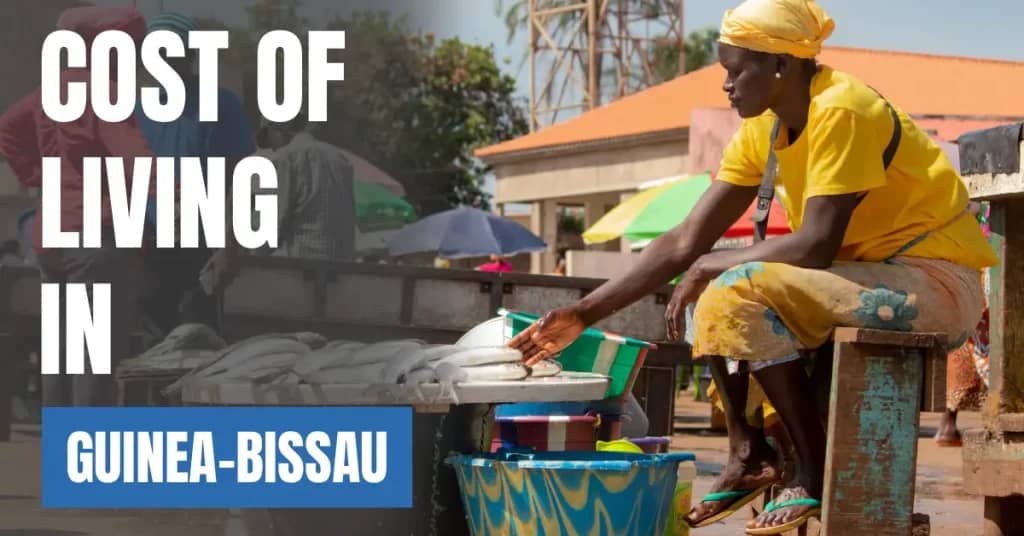
Cost of Living in Guinea-Bissau 2026: Rent, Salaries and Monthly Expenses
The cost of living in Guinea-Bissau in 2026 depends on accommodation, household size, access to reliable electricity and the use of imported goods. The country offers relatively inexpensive local food and shared transportation, but modern housing, healthcare, internet access and dependable utilities can make life considerably more expensive than basic price comparisons suggest.
On this pageTable of Content
A budget-conscious single person may need approximately XOF 200,000 to XOF 350,000 per month including modest accommodation. Someone renting a more comfortable property in Bissau could budget XOF 400,000 to XOF 800,000 or more. These are illustrative planning ranges rather than official national averages.
Guinea-Bissau uses the West African CFA franc (XOF), which is fixed to the euro at EUR 1 = XOF 655.957. This provides exchange-rate stability against the euro, although prices of imported goods can still fluctuate.
According to the World Bank's June 2026 Economic Update, inflation decreased to 0.9% in 2025, but higher international food and energy costs remained important risks during 2026. The International Monetary Fund's 2026 projections also indicate moderate inflation, although forecasts can change.
Cost of Living in Guinea-Bissau at a Glance
Living expenses are generally lower for people using local markets, shared transport and simpler accommodation. Households requiring air conditioning, backup power, private healthcare and imported products should expect higher spending.
| Expense | Estimated Cost in XOF | Basis |
|---|---|---|
| Single person, basic living expenses | 110,000-230,000 | Monthly, excluding rent |
| Single person, moderate living expenses | 250,000-500,000 | Monthly, excluding rent |
| Budget-conscious single person | 200,000-350,000 | Monthly, including modest rent |
| Moderate single person | 400,000-800,000 | Monthly, including rent |
| Small furnished studio | 90,000-120,000 | Monthly, limited reported market examples |
| Larger furnished accommodation | Approximately 200,000+ | Monthly, premium-market example |
| Groceries for one adult | 60,000-130,000 | Monthly planning allowance |
| Electricity, water and cooking fuel | 25,000-100,000+ | Monthly, consumption dependent |
| Internet and mobile | 10,000-40,000+ | Monthly allowance |
| Basic shared transport | 10,000-35,000 | Monthly illustrative commute |
| Private-sector minimum wage | 50,000 | Monthly, announced October 2026 |
Data limitation: Guinea-Bissau has very limited publicly available consumer-price observations. These are broad planning estimates combining reported prices with illustrative household budgets. They are not official nationwide averages or guaranteed quotations.
Expatistan's available country estimate places monthly living costs at approximately XOF 806,780 for one person and XOF 1,682,272 for a family of four. However, the database explicitly warns that its calculations use only a few data points. Its relatively expensive household basket should not be treated as representative of every local resident.
How Much Does It Cost to Live in Guinea-Bissau Per Month?
A single person living economically may budget approximately XOF 200,000 to XOF 350,000 per month including modest rent. A person seeking independent furnished accommodation, dependable connectivity and more private services may require XOF 400,000 to XOF 800,000 or more.
The amount depends particularly on whether accommodation is shared or privately rented. Someone living in family-owned housing may spend much less than a newcomer securing accommodation on the commercial rental market.
The existing VisaBoards guide previously estimated monthly living expenses of USD 450 to USD 800 for singles, USD 800 to USD 1,300 for couples and USD 1,000 to USD 1,800 for families. These estimates are useful as historical planning references but lack a complete supporting methodology and should not be interpreted as verified 2026 household averages.
People relocating to Guinea-Bissau should obtain actual housing quotations and account for electricity reliability, medical needs, school fees and travel before finalising a budget.
Housing and Rent Prices in Guinea-Bissau
Housing costs vary substantially depending on location, property size, furnishing and access to utilities. Bissau has the greatest concentration of commercial accommodation, international organisations and higher-standard rental properties.
How Much Is Rent in Bissau?
A small furnished studio in Bissau may cost approximately XOF 90,000 to XOF 120,000 per month in reported market examples. Larger furnished properties and accommodation in expensive areas may cost XOF 200,000 or considerably more.
| Property Type | Indicative Monthly Rent |
|---|---|
| 45 m² furnished studio, normal area | XOF 90,000 |
| 45 m² furnished studio, expensive area | XOF 120,000 |
| 85 m² furnished accommodation, expensive area | XOF 200,000 |
| Modern apartment or larger family home | Property-specific quotation required |
These are reported examples from Expatistan, not verified median rents. Its limited sample means figures should be checked against current listings and local agents.
Another provider, Wise, lists substantially higher dollar-denominated estimates for one-bedroom and three-bedroom apartments. The disagreement illustrates how small samples, property standards and different collection methods can produce very different housing figures.
What Should Tenants Check Before Renting?
Renters should confirm the property's electricity arrangements, water supply, security, furnishing and maintenance responsibilities.
- Verify whether rent includes electricity, water and waste collection.
- Check whether backup power is available and who pays for fuel.
- Ask about water storage and whether additional deliveries are necessary.
- Confirm internet availability at the exact address.
- Inspect the property and obtain a written lease.
- Verify deposit terms, advance payments and the authority of the landlord or agent.
Local rental contracts can involve advance payments and negotiations that differ from standard international arrangements. Because reliable current evidence on legally permitted advance periods is limited, tenants should confirm applicable rules before transferring money.
Groceries and Food Prices
Food is often relatively affordable when households purchase local staples and seasonal produce. Rice, fish, vegetables, fruit and locally prepared meals are central to everyday consumption. Imported food products are generally more expensive and may be affected by freight costs and supply interruptions.
Typical Grocery Prices in Guinea-Bissau
| Grocery Item | Reported Reference Price |
|---|---|
| Milk, 1 litre | XOF 1,000-1,400 |
| White rice, 1 kg | Approximately XOF 1,200 |
| Eggs, 12 | XOF 3,000-5,800 |
| Chicken fillets, 1 kg | Highly variable, roughly XOF 2,000-8,000 in available samples |
| Bananas, 1 kg | Approximately XOF 600 |
| Potatoes, 1 kg | Approximately XOF 600-800 |
Prices are drawn from limited observations published by Numbeo and Expatistan. Some reported prices conflict significantly, particularly for fresh produce and chicken. They should be treated as examples rather than reliable nationwide retail averages.
For monthly planning, a single person might allocate XOF 60,000 to XOF 130,000 for groceries, while a family of four might allow XOF 150,000 to XOF 300,000 or more depending on food preferences.
Purchasing local ingredients and cooking at home generally reduces expenses. A diet dependent on imported dairy, processed food and specialist ingredients can cost substantially more.
Restaurants and Eating Out
Eating out in Guinea-Bissau can be inexpensive at local food stalls, but restaurant meals aimed at business travellers and international visitors are considerably more expensive.
Expatistan reports an approximate price of XOF 4,391 for a basic lunchtime meal with a drink in a business district and XOF 8,500 for a fast-food combination meal. These are limited-sample references, not fixed menu prices.
| Dining Expense | Planning Estimate |
|---|---|
| Basic local prepared meal | XOF 1,500-3,500 |
| Business-district restaurant lunch | Approximately XOF 4,400 |
| Fast-food combination meal | Approximately XOF 8,500 |
| Dining and occasional leisure for one person | XOF 15,000-60,000 monthly |
Only the business lunch and fast-food figures are directly drawn from Expatistan observations. Other amounts are illustrative budgeting allowances and should be checked locally.
Frequent restaurant dining can quickly increase household spending. For example, purchasing a XOF 4,400 lunch on 20 working days would cost XOF 88,000 per month, excluding breakfast, dinner and drinks.
Utilities: Electricity, Water and Cooking Gas
Utility costs depend on consumption, property size and whether the household requires backup power or independent water arrangements. Reliable electricity is a practical budgeting consideration rather than simply a monthly billing expense.
Expatistan reports approximately XOF 48,279 monthly for basic utilities in a small furnished studio and approximately XOF 100,000 for two people in an 85 m² apartment. These figures are based on limited observations and may not reflect typical local households.
The International Monetary Fund reported in March 2026 that reforms in the electricity sector had improved cost recovery and expanded connectivity, while additional power capacity remained an important policy objective.
Households should ask whether utilities are billed separately and whether electricity supply, generator fuel or water delivery will create additional expenses.
Internet and Mobile Phone Costs
Internet affordability depends on the available provider, connection type, data allowance and service reliability. Fixed broadband coverage is not equally available throughout Guinea-Bissau.
Expatistan lists a limited-sample reference of approximately XOF 5,000 monthly for an 8 Mbps connection, but this should not be assumed to represent currently available packages at every address.
For practical planning, someone using mobile data and home connectivity might allow XOF 10,000 to XOF 40,000 or more per month. This is a constructed allowance rather than an official provider tariff.
Remote workers should confirm connection speed, network coverage, backup data options and electricity reliability before signing a long-term accommodation agreement.
Transportation Costs in Guinea-Bissau
Shared taxis, minibuses and motorcycle taxis provide relatively economical transport in urban areas. However, commuting costs depend on the route, frequency and the availability of services.
The earlier VisaBoards article described low fares for local transport, but its published prices were expressed in dollars without a documented source. A formal nationwide monthly transport-pass system also could not be verified.
For a person using shared transport regularly, XOF 10,000 to XOF 35,000 monthly can serve as an initial planning allowance. This is not a regulated national fare estimate.
Private taxis, vehicle maintenance, insurance and fuel add substantially to spending. The World Bank's 2026 assessment identified imported fuel-price pressures as an important risk to the country's economy.
Healthcare Costs and Medical Insurance
Healthcare in Guinea-Bissau should not be assumed to be universally free. Public services exist, but access, medicine availability, staffing and specialist services vary. Private healthcare and treatment abroad may generate significant additional expenses.
The World Health Organization tracks Guinea-Bissau's progress toward universal health coverage, but progress toward coverage does not mean every resident automatically receives all treatments without payment.
Public Versus Private Healthcare
Public facilities may provide lower-cost treatment, while private providers can charge more for consultations, diagnostics and medicines. Availability is especially important for patients needing specialist care, surgery or ongoing treatment.
The original VisaBoards page estimated doctor visits at USD 5 to USD 10 and specialist visits at USD 10 to USD 20. However, these amounts are not supported by sufficiently detailed current facility-level quotations to be presented as verified national prices.
Residents should request current prices from the intended clinic or hospital. Expatriates should assess private medical insurance and emergency evacuation coverage, particularly when specialist treatment may not be available locally.
Education and Childcare
Public and private education have different costs. Public schooling can involve lower direct tuition expenses, but families may still need to pay for uniforms, textbooks, school transport, supplies and meals.
Private schools can charge tuition and administrative fees, while international education may be substantially more expensive.
The original VisaBoards guide estimated private-school fees at USD 100 to USD 800 annually and international-school fees at USD 1,000 to USD 4,000 annually. These figures are not independently verified current school quotations and should not be used as universal 2026 rates.
Families should request complete fee schedules from the specific school, including registration, tuition, transport, meals and examination charges.
In rural areas and smaller towns, school availability and transport requirements may matter more than headline tuition costs.
Salaries and Minimum Wage in Guinea-Bissau
Guinea-Bissau's government set a monthly minimum wage of XOF 50,000 for the private sector in an announcement reported on October 1, 2026. The amount matches the minimum wage that had been applied in the public sector for several years.
This is an important development because older international databases continue to display a minimum wage of approximately XOF 19,030 per month. The October announcement is more recent and should take priority when discussing the reported current private-sector wage floor, subject to confirmation of the applicable implementing instrument.
According to Deutsche Welle's October 1, 2026 report, trade-union representatives welcomed the new minimum but warned that XOF 50,000 monthly remained insufficient to cover basic living expenses.
For example, a minimum-wage worker would earn substantially less than the XOF 90,000 monthly rent listed for a furnished studio in Expatistan's limited housing sample. This illustrates the affordability difficulties faced by workers renting independently at commercial market rates.
What Salary Is Needed to Live Comfortably?
A single person paying market rent may need approximately XOF 400,000 to XOF 800,000 in take-home income for a moderate lifestyle in Bissau, depending on housing standards and personal spending.
A couple sharing housing expenses may be able to manage with less per person, while families requiring private healthcare, reliable utilities and schooling will need a higher combined income.
These figures are illustrative living-budget targets, not estimates of average local earnings. Available salary datasets are too limited to establish a reliable national 2026 average salary.
Taxes and Take-Home Pay
Formal workers should consider income tax and social security deductions when assessing salary offers. Gross income does not necessarily represent the amount available for rent and living expenses.
An IMF analysis published in 2025 described Guinea-Bissau's personal income tax rate as approximately 20% in its comparative assessment and reported social security contribution rates of 8% for employees and 14% for employers, alongside additional work-accident insurance costs.
These figures describe the IMF's assessed framework and should not be treated as a complete individual payroll calculation. Actual deductions depend on current legislation, taxable earnings and employment arrangements.
Before accepting a job, workers should ask the employer for a written net-pay calculation and details of registration, insurance and social contributions.
Realistic Monthly Budgets for Guinea-Bissau
The following are constructed monthly budget examples designed to help readers calculate their own costs. All budgets include rent and normal monthly expenses, but exclude relocation costs, large medical bills, major travel, immigration fees and substantial unexpected purchases.
Budget 1: Budget-Conscious Single Person
Assumptions: a modest studio or shared accommodation, mainly local groceries, shared transport and limited leisure expenses.
| Expense | Monthly Cost |
|---|---|
| Rent | XOF 90,000 |
| Utilities | XOF 30,000 |
| Groceries | XOF 70,000 |
| Transport | XOF 15,000 |
| Internet and mobile | XOF 15,000 |
| Healthcare allowance | XOF 10,000 |
| Dining, leisure and miscellaneous | XOF 20,000 |
| Total Including Rent | XOF 250,000 |
Budget 2: Moderate Single Person in Bissau
Assumptions: furnished accommodation, higher utility consumption, more varied groceries, paid transport and occasional restaurant dining.
| Expense | Monthly Cost |
|---|---|
| Rent | XOF 200,000 |
| Utilities | XOF 75,000 |
| Groceries | XOF 120,000 |
| Transport | XOF 45,000 |
| Internet and mobile | XOF 25,000 |
| Healthcare and insurance allowance | XOF 40,000 |
| Dining, leisure and miscellaneous | XOF 75,000 |
| Total Including Rent | XOF 580,000 |
Budget 3: Couple Sharing Accommodation
Assumptions: a couple renting furnished accommodation, sharing utilities and groceries, with regular transport and occasional leisure spending.
| Expense | Monthly Cost |
|---|---|
| Rent | XOF 220,000 |
| Utilities | XOF 85,000 |
| Groceries | XOF 180,000 |
| Transport | XOF 60,000 |
| Internet and mobile | XOF 35,000 |
| Healthcare and insurance allowance | XOF 60,000 |
| Dining, leisure and miscellaneous | XOF 90,000 |
| Total Including Rent | XOF 730,000 |
Budget 4: Family of Four
Assumptions: two adults and two children renting larger accommodation, with regular household expenses, an allowance for schooling and some private medical costs. This budget does not include premium international schooling.
| Expense | Monthly Cost |
|---|---|
| Rent | XOF 300,000 |
| Utilities | XOF 120,000 |
| Groceries | XOF 280,000 |
| Transport | XOF 100,000 |
| Internet and mobile | XOF 45,000 |
| Healthcare and insurance allowance | XOF 100,000 |
| Education and childcare | XOF 150,000 |
| Dining, clothing, leisure and miscellaneous | XOF 130,000 |
| Total Including Rent | XOF 1,225,000 |
Real family expenses can be much lower when housing is owned or shared, or significantly higher when premium accommodation, international education or medical evacuation insurance is required.
Cost of Living by City and Region
Living costs differ between Bissau and smaller cities, but reliable comparable city-level datasets are scarce. It is therefore more useful to evaluate local accommodation and service availability than to rely on unsupported city rankings.
Bissau
Bissau is the capital and the country's main administrative and commercial centre. It has more options for modern rentals, international services and private healthcare, but these conveniences can increase the cost of living.
Bafatá
Bafatá may provide simpler housing and local shopping options at lower prices than premium accommodation in Bissau. However, the availability of specialist services and suitable rental properties may be limited.
Gabú
Gabú serves as a regional trading centre. Local markets can support more economical daily spending, while limited accommodation choices and transport needs may offset some savings.
Bolama
Bolama has a smaller property and service market. Availability of suitable housing, transportation, electricity and healthcare should be considered before relocating.
Bijagós Islands
Island living may appear affordable in terms of basic local consumption, but transport, imported supplies, medical access and electricity arrangements can create substantial additional expenses. Island costs should not be assumed to be lower than mainland costs.
Guinea-Bissau Compared With Nearby Countries
Guinea-Bissau shares the West African CFA franc with Senegal, which simplifies direct currency comparisons. However, wages, housing availability, imported goods and household consumption differ between the two countries.
Premium housing in Dakar can be more expensive than many properties in Bissau, but this does not establish that all living costs in Senegal are higher.
Comparisons with Guinea and The Gambia also require caution. These countries use different currencies, and exchange-rate movements can significantly affect relative prices.
Because matched, current household-level price datasets are limited, claims that Guinea-Bissau is categorically cheaper than its neighbours should be avoided. Compare actual rent, food and transport quotations for the relevant cities.
Hidden Costs New Residents Often Overlook
- Advance rent and deposits: Significant initial payments may be required before moving in.
- Backup electricity: Generators, fuel, batteries or other systems can increase both initial and monthly costs.
- Water storage: Additional equipment or water delivery may be necessary.
- Imported goods: Electronics, appliances, specialist foods and medical supplies may carry substantial price premiums.
- Healthcare emergencies: Specialist treatment and travel for medical care can be costly.
- Schooling: Registration, uniforms, supplies and transport are additional to tuition.
- Domestic travel: Poor road conditions and island transport can make some journeys expensive or time-consuming.
- Connectivity: A backup mobile connection or power source may be necessary for remote work.
- Currency conversion: Transfer charges and exchange spreads affect residents receiving income in foreign currencies.
- Legal and immigration fees: Permits, documentation and professional assistance should be budgeted separately.
Cost of Living Versus Residency Financial Requirements
A household budget is not the same as an immigration financial requirement. Having enough money to live in Guinea-Bissau does not automatically establish a foreign national's eligibility for residence or employment.
Entry, residence and work requirements depend on nationality, purpose of stay and the relevant immigration category. Supporting documentation may include evidence of employment, sponsorship, accommodation or financial resources, depending on the application.
A single verified monthly financial threshold applicable to all foreign residents could not be established from the available sources. Applicants should obtain current requirements from the relevant Guinea-Bissau immigration authorities or diplomatic mission before relocating.
Is Guinea-Bissau Affordable for Expats and New Residents?
Guinea-Bissau can be affordable for residents relying on local goods and economical housing, but newcomers often face higher costs because they need independent rentals, dependable utilities, specialist healthcare and imported products.
Employer-provided housing, medical insurance, transport and relocation support can make a major difference to an expatriate's disposable income.
People earning local wages may face considerable affordability pressure. The newly reported XOF 50,000 monthly private-sector minimum wage is substantially below the rent of even modest furnished accommodation in the limited reported commercial housing sample.
Before moving, obtain quotations for accommodation and healthcare, confirm expected net pay, investigate the availability of schools and internet, and reserve funds for irregular expenses.
Conclusion: Is Guinea-Bissau Expensive in 2026?
Guinea-Bissau offers relatively economical local food and transport, but accommodation, imported goods and infrastructure-related costs make its overall affordability more complicated than basic country rankings suggest.
A single person living economically may budget XOF 200,000 to XOF 350,000 monthly including modest accommodation. A newcomer seeking a moderate lifestyle in Bissau may need XOF 400,000 to XOF 800,000 or more. Families should prepare individual budgets based on housing, education and healthcare needs.
Available price datasets are limited, so actual quotations are essential. Advance rent, backup power, medical care and travel contingencies should be included in any realistic relocation plan.
Sources and Methodology
Information was reviewed on October 24, 2026. This guide uses official international economic assessments, contemporary wage reporting, the existing VisaBoards article and available consumer-price databases.
Reported consumer prices and rental figures are based on limited samples and may not represent typical household spending throughout Guinea-Bissau. The monthly budget examples are constructed planning scenarios, not official statistics. Differences between sources have been identified rather than presented as definitive national averages.
Housing prices, utilities, food, fuel and salaries can change. The West African CFA franc is used as the primary currency throughout the article.
- VisaBoards: Existing Guinea-Bissau Cost of Living Guide
- World Bank: Guinea-Bissau Economic Update, June 2026
- World Bank: Guinea-Bissau Country Overview
- International Monetary Fund: Guinea-Bissau
- IMF: March 2026 Guinea-Bissau Programme Review
- Deutsche Welle: October 2026 Minimum Wage Announcement
- Expatistan: Guinea-Bissau Cost of Living
- Numbeo: Guinea-Bissau Food Prices
- Wise: Cost of Living in Bissau
- World Health Organization: Guinea-Bissau
- IMF: Domestic Revenue Mobilization in Guinea-Bissau, 2025
Frequently Asked Questions
How much does it cost to live in Guinea-Bissau per month?
A budget-conscious single person may need approximately XOF 200,000 to XOF 350,000 per month including modest accommodation. A moderate lifestyle in Bissau may require XOF 400,000 to XOF 800,000 or more. These are illustrative planning estimates, not official national averages. Housing, imported groceries, electricity reliability and healthcare are important variables.
How much is rent in Bissau in 2026?
Limited market observations place furnished studios at approximately XOF 90,000 to XOF 120,000 monthly, while larger furnished accommodation in expensive areas can cost around XOF 200,000 or more. These figures come from small consumer-price samples rather than a comprehensive rental survey. Actual prices depend on location, furnishing, property condition and utilities.
What is the minimum wage in Guinea-Bissau in 2026?
Guinea-Bissau's government announced a private-sector monthly minimum wage of XOF 50,000, reported on October 1, 2026. The amount matches the public-sector minimum that had been applied for several years. Some older databases still show XOF 19,030, but this does not reflect the more recent announcement. Employers should verify the applicable implementing rules.
What salary is enough to live comfortably in Guinea-Bissau?
A single person paying commercial rent in Bissau may target approximately XOF 400,000 to XOF 800,000 in monthly take-home income for a moderate lifestyle. This is a practical budgeting range, not a national salary benchmark. Someone sharing housing or using family accommodation could require less, while premium housing and private medical services increase costs.
Is healthcare free in Guinea-Bissau?
Healthcare should not be assumed to be universally free. Public healthcare facilities exist, but service availability, medicines and specialist treatment vary. Private care may require direct payment, and complicated treatment can involve travel costs. New residents should investigate local medical facilities and consider insurance that provides suitable specialist and emergency coverage.
How much does a family of four need in Guinea-Bissau?
A family of four could budget approximately XOF 1,225,000 monthly including rent under the moderate illustrative scenario in this guide. The example includes housing, groceries, utilities, transport, healthcare allowances and school-related expenses. Families requiring international education, more expensive accommodation or comprehensive medical insurance may spend considerably more.
Is Guinea-Bissau cheaper than Senegal?
Guinea-Bissau may offer cheaper accommodation than premium areas of Dakar, but reliable matched comparisons are limited. Both countries use the West African CFA franc, making nominal price comparisons straightforward. However, housing standards, salaries, imported groceries and transport differ, so actual costs should be compared city by city rather than through a universal country ranking.
What currency is used in Guinea-Bissau?
Guinea-Bissau uses the West African CFA franc, abbreviated XOF. It is issued through the regional monetary framework associated with the Central Bank of West African States. The currency has a fixed euro parity of EUR 1 = XOF 655.957. Its value against currencies such as the US dollar and British pound can fluctuate.
Is public transportation affordable in Guinea-Bissau?
Shared taxis, minibuses and motorcycle taxis can provide economical local transportation. A regular public-transport user might initially budget XOF 10,000 to XOF 35,000 monthly, depending on route and usage. This is an illustrative allowance rather than an official fare schedule. Long-distance journeys, private taxis and vehicle ownership can cost substantially more.
Do foreigners need a minimum monthly income to live in Guinea-Bissau?
No single verified financial threshold applies to every foreign resident based on the available information. Entry, residence and work requirements vary by nationality and immigration category. Applicants may need employment, sponsorship, accommodation or financial documents, depending on their circumstances. Confirm current requirements with the appropriate immigration authority or diplomatic mission before making financial commitments.
Join the conversation
Have thoughts on this topic? Share them with others.
Ask questions, share experience, and learn from the Visaboards Community.