
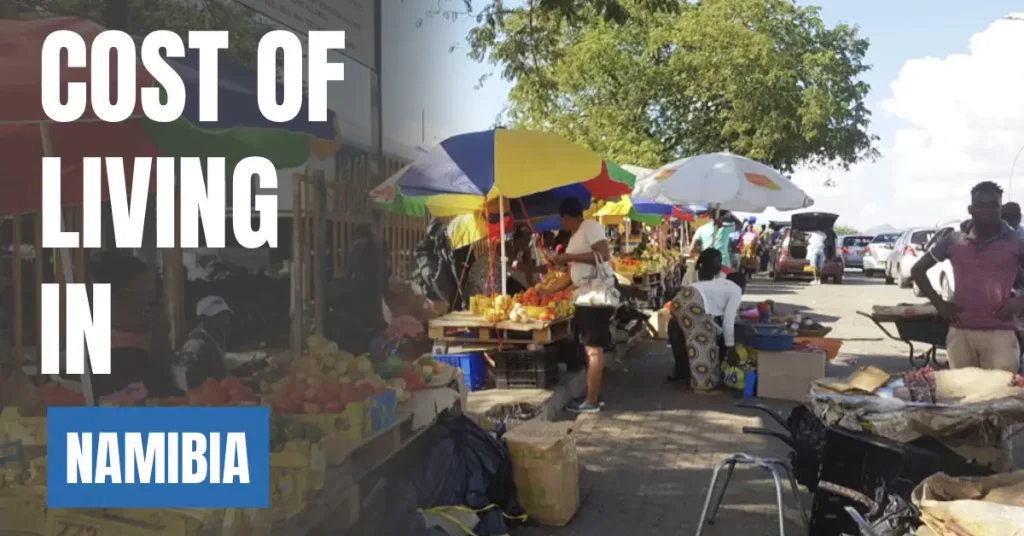
Cost of Living in Namibia in 2026: Rent, Food, Salaries and Monthly Budgets
The cost of living in Namibia in 2026 depends heavily on where you live, how much rent you pay and whether you need a car, private healthcare or private schooling. A budget-conscious single person renting modest accommodation may spend around N$10,500 per month, while someone seeking a more comfortable lifestyle in Windhoek may need N$20,000 or more.
On this pageTable of Content
Namibia offers a combination of urban conveniences, coastal towns and spacious rural communities. However, affordable living is not guaranteed. Housing in desirable neighbourhoods, imported groceries, fuel, internet and private services can make everyday life expensive relative to local earnings.
This guide examines current living expenses in Namibian dollars (NAD or N$), using available 2026 consumer-price information, official government publications and practical household budget estimates. It also explains the difference between living costs and immigration requirements for foreigners considering a move.
Cost of Living in Namibia at a Glance
A single person in Namibia may need approximately N$10,000 to N$22,000 per month including rent, depending on accommodation and lifestyle. Families generally require more, particularly when paying for private schooling, childcare, medical insurance or multiple vehicles.
| Expense | Indicative Cost in Namibia |
|---|---|
| Single person's monthly expenses, excluding rent | N$5,500 to N$12,000 |
| Single person's total monthly budget, including rent | N$10,000 to N$22,000 |
| Couple's total monthly budget, including rent | N$18,000 to N$35,000 |
| Family of four, including rent | N$32,000 to N$55,000 or more |
| One-bedroom apartment outside city centre | N$4,000 to N$11,000 per month |
| One-bedroom apartment in city centre | N$6,000 to N$15,000 per month |
| Three-bedroom apartment outside city centre | N$10,600 to N$50,500 per month |
| Monthly groceries for one adult | N$2,500 to N$4,500 |
| Basic monthly utilities for a typical apartment | N$1,200 to N$3,000 |
| Home broadband internet | N$550 to N$1,500 per month |
| Inexpensive restaurant meal | N$120 to N$300 in Windhoek |
| Local public transport journey | Approximately N$9 to N$15 |
Important: The household totals are illustrative planning estimates, not official national averages. They combine selected accommodation and living-expense assumptions. Rent ranges are based primarily on crowdsourced market observations, especially Windhoek, where prices vary considerably. Private school fees and major medical expenses may increase family budgets substantially.
Sources include Numbeo's Windhoek price observations and Namibia-wide consumer-price data.
How Much Does It Cost to Live in Namibia Per Month?
A single renter can plan around N$10,000 to N$22,000 monthly including accommodation, groceries, basic utilities, connectivity, transport and ordinary personal spending. Shared housing and limited discretionary spending can reduce costs, while larger apartments, car ownership and private healthcare can push spending higher.
For someone living alone, rent is usually the most important variable. A person paying N$5,000 for accommodation will have a significantly different budget from someone paying N$12,000, even if their food and transport habits are similar.
Couples can share rent, internet and some transport costs. A couple might reasonably plan for N$18,000 to N$35,000 per month, depending on housing and lifestyle.
Families of four may need N$32,000 to N$55,000 or more monthly including rent. International school tuition, childcare, private medical cover and vehicle expenses can move the required budget well above that range.
These estimates should not be interpreted as the minimum income every Namibian household needs or earns. Many residents live on substantially lower incomes through shared housing, family support, different consumption patterns or reduced access to services.
Housing and Rent Prices in Namibia
Renting a one-bedroom apartment in Windhoek commonly requires several thousand Namibian dollars per month. October 2026 crowdsourced observations indicated approximately N$8,325 for a centrally located one-bedroom apartment and N$5,889 outside the centre, although individual rental quotes can differ substantially.
Typical Apartment Rental Prices
| Property Type | Observed Monthly Range |
|---|---|
| One-bedroom, city centre | N$6,000 to N$15,000 |
| One-bedroom, outside centre | N$4,000 to N$11,000 |
| Three-bedroom, city centre | N$14,100 to N$66,700 |
| Three-bedroom, outside centre | N$10,600 to N$50,500 |
These are reported price ranges rather than guaranteed listings. The highest figures may reflect premium accommodation and should not be used as typical family rent.
Windhoek generally offers the broadest range of employment, education and private services. Demand for well-located properties can make central and established residential neighbourhoods costly.
Swakopmund and Walvis Bay have their own property markets, influenced by coastal location, tourism, port activity and industrial employment. A coastal apartment is not necessarily cheaper than an equivalent property in Windhoek.
Smaller towns may offer lower rents, but accommodation availability, employment opportunities, transport choices and access to specialist services can be limited.
Buying Property in Namibia
Property buyers need to consider more than the asking price. Financing costs, legal fees, transfer-related expenses, municipal charges, maintenance and insurance can materially increase the total cost of ownership.
Property values vary greatly by suburb and type of dwelling. Buyers should compare current listings and financing quotations rather than relying on one nationwide average.
Hidden Housing Expenses
- Security deposits and rent paid in advance.
- Electricity and water deposits where required.
- Furniture, appliances and moving expenses.
- Security services, building levies or maintenance contributions.
- Commuting costs associated with more affordable neighbourhoods.
- Potential rent increases when renewing a lease.
Before signing a tenancy agreement, confirm which utilities and services are included, the deposit conditions and whether the advertised price covers parking or other facilities.
Food and Grocery Costs in Namibia
A single adult might budget approximately N$2,500 to N$4,500 monthly for groceries, depending on household habits and dietary requirements. Shopping for imported specialty products, convenience foods or premium meat can increase spending.
Basic grocery costs provide a useful starting point, but product brands, packaging sizes and shopping locations matter.
| Grocery Item | Indicative Price |
|---|---|
| Milk, 1 litre | N$20 to N$40 |
| White bread, approximately 454 g | N$13 to N$18 |
| White rice, approximately 454 g | N$10 to N$22 |
| Eggs, 12 | N$30 to N$120 |
| Chicken fillets, approximately 454 g | N$16 to N$66 |
| Apples, approximately 454 g | N$9 to N$28 |
| Bananas, approximately 454 g | N$13 to N$18 |
The table reflects observed Windhoek price ranges, not fixed retail prices. Weight-based quantities are specified because market databases sometimes display products in pounds rather than kilograms. Extremely wide ranges, such as those for eggs, indicate that the observations should be treated cautiously.
Consumers can often manage their food budgets by comparing major supermarkets, choosing seasonal produce and preparing meals at home. Prices and availability may differ in remote communities, where transporting goods adds to retail costs.
Restaurant and Eating Out Costs
Dining out in Namibia can be relatively affordable for occasional meals, but frequent restaurant visits make a noticeable difference to monthly spending. Windhoek restaurant prices cover everything from casual takeaway food to higher-priced restaurants.
| Restaurant Expense | Indicative Price |
|---|---|
| Inexpensive restaurant meal | N$120 to N$300 |
| Mid-range three-course meal for two, excluding drinks | N$600 to N$1,300 |
| Fast-food combination meal | N$90 to N$120 |
| Cappuccino | N$22 to N$50 |
| Soft drink at a restaurant | N$12 to N$20 |
Someone buying a N$150 restaurant lunch on 20 working days would spend N$3,000 per month on those lunches alone. This is why eating habits can change the affordability of an otherwise reasonable housing budget.
Utilities: Electricity, Water and Household Bills
Basic utilities for an approximately 85-square-metre apartment in Windhoek are commonly estimated at N$1,200 to N$3,000 per month. The reported average in October 2026 was approximately N$2,268.
This category combines costs such as electricity, water, refuse collection and other basic services. Actual bills depend on household size, heating or cooling equipment, water consumption and local municipal charges.
Electricity and water should be checked separately in a rental agreement. Some properties use prepaid electricity, while others bill consumption monthly. Tenants should not assume that advertised rent includes these services.
In areas with unreliable water supply or other infrastructure constraints, households may incur additional expenses for storage, backup equipment or maintenance.
Internet and Mobile Phone Costs
Home internet and mobile connectivity can be substantial recurring expenses. October 2026 Windhoek observations placed unlimited broadband of at least 60 Mbps at roughly N$550 to N$1,500 per month, with an estimated average of N$839.
Mobile plans including calls and at least 10 GB of data were reported at approximately N$250 to N$600 per month.
The price alone does not determine the best connection. Coverage, actual download speed, data limits, contract duration, installation charges and service quality should also be considered.
Remote workers should verify broadband availability at their specific property before signing a lease. Reliable connectivity in one neighbourhood does not guarantee comparable service elsewhere.
Transportation Costs in Namibia
Public transport can be inexpensive for individual journeys, but Namibia's large distances and uneven transport coverage make personal vehicles important for many households. In Windhoek, a reported local transport journey cost approximately N$9 to N$15 in October 2026.
Public Transport and Taxis
Shared taxis and other local services are common transport options. Prices and routes differ by operator and location. Crowdsourced databases also report a monthly transport pass around N$800, but this should not be interpreted as proof of a universally available national monthly ticket.
People depending on public transport should verify their actual commuting route, service frequency and fares. Many trips require route-specific arrangements rather than a comprehensive urban transport network.
Fuel and Car Ownership
Fuel costs became especially important in November 2026. An increase effective 4 November raised the petrol price at Walvis Bay to N$28.58 per litre, while reported diesel prices were approximately N$30.86 to N$30.96 per litre, depending on grade.
These were Walvis Bay reference prices, and pump prices can vary by location. The increase was reported by The Namibian on 2 November 2026.
At N$28.58 per litre, using 100 litres of petrol in a month costs N$2,858 before vehicle insurance, servicing, parking, tyres or loan payments. Drivers with long commutes or frequent intercity trips may need a significantly larger transport budget.
For anyone moving to Namibia, choosing a home close to employment and essential services can reduce both transport spending and travel time.
Healthcare Costs in Namibia
Healthcare in Namibia is not universally free. Public facilities generally provide subsidised services, while eligibility, fees and access differ between patient categories. Private healthcare and medical insurance can create additional household expenses.
Public Healthcare
Public health facilities offer a range of primary, hospital and specialist services. Some patients may qualify for free or reduced-cost treatment, while others pay consultation and treatment charges.
Windhoek Central Hospital publishes consultation tariffs that distinguish between state patients, private patients, medical-aid patients, foreign patients and certain exempt categories.
| Patient Category | Published Initial Consultation Fee |
|---|---|
| State patient | N$30 |
| Private patient | N$200 |
| Foreign patient | N$200 |
| Patient exempt under applicable policy | N$0 |
These figures are facility-specific consultation tariffs, not guaranteed total treatment costs. Admissions, medicines, investigations and procedures may involve separate charges. Foreign residents and visitors should confirm their patient classification directly with the provider.
Private Healthcare and Insurance
Private hospitals and medical practices generally charge commercial rates. The full cost of consultations, tests, surgery and emergency treatment may be substantial without suitable insurance or medical-aid coverage.
Insurance premiums depend on age, dependants, benefits, exclusions, deductibles and provider networks. A low-cost plan may not include comprehensive inpatient care or specialist treatment.
New residents should request quotations for their actual circumstances rather than budgeting from a single generic insurance estimate. They should also check emergency transport coverage, chronic medication benefits and any waiting periods.
Education and Childcare Costs
Namibia provides government-funded education through its public school system, while private and international education can add major expenses to a family's budget.
Public Schools
Primary and secondary tuition is provided free at public schools under Namibia's universal access to education policy. Families may still need to budget for uniforms, transport, stationery, meals, boarding and other permitted expenses.
Foreign families should confirm admission requirements, available school places and applicable documentation before relying on public schooling in their relocation budget.
Private and International Schools
Private school fees vary by institution, grade and services. Crowdsourced Namibia-wide data has reported international primary school tuition around N$88,667 annually, while more recent Windhoek observations indicate a substantially higher central estimate and a very wide range.
This difference highlights why a single national school-fee estimate can be misleading. Parents should obtain a current fee schedule directly from each school, including registration charges, uniforms, meals, transport and extracurricular activities.
Childcare
Private full-day preschool or kindergarten fees in Windhoek have been reported at approximately N$1,200 to N$5,000 per child monthly, with an average near N$3,467.
Additional childcare, holiday programmes and transport can increase the total. Parents should verify opening hours, age eligibility and whether meals are included.
University and Vocational Education
Namibia introduced a subsidised tertiary education funding model for 2026. Under the official framework, qualifying Namibian students pursuing their first eligible undergraduate qualification at public tertiary institutions can receive full tuition and registration fee subsidies.
The scheme is subject to eligibility requirements and does not automatically provide free accommodation, meals, transport or learning materials. International students should not assume that they qualify.
Details are available in the official 2026 Subsidised Tertiary Education Funding Model FAQs.
Salaries and Income in Namibia
There is no single salary that guarantees a comfortable life in Namibia. The amount needed depends mainly on rent, dependants, work location, transport arrangements and healthcare requirements.
For a single person renting privately in Windhoek, a take-home income around N$18,000 to N$25,000 per month may support a moderate lifestyle, depending on housing and spending choices. A family may need substantially more, particularly when supporting children in private education.
These are practical affordability targets, not official salary averages.
Namibia's Statistics Agency reports a 2023 unemployment rate of 36.9% under the strict statistical definition. Its publicly available labour-market portal also shows an average monthly wage of N$13,949, but that wage statistic refers to 2018 and should not be described as a current 2026 salary average.
According to the 2023 labour-force findings, more than half of employed people earned below N$5,000 per month. This demonstrates a major difference between the spending capacity of many local households and the budgets commonly recommended to foreigners seeking independent private accommodation.
See the Namibia Labour Market Information System and the official 2023 labour-force report.
What Is the Minimum Wage in Namibia in 2026?
Namibia's national minimum wage is N$18 per hour for workers covered by the standard rate, effective from 1 January 2025. Certain sectors have transitional rates that remain below N$18 during 2026.
| Worker Category | Minimum Hourly Wage in 2026 |
|---|---|
| General employees covered by standard rate | N$18 |
| Domestic workers | N$15 |
| Agricultural workers | N$14 |
| Security workers | N$16 |
The government schedule provides for the transitional categories to reach N$18 per hour on 1 January 2027.
At a hypothetical 45 paid hours per week across 52 weeks, N$18 per hour is approximately N$3,900 gross per month. Actual wages depend on paid hours and applicable employment arrangements.
This level of income is far below the illustrated cost of independently renting a typical one-bedroom apartment in central Windhoek. It is therefore important not to confuse the statutory wage floor with a living wage sufficient for every household.
The rates are published by Namibia's Ministry of Labour in its amended national minimum wage order.
Taxes and Take-Home Pay in Namibia
Personal income tax reduces the amount of salary available for rent and living expenses. Namibia applies progressive income-tax brackets, meaning higher portions of taxable income are taxed at higher marginal rates.
The published individual income-tax schedule introduced in 2024 provides a tax-free threshold of N$100,000 in annual taxable income and higher marginal rates above that amount, reaching 37% for the top bracket.
For example, a person with N$240,000 in annual taxable income would have income tax calculated on the applicable brackets, rather than paying a single flat rate on their entire income.
Employees should also consider applicable social security deductions and any contractual medical-aid or pension contributions. Tax residency and the treatment of different income sources can affect individual liabilities.
Consult the Namibia Revenue Agency's published income-tax brackets and obtain current payroll calculations before accepting an employment offer.
Realistic Monthly Budgets in Namibia
The following examples show how housing and lifestyle choices affect total monthly expenses. All four budgets include rent and are illustrative rather than official household-expenditure statistics.
| Monthly Expense | Budget Single | Moderate Single | Couple | Family of Four |
|---|---|---|---|---|
| Rent | N$4,500 | N$8,500 | N$11,000 | N$16,500 |
| Utilities | N$1,300 | N$2,200 | N$2,600 | N$3,500 |
| Groceries | N$2,500 | N$3,800 | N$6,500 | N$10,500 |
| Transport | N$700 | N$1,800 | N$2,800 | N$4,500 |
| Internet and mobile | N$600 | N$1,100 | N$1,300 | N$1,700 |
| Healthcare or insurance provision | N$500 | N$1,500 | N$2,600 | N$5,000 |
| Dining, leisure and miscellaneous | N$400 | N$1,800 | N$3,000 | N$4,500 |
| Childcare provision | N$0 | N$0 | N$0 | N$3,500 |
| Estimated Monthly Total | N$10,500 | N$20,700 | N$29,800 | N$49,700 |
Budget Assumptions
Budget-conscious single person: Modest accommodation, home-cooked meals, limited paid entertainment and inexpensive transport. The healthcare allocation is a planning provision, not a verified insurance quotation.
Moderate single person: Private one-bedroom accommodation, more flexible spending, regular connectivity and a larger allowance for transport and healthcare.
Couple: Shared household expenses, one residential rental and a combined grocery, transport and personal-spending budget.
Family of four: Larger accommodation, two adults and two children, plus a childcare allowance. This example assumes no private or international school tuition and does not fully account for vehicle financing or unusually high medical costs.
The family example should not be treated as sufficient for every household. International education, higher insurance premiums, private transport arrangements and large rental properties can increase required spending substantially.
Cost of Living in Windhoek, Swakopmund, Walvis Bay and Other Areas
Living costs vary across Namibia, but available pricing evidence is strongest for Windhoek. Reliable national comparisons are difficult because smaller towns have fewer consistently collected rental and consumer-price observations.
Windhoek
Windhoek is the main employment and administrative centre. Residents benefit from a broader selection of hospitals, schools, supermarkets and professional services, but desirable accommodation and commuting can be costly.
Swakopmund
Swakopmund is a coastal town with tourism and residential demand. Lifestyle and housing preferences, particularly near the coast, can significantly influence costs. Short-term holiday accommodation prices should not be confused with annual residential lease rates.
Walvis Bay
Walvis Bay is a major port and commercial centre. Housing demand can reflect industrial activity and employment opportunities. Fuel, transport and accommodation should be checked against local quotations rather than national estimates.
Oshakati, Rundu and Smaller Towns
Some smaller towns may offer more affordable accommodation, particularly outside premium neighbourhoods. However, limited rental supply, distance to specialist healthcare and additional travel needs can offset some savings.
The most practical comparison is the combined cost of housing, transport, healthcare access and employment opportunities, not rent alone.
Is Namibia Cheaper Than South Africa or Botswana?
Namibia is not consistently cheaper than its neighbours across every category. The comparison changes by city, rental market, household lifestyle and exchange-rate conditions.
Numbeo's 2026 African city index placed Windhoek at 37.4 for living expenses excluding rent, compared with Johannesburg at 40.4 and Cape Town at 39.6. Including rent, the corresponding index was approximately 27.5 for Windhoek, 28.4 for Johannesburg and 31.5 for Cape Town.
These figures suggest Windhoek was somewhat less expensive than those South African cities within that specific dataset, but the gaps are relatively small and do not establish that every household will spend less in Namibia.
The comparisons also exclude important personal differences, including school choices, salary levels, transportation needs and healthcare coverage.
For Botswana, Gaborone and Windhoek should be compared using equivalent neighbourhoods, property sizes and current rental listings. Available evidence is insufficient to support a categorical claim that Namibia is always cheaper.
See Numbeo's 2026 African city cost-of-living index.
Costs New Residents Often Overlook
Moving to Namibia can involve substantial expenses beyond the ordinary monthly budget.
- Rental deposits: Upfront housing payments can make the first month considerably more expensive.
- Vehicle expenses: Fuel, servicing, insurance and repairs may exceed an initial transport allowance.
- Medical cover: Private insurance premiums, deductibles and uncovered treatment may increase costs.
- School expenses: Registration, tuition, uniforms, transport and extracurricular activities can add up.
- Imported products: Specialty foods, electronics and branded goods may carry higher prices.
- Connectivity: Installation, equipment and upgraded internet packages may incur additional charges.
- Long-distance travel: Visits between cities or to remote destinations can be costly.
- Immigration documentation: Permits, translations, medical reports and police certificates may create initial expenses.
- Emergency savings: Unexpected healthcare, transport and accommodation costs should be considered separately from ordinary spending.
New arrivals should maintain savings for initial settlement and unexpected costs rather than planning to spend their full monthly income.
Cost of Living Versus Residency and Visa Financial Requirements
A sufficient monthly living budget does not automatically satisfy Namibia's immigration rules. Visa and permit applications have their own eligibility requirements, documentation and administrative fees.
The Ministry of Home Affairs lists proof of means of sustenance for certain visitor visa applications. Employment-related permissions may require additional documents, including employer support, qualifications or other evidence relevant to the specific application.
The official online short-term employment permit service lists application fees of N$1,600 for permits up to three months and N$3,200 for permits up to six months, alongside supporting documentation requirements.
These are application charges, not monthly living expenses or universal minimum-income thresholds. Different immigration categories may follow different rules.
Applicants should consult the Ministry of Home Affairs visa guidance, permit information and official employment permit service.
Is Namibia Affordable for Expats and New Residents?
Namibia can be affordable for newcomers earning sufficient and reliable income, especially those able to choose practical accommodation and manage vehicle expenses. However, affordability is much more difficult for households dependent on low local wages.
People moving for employment should compare their net salary with a complete household budget that includes rent, utilities, insurance, transport and emergency savings.
Remote workers must also consider reliable internet access, workspace needs and applicable immigration permissions. An affordable living budget does not establish permission to work remotely from Namibia.
Families should research school admission and healthcare availability before choosing an area. Retirees should consider proximity to medical services as well as accommodation costs.
In every case, the strongest approach is to obtain current local quotations for the main expenses before committing to a move.
Conclusion: How Much Money Do You Need to Live in Namibia?
A practical starting point for a single renter is approximately N$10,000 to N$22,000 per month including rent, while a couple may plan around N$18,000 to N$35,000. A family of four may require N$32,000 to N$55,000 or more, especially when housing, childcare and healthcare costs are high.
These planning ranges describe different lifestyles rather than guaranteed national averages. Renting a suitable home, managing transport and choosing between public and private services will usually determine the largest differences.
Namibia has attractive qualities for long-term residents, but its living costs must be considered alongside local income levels and employment opportunities. A realistic personal budget, supported by actual housing and service quotations, is more useful than relying on a single countrywide affordability figure.
Sources and Methodology
This article was reviewed on 4 November 2026. It combines official Namibian government information, national labour statistics, institutional healthcare tariffs, immigration guidance, consumer-price observations and market-based planning estimates.
Prices from Numbeo are crowdsourced and may be based on relatively small samples. Its Windhoek dataset reported 553 price entries from 33 contributors in the preceding 12 months as of 31 October 2026. These observations are useful indicators but are not a representative government household-expenditure survey.
Rental, grocery, transport and utility prices can change over time. The November 2026 fuel increase illustrates why older consumer-price snapshots may understate current spending. The illustrative household budgets are calculations developed for planning purposes and should not be interpreted as officially published average expenditures.
Official sources were prioritised for minimum wages, taxation, education policy, immigration conditions, healthcare tariffs and labour-market data. Multiple data sources were compared where appropriate, and limitations or inconsistent estimates have been identified in the relevant sections.
- Numbeo: Cost of Living in Windhoek, October 2026
- Numbeo: Cost of Living in Namibia
- Numbeo: Africa Cost of Living Index 2026
- Namibia Ministry of Labour: Amended National Minimum Wage Order
- Namibia Statistics Agency: Labour Market Information System
- Namibia Statistics Agency: 2023 Labour Force Report
- Namibia Revenue Agency: Individual Income Tax Brackets
- Windhoek Central Hospital: Consultation Tariffs
- Namibia Education Authorities: Subsidised Tertiary Education Funding Model FAQs
- Ministry of Home Affairs: Visa Requirements
- Ministry of Home Affairs: Short-Term Employment Permit Service
- The Namibian: November 2026 Fuel Price Increase
Frequently Asked Questions
How much does it cost to live in Namibia per month?
A single person renting independently may need approximately N$10,000 to N$22,000 monthly including rent and ordinary living expenses. A moderate Windhoek budget can be around N$20,700. Housing choice, transport, healthcare and lifestyle have the biggest influence on the total. These are planning estimates rather than official national averages, and shared accommodation can reduce costs.
How much is rent in Windhoek in 2026?
October 2026 crowdsourced data placed a one-bedroom apartment at approximately N$8,325 per month in central Windhoek and N$5,889 outside the centre. Observed prices ranged widely, depending on property quality and location. Larger family homes can cost considerably more. Check current listings and confirm deposits, utilities and lease conditions before making a rental decision.
What salary is needed to live comfortably in Namibia?
A single person renting privately in Windhoek may target roughly N$18,000 to N$25,000 in monthly take-home income for a moderate lifestyle, depending on expenses. A couple or family generally needs a higher combined income. These figures are affordability targets, not national salary statistics. Healthcare, commuting costs and private schooling can increase the amount required.
What is Namibia's minimum wage in 2026?
The standard national minimum wage is N$18 per hour. During 2026, transitional rates are N$15 for domestic workers, N$14 for agricultural workers and N$16 for security workers. The government schedule provides for those categories to reach N$18 per hour from 1 January 2027. Actual monthly earnings depend on paid working hours and employment arrangements.
Is healthcare free in Namibia?
Healthcare is not universally free. Public health services are generally subsidised, and some patients qualify for exemptions or reduced fees. Windhoek Central Hospital publishes an initial consultation fee of N$30 for state patients and N$200 for foreign patients, subject to patient classification. Private care, investigations, admissions and medicines may create additional costs, making appropriate healthcare coverage important.
How much do groceries cost in Namibia?
A single adult may budget roughly N$2,500 to N$4,500 monthly for groceries, depending on diet, household size and shopping preferences. Basic foods purchased locally can help control spending, while imported brands and specialty products may increase costs. Prices also vary between Windhoek, coastal communities and remote towns. Comparing retailers and planning meals can reduce monthly spending.
Is public transport free in Namibia?
Public transport is not generally free. In Windhoek, reported local journey prices were approximately N$9 to N$15 in October 2026. Services and routes vary, and a quoted monthly transport pass in a crowdsourced database should not be assumed to be universally available. People living far from employment or essential services may need taxis or a personal vehicle.
How much does a family of four need in Namibia?
A family of four may need approximately N$32,000 to N$55,000 or more monthly including rent. An illustrative budget of N$49,700 covers housing, groceries, utilities, transport, connectivity, a healthcare allowance, childcare and ordinary personal spending. International school tuition and major medical costs are not included. Families should request actual school and insurance quotations before relocating.
Which areas of Namibia are cheaper to live in?
Some smaller towns and less central residential areas may offer lower accommodation costs than premium Windhoek neighbourhoods. However, lower rent does not automatically mean lower overall expenses. Limited transport, specialist healthcare and shopping options can create additional costs. Reliable city-by-city data is limited, so compare actual housing listings, commuting distances and essential services rather than relying on broad rankings.
Is Namibia cheaper than South Africa?
Some 2026 crowdsourced comparisons suggest Windhoek is moderately less expensive than Johannesburg or Cape Town, particularly when rent is included. However, the difference depends on the cities, property types and household spending patterns being compared. It is not accurate to say Namibia is cheaper in every category. Salaries and local purchasing power also matter when evaluating affordability.
Can foreigners live in Namibia if they can afford the monthly costs?
Having enough money for daily expenses does not automatically provide permission to reside or work in Namibia. Foreign applicants must meet the conditions of their specific visa or permit category. Certain applications require evidence of financial means, employment documentation or other supporting information. Applicants should check official Ministry of Home Affairs requirements rather than treating a living-cost estimate as an immigration threshold.
Join the conversation
Have thoughts on this topic? Share them with others.
Ask questions, share experience, and learn from the Visaboards Community.