
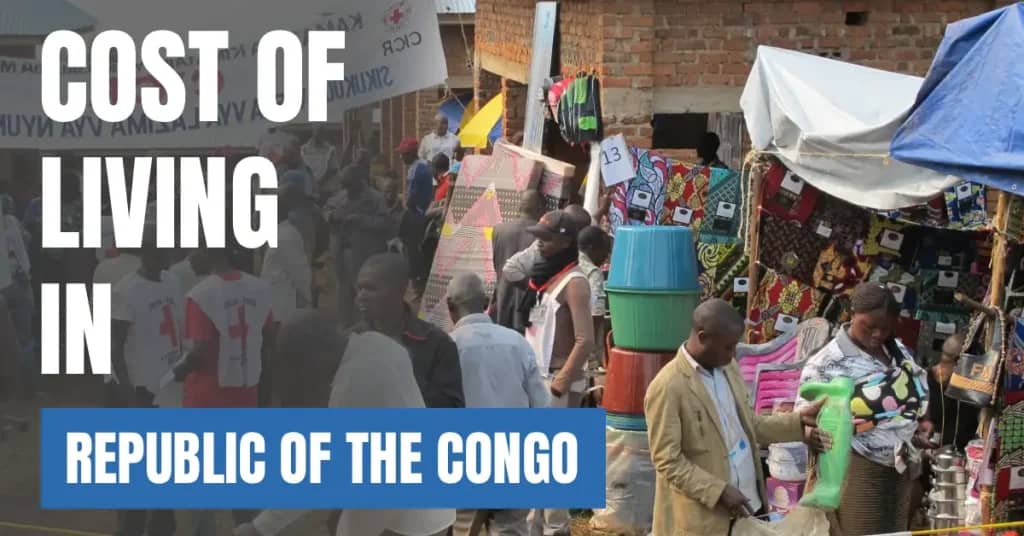
Cost of Living in Republic of the Congo in 2026: Rent, Salaries and Monthly Expenses
The cost of living in the Republic of the Congo in 2026 depends heavily on where you live, your housing standards, your income and whether you rely on local or imported products. Brazzaville, the capital, and Pointe-Noire, the country's main commercial and port city, offer employment opportunities and services, but suitable rental accommodation, private healthcare and imported goods can significantly increase expenses.
On this pageTable of Content
A single person planning a modest, independent lifestyle can use approximately XAF 350,000 to XAF 650,000 per month including rent as an initial planning range. A family of four may need XAF 800,000 to XAF 1,600,000 or more, especially when private schooling, larger accommodation or international health insurance is required. These are illustrative planning estimates, not officially measured national averages.
The Republic of the Congo is also called Congo-Brazzaville. It is a separate country from the Democratic Republic of the Congo (DRC), which has different wages, taxes, public services and living costs.
All prices in this guide are primarily shown in Central African CFA francs (XAF or FCFA). The currency has a fixed exchange rate of XAF 655.957 to €1. Information was reviewed in October 2026.
Cost of Living in Republic of the Congo at a Glance
Housing is usually the largest recurring expense for someone renting independently. Local food and shared transportation can be relatively economical, while imported groceries, private clinics, international schools and accommodation with reliable utilities can substantially increase a household's monthly spending.
| Expense | Estimated Cost in XAF | Notes |
|---|---|---|
| Single person, excluding rent | 180,000 to 350,000/month | Basic spending and modest lifestyle |
| Single person, including rent | 350,000 to 650,000/month | Independent rental accommodation |
| Couple, including rent | 500,000 to 950,000/month | Shared accommodation and household expenses |
| Family of four, including rent | 800,000 to 1,600,000+/month | Excludes expensive international-school scenarios |
| One-bedroom apartment | 80,000 to 550,000+/month | Very dependent on neighbourhood and property standards |
| Three-bedroom accommodation | 230,000 to 750,000+/month | Higher for premium or expatriate-oriented housing |
| Single-person groceries | 80,000 to 180,000/month | Depends on local versus imported food |
| Basic utilities | 20,000 to 75,000/month | Excludes substantial generator and fuel expenses |
| Mobile data | 5,550 to 32,000/month | Examples from MTN Congo's published 30-day packages |
| Urban bus fare in Brazzaville | 150/ride | Reported regulated fare in February 2026 |
| Taxi journey in Brazzaville | 1,000/ride | Reported standard fare, subject to actual service conditions |
| Private-sector monthly minimum wage | 70,400/month | WageIndicator figure effective January 2025 |
| Public-sector minimum wage reference | 120,000/month | WageIndicator figure effective January 2025 |
The household budgets and broad rental allowances above are editorial estimates designed for financial planning. They should not be interpreted as verified national averages. Accommodation figures vary particularly widely because housing datasets measure different property types and frequently contain limited local observations.
How Much Does It Cost to Live in Republic of the Congo Per Month?
A single renter can initially budget XAF 350,000 to XAF 650,000 monthly including rent, utilities, groceries, local transport, communication and ordinary personal expenses. Someone living with relatives or sharing accommodation may spend considerably less. A person seeking furnished accommodation, regular restaurant meals and private healthcare may require significantly more.
Published cost-of-living estimates are inconsistent. Livingcost's June 2026 Brazzaville estimate was about $590 monthly for one person including rent, compared with about $344 excluding rent. CostLens's September 2026 modeled national reference was approximately XAF 332,730 including a one-bedroom rental outside the centre.
By contrast, Expatistan's October 2026 Brazzaville estimate was approximately XAF 1,714,980 for one person, but the platform specifically warned that the estimate relied on very few observations. The figures cannot be treated as interchangeable because their housing assumptions, consumer baskets and sample quality differ.
Sources: Livingcost Brazzaville, CostLens and Expatistan.
Housing and Rent in Republic of the Congo
Rent can range from under XAF 100,000 for basic accommodation in some markets to several hundred thousand CFA francs for urban apartments. Modern furnished housing, backup power, good security and proximity to major employment districts can make accommodation substantially more expensive.
Typical Rental Planning Ranges
| Accommodation | Estimated Monthly Rent |
|---|---|
| Basic room or shared accommodation | XAF 50,000 to 150,000 |
| Modest one-bedroom accommodation | XAF 80,000 to 200,000 |
| Better-equipped urban one-bedroom apartment | XAF 200,000 to 550,000+ |
| Modest three-bedroom property | XAF 230,000 to 450,000 |
| Larger or higher-standard urban family property | XAF 450,000 to 750,000+ |
These are broad search and negotiation allowances, not verified live rental quotations. The lower end reflects modest or modeled accommodation, while the upper end incorporates higher-standard urban housing. The previous Visaboards article quoted one-bedroom city-centre rents of $500 to $900, but those figures should not be presented as the universal local market rate.
Before signing a lease, confirm whether rent includes electricity, water, security, furniture, maintenance and generator access. Also establish the deposit, advance-payment schedule, agency commission and responsibility for repairs.
Rental affordability is especially important for expatriates. Employer-provided accommodation can make a much greater difference than a small increase in salary.
Groceries and Food Prices
Groceries are generally less expensive when households purchase local products from traditional markets and cook at home. Imported packaged food, dairy products and specialist items can be substantially more expensive.
| Food Item | Indicative Price in XAF |
|---|---|
| Milk, 1 litre | 700 to 2,100 |
| Bread, approximately 500 g | 300 to 1,000 |
| Rice, 1 kg | 350 to 1,800 |
| Eggs, 12 | 900 to 2,500 |
| Chicken, 1 kg | 2,000 to 6,000 |
| Beef, 1 kg | 2,900 to 5,000+ |
| Tomatoes, 1 kg | 350 to 3,500 |
| Bottled water, 1.5 litres | 200 to 750 |
These indicative prices consolidate different consumer-cost datasets and previously published market estimates. They reflect considerable uncertainty rather than a single independently verified October 2026 price survey. Quality, imports, product variety and neighbourhood can all affect actual prices.
For monthly planning, a single person may allocate approximately XAF 80,000 to XAF 180,000 for groceries, while a family of four may allocate XAF 200,000 to XAF 400,000. Imported-food preferences can raise both totals.
Restaurants and Eating Out
Local restaurants and informal food outlets usually cost less than international-standard establishments. A simple local meal may cost a few thousand CFA francs, while meals in business districts and higher-end restaurants can be considerably more expensive.
For example, Expatistan's October 2026 Brazzaville listing reported approximately XAF 11,040 for a business-district lunch including a drink and around XAF 7,699 for a fast-food combination meal. These should be understood as particular urban market observations rather than prices for all restaurants.
A moderate personal budget may allocate XAF 20,000 to XAF 70,000 monthly for occasional dining and leisure. Frequent restaurant use can significantly increase expenditure.
Utilities: Electricity, Water and Cooking Fuel
For ordinary household planning, basic utilities may require XAF 20,000 to XAF 75,000 monthly. Actual costs depend on the size of the home, consumption, billing arrangements and the reliability of service.
Electricity and water supply interruptions can create expenses beyond utility bills. Households may need to purchase generator fuel, maintain backup equipment, store water or arrange alternative supply.
Before renting, ask how frequently power interruptions occur, whether a generator is available, who pays for fuel and whether water storage is included. These questions can be particularly important in larger homes and locations with inconsistent services.
Internet and Mobile Phone Costs
Mobile internet is available through providers including MTN Congo. Published 30-day MTN packages provide useful retail price references, although offers and conditions can change.
| MTN Package | Published Price |
|---|---|
| 6.7 GB, 30 days | XAF 5,550 |
| 14.1 GB, 30 days | XAF 10,000 |
| 30.3 GB, 30 days | XAF 16,000 |
| 60.7 GB, 30 days | XAF 32,000 |
| 5G home box, 220 GB, 30 days | XAF 18,000 |
| 5G home box, unlimited, 30 days | XAF 32,000 |
The home-box options require appropriate equipment and network availability. Confirm coverage, installation charges, fair-use terms and actual speed before choosing a package.
Sources: MTN Congo Mobile Internet Packages and MTN Congo Home Internet Packages.
Transportation Costs in Republic of the Congo
Public transport is not generally free. Buses and taxis are common options for urban travel, while households using private vehicles must account for fuel, maintenance, repairs and insurance.
According to the Agence Congolaise d'Information, a transport federation representative confirmed in February 2026 that the Brazzaville bus fare remained XAF 150, while the standard taxi fare remained XAF 1,000. Transport operators had proposed changes, but the cited report stated that the existing tariffs had not been increased at that point.
A person taking two bus journeys on 22 working days would spend approximately XAF 6,600, before additional journeys. Two XAF 1,000 taxi trips across the same working schedule would total XAF 44,000.
For a modest urban transport allowance, XAF 10,000 to XAF 35,000 monthly may be workable for regular shared services. Frequent taxi use can increase the budget to XAF 40,000 to XAF 100,000 or more.
Source: Agence Congolaise d'Information, 25 February 2026.
Healthcare Costs and Insurance
Healthcare is not universally free at the point of use, and residents should not assume that every consultation, medicine, hospital admission or specialist service will be covered without payment. Availability and quality of services also differ by location and facility.
The country has public and private healthcare providers. Urban private facilities can be attractive to residents seeking particular services, but consultation fees are only one part of the potential cost. Diagnostics, medicines, procedures, inpatient treatment and emergency transfers can add substantially to medical bills.
The WHO African Region's December 2024 publication on financial hardship from healthcare documented the importance of out-of-pocket spending across the region. Its historical comparative data included the Republic of the Congo, although such historical percentages should not be mistaken for current individual insurance entitlements.
For planning purposes, households can reserve XAF 10,000 to XAF 50,000 monthly for routine health-related spending. This does not represent a verified insurance premium and is insufficient as a guarantee against major medical emergencies.
Expats should check whether employer or private insurance covers hospitalisation, specialist treatment, evacuation and pre-existing conditions. Eligibility for any public or employment-linked scheme must be confirmed individually rather than assumed.
Sources: WHO African Region and WHO African Health Observatory.
Education and Childcare
Public education and private education create very different household budgets. The Republic of the Congo has a legal policy framework for free public primary and secondary education, but families may still encounter expenses for uniforms, materials, transportation and other practical requirements.
A report to the United Nations Committee on the Rights of the Child described measures introduced from 2007 to remove public-school fees and support operating costs. However, this historical legal framework does not guarantee that every school-related expense is eliminated in practice.
Private and international schools set their own fees, and prices can differ greatly according to curriculum, facilities and educational level. The previous Visaboards article's estimate of $300 to $2,000 annually for private schooling should not be used as a universal ceiling, particularly for international schools.
Families should request the complete annual fee schedule, including registration, tuition, uniforms, school transport, meals and extracurricular activities. Daycare and childcare prices should also be verified locally, since reliable nationwide pricing is limited.
Source: Republic of the Congo report to the UN Committee on the Rights of the Child.
Salaries and Minimum Wage in Republic of the Congo
The monthly minimum wage references published by WageIndicator and effective from 1 January 2025 are XAF 70,400 for the private sector and XAF 120,000 for the public sector. These remained the figures shown in its June 2026 data. They should be checked against any newer applicable decree or employment agreement.
| Employment Category | Published Monthly Minimum |
|---|---|
| Private sector | XAF 70,400 |
| Public sector | XAF 120,000 |
Source: WageIndicator, Republic of the Congo.
For context, a private-sector monthly minimum wage of XAF 70,400 is far below the illustrative XAF 350,000 lower-end budget for a single independent renter. Minimum-wage workers may therefore depend on shared or family housing, lower-cost consumption, multiple household earners or other support.
Average salaries are also difficult to generalise. Livingcost's June 2026 Brazzaville dataset estimated after-tax earnings of roughly $211 monthly, while CostLens's September modeled reference was XAF 211,750. These are platform-specific estimates, not official national salary statistics.
What Salary Is Needed to Live Comfortably?
A single renter seeking a moderate lifestyle may target approximately XAF 450,000 to XAF 650,000 in monthly take-home income, while a family with children may require XAF 900,000 to XAF 1,600,000 or more. These figures are planning targets derived from the sample budgets, not official wage standards.
Housing allowances, school-fee support, insurance and employer-provided transportation should be evaluated alongside salary. A gross salary should not be confused with the amount available after deductions.
Taxes and Take-Home Pay
Congolese personal income tax is progressive, with published marginal rates of 1%, 10%, 25% and 40% across the relevant taxable-income bands. The maximum rate does not apply to a worker's entire salary automatically. Taxable income calculations depend on deductions, employment circumstances and other applicable rules.
PwC's August 2026 country tax summary identifies annual taxable-income bands of up to XAF 464,000 at 1%, XAF 464,000 to XAF 1 million at 10%, XAF 1 million to XAF 3 million at 25%, and amounts above XAF 3 million at 40%.
PwC also reports a standard VAT rate of 18%, plus a 5% surtax on VAT, yielding a combined headline rate of 18.9%. Actual treatment depends on the good or service and available exemptions.
Residents may face taxation on worldwide income, while non-residents are generally taxed on relevant Congolese-source income, subject to special rules and treaties. Employees should obtain an accurate net-pay calculation from their employer or tax adviser.
Sources: PwC Personal Income Tax and PwC Republic of the Congo Tax Overview.
Realistic Monthly Budget Examples
The following budgets are illustrative, not market averages. All examples include rent, basic utilities, groceries, communications, transportation, ordinary medical reserves and modest personal expenses. None includes international-school tuition, major medical emergencies, significant debt payments or one-time relocation costs.
| Expense | Budget Single | Moderate Single | Couple | Family of Four |
|---|---|---|---|---|
| Rent | 100,000 | 220,000 | 260,000 | 450,000 |
| Utilities | 20,000 | 35,000 | 45,000 | 75,000 |
| Groceries | 90,000 | 120,000 | 190,000 | 330,000 |
| Transportation | 15,000 | 30,000 | 45,000 | 85,000 |
| Internet and mobile | 10,000 | 20,000 | 25,000 | 40,000 |
| Healthcare reserve | 10,000 | 20,000 | 35,000 | 60,000 |
| Dining, leisure and miscellaneous | 35,000 | 75,000 | 100,000 | 160,000 |
| Total Including Rent | XAF 280,000 | XAF 520,000 | XAF 700,000 | XAF 1,200,000 |
| Total Excluding Rent | XAF 180,000 | XAF 300,000 | XAF 440,000 | XAF 750,000 |
The budget-conscious single-person example assumes low-cost accommodation, home cooking and limited discretionary spending. Its XAF 280,000 total is below the broader independent-renter planning range and depends on securing unusually economical housing.
The moderate single-person example assumes a better-equipped apartment and occasional restaurant meals. The couple shares accommodation and some expenses. The family example assumes a larger property and ordinary family spending, but no substantial private-school tuition or full international medical insurance.
Cost Differences Between Brazzaville, Pointe-Noire and Smaller Towns
Brazzaville
As the capital, Brazzaville has government offices, employment centres, healthcare providers and a substantial urban housing market. Costs vary considerably by neighbourhood, building standards and proximity to work. Some expatriate-oriented accommodation can be expensive even where basic housing is affordable.
Pointe-Noire
Pointe-Noire is an important port and commercial centre associated with energy-sector activity. Accommodation targeting corporate employees can be costly, while local housing and food markets offer different spending options. Employer benefits can be particularly influential in relocation budgets.
Dolisie and Other Smaller Towns
Some smaller towns may offer lower housing costs, but comparisons are difficult because detailed and representative rental data are limited. Reduced access to specialised healthcare, imported goods, reliable utilities or transport links may offset apparent rental savings.
Do not assume that every smaller town is cheaper for every household. Compare the exact property, available services and transportation requirements.
How Does Republic of the Congo Compare With Nearby Countries?
The Republic of the Congo shares a currency with Cameroon, Gabon and several other Central African countries, making comparisons in XAF convenient. However, sharing a currency does not mean prices, salaries or taxes are identical.
Cameroon may offer different grocery, housing and transport prices depending on whether the comparison is with Douala, Yaoundé, Brazzaville or Pointe-Noire. Similarly, the Democratic Republic of the Congo has a separate currency and a different economic environment.
Available comparisons are too inconsistent to establish a reliable countrywide ranking between these neighbours. Anyone relocating should compare the specific cities, accommodation standards and household needs rather than rely on an unsupported claim that one country is always cheaper.
Costs New Residents Often Overlook
- Rental deposits, advance rent and property agent commissions.
- Backup electricity, generator maintenance and fuel.
- Water storage, filtration or bottled drinking water.
- Imported household goods and replacement appliances.
- Medical insurance exclusions and emergency evacuation arrangements.
- School registration, uniforms, transport and childcare.
- Vehicle repairs, fuel, insurance and unexpected travel.
- Residence documentation, translations and administrative fees.
- Home internet equipment, installation and network availability.
- International flights and currency-transfer charges.
New residents should maintain a separate relocation fund and emergency reserve. An adequate monthly income does not necessarily cover the one-time costs of establishing a household.
Cost of Living Versus Residency Financial Requirements
A cost-of-living budget is not the same as an immigration financial requirement. Rent, groceries and transportation determine ordinary household affordability, while visa and residency authorities may request different documentation, fees, employment evidence or proof of support.
No single, generally applicable minimum monthly bank-balance requirement for all foreign residents was independently established from the sources reviewed for this guide.
Requirements should therefore be checked with the relevant Congolese diplomatic mission, immigration authority and prospective employer for the intended residence category. Do not treat the monthly budgets in this article as evidence of visa eligibility.
Is Republic of the Congo Affordable for Expats and New Residents?
The Republic of the Congo can be financially manageable for expatriates receiving a suitable salary and employer-funded benefits. It can be significantly less affordable for people relying on low local wages while paying market rent independently.
Before accepting an employment offer, compare net salary against rent, insurance, transport and family education expenses. Confirm whether the employer pays accommodation deposits, provides healthcare coverage or covers family relocation costs.
The most important affordability distinction is often not simply between cities, but between a locally funded household and a household receiving substantial employer support.
Conclusion
The cost of living in the Republic of the Congo in 2026 varies significantly by lifestyle, housing and access to employer benefits. Local markets and shared transportation can help keep ordinary expenses low, but reliable accommodation, imported groceries, private healthcare and international schooling can make relocation much more expensive.
A single renter can initially plan around XAF 350,000 to XAF 650,000 monthly, while many families will need a substantially larger budget. These ranges should be tested against real rental quotations, school invoices and personal requirements before making a financial commitment.
Sources and Methodology
This guide was reviewed in October 2026. It combines the existing Visaboards article, published consumer-cost datasets, service-provider tariffs, labour information, tax guidance, health references and public transport reporting.
Consumer-price datasets often include small samples, modeled estimates and different spending baskets. Published city averages therefore differ substantially. Rental prices, groceries, communication packages and transport conditions can change, and the figures in this article are not guaranteed quotations.
The sample household budgets are constructed planning scenarios, not official statistics. Wherever possible, country-specific and provider-issued information is distinguished from third-party estimates.
- Visaboards: Original Cost of Living Article
- Livingcost: Brazzaville
- CostLens: Republic of the Congo
- Expatistan: Brazzaville
- WageIndicator: Minimum Wage
- Agence Congolaise d'Information: Transport Fares
- MTN Congo: Mobile Data Prices
- MTN Congo: Home Internet Prices
- PwC: Republic of the Congo Personal Taxes
- PwC: Republic of the Congo Tax Overview
- WHO: Healthcare Financial Hardship
- United Nations: Republic of the Congo Education Information
- XE: XAF Currency Reference
Frequently Asked Questions
How much does it cost to live in Republic of the Congo per month?
A single person renting independently can initially budget approximately XAF 350,000 to XAF 650,000 monthly including rent. Expenses can be lower with shared housing or higher with furnished accommodation and imported goods. This range is an illustrative planning estimate, not an officially measured national average.
How much is rent in Republic of the Congo?
A modest one-bedroom property may cost around XAF 80,000 to XAF 200,000 monthly, while better-equipped urban accommodation can cost XAF 200,000 to XAF 550,000 or more. Location, furnishing, security and reliable utilities strongly affect prices. Obtain current property quotations before relying on these broad estimates.
What is the minimum wage in Republic of the Congo in 2026?
WageIndicator's June 2026 data lists monthly minimum-wage references of XAF 70,400 in the private sector and XAF 120,000 in the public sector, effective from 1 January 2025. These amounts are substantially below many independent-renter budgets. Workers should check for newer rules and any applicable sector agreement.
What salary is needed to live comfortably in Brazzaville?
A single renter seeking a moderate lifestyle may plan for approximately XAF 450,000 to XAF 650,000 in monthly take-home income. A comfortable budget depends on rent, commuting, health coverage and imported goods. Employer-funded housing or transport can substantially reduce the cash salary required.
Is healthcare free in Republic of the Congo?
Healthcare should not be assumed to be universally free at the point of use. Public and private providers exist, but patients may face charges for consultations, medicines, tests and treatment. Expats should verify their coverage and consider insurance that includes hospitalisation and medical evacuation where appropriate.
How much does public transport cost in Brazzaville?
A February 2026 report by the Agence Congolaise d'Information stated that the urban bus fare remained XAF 150 and a standard taxi journey was XAF 1,000. These were reported fares at that date, not guaranteed prices for every journey. Public transport is not generally free.
How much does a family of four need per month?
A family of four may use XAF 800,000 to XAF 1,600,000 or more per month as an initial budget including housing, groceries, transport and ordinary household spending. International schools, larger properties, private insurance and frequent travel can increase costs significantly. The sample family budget in this guide totals XAF 1,200,000.
Is Brazzaville more expensive than Pointe-Noire?
Neither city can be reliably described as universally more expensive. Brazzaville has substantial capital-city demand, while Pointe-Noire has commercial and corporate housing markets. Accommodation standards and neighbourhoods matter more than a simple citywide ranking. Compare actual rental offers and personal commuting needs.
Is Republic of the Congo cheaper than Cameroon?
There is insufficient consistent evidence to establish that the Republic of the Congo is cheaper than Cameroon for every household. Both countries use the Central African CFA franc, but rents, groceries and salaries vary between cities. Comparing Brazzaville with Douala or Yaoundé requires equivalent housing and lifestyle assumptions.
How much money do you need for residency in Republic of the Congo?
No single universal minimum bank balance for all foreign residence categories was independently verified in the sources reviewed. Financial and documentary requirements may depend on nationality, employment and permit type. Confirm the applicable rules through a Congolese diplomatic mission or competent immigration authority before applying.
Join the conversation
Have thoughts on this topic? Share them with others.
Ask questions, share experience, and learn from the Visaboards Community.