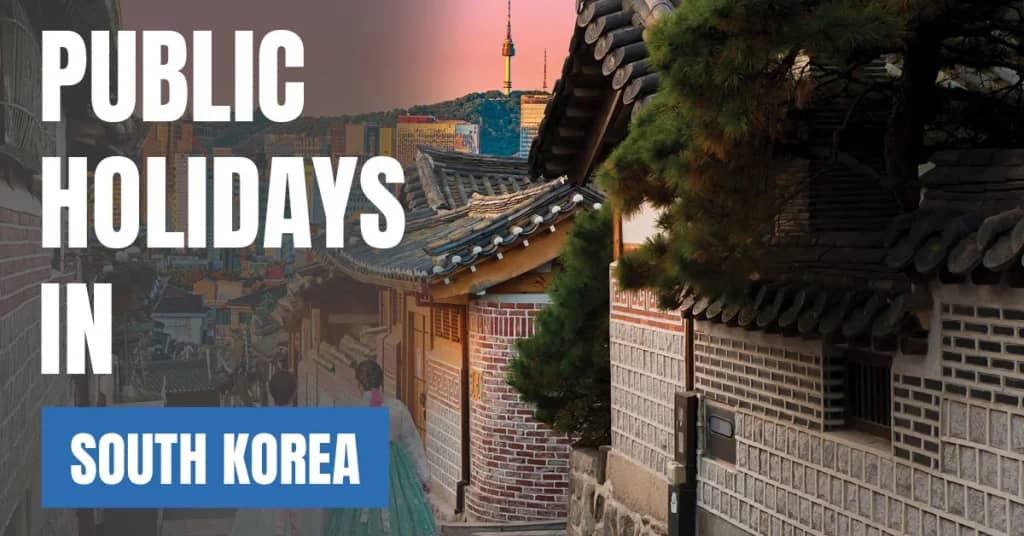
Public holidays in South Korea in 2026 include traditional celebrations, national commemorations, religious observances and special election holidays. The calendar includes Seollal (Lunar New Year), Chuseok (Korean Thanksgiving), National Liberation Day and four substitute holidays. Labour Day and Constitution Day also became nationwide public holidays in 2026 following changes to government regulations. This guide explains the official holiday schedule, major celebrations, substitute-day rules, long weekends and practical arrangements for residents, employees and travellers.
On this pageTable of Content
Next Public Holiday in South Korea
No public holidays found.
Public Holidays in South Korea 2026
No public holidays found.
South Korea's 2026 calendar contains 22 individual holiday dates, counting each day of the multi-day Seollal and Chuseok celebrations separately and including four substitute holidays.
The calendar follows the Korea Tourism Organization's official 2026 holiday guide and subsequent government amendments confirming Labour Day and Constitution Day as public holidays.
What's New in South Korea's 2026 Public Holiday Calendar?
Two important changes expanded South Korea's national public holiday calendar in 2026. Labour Day and Constitution Day were designated as public holidays following amendments to the relevant legislation and government regulations.
Labour Day Becomes a Nationwide Public Holiday
Labour Day, observed on May 1, became a nationwide public holiday in 2026. Previously, the occasion was primarily recognized as a paid holiday for workers covered by the relevant labour legislation rather than a general public holiday for government offices.
In April 2026, the Ministry of Employment and Labor and the Ministry of Personnel Management announced the legal changes establishing Labour Day as a public holiday.
The change expanded the recognition of the day beyond its earlier employment-specific framework.
The decision is explained in the Ministry of Employment and Labor's official announcement on Labour Day.
Constitution Day Returns as a Public Holiday
Constitution Day, observed on July 17, was reinstated as a public holiday beginning in 2026 after an absence of 18 years.
The holiday commemorates the proclamation of the Constitution of the Republic of Korea on July 17, 1948.
Constitution Day had remained one of South Korea's five major national commemorative days after being removed from the general public holiday calendar in 2008.
Its reinstatement means that all five major national commemorative days are again recognized as public holidays.
The Ministry of Personnel Management's announcement explains the restoration of Constitution Day's public holiday status.
Seollal: Korean Lunar New Year in 2026
Seollal is one of South Korea's most important traditional holidays. It marks the beginning of the lunar new year and is celebrated with family gatherings, ancestral traditions and special foods.
In 2026, the official Seollal holiday period runs from Monday, February 16, through Wednesday, February 18. Lunar New Year's Day itself falls on Tuesday, February 17.
The holiday traditionally covers three days: the day before Lunar New Year's Day, the day itself and the following day.
How Is Seollal Celebrated?
During Seollal, many Korean families travel to their hometowns to spend time with relatives and observe traditional customs.
Common traditions include sebae, a formal New Year's bow performed to show respect to elders, and eating tteokguk, a traditional rice cake soup associated with the new year.
Families may also play traditional games such as yutnori and participate in ancestral remembrance ceremonies.
The celebration is an important period for family reunions, which can lead to increased demand for intercity transport and accommodation.
The Korea Tourism Organization's guide to traditional Korean holidays explains the cultural significance of Seollal and Chuseok.
Chuseok: Korean Thanksgiving in 2026
Chuseok is another major traditional festival in South Korea. Often described as Korean Thanksgiving, it celebrates the harvest and emphasizes family reunions, gratitude and respect for ancestors.
In 2026, Chuseok is observed from Thursday, September 24, through Saturday, September 26. The principal festival day falls on Friday, September 25.
Like Seollal, Chuseok follows the traditional lunar calendar, so its Gregorian dates change each year.
Chuseok Traditions
Chuseok celebrations commonly involve travelling to ancestral hometowns, preparing traditional meals and holding family gatherings.
Some families perform charye, an ancestral memorial ritual, and visit family graves.
Songpyeon, a traditional Korean rice cake, is one of the foods closely associated with the festival.
Because Chuseok is a major travel period, transport services and accommodation can become particularly busy. Some smaller businesses may also close for several consecutive days.
National Public Holidays in South Korea
South Korea recognizes several national holidays commemorating its independence movement, liberation, constitutional development, national origins and cultural identity.
Independence Movement Day
Independence Movement Day, known as Samiljeol, is observed on March 1. It commemorates the March First Movement of 1919, when Koreans demonstrated for independence during Japanese colonial rule.
The observance is marked by national ceremonies and remembrance of those who participated in the independence movement.
In 2026, March 1 falls on Sunday, with Monday, March 2, designated as a substitute public holiday.
National Liberation Day
National Liberation Day, known as Gwangbokjeol, is celebrated annually on August 15.
The holiday commemorates Korea's liberation from Japanese colonial rule in 1945. It also carries significance in the country's modern national history.
In 2026, August 15 falls on Saturday. Monday, August 17, is the officially recognized substitute holiday.
National Foundation Day
National Foundation Day, or Gaecheonjeol, is observed on October 3. It commemorates the traditional founding of the Korean nation associated with the legendary figure Dangun.
The occasion reflects South Korea's historical traditions and national identity.
In 2026, National Foundation Day falls on Saturday, October 3. Monday, October 5, is the substitute public holiday.
Hangeul Day
Hangeul Day is observed annually on October 9 and celebrates Korea's writing system.
The holiday commemorates the creation and proclamation of Hangeul under King Sejong during the fifteenth century.
Hangeul is recognized as an important part of Korean cultural and linguistic identity.
In 2026, Hangeul Day falls on Friday, October 9, creating a three-day break for people following a standard Monday-to-Friday work schedule.
Constitution Day
Constitution Day is celebrated on July 17 and commemorates the proclamation of South Korea's Constitution in 1948.
The holiday was restored to the national public holiday calendar in 2026 after legislation and government regulations were amended.
In 2026, Constitution Day falls on Friday, July 17.
Religious Public Holidays in South Korea
South Korea recognizes public holidays associated with Buddhist and Christian traditions. These observances are part of the nationwide calendar and are not restricted to members of a particular religion.
Buddha's Birthday
Buddha's Birthday is observed on the eighth day of the fourth month of the traditional lunar calendar.
In 2026, the holiday falls on Sunday, May 24, with Monday, May 25, recognized as a substitute public holiday.
Buddhist temples across South Korea hold ceremonies and special events. Colorful lantern displays are particularly associated with the celebration.
The holiday is also an opportunity to experience South Korea's Buddhist heritage and cultural traditions.
Christmas Day
Christmas Day is celebrated on December 25 and is a nationwide public holiday in South Korea.
Christian communities observe the religious occasion through church services and celebrations. Christmas decorations, seasonal events and public displays are also common in major cities.
In 2026, Christmas Day falls on Friday, December 25.
Other Important Public Holidays in South Korea
Children's Day
Children's Day is observed annually on May 5. It celebrates children's well-being, happiness and development.
Families often mark the occasion with outings, educational activities and visits to attractions such as museums, parks and amusement facilities.
In 2026, Children's Day falls on Tuesday, May 5.
Memorial Day
Memorial Day, known as Hyeonchungil, is observed on June 6.
The day honors military personnel and other individuals who sacrificed their lives in service to South Korea.
National remembrance ceremonies take place, including events at the Seoul National Cemetery.
In 2026, Memorial Day falls on Saturday, June 6. Under the applicable substitute-holiday rules, it does not automatically generate an additional Monday holiday.
Local Election Day
Wednesday, June 3, 2026, was designated as a nationwide public holiday for South Korea's ninth nationwide local elections.
The holiday allows eligible voters to participate in elections for local government representatives.
Election holidays differ from permanently recurring public holidays because they arise from particular election schedules and applicable legislation.
The June 3 election holiday is included in the Korea Tourism Organization's 2026 holiday calendar.
Substitute Public Holidays in South Korea 2026
South Korea operates a substitute public holiday system under which specified holidays falling on weekends or overlapping with other holidays can generate an alternative day off.
The rules do not apply identically to every holiday. Replacement dates must follow the relevant laws and government regulations.
Four substitute public holidays are confirmed for 2026:
- March 2, Monday – Substitute holiday for Independence Movement Day.
- May 25, Monday – Substitute holiday for Buddha's Birthday.
- August 17, Monday – Substitute holiday for National Liberation Day.
- October 5, Monday – Substitute holiday for National Foundation Day.
Memorial Day falls on Saturday, June 6, but does not receive an automatic substitute holiday under the applicable rules.
Employees and travellers should use the official calendar rather than assuming that every weekend holiday creates an additional weekday off.
Long Weekends in South Korea in 2026
South Korea's 2026 holiday calendar creates several opportunities for extended breaks. Most government offices and many workplaces follow a Monday-to-Friday schedule, with Saturday and Sunday as the regular weekend.
Seollal Holiday Break
Seollal runs from Monday, February 16, through Wednesday, February 18.
For employees with a Saturday-Sunday weekend, this creates a five-day break from February 14 through February 18.
Independence Movement Day Weekend
The substitute holiday on Monday, March 2, creates a three-day break from Saturday, February 28, through Monday, March 2.
Labour Day Weekend
Labour Day falls on Friday, May 1, creating a three-day break through Sunday, May 3.
Children's Day follows on Tuesday, May 5. Employees who obtain approval to take Monday, May 4, as annual leave could create a five-day break from May 1 through May 5.
May 4 is not an official public holiday.
Buddha's Birthday Weekend
Buddha's Birthday falls on Sunday, May 24, with a substitute holiday on Monday, May 25.
This creates a three-day break from Saturday, May 23, through Monday, May 25.
Constitution Day Weekend
Constitution Day falls on Friday, July 17, creating a three-day break through Sunday, July 19.
National Liberation Day Weekend
The substitute holiday on Monday, August 17, creates a three-day break from August 15 through August 17.
Chuseok Holiday Break
Chuseok runs from Thursday, September 24, through Saturday, September 26.
For employees following a standard five-day workweek, the holiday period together with Sunday, September 27, creates a four-day break.
October Holiday Weekends
National Foundation Day falls on Saturday, October 3, with a substitute holiday on Monday, October 5.
Hangeul Day falls on Friday, October 9, creating another three-day break through Sunday, October 11.
Taking approved annual leave from October 6 through October 8 could connect these two holiday periods into a nine-day break from October 3 through October 11.
These additional annual leave dates are optional and are not official public holidays.
Christmas Weekend
Christmas Day falls on Friday, December 25, creating a three-day break through Sunday, December 27 for people who normally have weekends off.
Are Public Holidays Paid in South Korea?
South Korea's employment legislation establishes rules governing paid public holidays for covered employees.
Under the Labour Standards Act and related regulations, employers covered by the applicable provisions must provide paid leave for designated public holidays and substitute holidays.
The rules concerning public holiday pay, working on holidays and compensatory leave depend on factors including the employee's legal coverage, employment conditions and workplace arrangements.
Labour Day also has specific legislative provisions governing workers' holiday entitlements.
The 2026 designation of Labour Day as a nationwide public holiday expanded the recognition of the occasion to the general public holiday system.
Employees should consult applicable employment law and official guidance from the Ministry of Employment and Labor when determining holiday pay or compensation.
Are Banks, Government Offices and Businesses Closed?
Government Offices
Government offices in South Korea generally close on designated public holidays and officially recognized substitute holidays.
Essential public services may continue operating under separate staffing arrangements.
Banks and Financial Institutions
Bank branches generally close on national public holidays, although some electronic banking services remain available.
Customers should check bank-specific announcements for branch hours, payment settlement schedules and transaction processing arrangements.
Shops, Restaurants and Tourist Attractions
Not all private businesses close during public holidays. Major shopping centres, restaurants, museums, amusement parks and tourist attractions may remain open.
However, Seollal and Chuseok can affect operating hours more significantly because many employees travel to visit their families.
Smaller businesses, local restaurants and traditional markets may close for multiple days during these festivals.
The Korea Tourism Organization provides guidance on holiday celebrations and general visitor arrangements.
How Are Lunar Public Holiday Dates Determined?
South Korea uses the Gregorian calendar for official civil dates, but several traditional holidays follow the Korean lunar calendar.
Seollal falls on the first day of the first lunar month, while Chuseok falls on the fifteenth day of the eighth lunar month. Buddha's Birthday is observed on the eighth day of the fourth lunar month.
Because lunar calendar dates do not correspond to the same Gregorian dates every year, these holidays move through the internationally used calendar.
The official annual public holiday calendar converts these observances into their corresponding Gregorian dates and identifies any applicable substitute holidays.
Frequently Asked Questions
How many public holiday dates are listed for South Korea in 2026?
The 2026 calendar contains 22 individual public holiday dates, including four substitute holidays. The total counts each day of the three-day Seollal and Chuseok celebrations separately and includes the June 3 local election holiday.
When is Seollal in South Korea in 2026?
Seollal is celebrated from February 16 through February 18, 2026. Lunar New Year's Day falls on Tuesday, February 17.
When is Chuseok in South Korea in 2026?
Chuseok is observed from September 24 through September 26, 2026. The main Korean Thanksgiving celebration falls on Friday, September 25.
Is Labour Day a public holiday in South Korea in 2026?
Yes. Labour Day, observed on May 1, became a nationwide public holiday in 2026 following government-approved legislative changes.
Is Constitution Day a public holiday in South Korea in 2026?
Yes. Constitution Day was reinstated as a nationwide public holiday beginning in 2026. It is observed annually on July 17.
Is June 3, 2026, a public holiday in South Korea?
Yes. Wednesday, June 3, 2026, was designated as a nationwide public holiday for the country's ninth nationwide local elections.
How many substitute public holidays are there in South Korea in 2026?
Four substitute public holidays are listed for 2026: March 2, May 25, August 17 and October 5. These correspond to Independence Movement Day, Buddha's Birthday, National Liberation Day and National Foundation Day.
Does Memorial Day have a substitute holiday in 2026?
No. Memorial Day falls on Saturday, June 6, 2026, but does not receive an automatic substitute holiday under the applicable rules.
Are shops and tourist attractions open on public holidays?
Many shops, restaurants and tourist attractions remain open on public holidays in South Korea. However, operating hours can change, especially during Seollal and Chuseok, when some businesses close for several consecutive days.
Which South Korean holidays follow the lunar calendar?
Seollal, Chuseok and Buddha's Birthday follow the Korean lunar calendar. Their Gregorian dates change annually, while holidays such as National Liberation Day and Hangeul Day have fixed Gregorian dates.
Official Sources for Public Holidays in South Korea
- Korea Tourism Organization – Public Holidays in South Korea: Official tourism calendar confirming the 2026 national public holidays, traditional festivals, election holiday and substitute dates.
- Ministry of Employment and Labor – Labour Day Public Holiday Announcement: Confirms the designation of May 1 as a nationwide public holiday beginning in 2026.
- Ministry of Personnel Management – Constitution Day Reinstatement: Explains the restoration of July 17 as a public holiday after an 18-year absence.
- Ministry of Personnel Management – 2026 Public Holiday Regulation Amendments: Confirms the government regulation changes incorporating Labour Day and Constitution Day.
- Korea Tourism Organization – Traditional Korean Holidays: Explains the cultural significance and traditions associated with Seollal and Chuseok.
Join the conversation
Have thoughts on this topic? Share them with others.
Ask questions, share experience, and learn from the Visaboards Community.