
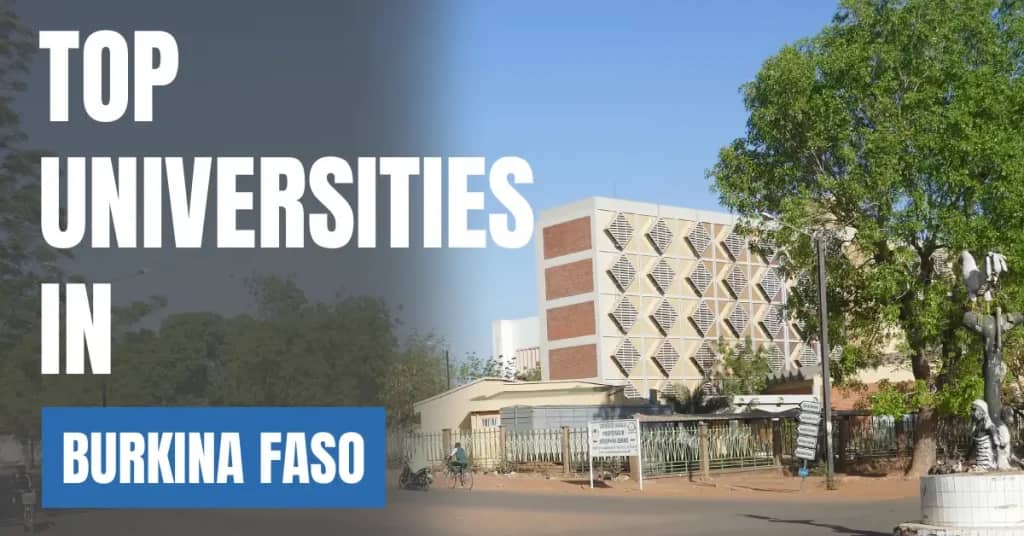
Burkina Faso does not have a university landscape where a simple international league table can identify a reliable national Top 10. Only a small number of institutions appear in major international ranking systems, while the government’s current university structure distinguishes between broad generalist universities and specialist higher-education institutions.
On this pageTable of Content
Based on the available 2025–2026 evidence, Université Joseph Ki-Zerbo (UJKZ) has the strongest independently documented overall research visibility. Université Nazi Boni (UNB) is particularly relevant for agriculture, health sciences and applied disciplines, while Université Norbert Zongo (UNZ) and Université Thomas Sankara (UTS) deserve consideration for specific subject strengths.
Ranking should therefore be treated as one part of the decision rather than the final answer.
Also Explore: Top Universities in BulgariaQuick Answer
| Student Priority | Strong Starting Point | Why |
|---|---|---|
| Strongest documented overall research visibility | Université Joseph Ki-Zerbo | QS Sub-Saharan Africa 2026 and SCImago 2026 evidence |
| Agriculture and rural development | Université Nazi Boni | Strong institutional focus through agriculture and rural-development structures |
| Health and applied sciences | Université Nazi Boni / UJKZ | Both offer substantial relevant academic provision |
| Mathematics, computing and AI | Université Norbert Zongo | Published mathematics, computing and AI pathways |
| Economics, management and law | Université Thomas Sankara | Specialist positioning and relevant faculties and programmes |
| Private university comparison | Start with current MESRI monitoring | Government monitoring gives stronger evidence than reputation alone |
How We Selected These Universities
The universities in this guide were not selected through an invented Visaboards score or by averaging unrelated ranking systems.
The research considered:
- current international ranking and research evidence where available;
- Burkina Faso’s official 2025 university classification;
- subject and programme evidence from official university sources;
- current government monitoring of private higher-education institutions;
- admission procedures through CampusFaso;
- programme-level cost evidence;
- recognition and authorization requirements;
- major recent higher-education reforms;
- practical issues affecting international students.
Comparable graduate-employment statistics, broad student-satisfaction surveys and reliable university-by-university living-cost totals were not available in the reviewed evidence. Those gaps are not filled with estimates.
Burkina Faso’s University System Changed in 2025
Students comparing older university guides should be aware that Burkina Faso introduced a new Carte universitaire in August 2025.
The Ministry of Higher Education identified four public institutions as generalist universities:
- Université Joseph Ki-Zerbo
- Université Nazi Boni
- Université Norbert Zongo
- Université Virtuelle du Burkina Faso
The system also contains 13 specialist public higher-education institutions, including Université Thomas Sankara and several other universities, grandes écoles and university centres.
This matters because the strongest university for a particular subject may be a specialist institution rather than the university with the highest overall research visibility.
Burkina Faso Ministry of Higher Education: 2025 university map
Leading Universities in Burkina Faso
| University | Location | Main Evidence-Supported Reason to Consider It | Important Limitation |
|---|---|---|---|
| Université Joseph Ki-Zerbo | Ouagadougou | Strongest documented international and research visibility | Overall position does not prove subject-level superiority |
| Université Nazi Boni | Bobo-Dioulasso | Strong agriculture, health, computing and applied-science breadth | Less international ranking visibility than UJKZ |
| Université Norbert Zongo | Koudougou | Relevant mathematics, computing, AI and science pathways | Limited comparable ranking evidence |
| Université Thomas Sankara | Ouagadougou area | Specialist strength in economics, management and law | Better evaluated by subject fit than overall ranking |
| Université Libre du Burkina | Ouagadougou | Highest score in 2025 MESRI private-university monitoring table | Monitoring score is not an international research ranking |
Université Joseph Ki-Zerbo
Why We Recommend It
Université Joseph Ki-Zerbo has the clearest evidence-supported case as the first university to investigate when a student wants Burkina Faso’s strongest documented overall academic and research visibility.
UJKZ appears at #51+ in the QS Sub-Saharan Africa 2026 ranking. SCImago’s 2026 Burkina Faso institutional table also places UJKZ first among the two Burkina Faso higher-education institutions included in that ranking.
These indicators do not establish that UJKZ is the best choice for every degree, but they provide stronger independent evidence than generic claims about reputation.
QS profile for Université Joseph Ki-Zerbo
SCImago Burkina Faso institutional rankings
Academic Breadth
UJKZ is a broad multidisciplinary institution. Official university information shows provision across areas including:
- medicine;
- pharmacy;
- dentistry;
- biomedical sciences;
- natural sciences;
- computing;
- environmental studies;
- statistics;
- economics;
- humanities;
- languages.
During the 2025 national information and orientation event, UJKZ reported presenting more than 110 study pathways.
Université Joseph Ki-Zerbo official website
Who Should Consider UJKZ?
UJKZ is particularly relevant for students who want:
- a large public multidisciplinary university;
- research-oriented postgraduate study;
- broad health-science options;
- access to both STEM and humanities disciplines;
- the Burkina Faso institution with the strongest currently documented international ranking visibility.
Important Tradeoff
Students should not interpret UJKZ’s overall position as evidence that every programme is superior to the same subject at UNB, UNZ or a specialist institution.
For regulated professions such as medicine and pharmacy, programme authorization and professional recognition should carry more weight than the overall university ranking.
Université Nazi Boni
Why We Recommend It
Université Nazi Boni in Bobo-Dioulasso has one of the clearest subject-fit cases in the country.
Its institutional structure includes academic units focused on:
- rural development;
- health sciences;
- computer science;
- technology;
- sciences;
- economics;
- law;
- humanities.
Current postgraduate recruitment has also included fields such as data science, agro-economics, biotechnology, mathematics, civil engineering and surgical sciences.
Université Nazi Boni official website
Independent Research Evidence
SCImago’s 2026 Burkina Faso table places UNB second among the two national higher-education institutions included.
That should not be converted into a universal claim that UNB is Burkina Faso’s second-best university. SCImago covers only part of the national university landscape.
It does, however, provide independent evidence that UNB has measurable research activity.
Who Should Consider UNB?
UNB is particularly worth comparing for:
- agriculture;
- rural development;
- animal and biological sciences;
- health sciences;
- computer science;
- engineering and applied technical study.
UJKZ or UNB?
Students prioritizing overall research visibility have a stronger evidence-based reason to start with UJKZ.
Students pursuing agriculture, rural development or certain applied disciplines may find UNB’s academic structure more directly aligned with their degree plans.
This is one of the clearest examples of why overall ranking and subject fit should be evaluated separately.
Université Norbert Zongo
Why It Deserves Consideration
Université Norbert Zongo is one of Burkina Faso’s four generalist public universities under the 2025 university map.
Its strongest recommendation case comes from science and technology rather than overall ranking.
Official information from its science and technology faculty includes study and research in:
- mathematics;
- physics;
- chemistry;
- computer science;
- life sciences;
- operational research;
- statistics and probability;
- mathematical modelling;
- energy.
Published postgraduate provision also includes an artificial intelligence pathway in computer science.
Université Norbert Zongo science and technology faculty
Best Fit
UNZ is particularly relevant for students considering:
- mathematics;
- statistics;
- computer science;
- artificial intelligence;
- physics;
- research-oriented quantitative disciplines.
Important Limitation
Comparable international ranking evidence is substantially weaker than for UJKZ and UNB.
The university should therefore be recommended because of documented programme fit, not because of an unsupported claim about its national position.
Université Thomas Sankara
Why It Is Different
Université Thomas Sankara is classified as a specialist institution under Burkina Faso’s current university map.
Its clearest evidence-supported strengths lie in economics, management, law and related areas.
Published academic pathways include areas such as:
- economics;
- agricultural economics;
- environmental and development economics;
- macroeconomics;
- finance;
- management;
- accounting;
- governance;
- public law;
- international law;
- business law;
- political science.
Université Thomas Sankara economics and management programmes
Who Should Consider UTS?
UTS is particularly relevant for students interested in:
- economics;
- development studies;
- business and management;
- finance;
- governance;
- law;
- public policy-related disciplines.
Why Ranking Can Mislead Here
A student interested in economics or law should not automatically reject UTS simply because UJKZ has stronger overall international ranking visibility.
The institutions serve different academic purposes, and programme fit may provide more decision value than overall institutional ranking.
What About Private Universities?
Burkina Faso’s private higher-education sector should be compared using current government authorization and monitoring evidence rather than reputation alone.
The Ministry of Higher Education’s 2025 monitoring report gave Université Libre du Burkina a score of 18.54/20, classified as “Excellent”, the highest score in the university section of the published monitoring table.
Other private institutions also received strong scores.
The report demonstrates an important point: a private university should not be recommended simply because it is well known or appears frequently in online guides.
MESRI 2025 private higher-education monitoring report
Aube Nouvelle Requires Campus-Level Comparison
Older guides often highlight Université Aube Nouvelle.
However, MESRI’s 2025 monitoring assessed its campuses separately. The Bobo-Dioulasso campus received a stronger evaluation than the Ouagadougou campus.
That makes a blanket statement such as “Aube Nouvelle is Burkina Faso’s best private university” difficult to defend from the available evidence.
Students should instead verify:
- the exact campus;
- the exact degree;
- current authorization;
- current tuition;
- any required professional recognition.
Ranking Does Not Tell the Whole Story
Burkina Faso provides several examples where a conventional ranking table can mislead students.
UJKZ vs UNB
UJKZ has the stronger documented overall external ranking profile.
UNB may nevertheless be a more natural academic fit for agriculture, rural development or certain applied sciences.
UJKZ vs UTS
UJKZ has much stronger overall ranking visibility.
UTS may make more sense for students focused specifically on economics, management or law because those areas are central to its specialist role.
UJKZ vs UNZ
UJKZ offers stronger overall research visibility.
UNZ deserves consideration for students whose interests align closely with its mathematics, computing and AI provision.
The practical question is therefore not simply “Which university ranks highest?”
Which university has the strongest evidence for the degree I actually want to study?
Admissions and CampusFaso
One of the most important practical features of Burkina Faso’s admissions system is CampusFaso.
CampusFaso operates as the centralized platform used for orientation procedures involving new Burkinabe and foreign baccalaureate holders and includes applications to public and private higher-education programmes.
CampusFaso official admissions portal
For the 2026–2027 cycle, published CampusFaso information included:
- an initial orientation period from 19 to 26 July 2026;
- another application/orientation window from 1 to 3 September 2026;
- first-session results scheduled during September 2026.
Applicants should use the live platform for current dates because admissions calendars are time-sensitive.
Admission Requirements Are Programme-Specific
There is no defensible single admission requirement for all Burkina Faso universities.
Requirements can differ according to:
- qualification level;
- previous academic results;
- subject prerequisites;
- professional versus academic programme;
- postgraduate specialization;
- selection tests;
- interviews;
- research requirements.
Students should therefore avoid unofficial websites claiming universal university acceptance rates.
Reliable acceptance-rate evidence was not identified in the supplied research and no estimates should be used.
Tuition and University Costs
Burkina Faso cannot be accurately summarized with one universal university tuition figure.
Fees vary by:
- university;
- programme;
- study level;
- public or private status;
- domestic/UEMOA or non-UEMOA student category.
Example: Université Thomas Sankara
Published UTS economics and management information lists different registration charges for several student categories, including higher charges for students from outside the UEMOA area.
These amounts apply to specific published programmes and should not be described as universal UTS tuition.
Public-University Fees
UJKZ programme documents similarly demonstrate that administrative registration fees and programme-specific training or laboratory charges can differ.
A fee quoted for one master’s programme should therefore never be transformed into a statement such as:
“UJKZ costs X FCFA per year.”
Private Tuition Regulation for 2026–2027
Burkina Faso introduced new controls over private education fees in July 2026.
The regulation applies from the 2026–2027 academic year and establishes ceilings differentiated by academic level, subject field and institution category.
The government’s examples for a category-three private higher-education institution included Licence-level ceilings of:
- 630,000 FCFA for exact, applied and agricultural sciences;
- 495,000 FCFA for literary studies;
- 457,000 FCFA for legal, political, economic, management, human and social sciences.
These are regulatory examples for specific categories rather than universal prices for all private universities.
MESRI announcement on 2026–2027 private education fee regulation
What About Living Costs?
The reviewed research does not provide sufficiently reliable and comparable current student budgets for Ouagadougou, Bobo-Dioulasso and Koudougou.
It would therefore be misleading to manufacture a precise annual “total student cost.”
[Internal link opportunity: Cost of Living in Burkina Faso]
Scholarships
Burkina Faso adopted a revised national scholarship framework in June 2026.
The new regime introduced 13 scholarship categories and revised selection criteria, including greater consideration of:
- academic merit;
- priority areas of study;
- type of baccalaureate;
- qualification level;
- student financial circumstances.
Burkina Faso government announcement on the 2026 scholarship reforms
International applicants should be cautious here.
The research does not establish that every national scholarship category is available to foreign students.
Students should confirm eligibility directly with the responsible authority or university before including a scholarship in their financial plan.
[Internal link opportunity: Scholarships in Burkina Faso]
Recognition and Accreditation
Official recognition is an important university-selection factor in Burkina Faso.
In January 2026, the Ministry of Higher Education reiterated that only properly authorized public and private higher-education institutions under its supervision may issue academic Licence, Master and Doctorate qualifications.
MESRI guidance on authorized higher-education institutions
Students entering regulated professions should go one step further and verify the specific degree.
This is particularly important for programmes such as:
- medicine;
- pharmacy;
- dentistry;
- engineering;
- other professions where specific authorization or professional recognition may apply.
A university’s overall ranking should not substitute for checking whether the exact programme is recognized for the student’s intended career.
Academic Delays Have Improved Significantly
Academic delays have historically been a serious practical issue in Burkina Faso’s public higher-education system.
By 31 August 2026, MESRI reported that 360 of 361 programmes had been academically normalized, equivalent to 99.69%.
The remaining programme was pharmacy at UJKZ, and the ministry stated that the 2026–2027 academic year was expected to begin across all levels on 1 October 2026.
This is important because prolonged academic calendars can affect the real time required to finish a degree.
MESRI September 2026 update on academic-year normalization
International Students: Visa and Residence Considerations
Foreign students planning a stay exceeding 90 days need to check Burkina Faso’s long-stay immigration requirements.
Official migration guidance indicates that a long-stay visa, residence permit or other appropriate authorization may be required depending on nationality and circumstances.
Study-related applications can require evidence such as:
- a valid passport;
- proof of the purpose of stay;
- evidence of enrolment or study;
- proof of sufficient financial resources;
- health-related documentation;
- insurance documentation.
Burkina Faso official long-stay visa information
The supplied research identified inconsistent study-related visa fee figures between different language versions of the official migration website.
Students should therefore confirm the current payable fee directly with the relevant authority rather than relying on one static figure.
The available official evidence also does not establish a general student work-hours entitlement comparable to countries such as the UK or Australia.
Do not assume that a student immigration status automatically provides unrestricted employment rights.
[Internal link opportunity: Student Visa for Burkina Faso]
Current Security Conditions Matter for International Students
International students must also consider Burkina Faso’s current security situation.
As of September 2026, several foreign governments maintain their highest or near-highest travel warnings for Burkina Faso because of terrorism, kidnapping and instability.
For example, the United States maintains a Level 4: Do Not Travel advisory, while UK and Australian authorities also advise against travel.
U.S. Department of State Burkina Faso travel advisory
UK government Burkina Faso travel advice
These travel advisories are not assessments of university academic quality.
They are nevertheless highly relevant to an international student’s decision about whether studying and living in Burkina Faso is currently practical.
Students should consult advice issued by their own government immediately before committing to travel.
Graduate Outcomes and Student Experience: Evidence Gaps
Comparable graduate-employment rates were not identified for the universities covered in this research.
Statements such as:
- “graduates are highly employable”;
- “the university has excellent job prospects”;
- “strong industry links guarantee employment”
should therefore not be presented as evidence-based conclusions.
Likewise, no sufficiently robust national student-satisfaction dataset was identified that allows UJKZ, UNB, UNZ and UTS to be compared fairly on student experience.
Generic claims about vibrant campus life, excellent support or student satisfaction should be avoided unless stronger evidence becomes available.
Which University Should You Choose?
Choose Université Joseph Ki-Zerbo if:
You want the strongest currently documented overall research visibility in Burkina Faso and a broad multidisciplinary public university.
Consider Université Nazi Boni if:
Your priority is agriculture, rural development, health sciences, computing or applied technical study.
Consider Université Norbert Zongo if:
You are particularly interested in mathematics, statistics, computing, artificial intelligence or related quantitative research.
Consider Université Thomas Sankara if:
Your intended field is economics, management, governance, law or another discipline closely aligned with its specialist academic role.
If You Want a Private University:
Begin with current MESRI authorization and monitoring evidence rather than online reputation lists. Université Libre du Burkina had the highest score in the ministry’s 2025 university monitoring table, but programme fit, tuition and recognition still need to be checked individually.
Be Careful About Choosing Purely by Ranking if:
You are entering medicine, pharmacy, engineering or another regulated profession.
Programme authorization and professional recognition may matter more than an institution’s overall ranking.
For an international student, the current security environment should also be considered before university quality, cost or ranking is treated as the final deciding factor.
Top Universities in Burkina Faso Frequently Asked Questions
What is the top university in Burkina Faso?
Université Joseph Ki-Zerbo has the strongest currently documented overall ranking and research evidence. It is listed at #51+ in the QS Sub-Saharan Africa 2026 ranking and is first among the two Burkina Faso institutions included in SCImago’s 2026 country table. This does not mean it is automatically the best university for every subject.
Which university in Burkina Faso is best for agriculture?
Université Nazi Boni is one of the strongest institutions to investigate for agriculture and rural development because these fields form a significant part of its academic structure. The evidence does not support declaring a universal national number-one agriculture programme.
Which university is suitable for computer science or AI?
Université Norbert Zongo deserves consideration for mathematics, computer science and artificial intelligence, including published postgraduate research pathways. UJKZ and UNB also offer computing-related study, so students should compare the exact programmes.
Is Université Joseph Ki-Zerbo internationally ranked?
Yes. Université Joseph Ki-Zerbo is listed at #51+ in the QS Sub-Saharan Africa 2026 ranking. SCImago’s 2026 Burkina Faso table also places it first among the two national institutions included.
Are private universities recognized in Burkina Faso?
Private universities can be officially authorized, but students should verify both the institution and the specific programme. Burkina Faso’s Ministry of Higher Education monitors private higher-education institutions and publishes quality-control findings.
Which private university received the strongest government monitoring score?
In MESRI’s 2025 monitoring table for private universities, Université Libre du Burkina received 18.54/20, the highest score in that university table. This is a government monitoring result, not an international academic ranking.
How do students apply to universities in Burkina Faso?
CampusFaso is the central platform used for orientation and application procedures for new Burkinabe and foreign baccalaureate holders. Exact admission requirements still vary by programme and university.
How much does university cost in Burkina Faso?
There is no single reliable tuition figure. Costs differ by institution, programme, study level and student category. Private higher-education fees are also subject to new 2026–2027 government regulation.
Are scholarships available in Burkina Faso?
Burkina Faso revised its national scholarship system in June 2026 and created 13 scholarship categories. International students should verify eligibility because the reviewed evidence does not establish that all categories are open to foreign applicants.
Is Burkina Faso currently suitable for international students?
Academically, the country has recognized universities and specialist institutions. However, the current security environment is a major consideration. Several foreign governments advise against travel to Burkina Faso because of terrorism, kidnapping and instability. Students should check the latest advice from their own government before applying or travelling.
Sources and Methodology
This guide was researched using evidence current through September 2026.
University System, Recognition and Regulation
Primary regulatory evidence came from Burkina Faso’s Ministry of Higher Education, Research and Innovation, including:
- the 2025 Carte universitaire;
- 2025 monitoring of private higher-education institutions;
- current higher-education authorization guidance;
- 2026–2027 private tuition regulation;
- September 2026 academic-year normalization reporting.
Rankings
International positioning was assessed using:
- QS World University Rankings: Sub-Saharan Africa 2026;
- SCImago Institutions Rankings 2026.
These rankings were not averaged or converted into an invented national score. Their limited Burkina Faso coverage is stated throughout the article.
University Programmes
Subject and programme information was checked against official information published by:
- Université Joseph Ki-Zerbo;
- Université Nazi Boni;
- Université Norbert Zongo;
- Université Thomas Sankara.
Admissions
Admissions and orientation procedures were assessed using CampusFaso.
Costs and Scholarships
University-specific published material was used where available. Programme-level fees were not generalized into university-wide tuition figures.
National scholarship reform and private tuition regulation were checked against official government sources.
International Students
Visa and residence information came from Burkina Faso’s official migration service.
Current international security considerations were assessed using government travel advisories. These advisories were treated as practical safety information, not as measures of university academic quality.
Join the conversation
Have thoughts on this topic? Share them with others.
Ask questions, share experience, and learn from the Visaboards Community.