
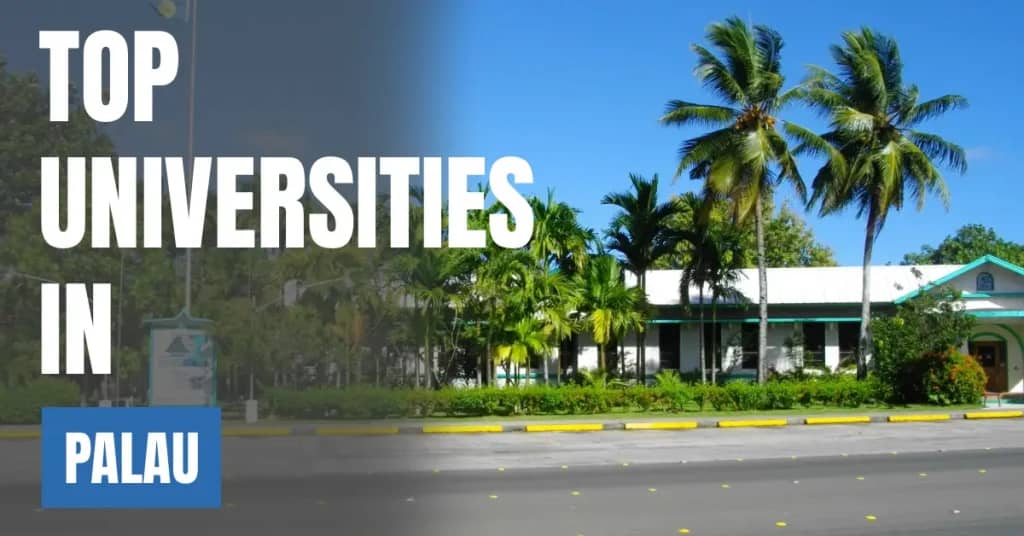
Students searching for the top universities in Palau need to understand one important fact first: Palau does not have a large domestic university system with several institutions competing in national or global rankings.
On this pageTable of Content
Palau’s Development Plan identifies Palau Community College (PCC) as the country’s only local higher-education institution. This makes Palau very different from destinations where students can compare five, ten or twenty universities.
The picture also changed in 2026. Palau Community College has launched its first-ever bachelor’s degree, a Bachelor of Science in Science, beginning in Fall 2026. PCC also continues to offer associate degrees, career and technical programs, and transfer pathways to institutions overseas.
For prospective students, the real question is therefore not which Palau university ranks first. It is whether PCC’s degree level, subject options, tuition, admission rules and transfer opportunities fit your study plans.
Quick Answer: What Are the Main Higher-Education Options in Palau?
| Institution | Type | Why It Matters | Main Limitation |
|---|---|---|---|
| Palau Community College | Public higher-education institution | Palau’s only local higher-education institution, with associate, technical and bachelor-level study | Only one bachelor’s-degree area is currently listed |
| Palau International Coral Reef Center | Marine research institution | Provides marine-science research and internship opportunities | It is not a university or alternative degree-granting institution |
PCC is therefore the primary institution students should investigate if they want to earn a higher-education qualification while studying locally in Palau. PICRC is better understood as a specialist research and internship opportunity, particularly for marine-science students.
Why There Is No Top 5 or Top 10 University Ranking for Palau
A conventional university ranking would not accurately represent Palau.
The Palau Development Plan 2023-2026 describes PCC as Palau’s only local higher education institution. The same government document reported that PCC enrolled 525 students in Fall 2022.
Because there is only one local higher-education institution, adding research organizations or training providers simply to create a longer “Top Universities” list would give students the wrong impression.
There is also no useful QS, Times Higher Education or ARWU comparison among multiple Palau universities. For this country, accreditation, available degree levels, subjects, costs, admissions and overseas transfer opportunities provide more decision value than a fabricated national ranking.
How We Selected the Institutions in This Guide
This guide does not use a numerical scoring model.
Palau Community College is included because it is identified in Palau’s national development plan as the country’s only local higher-education institution, provides post-secondary programs and holds institutional accreditation.
PICRC is discussed separately because there is documented evidence of PCC Environmental/Marine Science students completing practical field experience there. It is not treated as a university.
The guide focuses on the factors that materially affect a student’s decision in Palau: qualification level, subjects, accreditation, tuition, admission requirements, immigration restrictions, transfer pathways and research opportunities.
Palau Community College
Palau Community College is a public higher-education institution located in Koror.
Its current institutional form dates to the Higher Education Act of 1993, when Micronesian Occupational College became Palau Community College.
Why Students Should Consider Palau Community College
PCC deserves consideration for three particularly important reasons.
First, it is Palau’s only local higher-education institution according to the country’s national development plan.
Second, PCC is institutionally accredited by the Accrediting Commission for Community and Junior Colleges of the Western Association of Schools and Colleges, or ACCJC-WASC. Its accreditation was reaffirmed for seven years following the 2023 comprehensive review, and PCC states that its next comprehensive review is scheduled for 2030.
Third, PCC’s degree range expanded materially in 2026. The college now states that it offers associate degrees in 21 areas and one bachelor’s-degree area in science.
Best Suited To
PCC is particularly relevant for students who:
- want to study locally in Palau;
- want an associate or career-focused qualification;
- are interested in environmental or marine science;
- want technical education;
- want to begin locally before transferring abroad;
- or want to pursue PCC’s new Bachelor of Science in Science.
Students looking for a wide selection of bachelor’s majors will face a much more limited choice than they would in a larger national university system.
PCC’s First Bachelor of Science Degree
One of the most significant developments in Palau higher education in 2026 is PCC’s introduction of its first bachelor’s program.
PCC states that its Bachelor of Science in Science begins in Fall 2026. The program is multidisciplinary and emphasizes biological and physical sciences.
This changes the local study landscape because students can now pursue a bachelor’s qualification directly through PCC rather than being limited entirely to associate-level and technical routes.
However, students should keep the scale of this change in context. PCC currently lists only one bachelor’s-degree area, so students seeking bachelor’s degrees in fields such as business, engineering, computer science or many other disciplines may still need to investigate overseas universities.
Bachelor of Science Entry Requirements
PCC lists several routes into the Bachelor of Science in Science.
A high-school or adult-high-school graduate can meet the academic entrance condition with a minimum cumulative GPA of 2.5. PCC also publishes routes for applicants with HiSET or GED qualifications and for currently enrolled students who meet the stated GPA requirement.
Applicants should check the current program page before applying because program requirements can change.
What Can You Study at Palau Community College?
PCC organizes its programs through the School of Arts and Sciences, School of Business and School of Technical Education.
Arts, Science and Health-Related Subjects
PCC currently lists study areas including:
- Agricultural Science
- Community and Public Health
- Criminal Justice
- Education
- Environmental/Marine Science
- Liberal Arts
- Library and Information Services
- Nursing
- Palauan Studies
- Science
- STEM disciplines
PCC’s Associate of Science program is generally designed to prepare students either for employment or for transfer to a four-year institution.
Business and Information Technology
PCC’s School of Business lists:
- Business Accounting
- Business Administration
- Information Technology
- Office Administration
- Tourism and Hospitality
These options are useful for students wanting to study locally, but students seeking a bachelor’s degree specifically in business or computing should compare PCC’s current qualification level with overseas options.
Career and Technical Education
PCC’s School of Technical Education currently includes:
- Air Conditioning and Refrigeration Technology
- Automotive Technology
- Construction Technology
- Electrical Technology
- General Electronics Technology
- Small Engine and Outboard Marine Technology
These programs may be more relevant than a traditional four-year academic route for students whose main objective is occupational and technical training.
Environmental and Marine Science in Palau
Environmental and marine science is one of the more distinctive study areas available through PCC because students can combine formal study with a locally relevant marine environment.
PCC officially lists Environmental/Marine Science among its academic programs.
There is also documented evidence of PCC students completing field experience at the Palau International Coral Reef Center.
In July 2025, PICRC reported that two PCC Environmental Marine Science students completed a one-month internship as part of the four-credit SC270 Field Studies course. Their activities included ecological fieldwork, biological sampling, data handling and scientific reporting.
This provides evidence of a practical connection between PCC study and local marine research. It does not mean that every PCC student is automatically guaranteed an internship at PICRC.
Is Palau International Coral Reef Center a University?
No.
The Palau International Coral Reef Center should not be treated as a second university in Palau.
PICRC conducts marine research, education and internship activities, and it can be relevant to students interested in marine and environmental science. However, the available evidence supports describing it as a specialist research organization rather than as an alternative university.
Its relationship with PCC is academically useful. PCC Environmental Marine Science students have undertaken practical field experience at PICRC, including data collection and research activities.
For prospective students, the distinction is important: PCC provides the formal higher-education qualification. PICRC may provide specialist research experience.
Palau Community College Accreditation
PCC is accredited by ACCJC-WASC.
The college reports that it first became accredited by ACCJC-WASC in 1977. Following its comprehensive review in 2023, its accreditation was reaffirmed for another seven-year cycle, with the next comprehensive review scheduled for 2030.
Institutional accreditation is an important quality and recognition indicator, but students should avoid assuming that it guarantees automatic acceptance of every PCC qualification in every country.
Students who intend to:
- transfer credits overseas;
- enter a regulated profession;
- apply for postgraduate study;
- or seek professional licensing in another jurisdiction
should check the receiving institution or professional regulator’s specific requirements.
For regulated subjects such as nursing, institutional accreditation should not replace checking any program-specific professional recognition that may be required where you intend to work.
Tuition and Fees at Palau Community College
PCC’s 2024-2028 General Catalog publishes the following tuition rates:
| Charge | Published Rate |
|---|---|
| Resident tuition | US$130 per credit |
| Non-resident tuition | US$140 per credit |
| Registration fee | US$15 per semester |
| Health fee | US$20 per semester |
| Activity fee | US$45 per semester |
| Instructional support fee | US$150 per semester |
| Technology fee | US$75 per semester |
| Application fee | US$10 |
The catalog states that citizens of Palau, the Federated States of Micronesia, the Republic of the Marshall Islands and the United States are eligible for resident tuition.
Some programs or delivery formats have extra charges. PCC lists additional fees for areas such as distance education, hybrid classes, diving courses and shop tools.
Students should therefore avoid estimating the cost of their degree from the per-credit tuition rate alone.
PCC also states that the college and its Board of Trustees may review and adjust tuition and fees.
Campus Housing and Meal Costs
PCC’s 2024-2028 General Catalog lists the following charges for a regular Fall or Spring semester:
| Campus Cost | Published Charge |
|---|---|
| Room | US$588 per regular semester |
| On-campus board | US$1,102.50 per regular semester |
| Meal provision | Three meals daily, seven days a week |
For summer, the catalog lists a room charge of US$280 and on-campus board of US$525.
These figures are useful for estimating direct PCC accommodation and meal charges.
They should not be presented as Palau’s complete cost of living. Students may still need to budget for transportation, books, personal expenses, flights and other costs.
International Student Admission Requirements
PCC has specific requirements for international applicants.
The college classifies applicants from countries outside Palau, the Federated States of Micronesia, the Marshall Islands, the Northern Mariana Islands, Guam and the United States as international students.
International applicants currently need to provide:
- a completed PCC application;
- a US$10 non-refundable application fee;
- official academic transcripts;
- certified English translations where necessary;
- evidence that previous education is equivalent to the Palau system;
- proof of sufficient financial resources;
- English-language evidence where required;
- and compliance with applicable Palau immigration rules.
Financial Support Requirement
PCC requires an international applicant to submit an Affidavit of Financial Support of US$15,000 or more, together with official bank statements or equivalent evidence.
This requirement is important because it is separate from the actual tuition amount. Applicants must demonstrate financial capacity rather than simply show that they can pay one semester’s tuition.
TOEFL Requirement
PCC currently states that international applicants should submit an official TOEFL score of 500 or higher as proof of English proficiency.
The college’s catalog also describes a possible waiver process for some applicants who studied in an English-speaking environment, subject to PCC’s conditions.
Applicants relying on an English-language waiver should obtain confirmation from PCC rather than assuming that they qualify automatically.
Full-Time Study Requirement
International students must maintain at least:
- 12 credits during Fall and Spring semesters
- 6 credits during the Summer session
PCC accepts applications throughout the year but recommends that completed applications and supporting documents be submitted at least 60 days before the desired semester begins.
Student Visa and Work Rules in Palau
Palau’s immigration rules have a direct impact on the feasibility of studying there as an international student.
According to Palau’s Bureau of Customs and Border Protection, a Student Visa may be issued to a foreign national who is enrolled full-time at a school in Palau and who will live in housing maintained by that school. The applicant must provide evidence of admission and housing and remain in good standing.
A Palau Student Visa is valid for no more than one year.
One of the most important restrictions is employment.
The government states that a foreign national holding a Student Visa may not work in Palau unless expressly exempted in writing by the Director.
This matters financially. International students should not prepare a study budget that depends on routine part-time employment unless they have confirmed that they qualify for an official exemption.
Student Visa holders also need to provide continuing proof of enrollment and housing at the beginning of each semester.
Transfer Opportunities From PCC
Transfer pathways are especially important in Palau because PCC currently offers only one bachelor’s-degree area.
PCC states that it articulates with 19 institutions across the Asia-Pacific region and the United States.
The institutions listed by PCC include:
- University of Guam
- University of Hawaiʻi at Hilo
- University of Hawaiʻi at Mānoa
- University of Hawaiʻi-West Oʻahu
- San Diego State University
- Waseda University
- University of the Ryukyus
- Hawaii Pacific University
- Western Oregon University
- and other partner institutions
This creates an important alternative path for students: begin at PCC, then continue at a four-year institution where appropriate.
PCC’s Associate of Arts degree is specifically intended for students who want to complete the first two years of general college study before transferring to a four-year college or university.
However, articulation should not be confused with automatic transfer of every credit.
Students should confirm:
- which courses transfer;
- how those credits apply to the destination degree;
- whether minimum grades are required;
- and whether admission to the receiving institution is separately required.
PCC or an Overseas University?
For many students in Palau, this is more useful than comparing one local institution with another.
PCC May Make More Sense If:
- your intended program is available locally;
- an associate qualification meets your academic or career objective;
- you want technical or vocational education;
- you want the new Bachelor of Science in Science;
- or you want to begin locally before transferring overseas.
An Overseas University May Make More Sense If:
- you need a bachelor’s degree that PCC does not offer;
- you want a highly specialized major;
- you need a professional degree unavailable locally;
- or you want direct entry into a larger research-university environment.
PCC’s new bachelor’s program reduces the need to leave Palau for one area of four-year study, but it does not yet provide the subject breadth available in larger university systems.
Key Tradeoffs for Students
| Decision Factor | Evidence | What It Means for Students |
|---|---|---|
| Number of local institutions | PCC is Palau’s only local HE institution | Domestic university choice is extremely limited |
| Bachelor’s programs | One bachelor-degree area is currently listed | Many bachelor’s subjects require overseas study |
| Accreditation | PCC is ACCJC-WASC accredited | Useful institutional recognition, but program-specific requirements may still apply |
| Tuition | US$130 resident / US$140 non-resident per credit | Direct tuition is clear, but fees must also be included |
| Housing | PCC publishes campus room and board charges | International students should also confirm availability |
| International admission | US$15,000+ financial support and TOEFL 500+ are currently listed | Admission planning requires financial and language preparation |
| Student work | Student Visa holders generally cannot work without written exemption | Part-time employment should not be assumed |
| Transfer routes | PCC lists 19 articulation institutions | Valuable for degrees unavailable locally, but credit transfer must be verified |
| Marine science | PCC offers Environmental/Marine Science and documented PICRC field experience exists | Strong local practical context, but placements are not guaranteed |
Which Study Route Should You Choose in Palau?
Consider PCC’s Bachelor of Science in Science if you want a local bachelor’s-level science route. It is PCC’s first bachelor’s program and begins in Fall 2026.
Consider PCC Environmental/Marine Science if marine or environmental study is your priority. PCC offers the program, and students have completed documented practical experience at PICRC.
Consider PCC technical education if your goal is practical occupational training. Current options include automotive, construction, electrical, refrigeration, electronics and marine-engine technology.
Consider a PCC transfer pathway if the bachelor’s degree you want is unavailable locally. PCC’s articulation relationships and transfer-oriented associate study can provide a route toward continuing education overseas.
International students should evaluate immigration and finances before applying. The financial-support requirement, housing rules and restrictions on working while holding a Student Visa may be as important as the academic admission requirements.
Final Decision
Palau does not have a conventional “top universities” market. The evidence points instead to a single main local higher-education institution, Palau Community College, supported by specialist organizations such as PICRC that can add practical research experience without functioning as universities themselves.
PCC is most relevant for students who want to study locally, pursue an associate or technical qualification, study Environmental/Marine Science, begin a transfer pathway, or enroll in the new Bachelor of Science in Science.
Its biggest limitation is subject breadth at bachelor’s level. Students whose intended undergraduate major is not available at PCC should compare overseas universities rather than searching for another local Palau university.
For international students, the decision also depends heavily on practical feasibility. PCC requires evidence of substantial financial support, while Palau’s Student Visa generally prevents holders from working without written exemption. Those rules should be evaluated before an applicant commits financially.
Top Universities in Palau Frequently Asked Questions
How many universities are there in Palau?
Palau’s national development plan identifies Palau Community College as the country’s only local higher-education institution. Palau therefore does not have a large domestic university system that can realistically be ranked as a Top 5 or Top 10.
What is the main university-level institution in Palau?
Palau Community College is the main local higher-education institution. It offers associate degrees, technical programs and, from Fall 2026, its first Bachelor of Science in Science.
Does Palau Community College offer bachelor’s degrees?
Yes. PCC announced its first bachelor’s degree, the Bachelor of Science in Science, beginning in Fall 2026. PCC currently lists one bachelor’s-degree area.
Is Palau Community College accredited?
Yes. PCC is institutionally accredited by ACCJC-WASC. Its accreditation was reaffirmed for seven years following the 2023 comprehensive review, with the next comprehensive review scheduled for 2030.
How much is tuition at Palau Community College?
PCC’s 2024-2028 General Catalog lists resident tuition at US$130 per credit and non-resident tuition at US$140 per credit. Mandatory and course-specific fees can increase the total cost.
Can international students apply to Palau Community College?
Yes. PCC publishes a specific international-applicant process that includes official transcripts, proof of financial resources, English-language evidence where applicable and compliance with Palau immigration rules.
How much financial support must an international PCC applicant show?
PCC currently requires an international applicant to provide an Affidavit of Financial Support showing US$15,000 or more, accompanied by bank statements or equivalent evidence.
Can international students work while studying in Palau?
Palau’s immigration authority states that a foreign national holding a Student Visa may not work in the country unless expressly exempted in writing by the Director.
Is the Palau International Coral Reef Center a university?
No. PICRC is a marine research institution, not a university. It can still be relevant to marine-science students because PCC Environmental Marine Science students have completed documented field experience there.
Can PCC students transfer to universities abroad?
PCC lists articulation relationships with 19 institutions in the Asia-Pacific region and the United States. Students should still verify how individual credits apply to their intended destination degree before transferring.
Sources and Methodology
This article uses Palau’s Development Plan 2023-2026 to establish the structure of the country’s higher-education system and PCC’s role as the only local higher-education institution.
- Palau Development Plan 2023-2026
- Palau Community College Academics
- Palau Community College Accreditation
- Palau Community College Admissions
- Palau Community College 2024-2028 General Catalog
- Palau Bureau of Customs and Border Protection Student Visa Information
- PICRC PCC Student Marine Science Experience
Last reviewed: September 17, 2026.
Join the conversation
Have thoughts on this topic? Share them with others.
Ask questions, share experience, and learn from the Visaboards Community.