
US Immigration News
US Suspends Microsoft, Adobe and 6 IT Firms From Green Card Program: What H-1B Workers Need to Know
Post Date · Modified · Country · United States
Updated: October 9, 2026
On this pageTable of Content
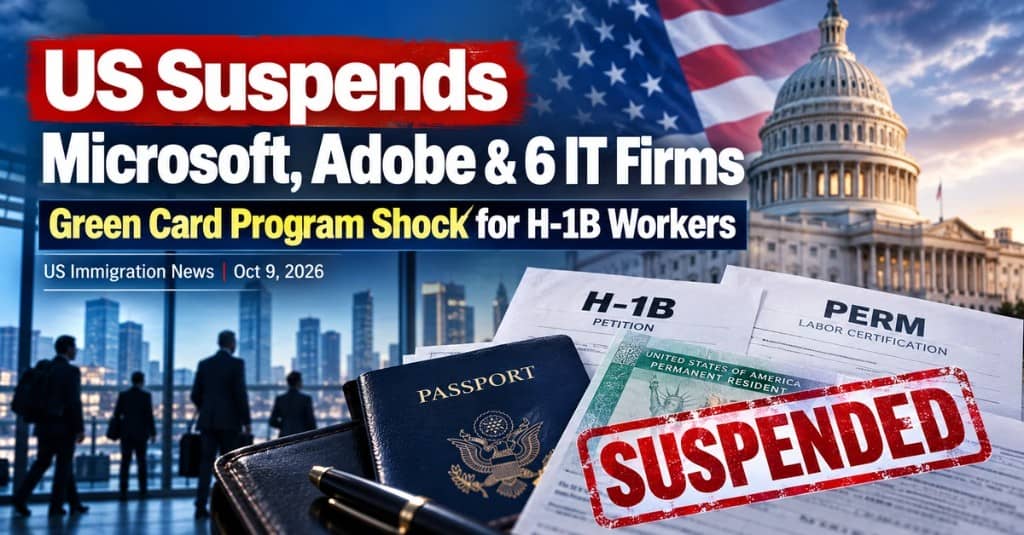
The United States has suspended Microsoft, Adobe, Infosys, Tata Consultancy Services (TCS), Wipro, HCLTech, Cognizant, and Capgemini from a major employment-based green card sponsorship program. The decision, announced on October 8, 2026, could disrupt permanent residency plans for foreign professionals working at these companies.
Vice President JD Vance and Labor Secretary Keith Sonderling announced the restrictions amid allegations that certain employers misused foreign worker programs and disadvantaged American workers. The companies' alleged misconduct has not been established simply by the announcement.
The restrictions concern the Permanent Labor Certification Program (PERM), an important part of many EB-2 and EB-3 employment-based green card applications.
Important: This is not a nationwide ban on H-1B visas. It does not automatically cancel existing H-1B status, approved immigrant petitions, or green cards. However, affected workers who have not completed the PERM stage may face significant delays and uncertainty.
What Happened on October 8, 2026?
During a White House news conference on October 8, Vice President JD Vance announced that Microsoft would be suspended from a federal program used by employers to sponsor foreign workers for permanent residence.
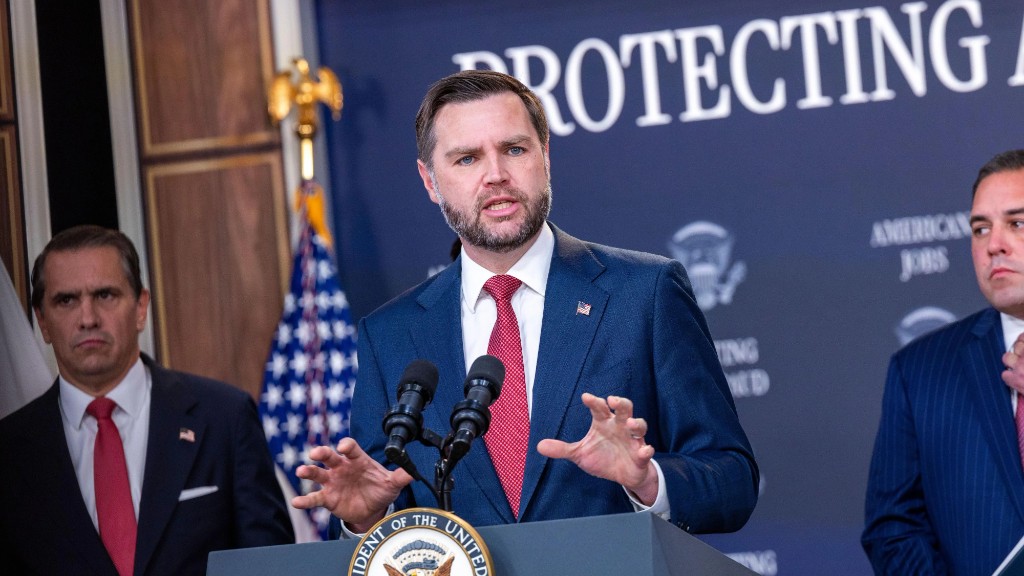
Labor Secretary Keith Sonderling subsequently identified Adobe and six large IT services companies as additional employers affected by the PERM restrictions.
The administration argued that the measures were necessary to protect American employment opportunities and address potential abuse of immigration and labor certification systems. Workers reviewing other options can also browse current United States jobs on Visaboards.
The government has alleged that some employers relied on foreign workers while laying off American employees or failing to provide appropriate employment opportunities to domestic applicants.
Those allegations remain distinct from proven violations. The announcement itself does not establish that every named company committed immigration fraud.
According to reporting by Reuters and The Guardian, the Labor Department is stopping new PERM submissions and the processing of pending PERM applications involving the affected companies.
The government has not publicly established a definite end date for the suspension. Questions also remain about the detailed treatment of some existing immigration applications.
Which Companies Have Been Suspended From the PERM Program?
Eight companies were identified in the October 8 announcement and subsequent reporting.
| Company | Main Business | Reported Restriction |
|---|---|---|
| Microsoft | Software, cloud computing and technology | PERM suspension |
| Adobe | Creative and enterprise software | PERM suspension |
| Infosys | IT consulting and outsourcing | PERM suspension |
| Tata Consultancy Services (TCS) | IT consulting and technology services | PERM suspension |
| Wipro | IT services and consulting | PERM suspension |
| HCLTech | Technology and IT services | PERM suspension |
| Cognizant | IT consulting and digital services | PERM suspension |
| Capgemini | Technology consulting and business services | PERM suspension |
Workers should verify the exact legal entity sponsoring their immigration case. Large multinational companies operate through subsidiaries, and the available reporting does not conclusively identify how every related corporate entity is treated.
The announcement does not mean every American technology employer has been barred from filing PERM applications.
Why Did the US Government Suspend These Companies?
Administration officials linked the measures to concerns about American worker displacement, wages, and employer compliance with immigration rules.
Vance specifically criticized Microsoft's use of H-1B visas and employer-sponsored green cards alongside layoffs affecting American employees.
Officials alleged that the company laid off approximately 6,000 American workers while receiving thousands of H-1B approvals and employment-based green card approvals.
However, the comparison requires caution. An H-1B approval may represent an extension, amendment, or other petition involving an existing employee. It is not necessarily the recruitment of a new foreign worker.
Likewise, two employment-related events occurring during the same period do not independently establish that laid-off workers were replaced by foreign employees.
Supporters of stricter enforcement argue that employers should demonstrate genuine recruitment of available American workers and comply fully with wage requirements.
Critics argue that restricting employment-based permanent residence may increase uncertainty for existing foreign employees, reduce their mobility, and make the United States less attractive to internationally recruited professionals.
These competing arguments are relevant to the broader policy debate, but the practical effects of the October 8 decision depend on the precise immigration category and application stage.
Microsoft Responds: 80% of H-1B Applications Were for Existing Employees
Microsoft issued an official response on October 8, challenging the impression that its visa applications primarily represented new foreign hires.
According to the company, it submitted approximately 6,000 H-1B applications during the previous fiscal year.
Microsoft said around 80% of those applications involved extensions or status changes for existing employees, rather than recruitment of new workers.
The company also said its remaining new-employee filings involved individuals already legally present in the United States. According to Microsoft, those filings represented approximately 1% of its American workforce.
Microsoft further maintained that it pays foreign employees comparably to other workers performing similar duties and that its H-1B compensation is among the highest in the technology sector.
These figures and compensation statements are Microsoft's own representations.
The response highlights an important issue in H-1B debates: the number of petitions filed by an employer should not automatically be interpreted as the number of newly recruited overseas employees.
Read the official Microsoft statement.
What Is the PERM Labor Certification Program?
The Permanent Labor Certification Program, generally known as PERM, is administered by the US Department of Labor.
It allows an employer to seek labor certification for a foreign worker who is being sponsored for certain employment-based immigrant visa categories.
For most PERM-covered positions, the employer must complete a prescribed process demonstrating that there are not sufficient able, willing, qualified and available US workers for the position and that employing the foreign worker will not adversely affect the wages and working conditions of similarly employed US workers.
PERM is commonly required for employer-sponsored EB-2 and EB-3 green card cases. However, some immigrant categories and exceptions do not require it.
How does the normal PERM-based green card process work?
- Prevailing wage determination: The employer obtains the required wage determination for the position.
- Recruitment: The employer completes the applicable recruitment steps to test the US labor market.
- PERM filing: The employer submits Form ETA-9089 to the Department of Labor.
- Labor certification: If approved, DOL certifies the application.
- Immigrant petition: The employer generally files Form I-140 with USCIS, using the certified PERM where required.
- Green card application: Once eligible under the applicable Visa Bulletin and immigration rules, the employee may pursue adjustment of status or an immigrant visa through consular processing.
For the normal PERM process, an approved labor certification generally must be submitted with the I-140 petition within 180 days of certification.
The October 8 suspension primarily targets the Department of Labor labor-certification stage, rather than automatically cancelling every later-stage application handled by USCIS.
For official program rules, consult the US Department of Labor's PERM guidance.
PERM vs H-1B vs Green Card: What Is the Difference?
These three immigration terms are closely connected in many employment cases, but they are not interchangeable.
| Immigration process | Purpose | Main authority |
|---|---|---|
| H-1B | Temporary employment in a qualifying specialty occupation | USCIS, with DOL requirements |
| PERM | Labor certification for certain employer-sponsored immigrant petitions | Department of Labor |
| I-140 | Petition seeking classification in an employment-based immigrant category | USCIS |
| I-485 | Application to adjust status to permanent residence inside the US | USCIS |
| Green card | Evidence of lawful permanent resident status | USCIS |
An H-1B employee can remain in valid temporary status without immediately receiving permanent residence, provided the individual continues meeting the applicable immigration requirements.
A suspended PERM process can interfere with the path to permanent residence without itself cancelling an otherwise valid H-1B approval.
Are Existing H-1B Visas Being Cancelled?
No blanket cancellation of existing H-1B visas was announced as part of this PERM suspension.
The reported measure specifically concerns employers' participation in the Permanent Labor Certification Program.
Existing H-1B holders must still comply with normal requirements concerning approved employment, immigration status, petition validity and authorized periods of stay.
The announcement does not independently establish that every existing H-1B petition, extension, or transfer involving the named employers is prohibited.
Workers should nevertheless distinguish between a visa stamp, USCIS-approved petition, I-94 expiration date, and lawful immigration status. These are related but different legal concepts.
What Happens to Pending PERM, I-140 and I-485 Applications?
The practical impact depends heavily on how far the employee has progressed through the employment-based immigration process.
| Current immigration stage | Potential impact |
|---|---|
| PERM not started | The affected employer's ability to initiate a new PERM filing is reportedly suspended. |
| Recruitment underway | The employer may be unable to proceed to a new PERM submission while the restriction remains. |
| PERM pending at DOL | Processing is reportedly paused for affected employers. |
| PERM already approved | Not automatically revoked by the announcement; filing deadlines and any applicable case-specific actions still matter. |
| I-140 pending | No blanket USCIS cancellation established by the PERM announcement; the particular petition requires review. |
| I-140 approved | Not automatically revoked solely because of the announced PERM suspension. |
| I-485 pending | No general cancellation established. Eligibility and portability depend on the individual case. |
| Permanent residence granted | Existing permanent resident status is not automatically cancelled by an employer's PERM suspension. |
These are general distinctions, not guarantees about every application. Future agency notices, investigations, revocation proceedings, or litigation could affect individual cases.
What if my PERM application is already certified?
A previously certified PERM application is different from one still awaiting Department of Labor review.
If the employer already has a valid certification, the employee should ask immigration counsel whether the associated I-140 has been submitted and whether any filing deadline remains outstanding.
The usual 180-day PERM certification validity period is particularly important.
What if my I-140 has already been approved?
An approved I-140 is not the same as a green card, but it may provide important benefits relating to immigrant classification, priority dates and, in some circumstances, extensions of H-1B status.
Whether those benefits remain available can depend on the petition's history, revocation grounds, employment changes and applicable regulations.
Employees should not assume that the employer's PERM suspension automatically destroys an already approved petition, nor should they assume that every future immigration benefit is guaranteed.
How Could This Affect H-1B Workers Approaching the Six-Year Limit?
Many H-1B professionals rely on progress toward employment-based permanent residence when seeking authorization beyond the normal six-year H-1B limit.
Under qualifying provisions of the American Competitiveness in the Twenty-First Century Act, commonly known as AC21, some H-1B employees can seek extensions beyond six years.
Depending on the circumstances, eligibility may be based on a qualifying labor certification or immigrant petition filed at least 365 days earlier, or on an approved I-140 where an immigrant visa is unavailable because of numerical limitations.
A delay in starting PERM may therefore be especially consequential for a worker who has limited remaining H-1B time and has not reached a qualifying direct immigration milestone.
However, a paused PERM application is not automatically equivalent to a denied application. Workers whose cases have already reached relevant AC21 milestones may have different options.
Immigration counsel should review the worker's remaining H-1B time, prior periods outside the United States that may be recaptured, PERM filing date, I-140 history and extension eligibility.
Why Are Indian IT Professionals Particularly Concerned?
The suspension affects several multinational technology services companies with significant Indian operations and large workforces of Indian professionals.
For some Indian-born workers, the problem may be especially difficult because their path to employment-based permanent residence already involves lengthy visa-number backlogs.
Two separate delays can affect these applicants:
- Labor certification delay: The employee may be unable to complete the PERM stage because of the employer's suspension.
- Visa availability delay: Even after I-140 approval, the employee may wait for an immigrant visa number under the applicable employment-based category and country-of-chargeability rules.
October 2026 Visa Bulletin: India employment-based Final Action Dates
| Category | India Final Action Date |
|---|---|
| EB-1 | February 1, 2023 |
| EB-2 | November 1, 2013 |
| EB-3 | January 1, 2014 |
These are Final Action Dates from the October 2026 Visa Bulletin, not estimated green card approval dates or guaranteed waiting times.
The Dates for Filing chart is different. Applicants adjusting status in the United States must follow USCIS instructions about which chart may be used during a particular month.
The PERM suspension itself does not automatically change the Department of State's published Visa Bulletin cutoff dates.
See the official October 2026 Visa Bulletin.
Are Workers From Pakistan, China and Other Countries Affected?
The announced restriction is employer-based, not a nationality-specific ban.
Foreign professionals from Pakistan, China, the Philippines, India and other countries may be affected if their green card sponsorship involves an employer covered by the suspension.
However, the consequences can differ because of the employee's country of chargeability, immigration category, priority date, remaining temporary status and stage of permanent residency processing.
For example, an employee whose category has an available immigrant visa number may face a different set of challenges from an employee whose approved I-140 is subject to a lengthy backlog.
Workers should not assume that holding a particular passport either automatically protects them from the suspension or makes them subject to additional restrictions.
Can an Affected H-1B Worker Change Employers?
Potentially, yes. The PERM announcement does not itself eliminate established H-1B change-of-employer procedures.
Under applicable H-1B portability rules, certain employees can begin working for a new qualifying employer after that employer properly files a nonfrivolous H-1B petition, provided the worker meets the legal requirements.
But changing employers can complicate an employment-based green card case.
- A pending PERM application ordinarily cannot simply be transferred to an unrelated employer.
- A new employer may need to begin its own recruitment and labor certification process.
- Some employees may retain an earlier priority date from an eligible approved I-140.
- Certain applicants with a sufficiently mature pending I-485 may qualify for employment-based adjustment portability under INA Section 204(j), subject to requirements.
Changing jobs without examining these issues can create significant immigration risk. Employees should discuss both H-1B portability and the immigrant petition before accepting an offer or resigning.
Can Employees Apply Through EB-1 or EB-2 NIW Instead?
Some foreign professionals may qualify for immigration categories that do not require the normal employer-sponsored PERM process.
| Pathway | PERM generally required? | Important consideration |
|---|---|---|
| EB-1A extraordinary ability | No | Requires evidence meeting a demanding extraordinary ability standard. |
| EB-1B outstanding professor or researcher | No | Requires qualifying employer sponsorship and other criteria. |
| EB-2 National Interest Waiver | No | Qualifying applicants may request a waiver of the job offer and labor certification requirements. |
| Regular employer-sponsored EB-2 | Usually yes | Normally relies on employer-sponsored labor certification. |
| Regular employer-sponsored EB-3 | Usually yes | Normally relies on employer-sponsored labor certification. |
These categories have substantially different eligibility standards. A software developer, researcher, engineer or IT consultant does not automatically qualify for EB-1A or EB-2 NIW based on occupation alone.
A self-petition option also does not automatically provide lawful status, employment authorization or an immediately available green card.
Furthermore, an eligible applicant may still face employment-based visa-number backlogs, depending on the category and country of chargeability.
What Does the Suspension Mean for F-1 OPT Workers and H-4 Dependents?
The October 8 PERM suspension does not itself impose a blanket cancellation of F-1 student status, Optional Practical Training (OPT), or H-4 dependent status.
However, an OPT employee hoping to obtain future employer-sponsored permanent residence through one of the affected companies may encounter additional uncertainty.
Similarly, an H-4 dependent's continuing status and, where applicable, employment authorization may depend on the principal H-1B employee's immigration circumstances and other legal requirements.
These groups should distinguish direct changes to their existing status from indirect consequences arising from an employer's inability to complete the normal green card process.
Separate Investigation: Nine US Universities Face J-1 Visa Scrutiny
The administration also announced investigations involving nine American universities over alleged misuse of the J-1 exchange visitor program.
The universities identified were:
- Harvard University
- Yale University
- Stanford University
- Massachusetts Institute of Technology (MIT)
- Brown University
- California Institute of Technology (Caltech)
- University of California, Davis
- University of Pittsburgh
- Arizona State University
Administration officials alleged that some universities used J-1 exchange visitors in research positions in ways that disadvantaged American researchers or lowered labor costs.
Vance claimed that certain wage differences and disproportionately high use of J-1 visitors in federally supported research warranted investigation.
Labor Department Inspector General Anthony D'Esposito said subpoenas had been issued as part of the investigations.
Those claims are allegations under investigation, not established findings against all nine institutions.
Importantly, J-1 investigations and the eight-company PERM suspensions are separate actions. There has been no general announcement that every J-1 researcher or scholar at the named universities must leave the country.
The J-1 program includes multiple exchange visitor categories, with different rules governing activities, duration, employment and potential home-residency obligations. It should not be confused with either the F-1 student visa program or H-1B specialty occupation employment.
What Should Affected Foreign Workers Do Now?
Employees working for one of the named companies should first identify whether their own case actually uses the PERM program and whether the sponsoring legal entity is covered by the announced restrictions.
- Confirm your immigration category. Identify whether you hold H-1B, F-1 OPT, H-4, another nonimmigrant status, or are already a permanent resident.
- Identify your green card stage. Ask whether prevailing wage determination, recruitment, PERM filing, PERM approval, I-140 or I-485 has been completed.
- Verify your case records. Keep copies of available filing receipts, approval notices, priority dates and certification information.
- Check critical expiration dates. Review your I-94, petition validity, employment authorization and any PERM or USCIS filing deadlines.
- Speak with employer immigration counsel. Request case-specific written guidance about the suspension and any available options.
- Review immigration alternatives where appropriate. Ask whether changing employers, an independent immigrant category or another lawful route could be relevant.
- Avoid assumptions about travel or resignation. International travel, employment changes and gaps in lawful status can raise separate immigration issues.
- Follow official updates. Verify announcements through DOL, USCIS and the Department of State rather than relying exclusively on social media headlines.
There is no single solution that applies to every H-1B worker. Someone who has not started PERM may require very different advice from someone with an approved I-140 and pending I-485.
How Long Will the PERM Suspension Last?
As of October 9, 2026, no definite end date for the announced suspensions has been established in the reporting reviewed for this article.
It also remains unclear whether the administration will introduce detailed conditions for restoring individual employers' participation, extend investigations, modify the scope of the restrictions or face legal challenges.
Workers should be cautious about online claims that the suspension will automatically end after a particular number of weeks or months.
Frequently Asked Questions
1. Has Microsoft been banned from hiring H-1B workers?
The announced action concerns Microsoft's participation in the PERM labor certification program. It is not, by itself, a blanket prohibition on all H-1B hiring, renewals or petitions. Other immigration requirements and any separate enforcement actions still apply.
2. Are Microsoft employees losing their green cards?
No automatic cancellation of existing lawful permanent resident status has been established by the October 8 PERM announcement. Permanent residence and an employer's eligibility to submit new labor certifications are different legal matters.
3. What happens to pending PERM applications?
The Department of Labor is reportedly stopping processing of pending PERM applications involving the suspended companies. The announcement does not establish that every pending application has already been formally denied or revoked.
4. Are existing H-1B employees required to leave the United States?
Not simply because their employer was named in the PERM suspension. Employees must continue to maintain valid immigration status and comply with the requirements applicable to their individual circumstances.
5. Does the suspension affect an approved I-140?
An approved I-140 is not automatically cancelled solely by the PERM suspension announcement. However, the petition's continuing validity and immigration benefits depend on its particular circumstances and any separate USCIS action.
6. Can a worker file a new PERM application with another employer?
A different eligible employer may be able to sponsor a new PERM case, subject to normal immigration and recruitment requirements. Existing PERM filings generally cannot simply be transferred from one unrelated employer to another.
7. Does this affect EB-2 NIW applicants?
The EB-2 National Interest Waiver does not require the standard PERM labor certification. The announced PERM suspension does not directly prohibit otherwise eligible NIW petitions, although applicants remain subject to USCIS requirements and visa availability.
8. Are Indian workers specifically banned?
No. The announcement identifies employers rather than imposing a nationality-specific prohibition. Indian professionals may experience substantial effects because of their representation in the affected workforce and existing employment-based green card backlogs.
9. Are Google, Amazon and Meta included?
These companies were not included in the eight employers identified in the October 8 suspension announcement. That does not guarantee their future treatment under unrelated government actions or investigations.
10. Can H-1B workers still extend their status beyond six years?
Some workers remain eligible for extensions beyond six years under qualifying AC21 provisions. Eligibility depends on circumstances such as labor certification and I-140 filing history, immigrant visa availability and other immigration requirements. A PERM suspension does not automatically eliminate every extension route.
11. Are J-1 research scholars affected?
The administration separately announced investigations at nine universities concerning alleged J-1 program misuse. Those investigations are not the same as PERM suspension and do not independently establish a blanket cancellation of J-1 status.
12. When will Microsoft resume green card sponsorship?
No confirmed date for restoring Microsoft's participation in the PERM program had been established as of October 9, 2026. Employees should seek current information from their employer's immigration counsel and official government notices.
What Happens Next?
Several developments could determine how the restrictions affect employees over the coming weeks and months.
These include further Labor Department guidance, clarification of the treatment of pending cases, possible employer responses or legal challenges, and any changes to the companies' ability to participate in the labor certification program.
Immigration professionals will also be watching whether the announcement leads to wider PERM enforcement activity or remains focused on the eight named employers.
For affected workers, the most important information will be case-specific: the legal sponsoring employer, current immigration status, progress of the permanent residency application and any approaching deadlines.
The Bottom Line
The October 8, 2026 decision represents a significant restriction on employer-sponsored permanent residency processing for Microsoft, Adobe and six major IT services companies.
It could delay the green card process for foreign professionals, particularly those who have not yet obtained PERM certification and those facing H-1B timing constraints.
But the action should not be confused with the automatic cancellation of existing H-1B visas, approved immigrant petitions, or permanent resident status.
While the government says the measures are intended to protect American workers and address potential immigration abuse, Microsoft has disputed key characterizations of its foreign worker filings.
Until detailed agency guidance becomes available, affected employees should verify their individual application stage, preserve essential immigration records and obtain advice about any time-sensitive decisions.
Sources and Further Reading
- Associated Press — Trump administration suspends Microsoft from green card program
- Reuters — US suspends Microsoft and major IT firms
- Microsoft — Official response, October 8, 2026
- The Guardian — Microsoft green card sponsorship suspension
- The Indian Express — Impact on Indian IT firms
- US Department of Labor — Permanent Labor Certification
- US Department of State — October 2026 Visa Bulletin
- The Harvard Crimson — J-1 university investigations
Disclaimer: This article provides general immigration news and information, not individualized legal advice. Immigration laws, application procedures and government actions may change. Readers with pending applications should consult a qualified US immigration attorney or accredited legal representative.
Still exploring?
Still not satisfied with the answer? Let’s discuss your future.
Ask follow-up questions, share your case, and get perspectives from others in the Visaboards Community.