Cost of Living in Angola 2026: Rent, Food, Salaries and Monthly Budgets
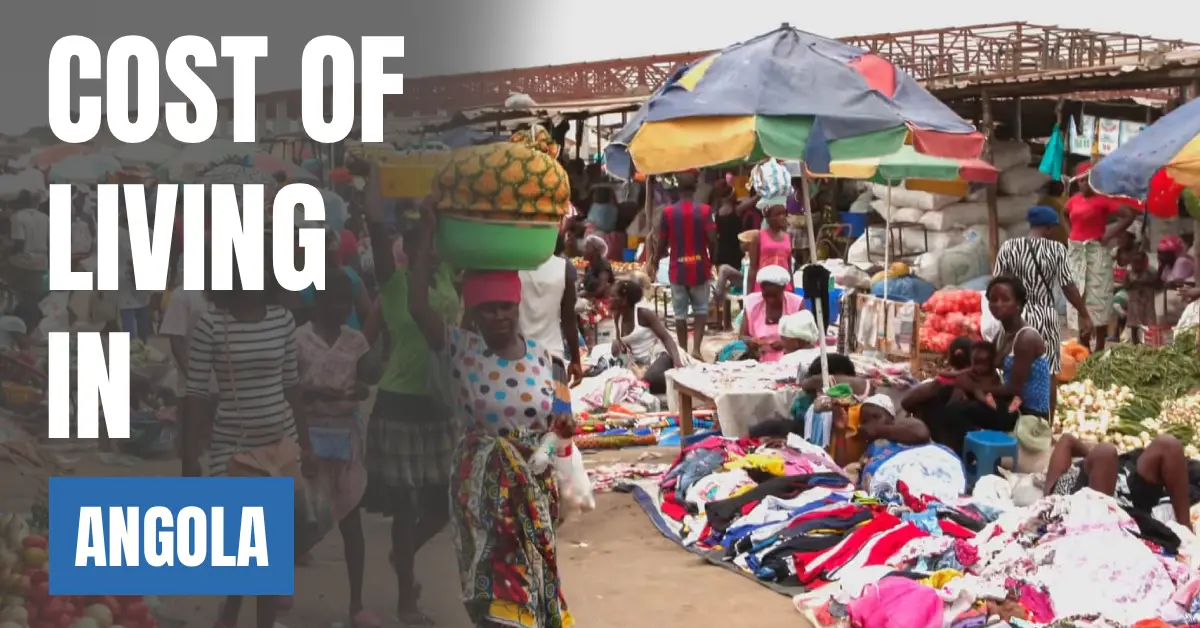
The cost of living in Angola varies sharply by housing choice, city and lifestyle. Luanda has the strongest available 2026 consumer-price data, but it also has an unusually wide rental market, where a modest apartment outside the centre can cost a fraction of a premium central or expatriate-oriented property. For practical planning, a budget-conscious single renter in Luanda may spend around Kz 380,000 to Kz 450,000 per month, while a more moderate single-person budget is closer to Kz 600,000 to Kz 700,000 including rent. A family of four can reasonably approach Kz 1.7 million or more before private or international schooling.
Prices are still changing quickly. Angola’s National Statistics Institute reported annual consumer inflation of 9.33% in July 2026. Food and non-alcoholic beverages were 10.40% higher year over year, housing, water, electricity and fuels were up 10.17%, health rose 10.16%, and education recorded a particularly large 25.24% increase.
All amounts below are shown primarily in Angolan kwanza, written as Kz or AOA. The figures should be treated as planning ranges rather than fixed national prices, especially because detailed current market-price samples outside Luanda remain limited.
Also Explore: Cost of Living in AfghanistanCost of Living in Angola at a Glance
| Expense | Typical 2026 Figure | What It Means |
|---|---|---|
| Budget-conscious single person | About Kz 386,000 per month including modest housing | Illustrative Luanda budget using low-cost outer-area housing |
| Moderate single person | About Kz 640,000 per month including rent | Illustrative budget for a private apartment outside the centre |
| Family of four | About Kz 1.77 million per month before private schooling | Illustrative budget using a three-bedroom home outside central Luanda |
| 1-bedroom rent outside Luanda city centre | About Kz 183,000, reported range Kz 60,000 to Kz 600,000 | Crowdsourced market estimate |
| 1-bedroom rent in Luanda city centre | About Kz 350,000, reported range Kz 274,000 to Kz 1.2 million | Premium properties can cost far more than the central estimate |
| Basic utilities for an 85 m² apartment | About Kz 65,000 per month | Electricity, water, cooling and related basic services |
| Minimum food basket for one adult | About Kz 129,000 to Kz 192,000 per month | Crowdsourced model based on different food-basket patterns |
| Inexpensive restaurant meal | About Kz 5,000 | Reported range roughly Kz 3,000 to Kz 9,100 |
| Urban bus | Kz 200 per trip | Official regulated urban fare |
| Collective taxi | Kz 300 per trip | Official regulated fare |
| General national minimum wage | Kz 100,000 per month | Current level after the statutory 12-month step-up |
Luanda price estimates are based on a relatively small crowdsourced sample. Numbeo’s May 2026 Luanda dataset contained 64 entries from only 11 contributors, so the wide reported ranges are more informative than any single average. Official transport and minimum-wage figures come from government and legal sources.
How Much Does It Cost to Live in Angola Per Month?
A single renter in Luanda should realistically plan roughly Kz 380,000 to Kz 700,000 per month for a modest to moderate lifestyle including rent. A family of four can need around Kz 1.7 million or more before private schooling. Premium housing, international education, private healthcare and frequent restaurant use can increase these totals substantially.
There is no credible single figure that describes every household in Angola. Rent alone ranges from Kz 60,000 at the low end of the reported outside-centre Luanda market to Kz 3.5 million for some three-bedroom properties in central areas.
A useful distinction is between living costs excluding rent and the complete household budget. In the sample budgets later in this guide, a moderate single person spends approximately Kz 420,000 before rent and about Kz 640,000 after adding a Kz 220,000 housing assumption. A family of four spends about Kz 1.07 million before rent and approximately Kz 1.77 million after adding housing, but before private school fees.
Housing and Rent in Angola
How Much Is Rent in Luanda?
A one-bedroom apartment in Luanda was reported at approximately Kz 350,000 per month in the city centre and Kz 183,000 outside the centre in May 2026. The ranges were extremely wide, which means location, building quality, security, utilities and property standard can matter more than the headline average.
| Luanda Rental Type | Reported Typical Price | Reported Range |
|---|---|---|
| 1-bedroom, city centre | Kz 349,574 | Kz 273,935 to Kz 1,200,000 |
| 1-bedroom, outside centre | Kz 182,702 | Kz 60,000 to Kz 600,000 |
| 3-bedroom, city centre | Kz 1,950,000 | Kz 1,100,000 to Kz 3,500,000 |
| 3-bedroom, outside centre | Kz 535,226 | Kz 280,000 to Kz 2,000,000 |
These are crowdsourced asking-price estimates, not an official rental index. Someone relocating to Luanda should therefore compare current listings in the exact neighborhood required rather than applying one citywide average.
How Much Rent Can a Landlord Request in Advance?
Angola’s Urban Tenancy Law provides an important protection that new residents can easily overlook. Article 28 prohibits contractual advance rent exceeding three months at the beginning of the relevant period. On renewal or extension, the landlord cannot require more than 30 days of rent in advance. Rent itself is legally fixed in kwanza.
Even with that legal limit, moving into a property can require significant cash because an initial advance, any agreed security deposit, agency expenses, furnishings and utility setup may arrive at the same time.
Groceries and Food Costs
How Much Should One Person Budget for Groceries?
A practical grocery allowance for one adult in Luanda is around Kz 130,000 to Kz 200,000 per month for mostly home-prepared food. Numbeo’s modeled minimum monthly food baskets in 2026 were approximately Kz 128,651 for an Asian-style 2,400-calorie basket and Kz 191,960 for a Western-style basket. These are modeled minimum food budgets, not official household expenditure statistics.
| Grocery Item | Luanda Price | Reported Range |
|---|---|---|
| Milk, 1 litre | Kz 1,775 | Kz 1,000 to Kz 3,442 |
| White bread, 500 g | Kz 850 | Kz 457 to Kz 1,500 |
| White rice, 1 kg | Kz 1,500 | Kz 350 to Kz 3,600 |
| Eggs, 12 | Kz 1,698 | Kz 1,200 to Kz 2,340 |
| Chicken fillets, 1 kg | Kz 3,100 | Kz 1,500 to Kz 9,000 |
| Beef, 1 kg | Kz 7,025 | Kz 2,500 to Kz 12,000 |
| Bananas, 1 kg | Kz 883 | Kz 500 to Kz 2,739 |
| Bottled water, 1.5 litres | About Kz 325 | Kz 200 to Kz 400 |
Food remains an important inflation pressure. INE reported food and non-alcoholic beverage inflation of 10.40% year over year in July 2026, with food contributing 6.30 percentage points to the overall inflation rate.
Restaurants and Eating Out
An inexpensive restaurant meal in Luanda costs about Kz 5,000, while dinner for two at a mid-range restaurant is around Kz 32,000. A fast-food combo is approximately Kz 6,000 and a regular cappuccino around Kz 1,885.
Eating out several times each week can therefore change a household budget quickly. Ten inexpensive restaurant meals at the typical reported price would cost approximately Kz 50,000, before drinks, transport or more expensive venues.
Utilities
How Much Are Monthly Utilities in Luanda?
Basic utilities for an approximately 85 m² Luanda apartment are estimated at about Kz 65,000 per month. The available market data show substantial variation, so actual electricity, water and cooling expenses depend heavily on household size, property efficiency and consumption.
Housing-related inflation also remains relevant. INE recorded a 10.17% year-over-year increase for housing, water, electricity and fuels in July 2026.
Internet and Mobile Costs
Mobile data can be relatively inexpensive at low usage levels. Africell’s current 30-day packages include approximately Kz 2,000 for 2.5 GB, Kz 3,000 for 4 GB, Kz 5,000 for 8 GB and Kz 10,000 for 18 GB. The operator states that VAT is included.
Home broadband is significantly more expensive. A crowdsourced Luanda estimate for unlimited broadband at 60 Mbps or more is around Kz 79,000 per month, while a mobile plan with calls and at least 10 GB is estimated near Kz 16,400. These figures can differ from specific operator packages and promotional offers.
Transportation
How Much Does Public Transport Cost in Angola?
The regulated urban bus fare is Kz 200 per trip, while a collective taxi trip costs Kz 300. These tariffs were introduced by Angola’s National Land Transport Agency after the July 2025 fuel-price adjustment. Intermunicipal passenger tariffs are set by local government administrations according to individual routes.
A worker taking two direct urban bus trips on each of 22 working days would spend about Kz 8,800 per month. Two collective-taxi trips per working day would cost around Kz 13,200. Commuters who need several route segments or transfers will spend more because the regulated amount is charged per trip rather than as one flat door-to-door fare.
For budgeting purposes, Kz 15,000 to Kz 35,000 per adult can therefore be a reasonable public-transport planning allowance for common urban commuting patterns, depending mainly on route complexity and additional journeys. This is a calculated allowance, not an official monthly pass price.
Healthcare
Is Healthcare Free in Angola?
Angola’s public health system is based on the principle of universal access and public provision that is intended to be free or preferentially free, but households should not assume that every healthcare need will involve zero out-of-pocket spending. Government health policy continues to emphasize universal access.
A 2025 World Health Organization financing review found that out-of-pocket expenditure represented about 28.8% of current health expenditure in Angola. The WHO described the health system as underfunded and still highly dependent on direct household payments.
For a new resident, this means a realistic budget should allow for medicines, tests, private consultations or insurance where required. There is not enough consistent nationwide 2026 price evidence to publish one trustworthy private-insurance premium, so the sample budgets in this guide use a healthcare contingency rather than presenting an invented insurance average.
Education and Childcare
Is Public Education Free in Angola?
Yes. Under Angola’s education framework, primary education from grades 1 to 6 and the first cycle of secondary education from grades 7 to 9 are compulsory and free. The relevant school-age group is generally 6 to 14 years.
Private and international schooling is a completely different cost category. Luanda crowdsourced estimates put full-day private preschool at around Kz 700,000 per child per month, with a reported range of Kz 500,000 to Kz 1 million. International primary school tuition was estimated at about Kz 12.25 million per child per year, with an exceptionally wide range of approximately Kz 7.61 million to Kz 20.4 million.
That annual international-school range is equivalent to approximately Kz 634,000 to Kz 1.7 million per month when spread over 12 months. For expatriate families, education can therefore cost as much as, or more than, housing. These figures come from a very small Luanda sample and should always be checked directly with individual schools.
Salaries and the Minimum Wage
What Is the Minimum Wage in Angola in 2026?
The general national minimum wage is Kz 100,000 per month in 2026. Presidential Decree 152/24 initially set the minimum at Kz 70,000 and provided for it to rise to Kz 100,000 after 12 months. The decree separately sets Kz 50,000 for micro-enterprises and startups.
The minimum wage is far below the cost of independently renting a typical Luanda apartment. The crowdsourced average for a one-bedroom home outside the city centre, about Kz 183,000, is already approximately 83% higher than the Kz 100,000 general minimum wage, before food, utilities or transport.
What Is the Average Salary in Luanda?
There is no sufficiently robust official current national take-home salary figure in the sources reviewed for this article. Numbeo reports a Luanda average monthly net salary of approximately Kz 1.28 million, but that figure comes from the same small city dataset, with only around a dozen recent contributors. It should not be interpreted as the typical salary of an Angolan worker or as a national average.
Broader labor-market conditions also matter. Angola’s INE reported an unemployment rate of 21.5% for people aged 15 or older in the second quarter of 2026.
What Salary Is Needed to Live Comfortably in Luanda?
A single person renting privately in Luanda may reasonably target take-home income of at least Kz 700,000 to Kz 900,000 per month to cover a moderate lifestyle and retain some room for savings or unexpected costs. A household choosing premium central accommodation may need substantially more than Kz 1 million per month.
For a family of four, a take-home household income above approximately Kz 2 million per month provides more room around the sample budget in this guide, but private or international schooling can push the required income much higher. These are affordability estimates derived from the sample budgets below, not government salary thresholds.
Taxes and Everyday Affordability
Employment income up to Kz 150,000 is exempt from personal income tax in 2026 following the increase introduced by the 2026 State Budget. Employee income above that threshold is taxed progressively, with the highest Group A rate reaching 25%.
Employees generally contribute 3% of gross income to social security, while employers contribute 8%. Angola’s standard VAT rate is 14%, so indirect taxation is also built into many everyday goods and services.
Anyone evaluating an employment offer should therefore distinguish gross salary from take-home income. The monthly budgets in this article are household spending estimates, so salary comparisons are most meaningful when made against net income after applicable payroll deductions.
Realistic Sample Monthly Budgets
The following budgets are planning scenarios based on current Luanda rent, food, utility, communications and transport evidence. Healthcare and leisure figures are planning allowances rather than quoted market averages. They are intended to show how monthly totals are built, not to claim that every household will spend exactly these amounts.
Budget-Conscious Single Person
This example assumes simple low-cost accommodation outside central Luanda, mostly home cooking and public transport.
| Expense | Estimated Monthly Cost |
|---|---|
| Rent | Kz 140,000 |
| Utilities | Kz 35,000 |
| Groceries | Kz 140,000 |
| Transport | Kz 18,000 |
| Internet and mobile | Kz 8,000 |
| Healthcare and medication contingency | Kz 15,000 |
| Dining and leisure | Kz 30,000 |
| Estimated Total | Kz 386,000 |
Excluding rent, this scenario costs approximately Kz 246,000 per month.
Moderate Single Person
This example assumes a private apartment outside the centre, a broader grocery budget, more transport and regular leisure spending.
| Expense | Estimated Monthly Cost |
|---|---|
| Rent | Kz 220,000 |
| Utilities | Kz 60,000 |
| Groceries | Kz 190,000 |
| Transport | Kz 35,000 |
| Internet and mobile | Kz 25,000 |
| Healthcare and medication contingency | Kz 30,000 |
| Dining and leisure | Kz 80,000 |
| Estimated Total | Kz 640,000 |
Excluding rent, the moderate single-person budget is approximately Kz 420,000.
Couple
This scenario assumes two adults sharing a good one-bedroom property outside the most expensive central locations.
| Expense | Estimated Monthly Cost |
|---|---|
| Rent | Kz 320,000 |
| Utilities | Kz 80,000 |
| Groceries | Kz 320,000 |
| Transport | Kz 60,000 |
| Internet and mobile | Kz 35,000 |
| Healthcare and medication contingency | Kz 50,000 |
| Dining and leisure | Kz 110,000 |
| Estimated Total | Kz 975,000 |
Excluding rent, this couple budget is approximately Kz 655,000 per month.
Family of Four
This example assumes a three-bedroom home outside central Luanda and use of the public education system. Private preschool or international school fees are not included.
| Expense | Estimated Monthly Cost |
|---|---|
| Rent | Kz 700,000 |
| Utilities | Kz 110,000 |
| Groceries | Kz 550,000 |
| Transport | Kz 100,000 |
| Internet and mobile | Kz 55,000 |
| Healthcare and medication contingency | Kz 100,000 |
| Dining and leisure | Kz 150,000 |
| Public-school tuition | Kz 0 |
| Estimated Total | Kz 1,765,000 |
Excluding rent, this household spends about Kz 1,065,000. Public education may be tuition-free at the compulsory levels, but families should still budget separately for transport, uniforms, supplies and other school-related expenses. One child in an international primary school could add roughly Kz 634,000 to Kz 1.7 million per month when annual tuition is converted into a monthly equivalent.
Cost Differences Between Luanda and Other Parts of Angola
Luanda is the only Angolan city with enough current publicly accessible consumer-price observations to support detailed 2026 tables with even moderate confidence. Data for cities such as Benguela and Huambo are much thinner, which makes precise city-to-city totals unreliable.
For that reason, this guide does not invent separate 2026 household budgets for every Angolan province. Housing outside the capital can differ substantially, but anyone moving to Benguela, Huambo, Lubango, Cabinda or another city should obtain current local rental quotes before using Luanda figures as a substitute.
How Does Luanda Compare With Lusaka?
There is no reliable basis for saying that Angola is always more or less expensive than neighboring countries. A current Numbeo comparison between Luanda and Lusaka illustrates how mixed the picture can be. Luanda’s reported one-bedroom city-centre rent was only about 2.9% higher and outside-centre one-bedroom rent about 7.8% higher, while a three-bedroom city-centre apartment was about 93% more expensive in Luanda. A three-bedroom property outside the centre was about 3% cheaper.
The same comparison showed Luanda utilities about 16% lower than Lusaka, but broadband about 49% higher. Private preschool was more than four times the Lusaka estimate. These figures are useful for identifying patterns, but the comparison was based on only 12 recent Luanda contributors and 20 Lusaka contributors, so it should not be treated as an official purchasing-power comparison.
Costs New Residents Often Overlook
- Initial housing cash: Angola’s tenancy law limits rent paid in advance to three months at the beginning of a rental period, but that can still be a substantial amount when combined with other moving costs.
- Multiple transport legs: the Kz 200 bus and Kz 300 collective-taxi fares apply per trip, so transfers can multiply a daily commute.
- Private medical spending: public healthcare is intended to provide broad access, but WHO data show that out-of-pocket health spending remains material.
- School extras: free compulsory public education does not mean every school-related household cost disappears.
- International education: private preschool and international-school tuition can exceed the monthly rent of many households.
- Taxes and payroll deductions: salary offers should be compared with net household budgets after applicable personal income tax and social-security deductions.
Cost of Living Versus Residency Financial Requirements
Angola’s immigration rules require applicants for residence-related visas to provide evidence of means of subsistence and accommodation, but the official residence-visa information reviewed for this article does not publish one universal monthly kwanza income threshold that should be treated as a cost-of-living requirement.
Angolan immigration law defines means of subsistence as proof that a foreign citizen has adequate means to support a stay. The law also allows subsistence requirements in some circumstances to be satisfied through guaranteed food and accommodation. Residence and temporary-stay applications may also use evidence such as accommodation arrangements and other supporting documentation.
This is an important distinction. A household may need Kz 600,000, Kz 1 million or substantially more each month for its actual lifestyle, but that private budget is not automatically the same as an immigration authority’s documentary financial requirement. Applicants should check the current rules of the Angolan diplomatic mission or migration authority handling their specific visa category.
Is Angola Affordable for Expats and New Residents?
Angola can be affordable for a well-paid employee whose employer covers housing, schooling, transport or medical insurance, but Luanda can be difficult on a local low salary. The current Kz 100,000 general minimum wage is below the reported price of an average outside-centre one-bedroom apartment and below even the modeled minimum monthly food basket for one adult.
Housing is the single biggest variable for many newcomers. A person renting a simple outer-area property can build a monthly budget below Kz 500,000, while a household requiring a premium three-bedroom central apartment may spend well over Kz 1 million on rent alone. International education can create another equally large cost.
Prospective residents should therefore negotiate employment packages based on the specific housing, school and healthcare standard they expect rather than relying on a generic national cost-of-living number.
Conclusion
A realistic 2026 cost-of-living plan for Angola needs to be built in kwanza and around the household’s actual housing choice. In Luanda, a very cost-conscious single renter may manage on roughly Kz 386,000 per month under the assumptions used here, while a moderate single-person budget is around Kz 640,000. A family of four can approach Kz 1.77 million before private education.
The general Kz 100,000 minimum wage remains far below these independent household budgets, while inflation continues to raise food, housing, healthcare and education costs. At the same time, public bus and collective-taxi fares remain relatively low, compulsory public education is tuition-free, and Angola’s public health system is based on universal-access principles.
The most important practical rule is to verify housing and school costs immediately before moving. Those two expenses can change an Angola relocation budget by millions of kwanza each month.
Sources and Methodology
This guide was reviewed on 4 September 2026. Priority was given to Angolan government bodies, legislation, official statistics and public authorities. WHO information was used for healthcare financing, current operator information was used for mobile data, PwC’s June 2026 Angola tax summaries were used for everyday tax context, and Numbeo was used for current consumer and rental price observations where no comprehensive official retail-price table was available.
Angola’s official national inflation index has broad statistical coverage, while consumer-price websites have much smaller samples. Numbeo reported only 64 Luanda price entries from 11 contributors in its May 2026 city dataset and 79 Angola entries from 16 contributors in its country dataset. Rental and retail prices should therefore be interpreted as indicative ranges rather than fixed market values.
Monthly sample budgets were calculated specifically for this guide using cited rent, food, utilities, communications and transport evidence. They are planning scenarios, not official cost-of-living statistics. Healthcare contingencies and discretionary leisure amounts are assumptions and are identified as such.
- Instituto Nacional de Estatística de Angola, National Consumer Price Index, July 2026.
- Instituto Nacional de Estatística de Angola, current economic and employment indicators.
- Presidential Decree 152/24, National Minimum Wage.
- Agência Nacional dos Transportes Terrestres, official urban transport tariff notice.
- Angola Urban Tenancy Law, Law 26/15.
- Angola Ministry of Health and World Health Organization healthcare sources.
- INE, 2024 Census final results, education provisions.
- PwC Angola individual tax summaries, reviewed June 2026.
- Africell Angola, current mobile data packages.
- Numbeo, Luanda and Angola cost-of-living datasets.
- Angolan immigration law and Ministry of External Relations residence-visa information.
Frequently Asked Questions
How much does it cost to live in Angola per month?
For Luanda, a budget-conscious single renter may spend around Kz 380,000 to Kz 450,000 per month, while a moderate single-person budget is closer to Kz 600,000 to Kz 700,000 including rent. A family of four can need around Kz 1.7 million or more before private schooling. Costs outside Luanda are less well documented and housing choice can change the total substantially.
How much is rent in Luanda?
A one-bedroom apartment in central Luanda is estimated at about Kz 350,000 per month, while one outside the centre averages around Kz 183,000. Reported ranges are very wide, from about Kz 60,000 for some outside-centre units to Kz 1.2 million for one-bedroom central properties. Premium three-bedroom central housing can exceed Kz 1 million per month.
Is Angola expensive for expats?
Angola can be expensive for expats who need premium Luanda housing, international education and private healthcare. It can be substantially more affordable when an employer provides housing, school support or medical cover. The biggest cost differences are usually caused by accommodation and education rather than basic public transport. New residents should price their exact neighborhood and school requirements before accepting a relocation package.
What is the minimum wage in Angola in 2026?
The general national minimum wage is Kz 100,000 per month in 2026. Presidential Decree 152/24 initially established Kz 70,000 and required the general level to rise to Kz 100,000 after 12 months. The decree separately sets a Kz 50,000 minimum for micro-enterprises and startups. The general minimum remains well below the cost of independently renting and supporting a household in Luanda.
What salary is needed to live comfortably in Luanda?
A single private renter may reasonably target take-home income of around Kz 700,000 to Kz 900,000 per month for a moderate lifestyle with some financial buffer. Premium central housing can require considerably more. A family may need household take-home income above Kz 2 million before private schooling, while international education can add hundreds of thousands or more than Kz 1 million per child each month.
Is healthcare free in Angola?
Angola’s public health system is based on universal-access principles and public care that is intended to be free or preferentially free, but healthcare does not always cost households zero. WHO data show meaningful out-of-pocket health spending, including expenses such as medicines and treatment. Expats and new residents should therefore budget for medical contingencies, insurance or private services according to their needs.
How much does public transport cost in Angola?
The official urban bus fare is Kz 200 per trip and a collective taxi costs Kz 300 per trip. A worker taking two direct bus journeys on each of 22 working days would spend about Kz 8,800 per month. Actual commuting expenses can be higher when several buses or collective taxis are needed because each route segment can create another fare.
How much does food cost per month in Angola?
For one adult in Luanda, roughly Kz 130,000 to Kz 200,000 per month is a useful grocery planning range for mostly home-prepared meals. A 2026 crowdsourced food model estimated approximately Kz 129,000 for one lower-cost basket and Kz 192,000 for a Western-style basket. Imported products, meat choices, supermarkets and frequent restaurant meals can raise the monthly total significantly.
Is public education free in Angola?
Yes. Primary education from grades 1 to 6 and the first cycle of secondary education from grades 7 to 9 are compulsory and free under Angola’s education framework. Families can still face costs for transport, uniforms, supplies and other school needs. Private education is far more expensive, and international primary-school tuition in Luanda can amount to hundreds of thousands of kwanza per month per child.
Do Angola residence visas require a specific monthly income?
Official residence-visa rules require evidence of means of subsistence and accommodation, but the current official sources reviewed for this guide do not state one universal monthly kwanza income figure for every residence applicant. Requirements depend on the visa category and supporting circumstances. Cost-of-living budgets should therefore not be presented as immigration thresholds. Applicants should confirm current documentation with the responsible Angolan mission or migration authority.