
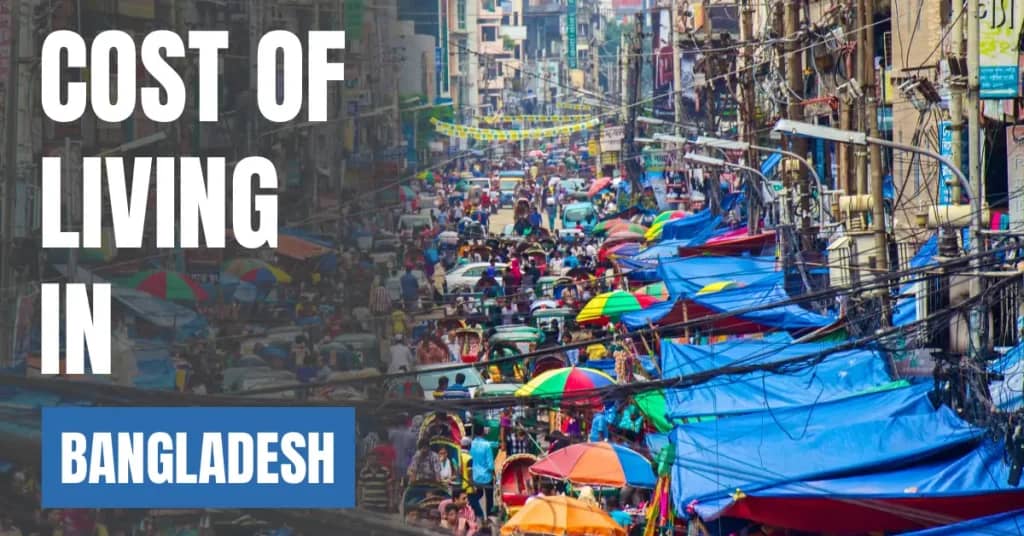
The cost of living in Bangladesh remains low by international standards, but that does not automatically make life affordable for someone earning a local salary. Housing outside premium areas can be inexpensive, local food and public transport remain relatively accessible, and domestic services are usually cheaper than in many countries. At the same time, inflation, private healthcare, imported goods, international schooling, air conditioning, and expat-oriented housing can push a monthly budget much higher.
On this pageTable of Content
Price pressure also remains important in 2026. Bangladesh’s overall point-to-point inflation was 8.26% in August 2026, while national wage growth was 8.05%. This means household purchasing power remains under pressure even though headline inflation has eased from earlier levels.
Also Explore: Cost of Living in BahrainCost of Living in Bangladesh at a Glance
A budget-conscious single person may manage on roughly BDT 30,000 to BDT 45,000 per month including inexpensive rent, while a more moderate single renter may need around BDT 50,000 to BDT 80,000. In Dhaka, furnished housing, frequent ride-hailing, imported groceries, private healthcare and regular dining out can raise the figure further.
| Expense | Typical 2026 Cost |
|---|---|
| Single person, excluding rent | About BDT 22,000 to BDT 45,000 per month |
| Single person, including rent | About BDT 30,000 to BDT 80,000 per month |
| Moderate single renter in Dhaka | About BDT 55,000 to BDT 90,000 per month |
| Couple, including rent | About BDT 70,000 to BDT 120,000 per month |
| Family of four, including rent | About BDT 130,000 to BDT 220,000 per month, excluding expensive international schooling |
| Countrywide 1-bedroom rent, city centre | About BDT 11,229 average, with a reported range of roughly BDT 5,500 to BDT 25,000 |
| Countrywide basic utilities | About BDT 3,800 per month for a typical 85 m² home |
| Broadband internet | About BDT 1,000 to BDT 3,000 for higher-speed plans |
| Inexpensive restaurant meal | About BDT 200 |
| Local transport trip | About BDT 40 |
These are planning ranges rather than official fixed budgets. Current Numbeo data for Bangladesh, updated on 13 September 2026, is based on 2,192 entries from 186 contributors. Expatistan separately estimates about BDT 71,141 per month for one person and BDT 201,324 for a family of four, but explicitly warns that its Bangladesh estimates rely on a small amount of data.
How Much Does It Cost to Live in Bangladesh Per Month?
A single person can realistically spend about BDT 30,000 to BDT 80,000 per month including rent, depending mainly on city, housing, transport and lifestyle. Dhaka normally requires the largest housing and commuting budget, while smaller cities and shared accommodation can reduce costs substantially.
The biggest reason different websites produce very different totals is housing. Someone renting a basic apartment outside a city centre and eating mostly local food has a very different budget from an expatriate renting a furnished apartment in Gulshan, Banani or another premium Dhaka area.
Housing and Rent in Bangladesh
Rent is often the largest monthly expense, but the market varies dramatically by location and housing standard. Countrywide September 2026 Numbeo data puts a 1-bedroom apartment at approximately BDT 11,229 in a city centre and BDT 5,743 outside central areas. Three-bedroom apartments average about BDT 26,883 centrally and BDT 15,896 outside the centre.
| Apartment Type | Bangladesh Average | Typical Reported Range |
|---|---|---|
| 1 bedroom, city centre | BDT 11,229 | BDT 5,500 to BDT 25,000 |
| 1 bedroom, outside centre | BDT 5,743 | BDT 3,000 to BDT 10,000 |
| 3 bedrooms, city centre | BDT 26,883 | BDT 12,000 to BDT 61,580 |
| 3 bedrooms, outside centre | BDT 15,896 | BDT 8,000 to BDT 30,000 |
How Much Is Rent in Dhaka?
Dhaka is generally more expensive than the national averages. June 2026 Numbeo data placed a 1-bedroom apartment at around BDT 18,342 in the city centre and BDT 9,412 outside it. A three-bedroom apartment averaged around BDT 53,833 centrally and BDT 28,632 outside the centre.
Furnished accommodation aimed at foreign workers and short-term residents can cost more. Expatistan’s September 2026 Dhaka data estimates approximately BDT 23,582 for an 85 m² furnished apartment in a normal area and BDT 41,678 in an expensive area, although the platform warns that its sample is limited.
Dhaka Versus Chattogram
Chattogram can be cheaper for some housing categories. Numbeo reported a 1-bedroom apartment outside the centre at around BDT 7,518 and a three-bedroom apartment outside the centre at roughly BDT 20,030 in June 2026. Expatistan’s September comparison estimated Dhaka to be about 13% more expensive overall than Chattogram, but described the comparison as based on relatively few data points.
Grocery Costs in Bangladesh
Local staples remain relatively affordable, particularly when bought from local markets rather than imported-food supermarkets. Current countrywide price data suggests roughly BDT 92 for one litre of milk, BDT 143 for 12 eggs, about BDT 74 per kilogram for white rice, around BDT 324 per kilogram for chicken fillets and about BDT 798 per kilogram for beef.
| Grocery Item | Approximate Price |
|---|---|
| Milk, 1 litre | BDT 92 |
| Eggs, 12 | BDT 143 |
| White rice, 1 kg | BDT 74 |
| Chicken fillets, 1 kg | BDT 324 |
| Beef, 1 kg | BDT 798 |
| Apples, 1 kg | BDT 300 |
| Tomatoes, 1 kg | BDT 71 |
| Potatoes, 1 kg | BDT 40 |
| Onions, 1 kg | BDT 69 |
A single person cooking mainly local food could reasonably budget around BDT 10,000 to BDT 18,000 per month for groceries. A family of four may spend roughly BDT 35,000 to BDT 60,000, depending on meat consumption, imported products, snacks, dairy products and where they shop.
Restaurants and Eating Out
Eating local food is inexpensive compared with many countries. In September 2026, a meal at an inexpensive restaurant averaged about BDT 200, while a three-course mid-range meal for two averaged around BDT 1,500. A fast-food combo was about BDT 550 and a regular cappuccino approximately BDT 231.
Local restaurants, canteens and street-food outlets can be cheaper, while international hotel restaurants, premium cafés and imported-food venues in Dhaka can cost several times more.
Utility Costs
For a typical 85 m² apartment, electricity, water, cooling and basic household utilities average around BDT 3,800 per month nationally, with reported bills from roughly BDT 2,000 to BDT 8,500. Air conditioning can substantially increase summer electricity costs.
Electricity tariffs changed in June 2026. DPDC’s published residential tariff shows BDT 4.63 per kWh for lifeline consumption up to 50 units and BDT 5.26 for the first residential slab, while higher consumption bands rise through BDT 8.50, BDT 9.10, BDT 9.62, BDT 15.01 and BDT 17.35 per kWh. Low-use consumers were spared the initially proposed increase for the lowest two slabs.
Internet and Mobile Costs
Fast home internet is generally affordable. September 2026 market data puts unlimited broadband of 60 Mbps or faster at about BDT 1,566 per month, with a typical reported range of BDT 1,000 to BDT 3,000. A mobile plan with calls and 10 GB or more of data averages around BDT 615.
BTRC’s published One Country, One Rate framework lists maximum monthly ISP tariffs of BDT 500 for at least 5 Mbps, BDT 800 for 10 Mbps and BDT 1,200 for 20 Mbps. Higher-speed commercial plans commonly cost more than these lower-speed benchmarks.
Transportation Costs
Public transport is inexpensive in cash terms. A normal local transport journey averages around BDT 40 nationally, while a regular monthly public transport budget or pass is around BDT 1,800 in the crowdsourced dataset. Taxi and ride-hailing costs can be much higher, particularly in Dhaka traffic.
Dhaka’s MRT Line 6 provides a more predictable option for journeys along its route. DMTCL lists a minimum metro fare of BDT 20, while the established maximum fare is BDT 100 for the longest journey on the main fare structure.
BRTA updated Dhaka metropolitan bus fare lists in April 2026, so passengers should check the current approved route chart rather than relying on old fixed-fare examples.
Healthcare Costs in Bangladesh
Healthcare is not simply “cheap” or universally free. Public facilities can charge relatively little for consultations and some services, but medicines, diagnostics, private hospitals and specialist treatment can create significant out-of-pocket expenses.
A Bangladesh Institute of Development Studies study reported in May 2026 found that out-of-pocket spending represented 79.3% of healthcare expenditure in its analysis and that a large share of reported healthcare need remained unmet. This makes an emergency medical reserve or employer-provided insurance especially important for new residents.
A practical monthly healthcare provision might be BDT 1,000 to BDT 3,000 for a healthy single person, but this is only a budgeting reserve. Families, people with chronic conditions or residents relying on private hospitals should budget significantly more.
Education and Childcare
Public education is far less expensive than international schooling, but families should still budget for uniforms, books, transport, tutoring and other incidental costs. Bangladesh’s legal framework establishes the state’s responsibility to extend free and compulsory education to children to the stage determined by law.
Private and international schooling is a different cost category. September 2026 Numbeo data estimates private full-day preschool at around BDT 4,314 per child per month and international primary-school tuition at about BDT 192,884 annually on average, with a broad reported range from BDT 84,000 to BDT 500,000.
Premium international schools can cost far more than this market average, so expatriate families should verify fees directly with their intended school before accepting a relocation package.
Salaries and the Minimum Wage in Bangladesh
There is no single nationwide private-sector minimum wage covering every worker in Bangladesh. Minimum wages are determined by sector. The Minimum Wages Board publishes sector-specific rates, while the ready-made garment sector’s entry-level minimum was set at BDT 12,500 per month in the 2023 wage order.
Garment wages also have an annual increment mechanism. A government decision increased the annual increment to 9% from December 2024 for covered RMG workers, although this should not be interpreted as creating one universal national minimum wage.
For broader salary context, Numbeo’s September 2026 Bangladesh dataset reports an average monthly net salary of about BDT 28,026. Because this is crowdsourced rather than an official national earnings survey, it should be treated as an indicative market figure.
What Salary Is Needed to Live Comfortably in Bangladesh?
There is no official “comfortable salary.” For a single renter, around BDT 50,000 to BDT 80,000 net per month can support a moderate lifestyle in many situations. In Dhaka, someone wanting a good private apartment, regular ride-hailing, private medical care and frequent restaurant meals may prefer BDT 70,000 to BDT 100,000 or more.
The gap between these budgets and many local salaries explains why Bangladesh can be inexpensive internationally while still feeling expensive to local households. In August 2026, consumer inflation of 8.26% was also slightly ahead of the 8.05% national wage growth rate.
Income Tax and Everyday Affordability
Taxes matter when comparing gross job offers with actual spending power. Bangladesh’s 2026 budget materials set the general individual tax-free income threshold at BDT 375,000 for tax years 2026-27 and 2027-28. Income above the threshold is subject to progressive rates, with rates rising through the higher tax bands.
The National Board of Revenue lists the Finance Act 2026 and publishes updated income-tax guidance, so expatriates and higher earners should check their residence status, taxable allowances and withholding position rather than estimating take-home pay from gross salary alone.
Realistic Monthly Budgets for Bangladesh
The following examples show actual calculations rather than presenting one national monthly total as a universal fact. They are planning scenarios based on 2026 rents, utilities, food prices and other current market data.
Budget-Conscious Single Person
| Expense | Estimated Monthly Cost |
|---|---|
| Rent | BDT 8,000 |
| Utilities | BDT 2,500 |
| Groceries | BDT 11,000 |
| Transport | BDT 2,000 |
| Internet and mobile | BDT 1,500 |
| Healthcare reserve | BDT 1,500 |
| Dining and leisure | BDT 3,000 |
| Household and personal expenses | BDT 3,000 |
| Contingency | BDT 2,000 |
| Estimated Total | BDT 34,500 |
This assumes modest accommodation outside a premium central area, mainly local food, public transport and limited discretionary spending.
Moderate Single Person
| Expense | Estimated Monthly Cost |
|---|---|
| Rent | BDT 20,000 |
| Utilities | BDT 4,000 |
| Groceries | BDT 16,000 |
| Transport | BDT 4,000 |
| Internet and mobile | BDT 2,000 |
| Healthcare reserve | BDT 3,000 |
| Dining and leisure | BDT 8,000 |
| Household and personal expenses | BDT 6,000 |
| Contingency | BDT 5,000 |
| Estimated Total | BDT 68,000 |
Couple
| Expense | Estimated Monthly Cost |
|---|---|
| Rent | BDT 25,000 |
| Utilities | BDT 5,000 |
| Groceries | BDT 28,000 |
| Transport | BDT 6,000 |
| Internet and mobile | BDT 2,500 |
| Healthcare reserve | BDT 5,000 |
| Dining and leisure | BDT 10,000 |
| Household and personal expenses | BDT 8,000 |
| Contingency | BDT 5,000 |
| Estimated Total | BDT 94,500 |
Family of Four
| Expense | Estimated Monthly Cost |
|---|---|
| Rent | BDT 40,000 |
| Utilities | BDT 8,000 |
| Groceries | BDT 50,000 |
| Transport | BDT 10,000 |
| Internet and mobile | BDT 3,000 |
| Healthcare reserve | BDT 10,000 |
| Education and childcare | BDT 20,000 |
| Dining and leisure | BDT 15,000 |
| Household and personal expenses | BDT 10,000 |
| Contingency | BDT 10,000 |
| Estimated Total | BDT 176,000 |
This family example assumes moderate housing and relatively modest schooling costs. Premium international-school tuition can add tens of thousands of taka per child each month and can become one of the household’s largest expenses.
Cost Differences by City and Area
Dhaka usually requires the highest budget, especially in premium residential areas and when a household depends on private cars, ride-hailing or imported goods. Chattogram can offer somewhat lower housing costs, while Rajshahi, Khulna and smaller cities can be cheaper again, particularly for basic local accommodation.
However, reliable city-level price samples outside Dhaka and Chattogram are limited. A national average should therefore not be treated as the expected rent in every district.
How Does Bangladesh Compare With Nearby Countries?
Bangladesh is inexpensive internationally, but the old claim that it is automatically cheaper than India, Pakistan or Nepal is not supported by current comparative data. Numbeo’s 2026 South Asia Cost of Living Index places Bangladesh at 22.8, Nepal at 22.6, Pakistan at 19.6 and India at 18.9. Bangladesh therefore appears slightly more expensive on this particular crowdsourced index than those three neighbours.
These indices are useful for broad comparison, not for predicting an individual’s monthly budget. Housing, city choice, household size and local purchasing power can produce very different real-world outcomes.
Costs New Residents Often Overlook
- Rental deposits and advance rent: Moving into a property can require several months of cash upfront.
- Air conditioning: Electricity consumption can rise significantly during hot and humid periods.
- Backup power or building charges: Some apartments have generator, security, lift or service charges in addition to rent.
- Private healthcare: Diagnostics, medication and hospital treatment can matter more than the advertised consultation fee.
- Imported groceries: Foreign brands, cheese, speciality foods and imported household products can be disproportionately expensive.
- School transport and activities: International-school tuition may not include buses, meals, trips, uniforms and activities.
- Traffic-related transport costs: Frequent ride-hailing can turn an apparently cheap transport budget into a substantial monthly expense.
- Visa, work-permit and relocation costs: Immigration and corporate compliance expenses are separate from normal household living costs.
Cost of Living Versus Residency and Work-Permit Financial Requirements
Monthly living costs should not be confused with Bangladesh immigration or investment requirements. Bangladesh does not use one universal monthly income threshold for every foreign resident. Work and investor routes have category-specific rules.
BIDA states that foreign investors and employees normally require relevant PI or E2/E3 visa status when applying for work permission. BIDA materials also list a minimum USD 50,000 inward remittance as an initial establishment cost in certain branch, liaison, joint-venture and foreign-owned company cases. This is a business or immigration compliance requirement, not a household cost-of-living figure.
Is Bangladesh Affordable for Expats and New Residents?
Bangladesh can be affordable for a foreign resident earning an international salary, particularly if housing and healthcare are included in an employment package. A single person earning BDT 70,000 to BDT 100,000 net can have much more flexibility than someone living on the current crowdsourced national net-salary average of around BDT 28,026.
Families need more careful planning. Rent can still be manageable, but international education, private medical treatment, imported goods, larger homes and private transport can quickly remove much of the country’s headline cost advantage.
Conclusion
Bangladesh remains a relatively low-cost place to live in 2026, especially for people who rent outside premium Dhaka neighbourhoods, buy local food and use public transport. A budget-conscious single person may manage at around BDT 35,000 per month, while BDT 60,000 to BDT 80,000 offers a more moderate single-person budget. Families should plan around BDT 130,000 to BDT 220,000 or more, particularly when private schooling and healthcare are involved.
The central affordability issue is not simply whether prices are low internationally. Local purchasing power matters. Consumer inflation remained above 8% in August 2026, average market-reported salaries are modest, and healthcare and education can create substantial private expenses. Anyone relocating should therefore build a budget using the exact city, housing standard, school choice and employer benefits that apply to them.
Sources and Methodology
This guide was reviewed in September 2026. Official government and public-authority sources were prioritized for inflation, taxation, electricity, transport, labour rules and immigration requirements. Current consumer and rental prices were cross-checked using Numbeo and Expatistan.
Rent, restaurant, grocery and salary figures from crowdsourced databases are estimates rather than official regulated prices. They can change quickly and may be based on uneven geographic samples. Where a source reported limited data, that limitation was taken into account rather than presenting its estimate as an absolute national fact.
- Bangladesh Bureau of Statistics inflation and Wage Rate Index data, reported for August 2026.
- Numbeo, Cost of Living in Bangladesh, updated 13 September 2026.
- Numbeo, Cost of Living in Dhaka and Chattogram, 2026.
- Expatistan, Bangladesh and Dhaka cost-of-living estimates, September 2026.
- Bangladesh Bureau of Statistics, Household Income and Expenditure Survey 2022.
- Dhaka Power Distribution Company, residential electricity tariffs effective from June 2026.
- Bangladesh Telecommunication Regulatory Commission, One Country, One Rate broadband tariff framework.
- Dhaka Mass Transit Company Limited and Bangladesh Road Transport Authority transport information.
- National Board of Revenue, 2026 budget and income-tax materials.
- Ministry of Labour and Employment and Minimum Wages Board materials.
- Bangladesh Investment Development Authority visa and work-permit guidance.
- Bangladesh Institute of Development Studies healthcare findings reported in May 2026.
Frequently Asked Questions
How much does it cost to live in Bangladesh per month?
A single person can reasonably budget about BDT 30,000 to BDT 80,000 per month including rent. A budget-conscious lifestyle outside premium areas may cost around BDT 35,000, while a moderate renter in Dhaka can need BDT 55,000 to BDT 90,000 or more. Housing, imported food, private healthcare and transport are the main variables.
How much is rent in Bangladesh in 2026?
Countrywide market data puts a 1-bedroom apartment at about BDT 11,229 per month in a city centre and BDT 5,743 outside central areas. Dhaka is more expensive, with June 2026 data showing averages of about BDT 18,342 centrally and BDT 9,412 outside the centre. Furnished expat housing can cost considerably more.
What salary is enough to live comfortably in Bangladesh?
For a single person, around BDT 50,000 to BDT 80,000 net per month can support a moderate lifestyle in many situations. In Dhaka, BDT 70,000 to BDT 100,000 or more offers greater flexibility for better housing, private healthcare, ride-hailing and dining. There is no official government figure for a “comfortable” salary.
What is the minimum wage in Bangladesh in 2026?
Bangladesh does not have one universal private-sector minimum wage. Minimum rates are set by sector. In the ready-made garment industry, the entry-level minimum wage was set at BDT 12,500 per month, while covered workers also have an annual wage-increment mechanism. Other industries can have different statutory wage floors.
Is healthcare free in Bangladesh?
No. Public healthcare can be heavily subsidized and some services may carry low charges, but Bangladesh relies heavily on direct household spending for medicines, diagnostics and treatment. A 2026 BIDS study reported very high out-of-pocket healthcare spending, so residents should not assume that low consultation fees mean medical care will always be inexpensive.
How much does a family of four need in Bangladesh?
A family of four should usually plan around BDT 130,000 to BDT 220,000 per month including rent for a moderate lifestyle. The sample budget in this guide totals BDT 176,000. International schooling can increase the total sharply, particularly when tuition, transport, activities, meals and other school charges are added.
How expensive are groceries in Bangladesh?
Local groceries remain relatively affordable. Current market data suggests around BDT 92 for a litre of milk, BDT 143 for 12 eggs, approximately BDT 74 per kilogram of rice, about BDT 324 per kilogram of chicken fillets and around BDT 798 per kilogram of beef. Imported foods can be considerably more expensive.
Is public transport expensive in Bangladesh?
No. Public transport is inexpensive in cash terms, with a typical local journey around BDT 40 in current countrywide data. Dhaka Metro’s minimum fare is BDT 20, while longer journeys cost more. Regular ride-hailing, taxis and private-car ownership are much more expensive than using buses, trains, metro services and local shared transport.
Is Bangladesh cheaper than India, Pakistan and Nepal?
Not according to every current comparison. Numbeo’s 2026 Cost of Living Index gives Bangladesh a score of 22.8, compared with 22.6 for Nepal, 19.6 for Pakistan and 18.9 for India. These are crowdsourced indices, so they are useful for broad comparison but should not be treated as precise household budgets.
Does Bangladesh require a minimum monthly income for foreign residents?
There is no single monthly income requirement that applies to every foreign resident. Requirements depend on the visa, employment and investment route. BIDA has separate rules for investors and foreign workers, and certain business-establishment cases require documented inward remittance. These immigration requirements should be assessed separately from normal monthly living expenses.
Join the conversation
Have thoughts on this topic? Share them with others.
Ask questions, share experience, and learn from the Visaboards Community.