
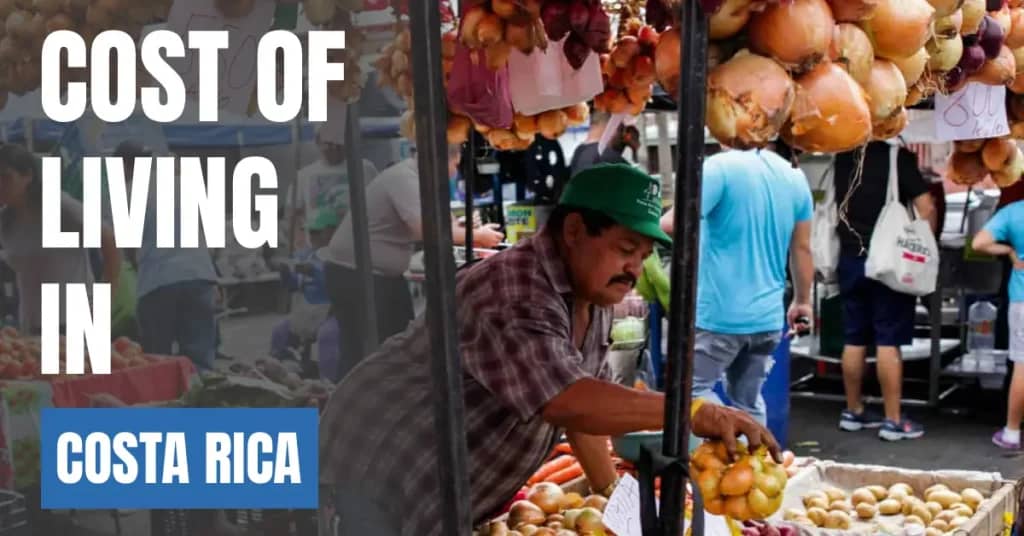
Cost of Living in Costa Rica in 2026: Rent, Salaries and Monthly Expenses
The cost of living in Costa Rica in 2026 varies considerably depending on location, accommodation, household size and lifestyle. San José and its surrounding metropolitan area offer employment, healthcare, universities and public transportation, while popular coastal destinations such as Tamarindo, Jacó and Santa Teresa can be expensive because of tourism and demand for furnished rental properties.
On this pageTable of Content
A single person renting independently may need approximately CRC 450,000 to CRC 850,000 per month for a modest to moderate lifestyle, including rent. A family of four may need approximately CRC 1,000,000 to CRC 1,900,000 or more, particularly when larger accommodation, private education and healthcare expenses are involved.
These amounts are illustrative planning ranges, not official national averages. Actual expenses can be much higher in premium neighbourhoods and beach communities.
Costa Rica's official currency is the Costa Rican colón (CRC), represented by the symbol ₡. All primary cost estimates in this guide use colones. The US dollar is also commonly used in property listings and some tourism-related transactions, but exchange rates change.
This guide was reviewed in October 2026 and includes published consumer-price observations, official minimum-wage rules, transportation regulations, tax thresholds and immigration requirements.
Cost of Living in Costa Rica at a Glance
Housing generally represents the largest monthly expense for renters in Costa Rica. Groceries, transportation and utilities can be managed with careful budgeting, but imported products, private schooling, frequent restaurant meals and vehicle ownership can increase spending substantially.
| Expense | Estimated Cost in CRC | Details |
|---|---|---|
| Single person, excluding rent | ₡220,000 to ₡400,000/month | Groceries, utilities, transport and basic personal expenses |
| Single person, including rent | ₡450,000 to ₡850,000/month | Modest to moderate independent lifestyle |
| Couple, including rent | ₡650,000 to ₡1,200,000/month | Shared household expenses |
| Family of four, including rent | ₡1,000,000 to ₡1,900,000+/month | Excludes expensive international-school scenarios |
| One-bedroom apartment outside central San José | ₡200,000 to ₡500,000/month | Consumer-reported rental range |
| One-bedroom apartment in central San José | ₡300,000 to ₡552,000/month | Consumer-reported rental range |
| Three-bedroom apartment outside central San José | ₡280,000 to ₡884,000/month | Varies greatly by property and neighbourhood |
| Groceries, single person | ₡100,000 to ₡180,000/month | Home cooking and a mix of local products |
| Basic household utilities | ₡30,000 to ₡65,000/month | San José consumer-reported range |
| Home broadband | ₡20,000 to ₡42,000/month | Indicative San José prices |
| Local public transportation journey | About ₡500 | Illustrative San José observation, not a nationwide fixed fare |
| Minimum monthly wage, generic unskilled worker | ₡373,092.30 | 2026 private-sector occupational minimum |
The household totals are constructed budgeting estimates. Rental, grocery and service prices are informed by 2026 consumer-cost data from Numbeo, which relies on contributed observations rather than a nationally representative official price survey.
Sources: Numbeo San José Cost of Living, Numbeo Costa Rica and Ministry of Labour and Social Security.
How Much Does It Cost to Live in Costa Rica Per Month?
A single person living independently in Costa Rica may initially budget ₡450,000 to ₡850,000 per month including rent, while someone sharing accommodation and keeping discretionary spending low may spend less. A family of four may need ₡1,000,000 to ₡1,900,000 or more, depending mainly on housing, childcare and education.
Location is a major reason monthly budgets differ. A resident renting outside central San José may spend considerably less on housing than someone seeking a furnished apartment in a desirable coastal community.
The original Visaboards guide estimated $900 to $1,500 monthly for a single person, but that broad dollar range did not clearly distinguish rent from other expenses or fully reflect differences among cities and housing standards. Budgeting directly in colones and separating rent from other spending offers a more useful approach.
Households should compare available take-home income with actual property offers before relocating. Living on a minimum wage is very different from living on an overseas salary or pension.
Housing and Rent in Costa Rica
Rent in Costa Rica depends on the city, neighbourhood, property size, furnishing and proximity to transport, beaches or business districts. In San José, consumer-reported one-bedroom rents have ranged from approximately ₡200,000 in some areas outside the centre to more than ₡550,000 for certain central properties.
Apartment Rental Prices in San José
| Property Type | Approximate Monthly Rent |
|---|---|
| One-bedroom apartment, city centre | ₡300,000 to ₡552,000 |
| One-bedroom apartment, outside centre | ₡200,000 to ₡500,000 |
| Three-bedroom apartment, city centre | ₡600,000 to ₡1,151,000 |
| Three-bedroom apartment, outside centre | ₡280,000 to ₡884,000 |
These ranges come from Numbeo's San José observations dated May 2026. They should not be interpreted as guaranteed available properties or nationwide averages.
How to Reduce Housing Costs
- Compare residential neighbourhoods in Alajuela, Heredia and Cartago with central San José.
- Look for long-term rentals rather than automatically choosing short-term holiday accommodation.
- Check whether electricity, water, internet, parking and condominium fees are included.
- Inspect ventilation, humidity, security and building condition before signing a lease.
- Confirm the deposit, permitted rent currency and annual adjustment conditions.
Some coastal rental properties are advertised in US dollars. A change in the exchange rate can alter the effective amount paid in colones, making contract terms important for residents whose income is earned locally.
Groceries and Food Prices in Costa Rica
A single person may allocate approximately ₡100,000 to ₡180,000 monthly to groceries when cooking regularly at home. Families may need approximately ₡250,000 to ₡400,000 or more, depending on appetite, product choices and household size.
Local farmers' markets, known as ferias del agricultor, can provide alternatives to supermarkets for fresh produce. Imported snacks, specialist dairy products and international brands may increase the grocery bill.
Common Grocery Prices
| Grocery Item | Approximate Price in CRC |
|---|---|
| Milk, 1 litre | ₡750 to ₡1,400 |
| Fresh white bread, 500 g | ₡600 to ₡2,200 |
| White rice, 1 kg | ₡900 to ₡1,800 |
| Eggs, 12 | ₡975 to ₡2,000 |
| Chicken fillets, 1 kg | ₡3,750 to ₡6,000 |
| Beef, 1 kg | ₡5,500 to ₡7,500 |
| Bananas, 1 kg | ₡300 to ₡1,500 |
| Tomatoes, 1 kg | ₡1,000 to ₡4,000 |
| Bottled water, 1.5 litres | ₡1,083 to ₡2,000 |
These are reported retail ranges rather than fixed national prices. Individual stores and markets can charge more or less.
Source: Numbeo San José, May 2026.
Restaurants and Eating Out
Eating out in Costa Rica can be reasonably priced at traditional local restaurants, commonly called sodas, but international restaurants and establishments in tourism-oriented areas are often more expensive.
| Restaurant Expense | Approximate Cost |
|---|---|
| Meal at an inexpensive restaurant | ₡3,000 to ₡10,000 |
| Three-course meal for two at a mid-range restaurant | ₡20,000 to ₡45,000 |
| Fast-food combination meal | ₡4,955 to ₡6,000 |
| Cappuccino | ₡1,300 to ₡3,000 |
| Soft drink at a restaurant | Approximately ₡785 to ₡1,625 |
A moderate household may reserve ₡25,000 to ₡80,000 per month for occasional restaurant meals and leisure, while frequent dining out can increase costs substantially.
Before ordering, check whether menu prices already include applicable taxes and service charges.
Utilities: Electricity, Water and Household Services
Basic utilities for an approximately 85-square-metre apartment in San José were reported at an average of about ₡46,800 per month in May 2026, with observations ranging from ₡30,000 to ₡65,000.
These figures cover a consumer-price category including electricity, water, cooling or heating and waste-related services. Actual billing arrangements vary by property.
Electricity spending can be higher where residents regularly use air conditioning, especially in hot coastal regions. Homes in cooler Central Valley locations may avoid some cooling costs.
Condominium fees, water charges and waste collection may be included in rent or billed separately. Confirm the arrangement before moving in.
Internet and Mobile Phone Costs
For financial planning, home internet may cost approximately ₡20,000 to ₡42,000 per month, while a mobile plan with calls and a meaningful data allowance may cost approximately ₡10,500 to ₡25,000 monthly.
In San José, Numbeo's May 2026 observations placed broadband internet at approximately ₡30,550 per month and mobile service at approximately ₡16,000.
Internet availability and speed differ by location. Remote workers should verify fibre coverage, mobile network reception, upload speed, installation charges and service reliability at the specific property rather than assuming an advertised speed is available everywhere.
Transportation Costs in Costa Rica
Public transportation is generally affordable compared with regular taxi use or private vehicle ownership, but it is not universally free. Bus fares depend on the route and operator, with approved tariffs regulated by Costa Rica's Autoridad Reguladora de los Servicios Públicos (ARESEP).
In May 2026, ARESEP approved an extraordinary increase of 5.43% in bus fares and increases of approximately 1.39% to 2.82% in taxi tariffs, reflecting higher fuel costs. This makes older published fare examples potentially outdated.
San José consumer data recorded approximately ₡500 for a local transport journey, around ₡1,110 as a taxi starting fare and approximately ₡725 per kilometre for standard taxi travel. These are market observations, not universal fixed legal fares.
Are Public Buses Free in Costa Rica?
Public buses are not generally free. However, ARESEP states that passengers aged 65 and older receive specific fare concessions on regulated services. For journeys shorter than 25 kilometres, eligible older passengers do not pay the fare. For journeys from 25 to under 50 kilometres, they pay 50%, and for journeys longer than 50 kilometres, they pay 75%.
These concessions are subject to the relevant rules and eligibility conditions and should not be described as free public transportation for everyone.
For ordinary working-age commuters, a monthly transport allowance of ₡20,000 to ₡60,000 may be appropriate for many bus-based routines. Frequent taxi use, longer journeys or private car ownership may require considerably more.
Sources: ARESEP Current Bus Tariffs and ARESEP May 2026 Fare Adjustment.
Healthcare Costs and Insurance in Costa Rica
Costa Rica has a public healthcare and social security system operated by the Caja Costarricense de Seguro Social (CCSS), commonly called the Caja, alongside private hospitals and clinics. Public healthcare is not automatically free for every foreign visitor or resident.
Access to public healthcare depends on applicable insurance affiliation, contributions and eligibility. Employees generally participate through the social security system, while other residents may have different insurance arrangements based on their immigration and employment status.
CCSS contributions and access rules should be checked according to the individual's circumstances. Emergency treatment, coverage, reimbursements and services are not necessarily identical for insured residents, uninsured patients and short-term visitors.
Public Versus Private Healthcare
Public healthcare can reduce direct treatment costs for eligible insured residents, but waiting times and referral procedures can affect access to some services.
Private healthcare offers another option, with expenses varying by provider and treatment. The previous Visaboards article suggested approximately $20 to $40 for general consultations and $40 to $60 for specialist visits, but these figures should not be treated as guaranteed 2026 quotations.
Expats should evaluate insurance coverage for hospitalisation, medication, specialist consultations and emergencies, particularly while their residency or public-system enrolment is being processed.
Official information: Caja Costarricense de Seguro Social.
Education and Childcare Costs
Costa Rica provides public education through its national education system. Public schooling is constitutionally supported, with free and compulsory education provisions applying to the relevant levels of general education.
However, households may still need to budget for uniforms, transport, meals, school supplies and extracurricular activities. Foreign families should confirm admission procedures and documentation requirements with the school or the Ministry of Public Education.
Private and international schools are a separate cost category. In May 2026, Numbeo's San José contributors reported approximately ₡450,000 per month for private full-day preschool and around ₡7.83 million annually for international primary schooling, with wide ranges around both estimates.
These figures demonstrate why an expatriate family using international education may need a much higher budget than a family using public schools.
For private education, request an itemised fee schedule covering registration, tuition, uniforms, transport, books and additional activities.
Sources: Ministry of Public Education and Numbeo San José.
Salaries and Minimum Wage in Costa Rica in 2026
Costa Rica does not have one universal minimum monthly wage that applies to every employee. The Ministry of Labour and Social Security publishes occupation-specific minimum wage rates, which differ according to job classification and qualifications.
Decree No. 45303-MTSS established private-sector minimum wage amounts effective from 1 January 2026.
| Occupation Category | 2026 Minimum Wage | Basis |
|---|---|---|
| Unskilled worker, generic monthly category | ₡373,092.30 | Monthly |
| Semi-skilled worker, generic monthly category | ₡405,710.70 | Monthly |
| Skilled worker, generic monthly category | ₡419,755.80 | Monthly |
| Specialised worker, generic monthly category | ₡487,335.00 | Monthly |
| Middle-level education technician | ₡496,838.17 | Monthly |
| University bachelor's degree category | ₡664,078.07 | Monthly |
| University licentiate degree category | ₡796,921.00 | Monthly |
| Unskilled occupation, daily classification | ₡12,436.41 | Ordinary workday |
The correct minimum depends on the employee's legally applicable occupational classification. Monthly and daily amounts must not be mixed without accounting for the relevant wage rules.
Source: Ministry of Labour, Official 2026 Minimum Wage List.
What Salary Is Needed to Live Comfortably in Costa Rica?
A single renter seeking a moderate lifestyle may aim for approximately ₡650,000 to ₡900,000 in monthly take-home income, depending on location. A family of four may need substantially more, particularly with private school fees or two vehicles.
For context, Numbeo's May 2026 San José dataset reported an average monthly net salary of approximately ₡482,400 from its contributors. This is a crowdsourced city estimate rather than an official national earnings statistic.
The minimum wage for an unskilled worker is below many independent-renter budget estimates. This demonstrates the importance of shared housing, multiple earners and location in assessing affordability.
Income Taxes and Everyday Affordability
Costa Rica uses progressive personal income tax bands for employment income. According to the Ministry of Finance's 2026 schedule, ordinary monthly gross employment income up to ₡918,000 is exempt from salary income tax, while higher portions are subject to progressively increasing marginal rates.
| Monthly Gross Salary Portion | 2026 Marginal Income Tax Rate |
|---|---|
| Up to ₡918,000 | 0% |
| Above ₡918,000 to ₡1,347,000 | 10% |
| Above ₡1,347,000 to ₡2,364,000 | 15% |
| Above ₡2,364,000 to ₡4,727,000 | 20% |
| Above ₡4,727,000 | 25% |
These are marginal rates, not flat taxes applied to an employee's entire salary. Social security contributions and other relevant deductions also affect take-home pay. The income tax table does not apply in the same way to every self-employed person or foreign-source income arrangement.
Costa Rica also applies value-added tax, with a general rate of 13% and reduced or special rates for certain goods and services. Tax treatment affects household purchasing power and should be included when comparing advertised prices.
Source: Ministry of Finance, Income Tax Bands for 2026.
Realistic Monthly Budget Examples for Costa Rica
The following budgets illustrate four possible household situations. Each includes rent, groceries, utilities, internet and mobile service, transportation, routine healthcare allowance and discretionary expenses. These are constructed examples, not official averages.
| Monthly Expense | Budget Single | Moderate Single | Couple | Family of Four |
|---|---|---|---|---|
| Rent | ₡180,000 | ₡320,000 | ₡400,000 | ₡600,000 |
| Utilities | ₡30,000 | ₡45,000 | ₡55,000 | ₡80,000 |
| Groceries | ₡100,000 | ₡140,000 | ₡220,000 | ₡350,000 |
| Transportation | ₡20,000 | ₡35,000 | ₡55,000 | ₡100,000 |
| Internet and mobile | ₡25,000 | ₡40,000 | ₡50,000 | ₡65,000 |
| Healthcare and insurance allowance | ₡20,000 | ₡35,000 | ₡55,000 | ₡100,000 |
| Dining, leisure and miscellaneous | ₡45,000 | ₡85,000 | ₡110,000 | ₡205,000 |
| Total Including Rent | ₡420,000 | ₡700,000 | ₡945,000 | ₡1,500,000 |
| Total Excluding Rent | ₡240,000 | ₡380,000 | ₡545,000 | ₡900,000 |
The budget-conscious single-person example assumes economical accommodation, potentially in a shared or less central property, frequent home cooking and limited leisure spending. Its ₡420,000 total falls below the broader independent-renter planning range and may not be achievable in expensive neighbourhoods.
The moderate single-person example assumes a conventional one-bedroom rental and some discretionary spending. The couple shares housing costs, while the family example assumes a three-bedroom rental and ordinary family expenses.
The family scenario does not include full private or international school tuition, major medical treatment, large loan repayments or major international travel. These can add hundreds of thousands of colones monthly.
Cost of Living by City and Region
San José
San José offers the largest concentration of metropolitan services, jobs, hospitals and education options. Rents vary considerably between central districts and surrounding residential neighbourhoods. Transport connections may allow some residents to save money by living farther from central business areas.
Heredia and Alajuela
Heredia and Alajuela offer alternatives within the Central Valley, with access to employment centres and regional services. Some residential locations may be less expensive than premium San José neighbourhoods, although commuter expenses and travel times must be considered.
Cartago
Cartago may appeal to households seeking a different pace of life and access to the wider metropolitan region. Housing choices and commuting requirements should be compared individually rather than assuming the entire city is inexpensive.
Tamarindo, Jacó and Santa Teresa
These coastal communities attract tourists, remote workers and expatriates. Furnished accommodation, imported groceries, private transportation and short-term rental demand can increase living costs. Prices may also fluctuate with tourism seasons.
Smaller Towns and Rural Areas
Some smaller communities may offer more affordable housing and local food, but healthcare access, transport frequency, reliable internet and employment opportunities can be more limited.
Households should assess total living costs rather than comparing advertised rent alone.
Is Costa Rica More Expensive Than Panama, Mexico or Colombia?
Costa Rica can be expensive by Central American standards, particularly for groceries and tourism-oriented accommodation. However, comparisons depend strongly on which cities and lifestyles are included.
Numbeo's 2026 Central America city index placed San José at 53.5 for cost of living excluding rent, compared with Panama City at 47.0 and Mexico City at 45.9. The combined cost-of-living-plus-rent indices were closer, at 39.3 for San José, 38.4 for Panama City and 37.9 for Mexico City.
This illustrates that San José may have relatively high consumer prices without necessarily having the highest rent among those cities. It does not establish a universal ranking for every town or household in Costa Rica, Panama, Mexico or Colombia.
Source: Numbeo Central America Cost of Living Index 2026.
Living Expenses New Residents Often Overlook
- Rental deposits, advance payments and possible property management charges.
- Condominium or homeowners' association fees.
- Air conditioning and higher seasonal electricity consumption.
- Private medical insurance and public social security contributions.
- Vehicle insurance, annual circulation charges, repairs and tolls.
- Residency applications, certified translations and document authentication.
- School enrolment fees, uniforms, educational materials and transport.
- Imported household goods, furniture and equipment.
- Currency fluctuations when rent is quoted in US dollars.
- Flights, relocation expenses and emergency savings.
New arrivals should set aside a separate relocation and emergency fund rather than using their entire savings for the first months of rent.
Cost of Living Versus Residency Financial Requirements
The amount needed to live in Costa Rica is not necessarily the amount required to qualify for a visa or residence category. Immigration rules may establish minimum income, insurance and documentation requirements independently of a household's actual monthly spending.
Digital Nomad Income Requirements
Costa Rica's official digital nomad requirements page states that remote workers must demonstrate at least US$3,000 per month in qualifying income from outside Costa Rica, or US$4,000 per month when applying with dependants.
However, the tourism authority's general digital nomad overview also displays a US$5,000 family threshold. Because the official pages are inconsistent, applicants with dependants should verify the amount directly with the immigration authority before submitting an application.
The digital nomad category also requires medical insurance covering the authorised stay, with at least US$50,000 in qualifying coverage for each person. The published application requirements include a US$100 government payment.
Income thresholds are legal eligibility rules, not estimates of how much applicants must spend every month.
Sources: Official Digital Nomad Requirements, Official Digital Nomad Overview and Official Insurance Policy Requirements.
Retirement and Other Residency Categories
Other residence categories, such as pensionado and rentista, have separate financial criteria. The frequently cited pensionado threshold is US$1,000 in qualifying monthly pension income, while rentista applicants are commonly required to document US$2,500 monthly in qualifying stable income.
These thresholds should be checked against the current category-specific immigration rules and accepted evidence before applying. They do not guarantee that an applicant can maintain a comfortable lifestyle on that amount.
Is Costa Rica Affordable for Expats, Retirees and Digital Nomads?
Costa Rica can be an appealing place to live, but affordability depends more on income, housing preferences and household structure than on the country's reputation as a retirement or remote-work destination.
A resident earning a local entry-level wage may face significant constraints when paying market rent independently. Someone receiving a higher foreign salary or pension may have more flexibility, particularly outside the most expensive coastal districts.
Retirees should evaluate medical coverage, access to specialists and transportation. Digital nomads should prioritise reliable internet, electricity and suitable workspaces. Families should consider school selection before choosing accommodation.
The most useful affordability test is to compare dependable monthly income after deductions against realistic expenses for the exact intended location.
Conclusion
The cost of living in Costa Rica in 2026 is shaped mainly by rent, location and lifestyle. San José provides broad access to services and employment, while popular coastal destinations can command higher accommodation costs. Local food markets and public transportation can help control expenses, but imported products, vehicles, private healthcare and international schools can increase household budgets considerably.
A single renter may initially plan around ₡450,000 to ₡850,000 monthly, while a family of four may require ₡1,000,000 to ₡1,900,000 or more. These are planning allowances rather than guaranteed living costs.
Before relocating, obtain real property quotations, confirm insurance and residency eligibility, and calculate a budget using income after taxes and contributions.
Sources and Methodology
Information was reviewed in October 2026. The guide combines Costa Rican government information, public-service regulation, the existing Visaboards article and consumer-price databases. Where official tariffs or wage rules were available, these were preferred over general market estimates.
The price examples from Numbeo are crowdsourced observations, not official national statistics. The San José dataset visible in May 2026 contained 473 entries from 36 contributors over the preceding 12 months. Such sample limitations mean that averages and ranges may not represent every location or household.
Monthly household budgets were constructed from indicative cost categories and specified lifestyle assumptions. They should be updated using current property listings, actual employer offers and relevant provider quotations.
The following sources were used:
- Visaboards: Original Costa Rica Cost of Living Article
- Numbeo: San José Consumer Prices and Rent
- Numbeo: Costa Rica National Consumer Estimates
- Numbeo: Central America City Comparison 2026
- Ministry of Labour: Official 2026 Minimum Wages
- Ministry of Finance: 2026 Income Tax Bands
- ARESEP: Official Bus Tariffs and Senior Concessions
- ARESEP: May 2026 Bus and Taxi Tariff Adjustment
- CCSS: Public Healthcare and Social Security
- Ministry of Public Education
- Costa Rican Tourism Board: Digital Nomad Requirements
- Costa Rican Tourism Board: Digital Nomad Insurance
- Costa Rican Tourism Board: Digital Nomad Programme
Frequently Asked Questions
How much does it cost to live in Costa Rica per month?
A single person renting independently may need approximately ₡450,000 to ₡850,000 per month including rent, groceries, utilities, transportation and ordinary personal spending. Shared housing can reduce costs, while premium urban or coastal rentals can increase them. These amounts are illustrative planning ranges rather than official nationwide averages.
Is Costa Rica expensive to live in?
Costa Rica can be relatively expensive compared with several other Central American locations, especially for imported groceries and accommodation in popular tourist communities. Local markets, public buses and modest housing can help reduce monthly expenses. Housing choice and household income are more important than a general countrywide affordability label.
How much is rent in Costa Rica in 2026?
In San José, consumer-reported one-bedroom rents ranged from approximately ₡200,000 to ₡500,000 outside the centre and ₡300,000 to ₡552,000 in central locations in May 2026. These are indicative observations, not verified current listings. Furnishing, neighbourhood and coastal tourism demand can make actual rents considerably higher.
What is the minimum wage in Costa Rica in 2026?
There is no single universal rate. The official 2026 minimum monthly wage for a generic unskilled private-sector worker is ₡373,092.30, while the generic skilled worker category is ₡419,755.80. Other qualifications and occupations have different rates. The correct minimum depends on the worker's official classification.
What salary is needed to live comfortably in Costa Rica?
A single renter may target approximately ₡650,000 to ₡900,000 in monthly take-home income for a moderate lifestyle, depending on housing and location. Families generally need more, particularly when paying for childcare or private education. These are affordability targets derived from sample budgets, not official salary requirements.
Is healthcare free in Costa Rica for foreigners?
Healthcare is not automatically free for every foreign national. Costa Rica operates a public healthcare and social security system through the CCSS, alongside private providers. Access and contributions depend on eligibility, insurance affiliation and residency or employment circumstances. Foreign residents should confirm coverage and any required payments before depending on public services.
Is public transportation free in Costa Rica?
Public buses are generally paid services, with route-specific fares regulated by ARESEP. Eligible passengers aged 65 or older receive concessions, including free travel on regulated routes shorter than 25 kilometres, according to ARESEP's published rules. Other travellers must normally pay the applicable fare.
How much does a family of four need to live in Costa Rica?
A family of four may require approximately ₡1,000,000 to ₡1,900,000 or more each month including rent and ordinary household spending. An illustrative family budget in this guide totals ₡1,500,000. International-school fees, private health insurance, childcare or premium accommodation can push the actual cost considerably higher.
Is Costa Rica cheaper than Panama or Mexico?
Not necessarily. Numbeo's 2026 city comparisons showed a higher cost-of-living index excluding rent for San José than for Panama City or Mexico City. However, rental patterns and household needs differ substantially. A reliable comparison should use specific cities, comparable accommodation and the same spending categories rather than national generalisations.
How much income is required for Costa Rica's digital nomad programme?
The official detailed requirements specify at least US$3,000 monthly in qualifying foreign-source income for individual applicants and US$4,000 when applying with dependants. However, an official programme overview also displays US$5,000 for families. Applicants should confirm the applicable family threshold with immigration authorities and meet the mandatory medical insurance requirements.
Join the conversation
Have thoughts on this topic? Share them with others.
Ask questions, share experience, and learn from the Visaboards Community.