
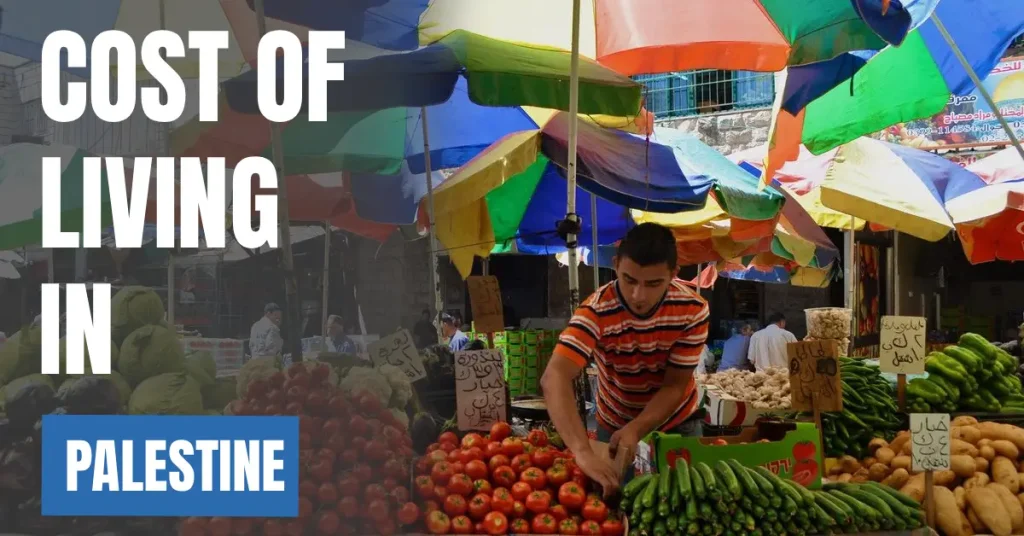
Cost of Living in Palestine 2026: Rent, Salaries and Monthly Expenses
The cost of living in Palestine in 2026 depends heavily on where you live, your housing arrangements, household income and access to essential services. A single person renting in the West Bank may need approximately ILS 2,750 to ILS 4,750 per month, while a family of four can require ILS 8,000 to ILS 11,000 or more. These are illustrative planning budgets, not official national averages.
On this pageTable of Content
Palestine's living costs cannot be understood through prices alone. The West Bank and Gaza Strip face very different economic and humanitarian conditions. In particular, the destruction of housing and infrastructure, displacement, supply shortages and disrupted employment in Gaza mean that ordinary rental and household budget estimates are not reliable measures of what people actually need.
In the West Bank, housing is often a major expense, especially in Ramallah. Transportation delays, healthcare access, salary uncertainty and the price of imported products also affect affordability.
This guide examines everyday expenses, including rent, groceries, restaurants, utilities, internet, transportation, healthcare, education and salaries. It also explains what prospective residents should know before relying on general cost estimates.
Also Explore: Cost of Living in NorwayCost of Living in Palestine at a Glance
The following figures provide an indicative overview of everyday costs in relatively functioning West Bank rental markets. They should not be applied to Gaza, where displacement and damage have substantially disrupted conventional housing and consumer markets.
| Expense | Estimated Cost in ILS | Frequency |
|---|---|---|
| Budget-conscious single person, including shared or low-cost rent | 2,500 to 3,500 | Monthly |
| Moderate single-person lifestyle, including rent | 4,000 to 5,500 | Monthly |
| Couple, including rent | 5,500 to 7,500 | Monthly |
| Family of four, including rent | 8,000 to 11,000+ | Monthly |
| Small apartment or studio rent | 1,200 to 2,600 | Monthly |
| Larger family apartment rent | 2,300 to 4,000+ | Monthly |
| Groceries for one adult | 600 to 1,100 | Monthly |
| Household utilities | 250 to 600 | Monthly |
| Home internet | 75 to 150 | Monthly |
| Local transportation | 150 to 450+ | Monthly |
| Basic restaurant meal | 25 to 50 | Per meal |
| Private doctor consultation | 75 to 150+ | Per visit |
| Statutory minimum monthly wage | 1,880 | Monthly |
Important: The household totals are constructed budget estimates based on broad West Bank spending assumptions. Individual prices use indicative market information from sources including Expatistan, Numbeo and the existing Visaboards guide. They are not official Palestinian Central Bureau of Statistics (PCBS) averages or verified November 2026 quotations for every city.
The new Israeli shekel (ILS or NIS) is the main currency used for these calculations. Palestine does not have a separate circulating national currency. US dollars and Jordanian dinars are also used in certain transactions.
How Much Does It Cost to Live in Palestine Per Month?
A single adult in a reasonably functioning West Bank market may budget around ILS 2,500 to ILS 3,500 per month with economical housing and careful spending. A person renting independently in a more expensive location may need ILS 4,000 to ILS 5,500 or more, including rent.
Excluding accommodation, a single adult might plan for around ILS 1,300 to ILS 2,200 in groceries, utilities, communications, transportation and basic personal spending. The exact amount depends on how many costs are shared and whether medical treatment, private transport or frequent dining out is needed.
For perspective, Expatistan's November 2026 Ramallah estimate is approximately ILS 4,918 for a single person and ILS 12,874 for a family of four. However, the website explicitly warns that its data contains inconsistencies and relies on very few contributors. These figures are useful as comparisons, not definitive population-wide averages.
Households should also allow for occasional spending such as medical bills, home repairs, school expenses, clothing, document fees and unexpected transportation costs.
Housing and Rent Prices in Palestine
Rent is one of the largest regular expenses for many people living in the West Bank. Prices vary according to the city, neighborhood, property condition, available utilities, furnishing and proximity to employment or educational institutions.
How Much Is Monthly Rent in Palestine?
A small rental apartment or studio may cost around ILS 1,200 to ILS 2,600 per month in selected West Bank locations. Larger apartments can cost ILS 2,300 to ILS 4,000 or more, particularly in desirable parts of Ramallah.
| Accommodation Type | Indicative Monthly Rent |
|---|---|
| Shared room or economical shared accommodation | ILS 600 to 1,200 |
| Small studio in a less expensive area | ILS 1,200 to 1,800 |
| One-bedroom apartment in a more central area | ILS 1,800 to 2,600+ |
| Three-bedroom apartment outside a premium area | ILS 2,300 to 3,200 |
| Larger apartment in a desirable urban location | ILS 3,000 to 4,000+ |
These figures are broad planning ranges, not guaranteed available rental listings. Shared-room costs in particular depend on actual availability and the number of occupants.
Expatistan reported approximately ILS 1,307 for a furnished 45-square-meter studio in a normal Ramallah area and ILS 1,832 in an expensive area in November 2026. Its estimate for an 85-square-meter furnished apartment was ILS 1,797 in a normal area and ILS 2,976 in an expensive area.
Numbeo's earlier Ramallah data indicated higher rents for some city-center apartments. Differences between these datasets reflect accommodation types, collection periods and very limited reporting samples.
Additional Housing Expenses
Tenants should clarify which expenses are included before signing an agreement. Depending on the property, extra costs may include:
- Security deposits and advance rental payments.
- Electricity, water, cooking gas and heating.
- Backup electricity or water storage arrangements.
- Building maintenance and shared service charges.
- Internet installation and equipment.
- Furniture, appliances and moving expenses.
Buying property involves additional legal and financial considerations, including ownership documentation, property rights, transaction costs and access restrictions. General price-per-square-meter estimates should not replace legal due diligence or a current local property valuation.
Why Gaza Requires a Different Housing Assessment
Conventional rent estimates are not meaningful for much of Gaza in 2026. Large-scale housing destruction and displacement have left many people without access to ordinary accommodation.
According to the United Nations Office for the Coordination of Humanitarian Affairs (OCHA), approximately 294,250 families required winter shelter assistance in October 2026, while available supplies could partially assist only about 18% of them.
In these conditions, housing affordability must be assessed alongside actual shelter availability, physical safety, access to water and sanitation, and humanitarian assistance. A low quoted rental price does not establish that safe, habitable accommodation is available.
Food and Grocery Costs in Palestine
A single adult in the West Bank may allocate approximately ILS 600 to ILS 1,100 per month for groceries, depending on diet, household size and shopping habits. Fresh produce, local bread and seasonal ingredients can help control spending, while imported foods may be more expensive.
Typical Grocery Prices
| Grocery Item | Indicative Price |
|---|---|
| Milk, 1 liter | ILS 6 to 8 |
| Eggs, 12 | ILS 12 to 16 |
| Chicken breast, 1 kg | ILS 40 to 50 |
| Apples, 1 kg | ILS 6 to 9 |
| Tomatoes, 1 kg | ILS 4 to 8 |
| Potatoes, 1 kg | ILS 3 to 6 |
| Local cheese, 500 g | ILS 12 to 20 |
These indicative retail ranges are informed mainly by limited Ramallah consumer-price observations. They are not fixed prices throughout Palestine, and the type of shop, packaging and supply conditions can cause substantial differences.
Why Food Prices Can Change Quickly
Consumer prices are especially sensitive to supply disruptions and transport costs. PCBS reported that Palestine's overall consumer price index increased by 4.69% in September 2026 compared with August. Gaza experienced an 11.36% monthly increase, compared with 0.53% in the West Bank and 0.44% in the Jerusalem J1 area.
The September report also recorded monthly increases of 11.96% for white flour and 8.57% for fresh vegetables at the overall Palestinian level.
Year-on-year changes tell a different story. Gaza's price index in September 2026 was 46.43% below September 2025, following an earlier period of extraordinary inflation. This does not mean that food has become reliably affordable or accessible. Availability, purchasing power and humanitarian conditions remain central concerns.
For Gaza residents, food assistance and irregular commercial supply can matter more than an ordinary grocery shopping budget.
Restaurant and Eating Out Costs
Eating out in West Bank cities ranges from inexpensive local meals to higher-priced restaurants and cafes. A basic restaurant meal can cost approximately ILS 25 to ILS 50, while larger meals and dining in expensive urban neighborhoods may cost considerably more.
| Food or Drink | Indicative Cost |
|---|---|
| Simple local meal | ILS 20 to 35 |
| Basic restaurant lunch with a drink | ILS 35 to 55 |
| Fast-food combination meal | ILS 25 to 40 |
| Casual dinner for two | ILS 100 to 160 |
| Cappuccino | ILS 10 to 18 |
Expatistan's November 2026 Ramallah observations include ILS 49 for a basic business-district lunch, ILS 32 for a fast-food combination meal and ILS 14 for a cappuccino.
Cooking at home generally makes it easier to control spending. A person buying lunch outside every working day could add several hundred shekels to a monthly budget.
Utilities: Electricity, Water and Cooking Gas
Typical utility spending for a small household in a functioning West Bank market may range from about ILS 250 to ILS 600 monthly. Larger households, intensive heating or cooling and additional water or power needs can increase the total.
Expatistan's November 2026 Ramallah data estimated approximately ILS 291 for utilities in a 45-square-meter studio occupied by one person and ILS 457 for two people in an 85-square-meter apartment.
Confirm whether electricity, water and heating are individually metered or included in the rent. Some households may need to budget for water delivery, storage or backup electricity.
In Gaza, damaged infrastructure and shortages mean that standard monthly utility charges may not reflect the true cost of accessing safe water or electricity. OCHA has documented significant constraints affecting desalination, fuel supplies, water systems and essential maintenance.
Internet and Mobile Phone Costs
Home internet in parts of the West Bank may cost approximately ILS 75 to ILS 150 per month, depending on the provider, package, location and available connection technology. Mobile expenses vary with data usage and prepaid or contract arrangements.
Expatistan lists an indicative Ramallah home internet charge of ILS 96 per month for a specified lower-speed package. Actual offers may differ significantly.
Internet speed and mobile coverage should be checked at the exact address before renting, especially when reliable connectivity is essential for remote work.
In January 2026, Israeli authorities approved an upgrade toward 4G mobile services for Palestinian operators in the West Bank. Approval does not by itself establish that 4G is available everywhere, and network deployment and service quality should be verified with the provider.
Gaza has faced substantially more severe telecommunications limitations and infrastructure disruption. Residents should not assume that West Bank service prices, speeds or reliability apply there.
Transportation Costs in Palestine
A person relying on shared taxis and occasional local transport in the West Bank may spend approximately ILS 150 to ILS 450 or more monthly. Regular private taxis, long commutes and vehicle ownership can raise costs substantially.
Common transport options include shared taxis, local minibuses, private taxis and private vehicles. Fare structures and availability differ by route.
| Transportation Expense | Indicative Cost |
|---|---|
| Short local shared-transport journey | ILS 3 to 8 |
| Monthly budget using shared transport | ILS 150 to 450+ |
| Private taxi journey of approximately 8 km in Ramallah | About ILS 80 |
| Petrol, 1 liter | Approximately ILS 7 |
Expatistan reports a notional monthly public-transport ticket price of ILS 326 for Ramallah. However, this crowdsourced entry should not be treated as confirmation that a standardized monthly pass is available across the Palestinian public transport system.
How Movement Restrictions Affect Transportation Costs
Travel planning should account for more than ticket prices. Road closures, checkpoints, access restrictions and security conditions can cause delays or require more expensive alternative routes.
These disruptions can affect access to employment, hospitals, universities and family services. Someone choosing cheaper accommodation outside a city should therefore consider whether the journey to work remains practical.
There is no verified nationwide entitlement to free public transportation for all residents. Fares and any applicable concessions should be confirmed locally.
Healthcare Costs in Palestine
Healthcare in Palestine is not universally free for every resident or visitor. Access and personal costs depend on eligibility, public-sector coverage, insurance, provider type, location and the availability of medical services.
The healthcare system includes Palestinian Ministry of Health facilities, private clinics, nongovernmental providers and services for eligible Palestine refugees. Some residents can access subsidized or covered services, while others may pay consultation fees, medication costs or insurance contributions.
Private Healthcare Expenses
A private consultation might cost approximately ILS 75 to ILS 150 or more, depending on the provider and specialty. Expatistan's November 2026 Ramallah observation gives an indicative price of ILS 103 for a short private doctor visit.
Diagnostic tests, specialist referrals, medicines, dental treatment and hospital procedures may create significant additional costs. An individual should not assume that a low consultation fee represents the total cost of treatment.
Public Healthcare and Insurance Eligibility
Eligible patients may receive care through public insurance or other approved arrangements. Palestine refugees who meet the relevant criteria may also access services provided through UNRWA and associated arrangements.
Coverage must be checked individually. The availability of a health card, insurance policy or referral does not guarantee that every treatment, medicine or hospital transfer is fully funded.
Access is an especially serious issue in Gaza. The World Health Organization's 2026 emergency appeal estimated that 2.9 million people across the occupied Palestinian territory would require humanitarian health assistance during the year.
For prospective foreign residents, appropriate medical and evacuation insurance is an important consideration, subject to actual policy coverage and travel exclusions.
Education and Childcare Costs
Education spending varies considerably between public, private and international institutions. Families should not assume that all schools charge the same fees or provide identical services.
Public Schools
Public schooling is generally the lower-cost choice for eligible families. However, uniforms, supplies, transportation, activities and other incidental expenses may still require a household budget.
Enrollment eligibility, language of instruction and required documents should be checked directly with the education authority or individual school.
Private and International Schools
Private school fees vary by institution, grade level and location. International schooling can be considerably more expensive and may involve admission, registration, transportation and activity charges in addition to tuition.
The previous Visaboards article quoted relatively low general private-school costs and annual international-school estimates. These are insufficient to establish reliable 2026 fees for specific schools. Parents should obtain an actual fee schedule rather than treating those figures as a national average.
Childcare
Nursery and daycare costs depend on the child's age, hours of care and location. Families should request local quotations and allow separately for meals, transport and registration expenses.
Education access in Gaza remains severely disrupted. In addition to fees, families must consider whether suitable, safe and regularly functioning educational facilities are available.
Salaries and Average Earnings in Palestine
Wages in the West Bank often provide limited financial flexibility once rent and basic household expenses are paid. Earnings vary substantially by occupation, sector, location and whether employment is in the local market or across the border.
According to PCBS, the average daily wage for wage employees in the West Bank was approximately ILS 134.3 in the second quarter of 2026. Based on the reported average of 22.4 working days per month, this is equivalent to roughly ILS 3,008 per month before any applicable deductions.
This calculation is an approximate monthly equivalent, not a separately measured median salary or a guarantee of full-time employment.
PCBS also reported a West Bank unemployment rate of 27.9% in the second quarter of 2026. This helps explain why a nominally affordable product or service may remain out of reach for many households.
What Is the Minimum Wage in Palestine in 2026?
The statutory Palestinian minimum wage reported by PCBS is ILS 1,880 per month, effective from the beginning of 2022. As of this review, no newer generally applicable statutory monthly figure was verified from the consulted official sources.
This minimum wage is below the illustrative monthly cost of independently renting and maintaining even a modest household in many West Bank locations.
Compliance is also a concern. PCBS reported that approximately 14.6% of private-sector wage employees in the West Bank earned less than ILS 1,880 in the fourth quarter of 2025. Their average reported monthly wage was approximately ILS 1,442.
The statutory minimum is therefore not the same as what every worker actually receives, and minimum-wage policy alone does not establish whether a household can afford its essentials.
Income Tax and Everyday Affordability
Income tax can reduce the amount available for rent, groceries and other regular expenses. Based on the Palestinian tax framework summarized by PwC in August 2026, annual employment income is subject to progressive tax brackets:
| Annual Taxable Income | Income Tax Rate |
|---|---|
| Up to ILS 75,000 | 5% |
| ILS 75,001 to 150,000 | 10% |
| Above ILS 150,000 | 15% |
These rates apply to taxable income after relevant legal exemptions and deductions, not necessarily to every shekel of gross salary. Employment benefits, residency status and the source of income can affect an individual's treatment.
For budgeting purposes, employees should use their actual take-home pay rather than gross wages. Foreign workers and remote employees should obtain advice about their specific tax and employment circumstances.
Realistic Monthly Budgets for Living in Palestine
The examples below illustrate how monthly expenses can add up in West Bank locations where housing and ordinary services are functioning. These are constructed planning scenarios, not official average household expenditure figures.
| Monthly Expense | Budget Single | Moderate Single | Couple | Family of Four |
|---|---|---|---|---|
| Rent | ILS 1,200 | ILS 2,200 | ILS 2,800 | ILS 3,600 |
| Utilities | ILS 300 | ILS 450 | ILS 550 | ILS 800 |
| Groceries | ILS 650 | ILS 900 | ILS 1,400 | ILS 2,400 |
| Transportation | ILS 180 | ILS 300 | ILS 450 | ILS 700 |
| Internet and mobile | ILS 120 | ILS 180 | ILS 220 | ILS 300 |
| Healthcare provision | ILS 150 | ILS 250 | ILS 400 | ILS 800 |
| Dining, personal expenses and leisure | ILS 150 | ILS 450 | ILS 600 | ILS 1,000 |
| School and childcare provision | ILS 0 | ILS 0 | ILS 0 | ILS 900 |
| Total Including Rent | ILS 2,750 | ILS 4,730 | ILS 6,420 | ILS 10,500 |
| Total Excluding Rent | ILS 1,550 | ILS 2,530 | ILS 3,620 | ILS 6,900 |
Budget Assumptions
- Budget single person: Uses lower-cost or shared accommodation, prepares most meals at home and relies on economical local transportation.
- Moderate single person: Rents a private apartment, spends more on food and personal activities, and has a larger healthcare reserve.
- Couple: Shares a two-person household, with moderate rent, groceries and transport expenses, and no dependants.
- Family of four: Assumes two adults and two children, larger accommodation and a provision for basic education-related costs. Full international school fees are not included.
The healthcare amounts are budget allowances, not quoted insurance premiums or guaranteed coverage. Similarly, the education provision is not a verified tuition quotation.
These examples exclude major emergencies, vehicle purchases, significant relocation costs, large medical procedures and premium international schooling. A household with these expenses would require a larger budget.
Cost of Living by City and Region
The cost of living varies within the West Bank, but reliable and representative city-by-city consumer-price datasets are limited. There is no sound basis for treating one national average as equally applicable to Ramallah, Bethlehem, Hebron, Nablus, East Jerusalem and Gaza.
Ramallah
Ramallah has a relatively developed apartment rental market and a concentration of offices, service businesses, restaurants and international organizations. Some central and furnished accommodation can be relatively expensive compared with other West Bank locations.
For independent renters, the main factors to compare are rent, commuting requirements and the location of essential services.
Bethlehem
Bethlehem has residential neighborhoods, local businesses and tourism-related employment. Individual costs depend on housing location, commuting arrangements and the stability of tourism-related activity.
Current local quotations are needed before concluding that Bethlehem is consistently cheaper than Ramallah for every household type.
Hebron and Nablus
Hebron and Nablus have established residential and commercial areas where some accommodation may be less expensive than premium Ramallah properties. However, rent differences need to be assessed alongside property quality, transport and access restrictions.
East Jerusalem
East Jerusalem should be considered separately because housing markets, services, administrative arrangements and access to certain public systems differ from other West Bank areas.
PCBS also reports price movements for Jerusalem J1 separately from the rest of the West Bank. It is therefore misleading to apply a Ramallah rental estimate automatically to East Jerusalem.
Gaza Strip
Gaza cannot be assessed using a standard expat-style monthly budget in 2026. Housing destruction, displacement, food insecurity, damaged utilities and restricted access to services have profoundly altered household spending and basic living conditions.
The World Bank reports that approximately 80% of Gaza's population was displaced by early 2026. By mid-October, OCHA reported that around 950,000 displaced people were living in sites with medium to high flood risk.
For Gaza, the immediate issues are safe shelter, food, clean water, healthcare, transport access and humanitarian assistance rather than conventional comparisons of apartment rent and restaurant prices.
Is Palestine Cheaper Than Nearby Countries?
Palestine can be less expensive than some regional cities for particular goods or housing arrangements, but it is not possible to make a dependable blanket claim that the entire country is cheaper than Jordan, Israel, Lebanon or Egypt.
Such comparisons require equivalent households, current exchange rates, comparable housing standards and consistent data collection methods.
For example, comparing a small apartment outside Hebron with an apartment in central Amman would not produce a meaningful country-level cost comparison.
Moreover, affordability depends on income as well as expenses. A market with relatively inexpensive rent can still be difficult to live in when wages are low or employment is scarce.
Given the highly fragmented Palestinian economy and limited comparable current data, city-specific comparisons are more reliable than broad national rankings. The previous article's unqualified statements that Jordan is more expensive, Egypt is cheaper and Lebanon is significantly more expensive should not be treated as verified 2026 country-wide findings.
Hidden Living Costs New Residents Often Overlook
Beyond routine rent and grocery spending, several less predictable expenses can affect the actual cost of living:
- Rental deposits, furniture and initial household setup.
- Water delivery, storage equipment and backup power where needed.
- Higher transport costs when routes are disrupted.
- Private healthcare, diagnostic testing and medication not covered by insurance.
- International school tuition, registration and school transportation.
- Imported goods, replacement electronics and specialized equipment.
- Banking, currency exchange and international transfer charges.
- Travel disruption, accommodation changes and unexpected return journeys.
- Legal and administrative fees related to residence or employment.
Budgeting an emergency reserve is particularly important where access to services, transport or employment can change without much notice.
Cost of Living Versus Residency Financial Requirements
A personal living budget is not the same as an immigration or residency financial requirement. An individual may be able to cover monthly expenses yet still lack the legal permission required to enter, reside or work.
Entry and residence arrangements vary according to nationality, travel purpose, location and applicable administrative rules. Israeli authorities control major entry routes into the Palestinian territories and apply specific procedures affecting foreign nationals entering the West Bank.
Foreign nationals should consult the current official entry procedures before making relocation commitments. Requirements relating to approved entry, employment, documentation and length of stay must be assessed separately from household expenses.
No single generally applicable minimum bank-balance requirement for all foreign nationals intending to reside in Palestine could be verified from the sources reviewed. It would be misleading to present a living-cost estimate as an official visa qualification threshold.
Prospective residents should also check their government's current travel advice. As of 4 November 2026, the UK's Foreign, Commonwealth and Development Office advised against all travel to Gaza and to specified other areas, while additional restrictions applied to parts of the West Bank.
Is Palestine Affordable for Expats and New Residents?
Palestine may be affordable for some people who have secure income, suitable housing and reliable access to essential services. However, it is not accurate to describe the country as uniformly inexpensive or straightforward for foreign residents.
A person receiving a stable income from abroad may have more financial flexibility than someone relying on wages in the local labor market. At the same time, foreign income does not remove restrictions relating to legal residence, security, access or service availability.
The World Bank's Fall 2026 economic assessment described a deeply fragmented economy, substantial employment disruption and continued pressure on public services. It also reported that national poverty exceeded 50% by 2025.
Before considering relocation, compare actual after-tax income with local rental quotations, healthcare arrangements, school access where needed and realistic commuting requirements. Legal eligibility and personal safety must be assessed independently of price.
Conclusion: How Much Should You Budget?
For practical planning in parts of the West Bank, a budget-conscious single renter might start with approximately ILS 2,750 monthly, while someone seeking more independent and comfortable accommodation could plan around ILS 4,730. A couple might use ILS 6,420 as an illustrative starting budget, and a family of four could require around ILS 10,500, depending especially on housing, healthcare and education.
These totals include rent and remain hypothetical examples rather than verified minimum living costs. Higher rents, full private schooling or frequent medical needs can increase expenses significantly.
The most important affordability question is whether reliable household income can cover local costs and whether essential services are genuinely accessible. This distinction is especially important in Gaza, where the ongoing humanitarian crisis makes ordinary household cost comparisons inadequate.
For an accurate personal budget, obtain current local housing prices, check services at the intended address, verify healthcare and school arrangements, and allow for disruptions and unexpected expenses.
Sources and Methodology
This article was reviewed on 5 November 2026. It draws on Palestinian official statistics, international economic and humanitarian reporting, travel and tax guidance, and selected consumer-price databases.
PCBS reports were prioritized for inflation, wages and labor-market conditions. World Bank, WHO and OCHA publications were used to assess wider affordability, service access and the exceptional conditions in Gaza.
Selected price observations from Expatistan and Numbeo helped inform West Bank retail and housing examples. These sources are crowdsourced, can contain inconsistencies and may reflect very small samples. Expatistan explicitly identifies fewer than ten price observations from fewer than five contributors in its Ramallah dataset. Consequently, the article uses indicative ranges rather than presenting individual market observations as authoritative national averages.
Sample monthly budgets were calculated by adding stated spending assumptions. They do not represent official consumer expenditure survey results. Consumer prices, rent, exchange rates, availability and access conditions can change quickly.
Sources used:
- Palestinian Central Bureau of Statistics, Consumer Price Index, September 2026.
- PCBS, Consumer Price Index during 2025.
- PCBS, West Bank Labour Force Survey, Second Quarter 2026.
- PCBS, West Bank Labour Force Survey, Fourth Quarter 2025 and Minimum Wage Information.
- World Bank, West Bank and Gaza Economic Overview and Fall 2026 Update.
- United Nations OCHA, Humanitarian Situation Report, 15 October 2026.
- World Health Organization, Occupied Palestinian Territory Health Emergency Appeal 2026.
- Expatistan, Ramallah Cost of Living, November 2026.
- Numbeo, Ramallah Consumer and Rental Prices.
- PwC, Palestinian Territories Individual Income Tax, reviewed August 2026.
- UK Government, Entry Requirements and Entering Palestine.
- UK Government, Palestine Travel Advice, current November 2026.
- Visaboards, Original Cost of Living in Palestine Article, March 2026.
Frequently Asked Questions
How much does it cost to live in Palestine per month?
A single person renting in parts of the West Bank may need approximately ILS 2,500 to ILS 5,500 per month, including rent, depending on accommodation and lifestyle. A constructed budget for a moderate single-person lifestyle is around ILS 4,730 monthly. These are planning estimates, not official national averages. Gaza cannot currently be represented reliably by a conventional monthly household budget because of displacement, damaged infrastructure and severe supply disruptions.
What is the average monthly rent in Palestine?
Rental prices vary considerably. A small studio or apartment in selected West Bank areas may cost roughly ILS 1,200 to ILS 2,600 monthly, while larger family apartments may cost ILS 2,300 to ILS 4,000 or more. Ramallah market data provides useful examples but has limited samples. These figures should not be treated as a national rental average or applied to Gaza, where conventional housing markets have been severely disrupted.
What salary is needed to live comfortably in Palestine?
A single renter seeking a moderate lifestyle in the West Bank might use ILS 4,000 to ILS 5,500 in monthly take-home income as an initial planning target. A couple or family may need considerably more depending on rent, childcare and healthcare. Actual needs depend on location and household circumstances. The target should not be confused with average local earnings or an official salary requirement.
What is the minimum wage in Palestine in 2026?
The statutory minimum monthly wage reported by the Palestinian Central Bureau of Statistics is ILS 1,880, effective from the beginning of 2022. No newer generally applicable monthly minimum was verified in the official material reviewed. PCBS reported that approximately 14.6% of private-sector wage employees in the West Bank earned less than that amount in the fourth quarter of 2025. The minimum wage is insufficient for many independent rental budgets.
Is healthcare free in Palestine?
Healthcare is not universally free for every person in Palestine. Eligible residents may access public coverage or subsidized services, and qualifying Palestine refugees may receive services through UNRWA arrangements. Other patients may need private insurance or direct payments. Costs depend on the treatment, provider and coverage. In Gaza, severe disruption to medical facilities and supplies can make access to treatment difficult regardless of the consultation price.
Is public transportation free in Palestine?
There is no verified nationwide policy providing free public transportation to all residents. People commonly use shared taxis, minibuses, local transport services and private vehicles, with fares varying by route and location. A basic monthly transport allowance of ILS 150 to ILS 450 or more may be useful for West Bank planning. Checkpoint delays, road restrictions and private taxi journeys can increase both travel time and actual costs.
How much does a family of four need in Palestine?
A family of four renting in a functioning West Bank market may use approximately ILS 8,000 to ILS 11,000 or more as a preliminary monthly budget, including housing. One illustrative calculation totals ILS 10,500, covering rent, utilities, groceries, transport, communications, basic healthcare provision, personal spending and a limited education allowance. Full international school fees, major medical costs and relocation expenses would require additional funds.
Is Ramallah more expensive than other Palestinian cities?
Some parts of Ramallah can be relatively expensive, especially for furnished apartments and centrally located accommodation. However, comprehensive current datasets do not establish a precise city-wide ranking against Bethlehem, Hebron and Nablus. Rent, transport and access to work should be compared together. The available Ramallah consumer-price databases also contain limited observations, so their figures should be used as estimates rather than definitive market averages.
Is Palestine cheaper than Jordan or Israel?
Some individual expenses in Palestinian cities may be lower than comparable costs in Jordanian or Israeli cities, but there is insufficient consistent current evidence to declare all of Palestine cheaper overall. Reliable comparisons require equivalent housing, household size, spending categories, income and exchange rates. Affordability also depends on local earning opportunities and access restrictions, not just shelf prices or rent. City-level comparisons are more informative than broad national claims.
Do foreigners need a minimum bank balance to live in Palestine?
No single universally applicable minimum bank-balance figure for all foreign residents was verified in the sources reviewed. Legal entry, residence and employment requirements depend on nationality, purpose of stay and applicable administrative procedures. Israeli authorities control major entry routes and apply specific rules affecting foreign nationals entering the West Bank. Anyone considering relocation should verify the current official requirements independently of their estimated monthly living costs.
Join the conversation
Have thoughts on this topic? Share them with others.
Ask questions, share experience, and learn from the Visaboards Community.