
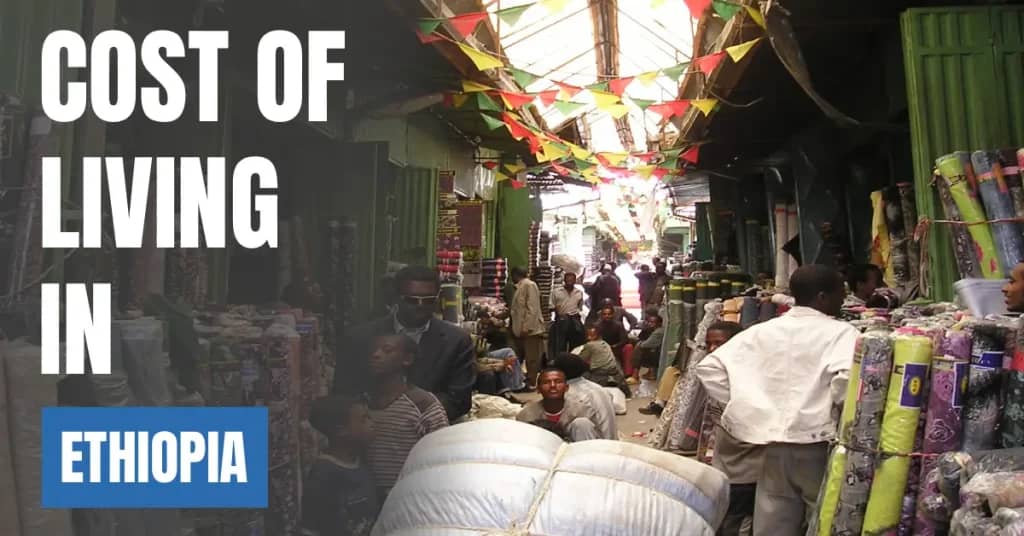
Cost of Living in Ethiopia 2026: Rent, Food, Salaries and Monthly Expenses
The cost of living in Ethiopia varies considerably depending on where you live, your accommodation, household size and lifestyle. Basic local food and public transportation can be relatively affordable, but renting a modern apartment in Addis Ababa, buying imported products, arranging private healthcare and paying international school fees can make life substantially more expensive.
On this pageTable of Content
For someone considering moving to Ethiopia in 2026, housing is one of the most important expenses to investigate. Addis Ababa has a particularly wide rental market, ranging from modest local accommodation to expensive furnished apartments marketed to expatriates and international organisations.
Ethiopia uses the Ethiopian birr (ETB). This guide presents prices primarily in birr to avoid misleading comparisons caused by exchange-rate fluctuations. It distinguishes everyday spending from rent, explains the difference between local and expatriate budgets, and incorporates available market information reviewed in October 2026.
Cost of Living in Ethiopia at a Glance
A practical monthly budget for a single person in Addis Ababa can range from approximately ETB 35,000 for economical living with modest accommodation to ETB 70,000 or more for a more comfortable lifestyle. Families requiring larger accommodation, private transport or international education may need significantly more.
The following figures are indicative planning estimates, not official national averages. They combine recent Addis Ababa consumer-price observations, published accommodation estimates and illustrative household spending assumptions.
| Expense | Estimated Cost in ETB | Explanation |
|---|---|---|
| Budget single person, including rent | 35,000 to 50,000/month | Modest accommodation and mainly local spending |
| Moderate single person, including rent | 65,000 to 90,000/month | Private studio or apartment and more discretionary spending |
| Couple, including rent | 90,000 to 145,000/month | Shared accommodation and moderate living expenses |
| Family of four, including rent | 180,000 to 280,000+/month | Family housing and household expenses, excluding international school tuition |
| Furnished studio in a normal Addis Ababa area | About 29,060/month | Expatistan October 2026 observation |
| Furnished studio in an expensive area | About 46,669/month | Expatistan October 2026 observation |
| Furnished 85 m² apartment in a normal area | About 78,247/month | Indicative furnished rental observation |
| Basic utilities for a single-person studio | About 2,058/month | Reported market estimate |
| Home broadband, 10 Mbps | 1,300/month | Published Ethio telecom standard tariff |
| Basic business-district lunch | About 871/meal | October 2026 price observation |
| Monthly groceries, one adult | 7,000 to 15,000 | Illustrative locally focused shopping allowance |
The household totals include rent, basic utilities, food, transportation, connectivity, healthcare allowances and discretionary spending. Actual costs can fall outside these ranges. International schools, luxury housing, imported groceries, private drivers and comprehensive medical insurance are not necessarily covered.
For comparison, Expatistan's October 2026 estimates put the monthly cost of living in Addis Ababa at approximately ETB 144,220 for one person and ETB 262,318 for a family of four. The provider explicitly warns that these figures are based on only a few data points. They should not be interpreted as representative costs for every Ethiopian household.
Sources: Expatistan Addis Ababa, Numbeo Addis Ababa and Ethio telecom.
How Much Does It Cost to Live in Ethiopia Per Month?
Monthly living costs in Ethiopia depend strongly on rent. Someone sharing basic accommodation, buying local groceries and using public transport may spend much less than an expatriate renting a furnished apartment in central Addis Ababa.
Living Costs Excluding Rent
For preliminary planning, a single adult can allocate approximately ETB 15,000 to 30,000 monthly for groceries, utilities, modest transportation, communication, healthcare allowances and limited leisure. Higher levels of restaurant spending, private transport and imported goods can push this figure upward.
A family of four may need approximately ETB 50,000 to 100,000 or more per month before rent and school fees, depending on consumption patterns and transportation choices. These are illustrative household budgets rather than measured national spending averages.
Living Costs Including Rent
Adding accommodation substantially changes the picture. A low-cost housing arrangement may support a single-person budget around ETB 35,000 to 50,000, while a furnished apartment in Addis Ababa can require much more.
Expats should avoid assuming that locally quoted averages apply to secure, furnished housing with backup power, reliable internet and convenient access to workplaces. Such requirements often narrow the available housing choices and raise monthly expenses.
Inflation and Changes in Consumer Prices
Inflation remains relevant when preparing a long-term budget. The Ethiopian Statistical Service reported a headline consumer-price inflation figure of 9.6% for September 2026. This is an economy-wide indicator, not a prediction of how much an individual household's expenses will rise.
Rent, individual grocery products, fuel and imported goods can change at different rates. Residents should update their budgets regularly rather than assume that prices quoted in early 2026 still apply unchanged.
Source: Ethiopian Statistical Service Consumer Price Statistics.
Housing and Rent Prices in Ethiopia
Rent is often the largest monthly expense for newcomers, especially in Addis Ababa. Housing prices vary by neighbourhood, furnishings, property condition, building services and rental arrangements.
Apartment Rent in Addis Ababa
Expatistan's October 2026 market observations provide the following examples.
| Accommodation | Monthly Rent (ETB) |
|---|---|
| 45 m² furnished studio, normal area | 29,060 |
| 45 m² furnished studio, expensive area | 46,669 |
| 85 m² furnished apartment, normal area | 78,247 |
| 85 m² furnished apartment, expensive area | 132,294 |
These are market estimates with limited samples, not mandatory rental rates or reliable nationwide medians. Unfurnished apartments, older buildings, shared accommodation and housing outside premium districts can be cheaper.
Numbeo's June 2026 dataset also shows considerable variation, reporting approximately USD 356 for a one-bedroom apartment outside central Addis Ababa and USD 707 for a central one-bedroom apartment. These dollar-denominated survey figures are included only as a comparison because the original dataset uses USD. They should not be converted into fixed birr prices without a dated exchange rate.
Source: Numbeo, Addis Ababa price survey.
Why Expat Housing Can Cost More
Foreign professionals and international organisation employees may look for properties offering security, furnished interiors, parking, consistent water supply and backup electricity. These features can command higher rents than ordinary local housing.
Before signing a lease, confirm whether rent includes maintenance, security, water, electricity, internet and generator expenses. Also ask about advance payments, deposits, agency fees and the currency or exchange-rate terms used for the agreement.
Buying Property in Ethiopia
Purchasing residential property raises legal questions that differ from renting. Foreign ownership and investment rules are not identical to those applying to Ethiopian citizens, and eligibility may depend on the property, applicable legislation and investor status.
Foreign nationals should obtain current legal advice and confirm land-use and ownership rights before making a purchase. A property listing price does not establish that a foreign buyer can legally acquire the property.
Food and Grocery Prices in Ethiopia
Local markets can offer relatively economical food options, especially for households purchasing seasonal produce, grains and traditional ingredients. Imported and specialty products can be substantially more expensive.
The following Addis Ababa grocery prices were reported by Expatistan in October 2026.
| Grocery Item | Estimated Price (ETB) |
|---|---|
| Milk, 1 litre | 114 |
| Eggs, 12 | 230 |
| Boneless chicken breast, 500 g | 649 |
| Tomatoes, 1 kg | 77 |
| Potatoes, 1 kg | 44 |
| Local cheese, 500 g | 385 |
| Apples, 1 kg | 608 |
| Bread for two people, one day | 86 |
These observations show why shopping habits matter. Potatoes and seasonal vegetables may be inexpensive compared with imported fruit, certain dairy products and meat.
An adult buying mostly locally produced foods could provisionally budget ETB 7,000 to 15,000 monthly. A family of four might start with ETB 25,000 to 45,000, adjusting for children's ages, dietary preferences, meat consumption and imported products. These shopping allowances are illustrative and not official food-basket statistics.
Source: Expatistan food prices.
Restaurants and Eating Out in Ethiopia
Eating out in Ethiopia can be affordable at local restaurants, but the difference between everyday dining and international restaurants is substantial.
In October 2026, Expatistan recorded a basic lunchtime meal with a drink in an Addis Ababa business district at approximately ETB 871, while a fast-food combination meal was around ETB 902.
Numbeo's June 2026 observations reported an inexpensive restaurant meal at approximately USD 4 and a mid-range, three-course meal for two at approximately USD 42.50. These figures reflect different restaurant categories and survey periods, so they should not be treated as directly comparable prices.
Traditional Ethiopian meals, injera-based dishes, small neighbourhood restaurants and local coffee shops may provide more economical options. Western-style dining, hotel restaurants, imported ingredients and delivery services generally increase spending.
For planning purposes, someone who cooks most meals at home might allocate ETB 2,000 to 5,000 a month for occasional dining. Frequent restaurant users should calculate their allowance based on the number of meals and the establishments they actually intend to visit.
Utilities: Electricity, Water and Household Services
Utilities are generally a smaller expense than rent, but consumption patterns, the type of accommodation and building infrastructure affect costs.
Expatistan's October 2026 estimates indicate approximately ETB 2,058 per month for utilities in a 45 m² single-person studio and ETB 3,307 for two people in an 85 m² apartment. The estimates cover a combination of household services such as electricity, water and related utility costs.
For a practical budget, allow approximately ETB 2,000 to 4,000 for a modest household, with additional provision for larger homes, higher electricity use, backup power or privately arranged water supply.
Ask landlords whether utility accounts are separately metered and whether building service charges are mandatory. Backup power and water-storage arrangements may matter as much as the headline monthly bill.
Internet and Mobile Phone Costs
Internet costs in Ethiopia depend on whether a household uses fixed broadband, wireless home internet or mobile data. Connection availability and actual service quality can vary by address.
Ethio telecom publishes the following standard monthly fixed-broadband prices.
| Broadband Speed | Published Monthly Price (ETB) |
|---|---|
| 7 Mbps | 999 |
| 10 Mbps | 1,300 |
| 15 Mbps | 1,875 |
| 20 Mbps | 2,500 |
| 30 Mbps | 3,700 |
| 50 Mbps | 5,900 |
| 100 Mbps | 11,000 |
Long-term contract packages may offer different pricing. Ethio telecom also lists wireless home broadband options, including a 10 GB monthly package at ETB 445 and a 100 GB package at ETB 1,475. Conditions, coverage, equipment costs and fair-use policies should be checked before subscribing.
A household needing a reliable home connection should generally budget separately for broadband, mobile voice and data, and any backup connectivity. Remote workers should verify connection performance at their exact accommodation rather than relying only on advertised speeds.
Source: Ethio telecom official broadband tariffs.
Transportation Costs in Ethiopia
Public transportation is one of the more economical ways to travel in Ethiopian cities. Options include buses, minibuses and, in Addis Ababa, light rail services. Private taxis and ride-hailing services offer greater convenience at a higher cost.
Numbeo's June 2026 observations indicate a typical one-way local transport ticket around USD 0.50 and a monthly public transportation pass around USD 21.11 in Addis Ababa. Actual fares vary by operator, route and service type.
For a regular public transport user, a provisional monthly allowance of ETB 2,000 to 4,000 may be a reasonable starting point, although travellers using minibuses for short routes may spend less. People regularly using private cars or taxis should expect a significantly higher budget.
Public Transport and Commuting
Commuting costs depend on how far you live from your workplace, whether direct services are available and the frequency of travel. Traffic congestion in Addis Ababa can make journey time an important consideration alongside the fare.
Public transportation is not generally free for all residents. Travellers should check current fares and any eligibility-based concessions directly with their chosen transport provider.
Private Cars and Taxis
Private vehicle ownership introduces fuel, insurance, parking, servicing, repairs and vehicle-related charges. Import costs can make vehicle purchase prices materially different from those in other countries.
Ride-hailing users should compare quoted fares before booking, especially during busy periods. The old assumption that all taxi journeys are uniformly inexpensive is not a reliable basis for an expatriate commuting budget.
Healthcare Costs and Insurance in Ethiopia
Healthcare is not universally free for every resident or foreign visitor in Ethiopia. Public services are often more affordable than private treatment, but eligibility, availability and out-of-pocket costs vary.
Ethiopia operates a Community-Based Health Insurance (CBHI) system primarily intended to improve financial protection for households, particularly those outside formal employment. The country has a legal framework for CBHI, including a community-based health insurance directive published in February 2026.
The Commonwealth Fund's 2026 country profile reports public insurance coverage of approximately 46% of the population and private insurance coverage of approximately 1%. It also reports that out-of-pocket payments accounted for about 46.3% of total health expenditure in 2022.
These figures illustrate why access to a public facility should not be confused with automatic comprehensive medical coverage.
Public Versus Private Healthcare
Public health facilities provide essential services, but the availability of medicines, diagnostic equipment, specialists and hospital capacity can differ considerably across regions.
Private clinics and hospitals in Addis Ababa may offer alternative access to consultations and diagnostics, but patients generally need to confirm treatment prices and accepted insurance arrangements in advance.
Foreign residents should consider comprehensive medical insurance suited to their visa status, employment circumstances and healthcare requirements. Policies may differ in their coverage of hospitalization, specialist treatment and medical evacuation.
A small monthly healthcare allowance may cover occasional routine expenses but is not a substitute for emergency savings or insurance.
Sources: Commonwealth Fund Ethiopia health system profile, WHO health legislation database and Ethiopian Ministry of Justice CBHI directive.
Education and Childcare Costs in Ethiopia
Education can have a major impact on a family's living expenses, particularly when international schooling is required.
Public Schools
Government schools generally provide a more economical option than private institutions. However, families should consider language of instruction, admission rules, location, educational materials, uniforms, transportation and other related expenses.
Foreign families should not assume that every public school offers the curriculum or language instruction they require.
Private and International Schools
Private school fees vary substantially by institution, educational level and facilities. International schools typically command much higher prices than ordinary local private schools.
Numbeo's June 2026 Addis Ababa observations list international primary school tuition at approximately USD 30,187.50 annually per child, with a reported range of USD 15,000 to USD 56,000. This is a crowdsourced estimate with considerable variation, not an official fee schedule.
These figures demonstrate why a family employing two children in international education could face annual costs far above ordinary living expenses. Families should request current written quotations directly from schools and budget for registration charges, meals, transport and other extras.
Preschool and Childcare
Private preschool fees also vary considerably. Working parents should research childcare availability, operating hours, safety arrangements and transportation before committing to a particular neighbourhood or employer.
Salaries and Minimum Wage in Ethiopia in 2026
There is no single salary that guarantees a comfortable life in Ethiopia. The appropriate income depends on household size, housing, location and whether the person is earning a local salary or receiving an internationally negotiated compensation package.
Average Salary and Purchasing Power
Numbeo's June 2026 Addis Ababa survey reported an average monthly net salary of approximately USD 203.50. However, the dataset was based on a small group of contributors and is not an official national earnings survey.
This estimate highlights an important affordability issue: apartments marketed to international tenants can cost substantially more than the earnings reported in crowdsourced local salary data.
For a moderate single-person lifestyle involving private rented accommodation, a planning target of approximately ETB 65,000 to 90,000 in monthly take-home income may be more appropriate than relying on a general national average. This is a lifestyle budget estimate, not a documented average salary.
Is There a Minimum Wage in Ethiopia?
As of October 2026, Ethiopia does not have a generally applicable statutory national minimum wage for private-sector workers. Public-sector employees are subject to government salary structures and minimum salary arrangements applicable to their positions.
The International Labour Organization and WageIndicator describe the distinction between public-sector pay arrangements and the absence of a general national minimum wage covering private employment.
Accordingly, publishing one universal monthly minimum-wage figure for Ethiopia would be misleading. Workers should verify sector-specific arrangements, employment contracts and any applicable collective agreements.
Sources: International Labour Organization and WageIndicator Ethiopia wage regulations.
Income Tax and Its Effect on Living Costs
Employment income tax reduces the salary available for everyday living. Ethiopia amended its federal income tax legislation in 2025, raising the monthly employment income tax-free threshold to ETB 2,000 and revising the tax brackets.
| Monthly Employment Income (ETB) | Applicable Marginal Rate |
|---|---|
| Up to 2,000 | 0% |
| 2,001 to 4,000 | 15% |
| 4,001 to 7,000 | 20% |
| 7,001 to 10,000 | 25% |
| 10,001 to 14,000 | 30% |
| Above 14,000 | 35% |
These are progressive marginal tax bands. The highest rate does not mean every birr of salary is taxed at 35%. Tax calculations can also depend on the type and sources of income, relevant deductions and other applicable rules.
The revised brackets were implemented from July 2025 under Proclamation No. 1395/2025. Employees negotiating a salary should calculate expected take-home pay rather than compare gross compensation directly with household expenses.
Source: Institute for Fiscal Studies, A Survey of the Ethiopian Tax System (2025-26).
Realistic Monthly Budgets for Living in Ethiopia
The examples below are illustrative planning budgets for Addis Ababa, expressed in Ethiopian birr. They show how different expenses combine into a monthly total. Actual rental quotations, food preferences and school costs can produce very different results.
| Monthly Expense | Budget Single | Moderate Single | Couple | Family of Four |
|---|---|---|---|---|
| Rent | 18,000 | 35,000 | 55,000 | 110,000 |
| Utilities | 2,000 | 3,000 | 3,500 | 5,000 |
| Groceries | 8,000 | 12,000 | 22,000 | 40,000 |
| Transportation | 2,000 | 4,000 | 7,000 | 14,000 |
| Internet and mobile | 1,500 | 2,500 | 3,000 | 5,000 |
| Healthcare and insurance allowance | 1,500 | 3,000 | 5,000 | 10,000 |
| Dining and leisure | 2,000 | 8,000 | 12,000 | 20,000 |
| Other expenses | 2,000 | 5,000 | 7,500 | 16,000 |
| Total Including Rent | 37,000 | 72,500 | 115,000 | 220,000 |
| Total Excluding Rent | 19,000 | 37,500 | 60,000 | 110,000 |
Budget-Conscious Single Person
Estimated monthly cost: ETB 37,000 including rent.
This example assumes modest accommodation below the listed typical furnished-studio observation, local groceries, frequent public transport use and limited restaurant spending. Finding suitable housing at ETB 18,000 is not guaranteed. Shared housing or a less central location may be necessary.
Moderate Single Person
Estimated monthly cost: ETB 72,500 including rent.
This budget allows for a studio or apartment, regular groceries, home internet, some taxi use and leisure spending. It does not include large international travel costs, expensive imported goods or comprehensive premium medical insurance.
Couple
Estimated monthly cost: ETB 115,000 including rent.
The couple shares accommodation and certain household bills while allowing a larger food and transportation budget. The example assumes no dependent children and no major continuing medical expenses.
Family of Four
Estimated monthly cost: ETB 220,000 including rent, excluding international school tuition.
This example assumes family-sized housing, regular groceries, transportation, utilities and routine household spending. International education, childcare and premium health insurance would require additional allowances.
The family estimate is consistent in broad scale with Expatistan's October 2026 family-of-four figure of ETB 262,318, although the two estimates use different methods and assumptions. Neither represents a universal requirement for Ethiopian households.
Cost of Living in Addis Ababa Compared With Other Ethiopian Cities
Addis Ababa generally presents the broadest selection of internationally oriented housing, services, schools and employment opportunities. It can also involve higher costs for secure furnished accommodation and lifestyle services.
Addis Ababa
The capital is the principal reference point for most available international cost-of-living datasets. Neighbourhood, building quality, commuting distance and property furnishings can all produce substantial differences in rental prices.
Dire Dawa
Dire Dawa offers a different housing and employment market from the capital. Some everyday expenses and local accommodation may be lower, but comparable current datasets are insufficient to publish a dependable city-wide percentage saving.
Hawassa
Hawassa may interest residents seeking an alternative to Addis Ababa. Rent, proximity to workplaces, transport availability and access to suitable schools should be checked locally instead of assuming that all expenses are proportionally cheaper.
Bahir Dar and Mekelle
Housing markets and services in Bahir Dar and Mekelle differ from those in Addis Ababa. Infrastructure, security conditions, healthcare access and local availability of goods may also influence the true cost of relocation.
Current, reliable and directly comparable rental and household expenditure data for these cities are limited. For that reason, precise claims that one city is a certain percentage cheaper than another would not be justified by the evidence reviewed.
How Does Ethiopia Compare With Kenya and Nearby Countries?
Ethiopia can be less expensive than neighbouring countries for certain local goods and services, but there is no reliable basis for claiming that it is always cheaper in every expense category.
Compared with Kenya, the outcome depends on whether the comparison involves Addis Ababa or Nairobi, a local or expatriate lifestyle, and the quality of accommodation and services purchased. Addis Ababa's premium furnished housing and international schooling can be expensive, while local food and shared public transportation may be more economical.
Similar qualifications apply when comparing Ethiopia with Uganda or other East African destinations. Exchange rates, availability of imported goods, taxes and household consumption patterns can materially change the result.
The available datasets do not establish a sufficiently robust, like-for-like October 2026 comparison across all major expense categories. People choosing between countries should compare actual rental listings, school quotations, healthcare coverage and transport needs rather than rely on a blanket regional affordability ranking.
Additional Living Expenses New Residents Often Overlook
New residents may underestimate the costs associated with getting established. These are often one-time or irregular expenses and should be planned separately from normal monthly spending.
- Rental deposits and advance rent: Landlords may require payments before moving in.
- Agent and relocation fees: Finding suitable accommodation may involve additional service charges.
- Furniture and appliances: Unfurnished housing can create significant upfront expenses.
- Backup electricity and water: Building infrastructure and service reliability may affect both comfort and costs.
- Medical insurance: Comprehensive private policies may cost more than a basic monthly allowance.
- School registration and transport: Tuition alone may not represent the complete educational expense.
- Foreign exchange costs: Exchange-rate changes and payment arrangements can affect the effective cost of internationally priced services.
- Imported household products: Certain electronics, personal-care products and specialty goods can cost substantially more than local alternatives.
- Work and residence documentation: Eligible foreign nationals may need permits, renewals and supporting documents.
- Emergency reserves: Households should allow for unexpected medical, transport or accommodation-related expenses.
Cost of Living Versus Ethiopian Residency Financial Requirements
A monthly cost-of-living estimate is not the same as an immigration or residence permit financial requirement. Someone may be able to afford everyday expenses without automatically qualifying for a particular visa, work permit or residence status.
Different immigration routes have different eligibility conditions. The Ethiopian Investment Commission publishes work permit requirements for expatriates involved in eligible investment projects, including documentation concerning employment, professional qualifications and the sponsoring enterprise.
Its published schedule lists a USD 100 fee for issuing a new work permit under the standard investment-project service and USD 80 for renewal. Separate charges apply in certain free trade zone arrangements. These are permit service fees, not minimum monthly income thresholds.
There is no single universal residency income requirement established by the sources reviewed that should be applied to every foreign national. Applicants must verify the requirements of their specific immigration category with the responsible Ethiopian authority.
Source: Ethiopian Investment Commission, Permit Requirements.
Is Ethiopia Affordable for Expats and New Residents?
Ethiopia can be affordable for expatriates who have dependable income and realistic housing expectations. However, affordability cannot be judged solely from the price of local meals or transportation.
Professionals paid in foreign currency or receiving employer-provided accommodation may experience very different purchasing power from locally employed workers. Conversely, newcomers paying for furnished housing, private health insurance, taxis and international education can face substantial expenses.
Before relocating, a prospective resident should evaluate net income, housing costs, healthcare needs, local transport, education and currency exposure together.
For a single person renting privately in Addis Ababa, approximately ETB 65,000 to 90,000 per month after tax is a useful moderate-lifestyle planning range rather than a guaranteed comfort threshold. Families with international-school requirements may need considerably more.
Practical Ways to Reduce Living Costs in Ethiopia
- Compare several neighbourhoods and actual housing offers before agreeing to a lease.
- Shop for seasonal vegetables, grains and locally produced food.
- Use suitable public transport where practical rather than relying entirely on taxis.
- Choose internet packages based on actual usage and address-level coverage.
- Ask employers whether housing, medical insurance and school allowances are available.
- Confirm whether utilities, security and maintenance are included in rent.
- Calculate salary affordability using take-home pay after relevant taxes.
- Maintain reserves for unexpected medical expenses, repairs and relocation costs.
Conclusion: Is Ethiopia Expensive to Live In?
Ethiopia is not uniformly expensive or cheap. A locally focused lifestyle with modest housing and public transport can be comparatively economical, but modern furnished apartments in Addis Ababa, imported products, private healthcare and international education can quickly increase living expenses.
For planning in 2026, a single adult might use ETB 35,000 to 50,000 monthly as an economical starting range including modest rent, or ETB 65,000 to 90,000 for a moderate lifestyle. A family of four could budget approximately ETB 180,000 to 280,000 or more, excluding potentially substantial international school fees.
These examples should be checked against real quotations before relocation. Housing is the biggest variable for many newcomers, and limited market samples mean that a single published average should never be treated as a guaranteed living cost.
Sources and Methodology
This guide was reviewed on October 23, 2026. It draws on Ethiopia's official statistical releases, government and telecommunications publications, labour and tax research, international healthcare resources and available crowdsourced consumer-price datasets.
The Ethiopian birr is used as the primary reporting currency. Expatistan's October 2026 local currency observations are used for many Addis Ababa prices. Numbeo's June 2026 observations are used as a secondary market comparison, with original USD values retained when no dated conversion basis was established.
Sample monthly budgets are editorial calculations based on explicit spending assumptions. They are not government-reported household expenditure statistics. Addis Ababa data should not be treated as representative of all Ethiopian regions.
Expatistan warns that its current estimates use only a few data points. Numbeo's June 2026 country dataset reported 320 entries from 38 contributors, while its Addis Ababa city dataset reported 273 entries from 32 contributors over the preceding year. These relatively small samples limit confidence in precise averages.
Consumer prices, rent, taxes, salaries, internet tariffs, permit charges and exchange rates may change. Multiple sources were compared where possible, and official sources were preferred for laws, policies and published tariffs.
Sources Used
- Visaboards: Original Cost of Living in Ethiopia Article
- Ethiopian Statistical Service: Consumer Price Statistics
- Ethiopian Statistical Service: September 2026 CPI
- Expatistan: Addis Ababa Cost of Living
- Numbeo: Addis Ababa Consumer Prices
- Numbeo: Ethiopia Consumer Prices
- Ethio telecom: Fixed Broadband Internet Tariffs
- International Labour Organization: Wage in Ethiopia
- WageIndicator: Ethiopia Minimum Wage Regulations
- Institute for Fiscal Studies: Ethiopian Tax System 2025-26
- Commonwealth Fund: Ethiopia Health System
- Ethiopian Ministry of Justice: Community-Based Health Insurance Directive
- WHO: Community-Based Health Insurance Legislation
- Ethiopian Investment Commission: Permit Requirements
Frequently Asked Questions
How much does it cost to live in Ethiopia per month?
A single person in Addis Ababa might budget approximately ETB 35,000 to 50,000 monthly for an economical lifestyle including modest rent, or ETB 65,000 to 90,000 for more comfortable living. These are planning estimates rather than national averages. Housing, groceries, transportation and healthcare choices can significantly change the total. Smaller cities and shared accommodation may offer cheaper alternatives.
What is the average rent in Addis Ababa in 2026?
Recent market observations show considerable variation. Expatistan's October 2026 data lists a furnished 45 m² studio at around ETB 29,060 monthly in a normal area and ETB 46,669 in an expensive area. An 85 m² furnished apartment is estimated at approximately ETB 78,247 to 132,294 depending on location. These figures are based on limited samples and are not official rental averages.
What salary is needed to live comfortably in Ethiopia?
A single person renting privately in Addis Ababa may use ETB 65,000 to 90,000 in monthly take-home income as a moderate-lifestyle planning target. The required salary depends on accommodation, dependants and personal spending. Locally employed residents may live on substantially smaller budgets, while expatriates requiring premium housing, private transport or international education may need much higher incomes.
Does Ethiopia have a minimum wage in 2026?
Ethiopia does not have a universally applicable statutory national minimum wage covering private-sector employment as of October 2026. Public-sector employees have separate government salary structures, and some employment arrangements may be subject to specific contractual or collective provisions. Consequently, no single minimum monthly wage should be presented as applying to all Ethiopian workers.
Is healthcare free in Ethiopia?
Healthcare is not universally free for all residents and foreign nationals. Ethiopia provides public healthcare services and operates a Community-Based Health Insurance system, but eligibility and coverage vary. Patients may face out-of-pocket expenses for consultations, medicines, diagnostics and treatment. Foreign residents should verify their insurance eligibility and consider private medical coverage, especially for hospitalization and specialist treatment.
Is public transportation free in Ethiopia?
No, ordinary public transportation is not generally free for all residents. Addis Ababa has buses, minibuses and light rail services with fares varying by operator and journey. Public transport is often less expensive than private taxi use, although congestion and availability affect convenience. Travellers should verify current fares and any applicable eligibility-based concessions with the relevant operator.
How much does a family of four need to live in Ethiopia?
A family of four planning to rent in Addis Ababa could use approximately ETB 180,000 to 280,000 or more per month as an initial budget range, depending on housing and lifestyle. This includes ordinary household costs and rent but does not necessarily cover international school tuition. Premium housing, comprehensive insurance, private transport and school fees can significantly increase the amount required.
How expensive are groceries in Ethiopia?
Locally produced food can be economical, while imported or specialty items may be expensive. October 2026 Addis Ababa observations included approximately ETB 114 for a litre of milk, ETB 230 for twelve eggs, ETB 77 for a kilogram of tomatoes and ETB 44 for a kilogram of potatoes. Shopping at local markets and choosing seasonal produce can help reduce household food expenses.
Is Addis Ababa more expensive than other Ethiopian cities?
Addis Ababa can be more expensive, particularly for modern furnished accommodation, international services and expatriate-oriented housing. However, reliable comparable price datasets are limited for Dire Dawa, Hawassa, Bahir Dar and Mekelle. Actual affordability depends on housing, employment, transportation and access to services. Precise percentage comparisons between these cities should not be assumed without current local quotations.
Is Ethiopia cheaper than Kenya?
Ethiopia may be cheaper for some local products and transportation services, but it is not necessarily cheaper in every category. Addis Ababa and Nairobi have different rental markets, wage levels, imported-goods prices and service costs. International schooling and premium housing can be expensive in both cities. A useful comparison should match accommodation standards, household needs and current exchange rates.
Can foreigners live in Ethiopia on a tourist visa?
A tourist visa should not automatically be treated as permission for indefinite residence or employment. Foreign nationals planning to work, invest or remain for an extended period must check the immigration status and permits required for their circumstances. Work permit applications may involve professional qualifications, employment contracts and supporting employer documents. Monthly living-cost estimates do not establish visa or residence eligibility.
Are there minimum income requirements for Ethiopian residency?
There is no single universal monthly income requirement that can be applied to every Ethiopian immigration category based on the sources reviewed. Eligibility depends on the relevant visa, employment, investment or residence route. The Ethiopian Investment Commission publishes specific work permit conditions and service charges for qualifying investment-related employment. Applicants should confirm current requirements directly with the competent authority before relying on a financial threshold.
Join the conversation
Have thoughts on this topic? Share them with others.
Ask questions, share experience, and learn from the Visaboards Community.