
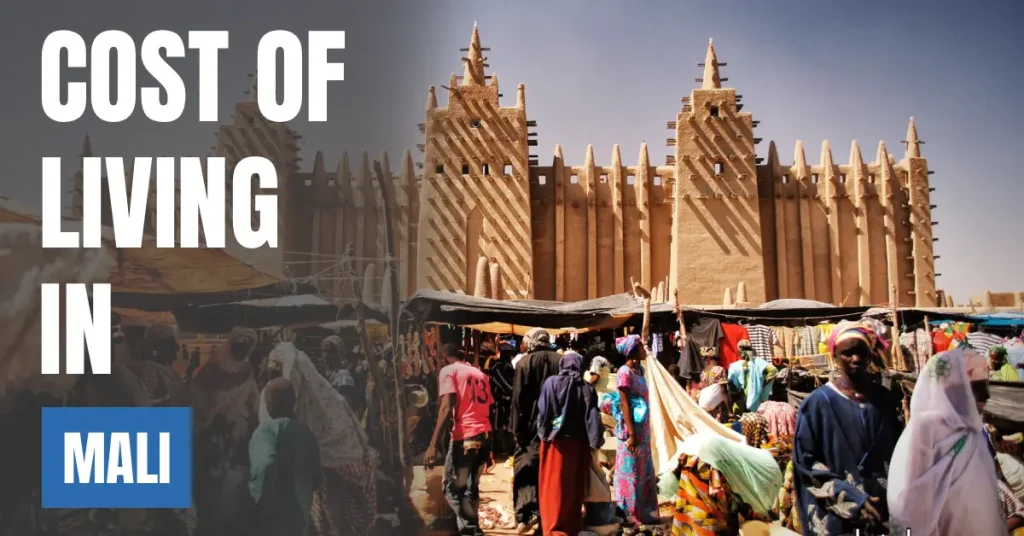
Cost of Living in Mali in 2026: Rent, Food, Salaries and Monthly Expenses
The cost of living in Mali in 2026 depends heavily on where you live, the accommodation you choose and whether you rely on local services or private facilities. Bamako, the capital, generally has higher housing and transport expenses than smaller cities such as Sikasso and Ségou.
On this pageTable of Content
For planning purposes, a single person renting modest accommodation may need approximately XOF 280,000 to XOF 550,000 per month, including rent. A family of four may need around XOF 800,000 to XOF 1,500,000 per month, depending on housing, education, healthcare and transport choices. These are illustrative planning ranges, not official national averages.
Mali uses the West African CFA franc (XOF), which has a fixed exchange rate of XOF 655.957 per euro. The Central Bank of West African States (BCEAO) reported a reference rate of approximately XOF 587 per US dollar on October 30, 2026. Dollar equivalents therefore change with the exchange rate.
Although Mali's prices can appear low when compared internationally, affordability is more complicated for people earning local salaries. Fuel shortages, electricity interruptions, insecure transport corridors and limited access to some services can significantly increase everyday expenses.
Important safety consideration: As of November 2, 2026, the UK Foreign, Commonwealth & Development Office advises against all travel to Mali because of serious security threats. Anyone considering relocating should evaluate security, medical access and emergency arrangements before comparing living costs.
Also Explore: Cost of Living in Marshall IslandsCost of Living in Mali at a Glance
The following table provides approximate 2026 costs in West African CFA francs. Consumer prices are indicative market estimates, while household budgets are planning examples constructed from typical expense categories. Actual prices may differ significantly by neighborhood, season, housing standard and availability.
| Expense | Estimated Cost (XOF) | Period or Basis |
|---|---|---|
| Budget-conscious single person | 280,000 to 350,000 | Monthly, including rent |
| Moderate single person | 400,000 to 550,000 | Monthly, including rent |
| Couple | 550,000 to 850,000 | Monthly, including rent |
| Family of four | 800,000 to 1,500,000 | Monthly, including rent and an allowance for schooling |
| One-bedroom apartment | 90,000 to 250,000 | Monthly rent, modest to central urban accommodation |
| Three-bedroom apartment | 160,000 to 400,000 | Monthly rent, standard urban accommodation |
| Groceries, one person | 80,000 to 150,000 | Monthly |
| Basic household utilities | 20,000 to 60,000 | Monthly, excluding internet |
| Home internet | 12,000 to 30,000 | Monthly |
| Local transport, regular user | 15,000 to 60,000 | Monthly, excluding a private vehicle |
| Simple local restaurant meal | 1,500 to 4,000 | Per person |
| Reported national minimum wage | 40,000 | Monthly statutory rate |
Data note: The housing, food and transport ranges are rounded planning estimates informed by the June 2026 Livingcost Mali dataset, its Bamako estimates, and the limited observations available through Numbeo. They are not verified quotations for currently available homes or services.
How Much Does It Cost to Live in Mali Per Month?
A single renter may budget approximately XOF 280,000 to XOF 550,000 per month including accommodation, utilities, food, transport, communication and ordinary personal spending. A family of four generally requires substantially more, especially if it uses private schools or private healthcare.
For a useful independent benchmark, Livingcost's June 21, 2026 dataset estimates the average monthly cost of living in Mali at approximately US$554 for one person including rent and US$318 excluding rent. Using the October 30 BCEAO reference exchange rate, these are approximately XOF 325,000 and XOF 187,000 respectively.
The same dataset estimates approximately US$1,342 per month for a family of four including rent, equivalent to about XOF 788,000. These figures represent a modeled consumer basket, not a surveyed average household's actual spending.
Livingcost explicitly notes that its basket reflects a moderate lifestyle commonly associated with developed-country consumption patterns. Consequently, families using local housing, home-grown food or informal services may spend less, while expatriates requiring reliable electricity, secure accommodation and imported products may spend much more.
Housing and Rent Prices in Mali
Rent is one of the largest and most variable expenses in Mali, especially in Bamako. A modest one-bedroom apartment may cost around XOF 90,000 to XOF 160,000 per month, while better-located or higher-standard accommodation can cost XOF 200,000 to XOF 350,000 or more.
Typical Apartment Rental Costs
| Accommodation | Indicative Monthly Rent (XOF) |
|---|---|
| Basic one-bedroom outside central Bamako | 90,000 to 150,000 |
| One-bedroom in central Bamako | 140,000 to 250,000 |
| Higher-standard one-bedroom apartment | 250,000 to 350,000+ |
| Three-bedroom apartment outside central areas | 160,000 to 300,000 |
| Three-bedroom in central urban areas | 250,000 to 400,000+ |
| Serviced or security-focused expatriate accommodation | Highly variable; obtain direct quotations |
Livingcost's June 2026 Bamako data reported approximately US$259 for a centrally located one-bedroom apartment and US$158 for a cheaper one-bedroom apartment. These convert to approximately XOF 152,000 and XOF 93,000 using the October 30 exchange-rate reference.
For comparison, Numbeo's September 2025 Bamako observations suggested a central one-bedroom average of US$175. However, its city dataset contained only 42 price entries from five contributors over the preceding 12 months. That small sample is insufficient to establish a definitive market-wide rental average.
The main reasons for differences include building quality, furnished versus unfurnished accommodation, neighborhood, security arrangements, electricity backup and the small number of reported listings.
What to Check Before Renting
- Whether electricity, water and waste collection are included.
- Whether the property has backup electricity or a generator.
- Whether a security guard or additional security service is required.
- Rental deposits, advance payments and agency commissions.
- Availability of drinking water and water storage.
- Internet connectivity and mobile coverage.
- Travel times to work, schools and hospitals.
Higher-standard or security-focused housing may cost substantially more than typical crowd-reported apartments. Renters should obtain current quotations, check the lease terms and verify the property in person where circumstances safely permit.
Groceries and Food Prices in Mali
A single adult may budget approximately XOF 80,000 to XOF 150,000 monthly for groceries, depending on their diet, shopping habits and reliance on imported products. Households buying local grains, vegetables and seasonal produce can often reduce food costs.
The following indicative retail ranges combine rounded June 2026 consumer-price observations with allowances for variation between retailers. They should not be treated as official government price controls.
| Grocery Item | Indicative Price (XOF) |
|---|---|
| Milk, 1 litre | 600 to 1,000 |
| Bread, approximately 500 g | 300 to 500 |
| Rice, 1 kg | 500 to 900 |
| Eggs, 12 | 750 to 1,300 |
| Chicken, 1 kg | 2,000 to 3,500 |
| Beef, 1 kg | 3,000 to 5,000 |
| Tomatoes, 1 kg | 400 to 900 |
| Potatoes, 1 kg | 400 to 900 |
| Oranges, 1 kg | 600 to 1,200 |
| Packaged drinking water, 1 litre | 150 to 350 |
Prices can vary considerably between local markets and supermarkets. Imported dairy products, packaged foods and international brands may be more expensive than locally available alternatives.
Food prices also depend on security and transport conditions. The Food and Agriculture Organization reports that disruption along transport corridors, fuel shortages and conflict have increased transport costs and food prices in affected areas. Therefore, ordinary grocery estimates may not accurately represent conditions in remote or disrupted markets.
Restaurants and Eating Out in Mali
Eating at a simple local restaurant can be relatively inexpensive, with a typical planning allowance of XOF 1,500 to XOF 4,000 for an individual meal. International restaurants and higher-end dining establishments may charge considerably more.
| Food or Drink | Indicative Price (XOF) |
|---|---|
| Simple local meal | 1,500 to 4,000 |
| Mid-range dinner for two | 10,000 to 25,000 |
| Fast-food-style meal | 2,500 to 5,000 |
| Cappuccino | 900 to 1,500 |
| Soft drink | 250 to 700 |
Livingcost's June 2026 Bamako estimate for a typical restaurant lunch was approximately US$3.06, whereas Numbeo's September 2025 data showed a higher average for an inexpensive restaurant meal. Different meal definitions, venue selection and small sample sizes partly explain the variation.
People who regularly eat in international restaurants should allocate a higher monthly dining budget than those who primarily cook at home.
Electricity, Water and Other Utilities
Basic household utilities may cost approximately XOF 20,000 to XOF 60,000 per month for modest accommodation. Actual spending can be higher where air conditioning, pumps or backup electricity are needed.
| Expense | Illustrative Monthly Allowance (XOF) |
|---|---|
| Electricity and cooling | 15,000 to 45,000 |
| Water | 3,000 to 10,000 |
| Waste collection and miscellaneous charges | 2,000 to 5,000 |
| Generator fuel or backup electricity | Additional, depends on usage |
Livingcost's June 2026 estimates placed combined basic utility bills at approximately US$39 per month for one person and US$61 for a family. However, these modeled averages may not reflect the costs of extensive air conditioning or privately provided backup power.
Power reliability is an important practical issue. The International Monetary Fund and World Bank identify energy and fuel pressures as significant challenges for Mali's economy. Households dependent on generators or alternative energy should include those costs separately.
Internet and Mobile Phone Costs
Home internet may cost approximately XOF 12,000 to XOF 30,000 per month, while a basic mobile package may cost around XOF 2,000 to XOF 10,000 depending on the included data and calls.
| Service | Indicative Monthly Cost (XOF) |
|---|---|
| Basic mobile use | 2,000 to 5,000 |
| Higher-data mobile package | 5,000 to 10,000+ |
| Fixed home internet | 12,000 to 30,000 |
| Backup mobile data | Additional, based on consumption |
These are budgeting ranges rather than verified live operator tariffs. Connection quality, network coverage, advertised speeds and installation charges should be checked directly with providers.
Remote workers should also allow for backup data, charging equipment and power interruptions. A low advertised monthly internet price does not necessarily indicate a reliable connection suitable for video meetings or continuous work.
Transportation Costs in Mali
Local transport can be inexpensive, but the true cost depends on availability, distance, fuel supplies and security conditions. A regular local-transport user might budget approximately XOF 15,000 to XOF 60,000 per month, while frequent private taxis or vehicle use can cost substantially more.
| Transport Expense | Indicative Cost (XOF) |
|---|---|
| Basic local journey | 150 to 400 |
| Illustrative monthly local-transport spending | 15,000 to 30,000 |
| Approximately 8 km taxi journey | 2,500 to 5,000 |
| Petrol, 1 litre | Variable; verify current availability and price |
| Private vehicle running costs | Highly dependent on fuel, maintenance and travel |
Livingcost's June 2026 Bamako dataset lists an indicative local transport fare of US$0.28 and an eight-kilometre taxi ride of approximately US$5.79. It also reports a modeled monthly transport-pass price, but this should not be interpreted as proof of a universally available integrated public-transport pass.
Fuel availability is a major limitation in 2026. The UK government's Mali safety guidance reports fuel shortages, long queues and higher prices in affected locations. It also warns of terrorist attacks and blockades on major transport routes.
Consequently, published fares or historical petrol prices may not reflect the actual cost or feasibility of travel. Travelers should not assume that intercity roads are safe simply because a ticket or transport service is advertised.
Healthcare Costs and Medical Insurance in Mali
Healthcare in Mali is not universally free for every resident or foreign national. Costs and eligibility depend on whether a person qualifies for a public assistance scheme, mandatory social insurance or privately funded treatment.
Public Healthcare and Insurance Coverage
Mali has an Assurance Maladie Obligatoire (AMO) system for covered categories of workers and other eligible beneficiaries. The system is contribution-based rather than automatically available to every newcomer.
The Malian government's National Social Insurance Institute information describes an AMO contribution of 6.56% of the relevant salary base, divided into 3.50% from employers and 3.06% from employees. Eligibility and actual benefits depend on the applicable scheme and enrollment status.
Mali also operates the Régime d'Assistance Médicale (RAMED) for qualifying people recognized as indigent and not covered by another insurance system. According to the National Medical Assistance Agency information, eligible beneficiaries can receive covered consultations, outpatient services, hospitalization and maternity care.
RAMED should not be described as free healthcare for all residents or expatriates. Coverage depends on the program's specific eligibility requirements.
Private Healthcare and Medical Expenses
| Healthcare Expense | Indicative Cost (XOF) |
|---|---|
| Basic private consultation | 6,000 to 15,000 |
| Specialist consultation | 12,000 to 30,000+ |
| Private insurance | Individual quotation required |
| Hospital treatment | Depends on provider and procedure |
| Medical evacuation | Specialist insurance or substantial funds may be necessary |
Consultation ranges are approximate planning figures, not standardized national tariffs. Laboratory tests, medications, admissions and specialist procedures can generate separate charges.
Medical capacity is limited in some areas, particularly outside Bamako. Foreign residents should confirm insurance eligibility, access to suitable hospitals, emergency transport and any medical evacuation coverage before relocation.
Education and Childcare Costs in Mali
Public primary education is officially tuition-free in Mali, but access and indirect costs can remain significant. Private and international education is substantially more expensive.
A World Bank poverty assessment notes that public primary schooling is officially free and universal, but the public system's capacity does not meet all demand. This creates reliance on private, community and other schools.
UNESCO's education policy profile also records a legal tuition-free provision for public pre-primary education. Legal provisions do not guarantee the availability of a suitable place in every location.
| Education Expense | Planning Consideration |
|---|---|
| Public primary school | Officially tuition-free; materials and other indirect costs may apply |
| Public pre-primary education | Legally tuition-free under applicable policy; access varies |
| Private school | Obtain school-specific tuition and fee schedules |
| International primary school | Livingcost's modeled average is approximately XOF 2.75 million annually |
| Private childcare | Livingcost's modeled average is approximately XOF 75,000 monthly |
The international-school and childcare figures above are approximate conversions from Livingcost's June 2026 national dataset. They do not represent confirmed fees at any named institution.
Parents should budget separately for registration fees, textbooks, uniforms, transport, meals and extracurricular activities. Security-related school closures and uneven educational access are additional considerations that cannot be captured through tuition figures alone.
Average Salaries and Minimum Wage in Mali
Salaries in Mali are generally low compared with the cost of maintaining a fully rented, independently financed urban household. Employment type, qualifications, employer and location can produce large differences in earnings.
The June 2026 Livingcost dataset estimated a monthly after-tax salary of approximately US$162 nationally and US$167 in Bamako. At the October 30 BCEAO reference rate, those correspond to approximately XOF 95,000 and XOF 98,000.
These are crowdsourced or modeled estimates rather than an official national salary survey. They should not be used to determine statutory pay or make a precise employment offer.
What Is the Minimum Wage in Mali in 2026?
The latest rate identified in WageIndicator's 2026 Mali minimum-wage database is XOF 40,000 per month, with an hourly equivalent of XOF 231. The listed effective date is January 1, 2016, and the database indicated the rate remained applicable in June 2026.
This is the latest publicly documented rate located during this review, not confirmation that every employee receives it or that no subsequent administrative changes are possible.
A monthly minimum wage of XOF 40,000 would cover only a small fraction of the illustrative independent renter budgets presented in this article. This highlights the difference between statutory wages, typical local household arrangements and a newcomer living independently in rented accommodation.
What Salary Is Needed to Live Comfortably in Mali?
For a single person paying market rent, an illustrative net income of XOF 400,000 to XOF 600,000 per month could support a moderate urban budget, depending on accommodation and transport needs. A family seeking private education or higher-standard housing may require well above XOF 1 million per month.
These are affordability targets derived from household expenditure assumptions, not observed salary averages or guaranteed employment opportunities. Employer-provided accommodation, transport, medical coverage and schooling allowances can substantially change the calculation.
Taxes and Social Contributions Affecting Take-Home Pay
Employees should distinguish gross salary from net take-home income when assessing affordability in Mali.
The Malian Directorate General of Taxes explains that salary income is subject to the Impôt sur les Traitements et Salaires (ITS). Its calculation considers taxable earnings and relevant personal or family circumstances.
Social contributions can also reduce take-home pay. The INPS lists a 3.6% employee pension contribution and a 3.06% employee AMO contribution for applicable workers, a combined listed employee share of 6.66% before considering income tax and any other applicable deductions.
Employers are responsible for additional contributions. Tax treatment can differ by employment arrangement and applicable rules. Individuals receiving foreign income or working remotely should seek current professional advice on their tax and residency obligations.
Realistic Sample Monthly Budgets for Mali
The following budgets illustrate possible household spending rather than official statistical averages. Every example includes rent and the named expense categories. They assume ordinary urban consumption without major emergencies, international travel or expensive specialist medical treatment.
Budget-Conscious Single Person
This example assumes a modest apartment, home cooking, mostly local transport and limited discretionary spending.
| Expense | Monthly Cost (XOF) |
|---|---|
| Rent | 100,000 |
| Utilities | 25,000 |
| Groceries | 80,000 |
| Transport | 25,000 |
| Internet and mobile | 15,000 |
| Healthcare allowance | 20,000 |
| Dining, personal and miscellaneous | 20,000 |
| Total Including Rent | 285,000 |
Moderate Single Person
This example assumes more centrally located accommodation, moderate restaurant spending and a larger transport and healthcare allowance.
| Expense | Monthly Cost (XOF) |
|---|---|
| Rent | 200,000 |
| Utilities | 40,000 |
| Groceries | 130,000 |
| Transport | 45,000 |
| Internet and mobile | 20,000 |
| Healthcare allowance | 35,000 |
| Dining and miscellaneous | 60,000 |
| Total Including Rent | 530,000 |
Couple
This example assumes two adults sharing accommodation, with no children and no major private-school or specialist medical expenses.
| Expense | Monthly Cost (XOF) |
|---|---|
| Rent | 250,000 |
| Utilities | 55,000 |
| Groceries | 200,000 |
| Transport | 65,000 |
| Internet and mobile | 30,000 |
| Healthcare allowance | 60,000 |
| Dining and miscellaneous | 90,000 |
| Total Including Rent | 750,000 |
Family of Four
This example assumes two adults and two children, family-sized accommodation and a modest allowance for schooling or childcare. International-school tuition, a dedicated security vehicle and major medical emergencies are not included.
| Expense | Monthly Cost (XOF) |
|---|---|
| Rent | 350,000 |
| Utilities | 75,000 |
| Groceries | 330,000 |
| Transport | 100,000 |
| Internet and mobile | 40,000 |
| Healthcare allowance | 100,000 |
| Education and childcare allowance | 150,000 |
| Clothing, dining and miscellaneous | 140,000 |
| Total Including Rent | 1,285,000 |
For all four examples, healthcare amounts are monthly budget reserves, not insurance quotations or guarantees of medical coverage. Families choosing higher-priced international education, extensive private healthcare, furnished expatriate housing or professional security arrangements may need significantly larger budgets.
Cost of Living Differences Between Cities in Mali
Bamako is generally more expensive than the smaller cities represented in available consumer-cost datasets. However, regional comparisons are affected by limited samples and do not account adequately for security, availability of services or transport disruptions.
Livingcost's June 2026 estimates provide the following comparison for one person, including rent:
| City | Modeled Monthly Cost (USD) | Approximate XOF Equivalent |
|---|---|---|
| Bamako | 561 | 329,000 |
| Sikasso | 501 | 294,000 |
| Ségou | 495 | 291,000 |
| Bougouni | 494 | 290,000 |
| Koulikoro | 493 | 289,000 |
The XOF amounts are rounded conversions using the October 30, 2026 BCEAO reference rate. These city values are modeled comparisons, not verified average spending by residents.
Bamako
Bamako provides the broadest concentration of urban accommodation, private services, schools and healthcare facilities. Housing quality, neighborhood and commuting requirements strongly influence costs.
Sikasso
Sikasso's modeled living costs are lower than Bamako's, particularly for transport. However, fewer higher-standard housing and service options may be available for households with specialized requirements.
Ségou and Other Regional Cities
Ségou and other smaller cities show lower modeled consumption costs. Nevertheless, security conditions, medical accessibility, electricity reliability and supply chains can matter more than the apparent monthly price difference.
There is insufficient reliable, comparable current evidence to provide defensible rental averages for every Malian city or for conflict-affected locations such as Timbuktu, Gao and Kidal.
How Does Mali Compare With Nearby Countries?
On Livingcost's June 2026 consumer-basket estimates, Bamako is less expensive than several regional capitals, including Dakar, Accra and Ouagadougou. This comparison applies to modeled living expenses, not necessarily to local purchasing power or the cost of maintaining equivalent secure accommodation.
| City | Country | Estimated Monthly Cost for One Person Including Rent (USD) |
|---|---|---|
| Bamako | Mali | 561 |
| Dakar | Senegal | 1,281 |
| Accra | Ghana | 927 |
| Ouagadougou | Burkina Faso | 988 |
| Niamey | Niger | 1,162 |
Source: Livingcost's Bamako comparisons, updated June 21, 2026.
The original article's broad assertion that Mali is cheaper than Ghana, Senegal and Nigeria in every major expense category is too sweeping. Countrywide averages, regional cities, housing types and exchange-rate differences can change individual comparisons.
Lower modeled expenditure does not necessarily mean that Mali is more affordable for someone earning locally, or that comparable housing and services are readily available.
Hidden Costs New Residents Often Overlook
The advertised rent and grocery budget may represent only part of a newcomer's total expenses in Mali.
- Backup electricity: Generator equipment, fuel, maintenance and alternative power supplies.
- Water storage: Tanks, pumps, water deliveries or filtration.
- Housing setup: Deposits, agency fees, furniture and household equipment.
- Security: Building security, approved transportation and potentially professional security support.
- Healthcare: Insurance exclusions, hospital deposits, medication and possible medical evacuation.
- Imported products: Higher prices and limited availability for specialized foods and supplies.
- Travel disruptions: Unexpected accommodation, fuel and transportation costs.
- Schooling: Registration charges, uniforms, textbooks, transport and extracurricular fees.
- Administrative costs: Visa or residence-document fees, translations, certificates and renewals.
Not every household will incur all these expenses. However, budgeting without considering them may significantly understate the financial resources necessary for a longer stay.
Cost of Living Versus Residency Financial Requirements
The amount needed to support daily living in Mali is not the same as the amount or documentation required to qualify for lawful residence.
According to Mali's official residence-permit portal, foreign adults staying longer than three months generally require residence authorization, subject to the applicable legal provisions and exceptions.
The official portal explains that a residence visa can have a validity of up to one year and may be renewed. It lists supporting documentation that can include an application, passport, criminal-record extract, medical certificate and residence certificate.
The legal information also states that a foreign national applying under the relevant residence-visa provisions must demonstrate the ability to live from their own resources. A salaried worker may require an employment contract approved through the appropriate labor authority.
No universal fixed minimum monthly income threshold was confirmed from the official residence portal. Applicants should not interpret the illustrative household budgets in this article as government-approved proof-of-funds requirements.
Visa fees, documentation requirements, nationality-specific rules and eligibility should be confirmed directly with the competent Malian authority before making financial commitments.
Is Mali Affordable for Expats and New Residents?
Mali can have comparatively low market prices for basic food, simple accommodation and some local services. However, it is not necessarily a low-cost or practical relocation destination for everyone.
Three factors deserve particular attention:
- Local earnings versus expenses: The estimated salary figures are considerably lower than the budget required for an independently rented moderate urban lifestyle.
- Infrastructure and service reliability: Backup electricity, secure housing and private healthcare may add substantial costs.
- Security: Current international travel warnings, attacks and fuel-related transport disruptions introduce risks that cannot be adequately represented by a monthly cost table.
The World Bank's October 2026 Macro Poverty Outlook for Mali projects economic growth of approximately 5.0% in 2026 but continues to identify poverty, insecurity, climate shocks and inflationary pressure as serious challenges.
For internationally recruited employees, the financial value of employer-provided housing, medical insurance, transportation and emergency assistance may exceed the apparent difference between salary offers.
Anyone considering a move should first evaluate current official security advice and the feasibility of safe residence. An attractive cost estimate alone is not sufficient grounds for relocation.
Conclusion: How Much Money Do You Need in Mali?
For an illustrative 2026 monthly budget including rent, a single person might plan for XOF 280,000 to XOF 550,000, a couple for approximately XOF 550,000 to XOF 850,000, and a family of four for approximately XOF 800,000 to XOF 1,500,000 or more.
Housing is a major expense, followed by food, utilities, transportation and healthcare. Families using private international schools or higher-security accommodation may face substantially higher costs.
These planning ranges should not be mistaken for official average household expenditures, guaranteed market quotations or residence-permit income thresholds. Local wages can be far lower, while supply disruptions and security-related expenses can make even apparently inexpensive arrangements difficult to maintain.
Before considering residence in Mali, verify housing costs, medical arrangements, income after tax, immigration requirements and current government travel advice.
Sources and Methodology
Last reviewed: November 2, 2026.
This guide combines available market-price estimates with official government information and international institutional research. The existing Visaboards article, published March 24, 2026, was reviewed against newer information where available.
Livingcost's June 2026 consumer data provides comparative estimates for Mali and selected cities. Numbeo was used as a secondary cross-check, with particular caution because its Bamako observations have a small contributor base.
The monthly household budgets are editorial planning calculations assembled from indicated cost categories. They are not survey-derived averages. Individual grocery and rent figures have been rounded to avoid implying greater precision than the underlying evidence supports.
Official and institutional sources were prioritized for minimum wages, social insurance, taxes, education policy, currency, economic developments, immigration conditions and security warnings.
Consumer prices, rents and transport availability can change rapidly. Regional data is incomplete, current listings are not consistently available, and market databases can disagree because of limited samples and different consumption assumptions.
Sources Used
- Visaboards: Existing Cost of Living in Mali Guide
- Livingcost: Cost of Living in Mali, June 2026
- Livingcost: Bamako Consumer Costs, June 2026
- Numbeo: Bamako Cost of Living Observations
- BCEAO: Official Currency Reference Rates
- WageIndicator: Mali Minimum Wage, 2026
- Mali INPS: Social Insurance Contributions
- Mali ANAM: Medical Assistance and RAMED
- Mali Directorate General of Taxes: Salary Income Tax
- World Bank: Mali Poverty Assessment
- UNESCO: Mali Education Financing Profile
- World Bank: Mali Macro Poverty Outlook, October 2026
- FAO: Mali Food Security and Market Conditions
- Mali Police: Official Residence-Permit Portal
- UK Government: Mali Travel Warnings
- UK Government: Mali Safety and Transport Information
Frequently Asked Questions
How much does it cost to live in Mali per month?
A single person renting modest accommodation may budget approximately XOF 280,000 to XOF 550,000 per month in Mali, including rent, food, utilities, transportation and ordinary personal expenses. A more economical household arrangement may cost less. These are planning estimates rather than official averages. Spending varies significantly between Bamako and smaller cities, especially when private healthcare, reliable electricity or higher-standard housing is required.
What is the average rent in Mali in 2026?
A modest one-bedroom apartment may cost approximately XOF 90,000 to XOF 250,000 per month, depending on location and standard. Three-bedroom apartments may cost around XOF 160,000 to XOF 400,000 or more. These are indicative urban ranges, not verified current listing averages. Furnished accommodation, backup electricity, building security and desirable Bamako neighborhoods can increase rental costs considerably.
What salary do you need to live comfortably in Mali?
A single person renting independently might target approximately XOF 400,000 to XOF 600,000 in monthly take-home income for a moderate urban lifestyle. A family requiring private schooling or higher-standard accommodation may need more than XOF 1 million. These figures describe illustrative spending capacity, not typical salaries. Employer-paid housing, healthcare and transportation can significantly reduce the income required.
What is the minimum wage in Mali in 2026?
WageIndicator's 2026 database lists Mali's national minimum wage at XOF 40,000 per month, equivalent to XOF 231 per hour, with an effective date of January 1, 2016. That was the latest rate identified in the database during this review. It is substantially below the estimated budget for someone independently renting an urban apartment, highlighting the difference between minimum pay and the cost of a newcomer-style household.
Is healthcare free in Mali?
Healthcare is not automatically free for everyone in Mali. Eligible workers and beneficiaries may receive coverage through the contribution-based Assurance Maladie Obligatoire (AMO) system. RAMED provides designated medical assistance to qualifying people recognized as indigent. Other residents, including foreign nationals without applicable coverage, may need to pay directly or purchase private insurance. Hospital access, specialist care and medical evacuation should be considered separately.
How much do groceries cost in Mali?
A single person might allocate approximately XOF 80,000 to XOF 150,000 monthly for groceries. Locally available rice, bread, vegetables and seasonal produce can help control spending, while imported food may cost more. Actual prices vary by city and market. Fuel shortages, transport disruption, seasonal production and insecurity can cause significant price increases in affected areas, so household budgets should allow some flexibility.
Is public transportation cheap in Mali?
Basic local journeys can cost only a few hundred CFA francs, but this does not guarantee inexpensive or reliable daily transport. A regular local-transport user might budget XOF 15,000 to XOF 60,000 monthly, depending on frequency and taxi use. Fuel shortages and security-related road disruptions have affected transport services in 2026. Published fares may therefore differ from real availability and costs.
How much does a family of four need to live in Mali?
A family of four may plan for approximately XOF 800,000 to XOF 1,500,000 per month including rent, groceries, utilities, transport and a schooling allowance. The illustrative family budget in this guide totals XOF 1,285,000. International-school tuition, extensive private healthcare, security services or premium housing can push expenses well above this range. Household needs and employer-provided benefits are major factors.
Is Bamako more expensive than other cities in Mali?
Yes, available modeled consumer-cost estimates generally place Bamako above cities such as Sikasso and Ségou. Livingcost's June 2026 data estimates approximately US$561 monthly for one person including rent in Bamako, compared with US$501 in Sikasso and US$495 in Ségou. These estimates have data limitations and do not reflect all differences in security, medical facilities, transport reliability or housing availability.
Is Mali cheaper than Senegal and Ghana?
In Livingcost's June 2026 city comparisons, Bamako has lower modeled monthly consumer costs than Dakar in Senegal and Accra in Ghana. However, this does not establish that every product, service or property is cheaper across the respective countries. Different exchange rates, local wages, housing standards and consumption assumptions affect comparisons. Security, fuel availability and access to services are also important considerations.
Do foreigners need proof of income to live in Mali?
Mali's official residence-visa information states that applicants under the relevant provisions must demonstrate sufficient resources to support themselves. However, no universal fixed monthly income threshold was confirmed from the official residence portal during this review. Immigration rules depend on the applicant's circumstances and legal category. A personal cost-of-living estimate should not be confused with an official proof-of-funds requirement.
Is Mali an affordable place for expats in 2026?
Mali has relatively low modeled prices for some basic living expenses, but affordability depends on income, housing needs and access to essential services. Reliable power, private medical care, imported products and secure transportation can add substantial costs. More importantly, international authorities advise against travel because of serious security threats. Prospective expatriates should assess safety and essential services before making relocation decisions.
Join the conversation
Have thoughts on this topic? Share them with others.
Ask questions, share experience, and learn from the Visaboards Community.