
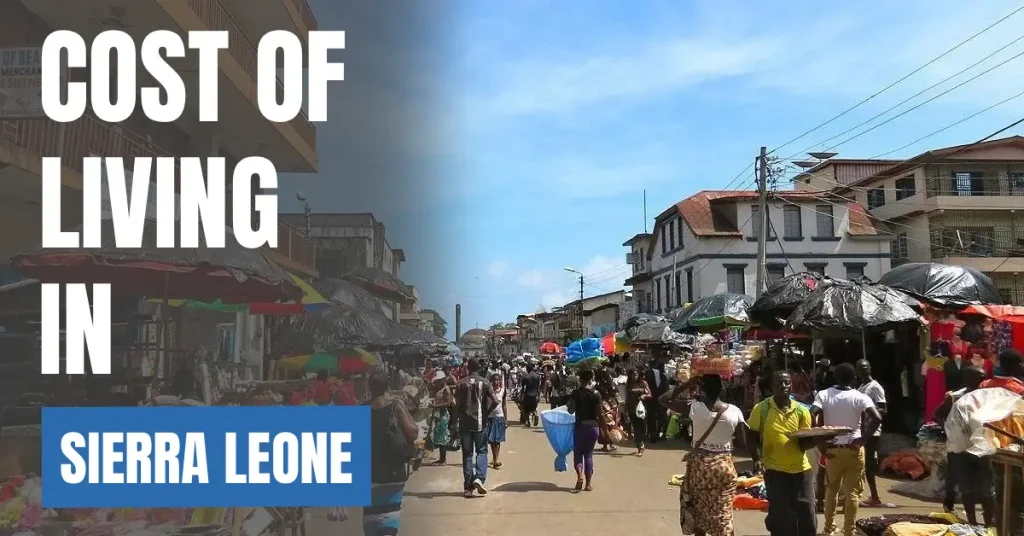
Cost of Living in Sierra Leone 2026: Rent, Food, Salaries and Monthly Expenses
The cost of living in Sierra Leone in 2026 varies considerably depending on where you live, your housing requirements, household size and lifestyle. Although local food, shared transportation and basic accommodation can be relatively affordable, modern housing in Freetown, imported groceries, reliable electricity and private healthcare can significantly increase monthly expenses.
On this pageTable of Content
For practical planning, a budget-conscious single person renting modest accommodation may need approximately SLE 4,000 to SLE 7,000 per month, while someone seeking a more comfortable lifestyle could require SLE 8,000 to SLE 15,000 or more. Families of four may need SLE 15,000 to SLE 30,000 or more, particularly when private schooling, higher-standard housing and medical insurance are necessary. These are illustrative planning ranges, including rent, rather than official national expenditure averages.
Sierra Leone's affordability also depends on earnings. The national minimum monthly wage increased to SLE 1,200 effective 1 April 2026, according to WageIndicator. Meanwhile, the World Bank reports that inflation accelerated from 6.4% in January 2026 to 15.7% in August 2026, increasing pressure on household purchasing power.
This guide examines the major living expenses in Sierra Leone, including rent, groceries, restaurants, utilities, internet, transport, healthcare, education and salaries. It also explains regional differences, hidden relocation costs and realistic monthly budgets for individuals, couples and families.
Also Explore: Cost of Living in SeychellesCost of Living in Sierra Leone at a Glance
Sierra Leone uses the Sierra Leonean leone (SLE), commonly written as Le. The Bank of Sierra Leone introduced the redenominated currency in July 2022, replacing 1,000 old leones with one new leone. All amounts in this guide refer to the new leone, not the former SLL currency unit.
| Expense Category | Estimated Cost (SLE) | Frequency |
|---|---|---|
| Budget-conscious single person, including rent | 4,000–7,000 | Monthly |
| Moderate single person, including rent | 8,000–15,000+ | Monthly |
| Couple, including rent | 10,000–20,000+ | Monthly |
| Family of four, including rent | 15,000–30,000+ | Monthly |
| Basic one-bedroom accommodation | 1,500–3,000 | Monthly rent |
| Better-equipped one-bedroom accommodation | 3,000–10,000+ | Monthly rent |
| Higher-end Freetown apartment | 14,000–28,000+ | Monthly rent |
| Groceries for one adult | 1,200–3,000 | Monthly |
| Basic electricity and water allowance | 400–1,500+ | Monthly |
| Internet and mobile services | 300–1,500+ | Monthly |
| Local transportation | 200–1,000+ | Monthly |
| National minimum wage | 1,200 | Monthly |
Important: These are indicative budgeting ranges, not guaranteed market quotations. Basic accommodation and food estimates draw partly from the existing Visaboards cost guide, while higher-end rental indications reflect other market datasets. Differences between sources are substantial, and the market has limited representative price information.
The original Visaboards article also provides approximate US-dollar equivalents using an implied conversion of SLE 10 per dollar. This should not be treated as a current exchange rate. Readers should obtain live exchange rates from the Bank of Sierra Leone or their financial provider when converting prices.
How Much Does It Cost to Live in Sierra Leone Per Month?
A budget-conscious single renter may plan for approximately SLE 4,000 to SLE 7,000 per month including rent. A person seeking better accommodation, reliable connectivity and more frequent dining out may need SLE 8,000 to SLE 15,000 or more.
Excluding rent, a single adult following a modest local lifestyle might budget SLE 2,000 to SLE 4,000 for groceries, utilities, communications, transportation and basic personal spending. A more internationally oriented lifestyle can cost considerably more, especially when imported products and private transport are involved.
Families face additional costs for larger homes, food, school supplies, childcare and healthcare. A four-person household may require SLE 15,000 to SLE 30,000 or more per month including rent, although international-standard accommodation or private schooling can push spending well above this range.
The World Bank's latest country assessment indicates that inflation reached 15.7% in August 2026, following much lower inflation at the end of 2025. Consequently, the cost of maintaining the same lifestyle can change over a relatively short period. A household should maintain room in its budget for price increases rather than assuming historical estimates will remain accurate.
Housing and Rent Prices in Sierra Leone
Rent is often the largest expense for people moving to Sierra Leone, particularly in Freetown. Basic locally marketed accommodation may be available at lower prices, but modern apartments with backup electricity, dependable water, security and furnished interiors can cost several times more.
Average Apartment Rent in Sierra Leone
| Accommodation Type | Indicative Monthly Rent (SLE) |
|---|---|
| Basic one-bedroom outside central areas | 1,500–3,000 |
| Standard one-bedroom in urban areas | 3,000–6,000 |
| Basic three-bedroom outside central areas | 3,000–6,000 |
| Three-bedroom in better urban locations | 6,000–10,000+ |
| Higher-end furnished one-bedroom in Freetown | 14,000–28,000+ |
The lower accommodation ranges reflect those in the original March 2026 Visaboards article, while the higher rental band illustrates the considerably more expensive market represented in some crowdsourced property databases. These categories should not be mistaken for a verified nationwide distribution of rents.
For example, Numbeo's property data updated in October 2026 reported an average central one-bedroom apartment rent of approximately US$928 and an outside-centre average of approximately US$745. However, the underlying country-level dataset contained only 14 price entries from four contributors.
The small sample means its figures are not reliable measures of what a typical Sierra Leonean household pays. They may disproportionately reflect internationally oriented accommodation. Other consumer-price platforms also produce inconsistent rental estimates, reinforcing the importance of direct local quotations.
What Makes Housing Expensive in Freetown?
- Location: Properties near central commercial areas, diplomatic offices and established residential neighbourhoods may command higher rents.
- Electricity: Backup generators, batteries and solar systems increase property operating costs.
- Water availability: Storage tanks, pumps and dependable water access can influence rent.
- Furnishing: Fully furnished apartments aimed at foreign residents may be substantially more expensive.
- Security: Guard services, gates and managed compounds can increase monthly housing expenses.
- Rental terms: Advance rent and deposits can create large initial cash requirements.
Prospective tenants should physically inspect accommodation, confirm total upfront payments and test the reliability of electricity and water supplies. They should also establish whether the landlord or tenant pays for generator fuel, repairs, security and internet.
Buying Property in Sierra Leone
The original Visaboards guide estimates apartment purchase prices between approximately SLE 4,000 and SLE 15,000 per square metre, depending on location. These broad estimates are not sufficient for valuing a particular property.
Property rights, land ownership documentation and eligibility to acquire land require careful legal verification. Foreign nationals should obtain advice from an appropriately qualified Sierra Leonean lawyer before purchasing, leasing long-term or investing in real estate.
Food and Grocery Costs in Sierra Leone
Groceries for one adult may cost approximately SLE 1,200 to SLE 3,000 per month when most meals are prepared at home. Spending depends on household size, consumption of imported products and access to local markets.
Rice, vegetables, locally available fruit and fish form important parts of everyday diets. Imported dairy products, meat, packaged foods and international brands may cost significantly more than locally sourced alternatives.
Estimated Grocery Prices
| Grocery Item | Indicative Price (SLE) |
|---|---|
| Milk, 1 litre | 15–25 |
| Bread, 1 loaf | 8–12 |
| Rice, 1 kg | 8–20 |
| Eggs, 12 | 15–30 |
| Chicken, 1 kg | 30–50+ |
| Beef, 1 kg | 40–70+ |
| Apples, 1 kg | 30–50+ |
| Bananas, 1 kg | 10–15+ |
| Bottled water, 1.5 litres | 7–12+ |
| Soft drink, 330 ml | 7–12+ |
These are indicative figures from the original Visaboards guide rather than independently verified November 2026 shop prices. Actual prices may be higher, particularly for imported products and in neighbourhoods serving higher-income customers.
For context, the Wise Freetown consumer-price dataset reports chicken fillets at approximately US$5 to US$10 per kilogram and rice at around US$0.89 to US$2 per kilogram. This illustrates the considerable variation in pricing between different product types and sources. Comparisons should use current exchange rates rather than the outdated conversion implied by the original guide.
How to Reduce Monthly Grocery Expenses
- Buy fresh produce and locally available foods from established markets.
- Compare rice, cooking oil and staple-food prices across different sellers.
- Choose seasonal fruit and vegetables when possible.
- Limit imported brands that have suitable local alternatives.
- Plan purchases to avoid unnecessary transport costs and food waste.
Food inflation is an important consideration. The World Bank links the rise in 2026 inflation partly to increases in global energy, food, fertiliser and shipping costs. Imported goods and items dependent on long supply chains may therefore be particularly vulnerable to price changes.
Restaurant and Eating Out Costs
Restaurant prices in Sierra Leone range from relatively inexpensive local meals to substantially higher prices at international restaurants, hotels and beachfront establishments. An inexpensive meal may cost around SLE 30 to SLE 60, based on the original Visaboards estimate, although actual prices vary.
| Restaurant Expense | Indicative Cost (SLE) |
|---|---|
| Inexpensive restaurant meal | 30–60+ |
| Mid-range meal for two | 200–400+ |
| Fast-food-style meal | 40–60+ |
| Coffee | 15–30+ |
| Tea | 5–10+ |
These amounts are historical guide estimates and should not be used as confirmed restaurant prices. Higher-standard restaurants serving foreign residents and visitors can charge considerably more.
Local dishes such as cassava leaves, groundnut stew, rice dishes and grilled fish can provide satisfying alternatives to imported or internationally branded food. However, the cost of any meal depends on ingredients, location and restaurant type.
Cooking regularly at home will generally make monthly food spending easier to control. Someone who eats out most days should include a separate restaurant allowance rather than relying solely on a grocery budget.
Electricity, Water and Utility Costs
Basic electricity and water expenses may require approximately SLE 400 to SLE 1,500 or more per month, depending on property size, consumption and electricity availability. Households using substantial air conditioning or private backup systems may spend considerably more.
The original Visaboards guide estimated electricity at SLE 200 to SLE 600 monthly and water at SLE 100 to SLE 200. However, these figures do not necessarily account for private generator use, fuel, repairs or additional water storage.
Actual utility costs are strongly influenced by the reliability of local infrastructure. Some households need backup power or alternative water arrangements, which can make their effective living expenses much higher than the standard monthly bill suggests.
Additional Utility Expenses
- Generator fuel and routine servicing.
- Solar panels, batteries or other backup electricity systems.
- Water tanks, pumping and private water deliveries.
- Air conditioning and refrigeration electricity use.
- Maintenance or replacement of electrical equipment.
Before renting an apartment, ask how often electricity is interrupted, what backup systems exist and which expenses are included in the rent. A cheaper apartment without dependable services may ultimately be more expensive than a better-equipped home.
Internet and Mobile Phone Costs
Internet and mobile services are important expenses, especially for remote workers. Basic mobile connectivity may cost considerably less than fixed broadband, while higher-speed internet packages can require a significant monthly allowance.
| Service | Indicative Monthly Cost (SLE) |
|---|---|
| Basic mobile usage | 50–150 |
| Mobile data package | 150–400+ |
| Fixed broadband service | 400–1,300+ |
| Additional backup connectivity | Varies by provider and usage |
The original guide suggested SLE 400 to SLE 800 for unlimited internet and SLE 50 to SLE 100 for mobile service. More recent comparative datasets show that higher-speed unlimited broadband can cost more. These are approximate budgeting allowances, not verified tariff quotations from individual providers.
Internet speeds and reliability may vary with location, weather, network congestion and electricity availability. People working online should confirm the actual service available at their address and test it before entering a long-term rental agreement.
Transportation Costs in Sierra Leone
Local transportation in Sierra Leone is generally affordable compared with private vehicle ownership, but fares are not fixed at the older levels shown in many online guides. Commercial buses, shared taxis, motorcycle taxis and three-wheeled vehicles are widely used.
In January 2026, the government announced revised transportation fares following increases in fuel prices. Reports of the updated fare schedule included higher charges for Waka Fine buses, commercial motorcycles and intercity journeys.
Updated Transportation Prices
| Transportation Service | Reported Fare (SLE) |
|---|---|
| Waka Fine bus | 12 per journey |
| Standardised short motorcycle or tricycle journey | 5 |
| Wilberforce to Jui route | 11 |
| Freetown to Bo | 130 |
| Freetown to Makeni | 120 |
| Freetown to Kono | 190 |
| Freetown to Kailahun | 250 |
These fares were reported as effective from 29 January 2026 and should be confirmed before travelling because fuel prices and official transport schedules can change. The figures are route-specific and should not be applied to every journey.
For example, a commuter making two SLE 12 bus journeys per working day over 22 working days would spend SLE 528 monthly on those journeys alone. This calculation excludes connecting transport and additional trips.
Consequently, the original guide's monthly transport estimate of SLE 150 to SLE 400 may be insufficient for some regular commuters.
Is Public Transport Free in Sierra Leone?
No, regular public transportation is not universally free in Sierra Leone. Passengers generally pay according to the vehicle type and route.
There is also no reason to assume that a universally available monthly public transport pass exists merely because older online price databases list one. Residents should check current payment methods, route coverage and fare structures with the relevant operators.
For private vehicle users, expenses include fuel, maintenance, insurance, parking and repairs. Road conditions, congestion and seasonal rainfall can increase travel time and operating costs.
Healthcare Costs and Medical Insurance
Healthcare in Sierra Leone is not universally free for every resident or visitor. However, specific groups qualify for services under the country's Free Health Care Initiative.
The Sierra Leone National Medical Supplies Agency identifies pregnant women, lactating mothers, children under five, persons living with disabilities and certain survivor groups among beneficiaries of free healthcare-related medical supply distribution.
Government and international health sources also describe free maternal and child healthcare and malaria-related services. Eligibility, actual availability and service coverage should be checked with the relevant health facility rather than assuming every medical expense is covered.
Public and Private Healthcare
Public facilities provide important healthcare services, but availability of specialist treatment, equipment and essential medicines differs by location. Private hospitals and clinics may provide alternatives, especially in Freetown, but patients can face significant out-of-pocket expenses.
The UK Foreign, Commonwealth and Development Office warns that medical facilities and services in Sierra Leone are severely limited. It also notes that many facilities, especially outside Freetown, accept only cash and that serious medical situations may require evacuation.
Estimated Healthcare Expenses
| Expense | Indicative Cost (SLE) |
|---|---|
| Routine general consultation | 50–100+ |
| Specialist consultation | 100–250+ |
| Medicines and diagnostic tests | Varies by treatment |
| Private health insurance | Individual quotation required |
| Medical evacuation coverage | Depends on policy and benefits |
The consultation figures reflect the original Visaboards guide and are not verified nationwide healthcare tariffs. Its older estimates for individual and family insurance should not be interpreted as quotations for comprehensive international medical coverage.
Healthcare Planning for Expats
- Check access to necessary medicines and specialist care before relocating.
- Consider insurance covering emergency treatment and medical evacuation.
- Maintain accessible emergency funds for treatment requiring immediate payment.
- Understand vaccination and malaria-prevention requirements.
- Identify suitable healthcare providers near the intended residence.
Healthcare affordability should be judged by the cost and availability of necessary treatment, not only the price of an ordinary doctor consultation.
Education and Childcare Costs
Sierra Leone has a Free Quality School Education programme covering government and government-assisted schools. This can reduce formal schooling expenses considerably, although parents may still need to budget for transport, meals, uniforms and additional learning materials.
The Ministry of Basic and Senior Secondary Education explains that the programme provides free admission, covers eligible public examination fees and supports selected textbooks and learning materials. The 2023 Basic and Senior Secondary Education Act also establishes the relevant education framework.
Public Education
Under the Free Quality School Education programme, eligible pupils in participating government and government-assisted schools can access education without ordinary school admission and tuition fees.
However, families should verify actual enrolment rules and the availability of places. Foreign households should not assume that every child automatically receives the same benefits without confirming eligibility.
Private and International Schools
Private schools charge tuition and may also require registration fees, uniforms, transport and other payments. International schools may be considerably more expensive and have different curricula and admission requirements.
The original Visaboards article estimated private schooling at SLE 200 to SLE 1,000 per month and international school fees at US$2,000 to US$6,000 annually. These figures should be treated as historical planning estimates, not verified 2026 fee schedules.
Parents should obtain current written quotations directly from schools and confirm whether amounts are payable monthly, per term or annually.
Childcare
Childcare costs depend on location, working hours, the age of the child and whether services are provided privately or through an educational institution. Reliable nationwide childcare pricing information is limited, so families should request local quotations rather than relying on a single average.
Average Salaries and Minimum Wage in Sierra Leone
Sierra Leone's national minimum wage is SLE 1,200 per month, effective 1 April 2026, according to WageIndicator's June 2026 schedule. This is an important update because older articles may still show previous minimum-wage figures.
| Wage Indicator | Amount |
|---|---|
| National minimum monthly wage | SLE 1,200 |
| Effective date | 1 April 2026 |
| Budget-conscious single renter | SLE 4,000–7,000 monthly |
| Moderate single renter | SLE 8,000–15,000+ monthly |
The reported statutory minimum wage is substantially below the cost of independently renting and maintaining even a basic household under the example budgets in this guide.
What Is the Average Salary in Sierra Leone?
A reliable, representative national average net salary could not be established from the available consumer-price databases. Some crowdsourced sources report monthly earnings well above the minimum wage, but they contain very few contributors and may disproportionately reflect professional or internationally employed respondents.
For example, Numbeo's Freetown dataset contains an unusually high reported average net salary relative to the legal minimum wage. With only a handful of observations, this should not be presented as the typical earnings of Sierra Leonean workers.
Actual salaries vary widely by occupation, education, location, sector and employer. Employment opportunities in government, education, healthcare, agriculture, mining, commerce and international organisations may have very different compensation structures.
What Salary Is Needed to Live Comfortably?
Someone renting independently in Freetown may target approximately SLE 8,000 to SLE 15,000 in monthly take-home income for a moderate lifestyle, provided accommodation is available within the assumed rent range.
People requiring higher-end property, private schooling, comprehensive insurance or substantial private transport may need far more. A comfortable income target is not the same as an average local salary or a legal minimum-wage requirement.
Taxes and Everyday Affordability
Sierra Leone applies a standard Goods and Services Tax (GST) of 15% to many taxable goods and services. According to the National Revenue Authority, some supplies are exempt or zero-rated, so the standard rate does not necessarily apply to every transaction.
GST can influence the price of goods, services and imports. Consumers may also indirectly bear costs associated with customs duties, transport, distribution and business operating expenses.
Employees and self-employed people should consider applicable income tax and statutory contributions when calculating their disposable income. Household budgets should be based on expected take-home earnings rather than gross salary alone.
Foreign residents should obtain current professional advice on tax residency and income from abroad. The treatment of employment, business and foreign-source earnings depends on individual circumstances and applicable law.
Realistic Monthly Budget Examples for Sierra Leone
The following monthly budgets illustrate how expenses may combine for different households. They are constructed planning scenarios rather than official household expenditure data. Each total includes rent, groceries, utilities, communication, transport and everyday personal spending.
| Monthly Expense (SLE) | Budget Single | Moderate Single | Couple | Family of Four |
|---|---|---|---|---|
| Rent | 1,800 | 4,000 | 5,000 | 8,000 |
| Groceries | 1,200 | 2,000 | 3,200 | 5,000 |
| Electricity and water | 400 | 900 | 1,200 | 2,000 |
| Internet and mobile | 300 | 700 | 900 | 1,300 |
| Transport | 400 | 800 | 1,200 | 2,000 |
| Routine healthcare allowance | 200 | 400 | 600 | 1,000 |
| Dining and leisure | 300 | 900 | 1,200 | 2,000 |
| Other expenses | 400 | 800 | 1,100 | 2,000 |
| Estimated Monthly Total | 5,000 | 10,500 | 14,400 | 23,300 |
Budget Single Person: SLE 5,000 Monthly
This example assumes basic accommodation outside higher-priced residential areas, mostly home-cooked food, shared transport and limited entertainment. It requires securing accommodation at the lower end of the market and does not represent a standard expatriate lifestyle.
Moderate Single Person: SLE 10,500 Monthly
This example assumes more comfortable rented accommodation, a wider grocery selection, improved internet access and occasional restaurant visits. It excludes premium furnished housing and major international insurance expenses.
Couple: SLE 14,400 Monthly
Two adults share housing and utility expenses while spending more on food, communication, transportation and leisure. The example assumes no dependent children and no significant medical or international travel requirements.
Family of Four: SLE 23,300 Monthly
This assumes two adults and two children renting a reasonably sized property, preparing many meals at home and using ordinary local services. It does not include substantial private-school tuition, full-time childcare, major medical treatment or comprehensive international health insurance.
Budget limitations: Healthcare amounts are allowances for routine expenses, not verified insurance premiums. Rental deposits, generator purchases, vehicle purchases, school admission charges, international travel and major emergencies are excluded. Households requiring premium Freetown accommodation may spend well beyond these totals.
Cost of Living Differences by City and Region
Living costs differ across Sierra Leone because accommodation availability, transport, infrastructure, commercial activity and access to imported goods vary between locations. Representative price datasets outside Freetown remain limited.
Freetown
Freetown is the capital and the main centre for government offices, international organisations, business services and higher-end residential accommodation. Imported goods and modern housing can be especially expensive, while congestion adds to commuting costs.
Neighbourhood choice can have a major effect on spending. Housing near major commercial areas and established expatriate residential districts may cost considerably more than basic accommodation in less central locations.
Bo
Bo is an important regional city with educational, trading and commercial activity. Some local accommodation options may be less expensive than premium housing in Freetown, but reliable citywide rent comparisons are unavailable.
Households should compare rental availability, access to schools, healthcare and the cost of travelling to Freetown before relocating.
Kenema
Kenema serves as an important economic centre in eastern Sierra Leone. Residents may find locally oriented markets and residential options, but prices depend on the neighbourhood and availability of essential services.
Travel to specialised medical services and other major facilities may add to overall household expenses.
Makeni
Makeni is another significant urban centre where accommodation and everyday spending patterns can differ from Freetown. Local prices may be attractive for some households, but lower rent should be considered alongside employment opportunities, transport costs and infrastructure.
Rural Areas
Rural communities may offer lower housing costs and access to locally produced food. However, employment opportunities, healthcare availability, transport connections, electricity and internet services may be more limited.
There is insufficient comprehensive evidence to rank Sierra Leone's cities or districts from cheapest to most expensive. Direct local comparisons are more reliable than broad nationwide assumptions.
How Does Sierra Leone Compare With Ghana, Liberia and Nigeria?
Sierra Leone can be less expensive than some larger West African urban markets for certain everyday expenses, but a reliable comparison requires equivalent accommodation, locations, transport needs and household expectations.
Sierra Leone vs Ghana
Ghana has larger commercial centres and a broader range of formal retail, housing and services in cities such as Accra. Some internationally oriented accommodation in Accra can be expensive, but this does not prove that Sierra Leone is cheaper across every category.
The original Visaboards article describes Ghana as more expensive for housing but sometimes cheaper for food. This remains a general comparison rather than a verified nationwide 2026 price ranking.
Sierra Leone vs Liberia
Sierra Leone and Liberia share some regional economic characteristics, including transport and infrastructure challenges. Housing, imported products and healthcare costs can vary substantially by city and lifestyle.
Direct comparisons between Freetown and Monrovia are more meaningful than assuming either country is universally cheaper.
Sierra Leone vs Nigeria
Nigeria has a much larger and more diverse economy, with major cost differences between Lagos, Abuja and smaller cities. Certain housing markets in large Nigerian cities can be more expensive than basic accommodation in Sierra Leone.
However, consumer prices, services and local earnings vary significantly. The available evidence does not support a precise nationwide affordability ranking.
Hidden Living Expenses in Sierra Leone
New residents often underestimate expenses outside ordinary rent and grocery bills. These costs can have a significant impact on household affordability.
- Advance rent and deposits: Initial accommodation payments can be much higher than one month's rent.
- Backup electricity: Generator fuel, repairs, batteries and solar systems create additional expenses.
- Water supply: Water storage and alternative delivery arrangements may be necessary.
- Imported goods: Electronics, appliances, vehicle parts and specialist products can be expensive.
- Healthcare: Private treatment, medicines, medical evacuation and overseas referrals may involve substantial costs.
- International schooling: Tuition, registration, transport and uniforms can exceed ordinary local education budgets.
- Transport: Intercity journeys, private drivers and vehicle maintenance add to spending.
- Internet: Remote workers may need backup mobile data or multiple connections.
- Relocation: International shipping, visa expenses and initial household purchases require separate funds.
- Inflation: Rising food, fuel and service prices can reduce purchasing power.
Maintaining an emergency reserve is particularly important for households dependent on imported supplies, uninterrupted work connectivity or specialised healthcare.
Cost of Living vs Residency Financial Requirements
The amount required to live comfortably in Sierra Leone is different from the financial, immigration and employment conditions associated with legal residence.
Visa, residence and employment requirements can vary by nationality, intended activity and length of stay. A monthly household budget of SLE 5,000 or SLE 10,500 does not automatically establish eligibility for a residence or work permit.
The Sierra Leone Immigration Department operates official visa and permit services and publishes fees through its website. However, a universal income or bank-balance threshold applicable to every residence applicant was not verified in the reviewed sources.
Prospective residents should check current documentation, permit fees, employment authorisation and renewal requirements directly with the relevant immigration authority or diplomatic mission. Tourists should not assume that ordinary visitor status permits long-term employment.
Is Sierra Leone Affordable for Expats and New Residents?
Sierra Leone can be affordable for people with dependable income, modest housing expectations and flexible spending habits. However, internationally oriented housing, private healthcare and imported products can make expatriate living considerably more expensive than local cost guides suggest.
Remote workers should evaluate internet and electricity reliability before committing to a long-term stay. Families should investigate education options, medical facilities and school transport. Retirees should place particular emphasis on healthcare availability and comprehensive insurance.
The World Bank expects economic growth of approximately 4.0% in 2026 but notes challenges including higher energy costs, inflation and fiscal pressures. These conditions affect both household expenses and employment opportunities.
People earning a stable foreign income may find some local expenses manageable, but those relying entirely on local wages need to assess affordability carefully. The statutory minimum wage is substantially lower than the illustrated cost of independent rented accommodation.
Final Verdict: Is Sierra Leone Expensive in 2026?
Sierra Leone can be relatively affordable for basic local living, but it is not uniformly inexpensive. Housing quality, access to reliable utilities, imported products, transport and healthcare requirements strongly influence the cost of maintaining a comfortable lifestyle.
A budget-conscious single renter may plan around SLE 4,000 to SLE 7,000 monthly including rent, while a moderate single-person lifestyle can require SLE 8,000 to SLE 15,000 or more. A family of four may need SLE 15,000 to SLE 30,000 or more. Premium accommodation, private schooling and comprehensive medical insurance can increase these totals significantly.
With the minimum wage at SLE 1,200 monthly and inflation reaching 15.7% in August 2026, everyday affordability remains challenging for many local households. Foreign residents should avoid treating low historical price estimates as proof that their preferred lifestyle will be inexpensive.
The most practical approach is to obtain current rent quotations, evaluate utility and internet reliability, confirm transport expenses and arrange suitable healthcare coverage before relocating.
Sources and Methodology
Last reviewed: 7 November 2026.
This article uses the original Visaboards Sierra Leone cost guide alongside official economic, monetary, education, taxation, immigration and healthcare sources. Additional market-price references help explain where consumer-price estimates differ.
The primary currency is the new Sierra Leonean leone (SLE). The Bank of Sierra Leone redenominated the currency at a ratio of 1,000 old leones to one new leone. Old SLL amounts should not be compared directly with current SLE prices without conversion.
Original Visaboards prices are treated as historical indicative estimates rather than confirmed November 2026 market prices. The more expensive rental references come from limited crowdsourced observations, including a Numbeo dataset with only four contributors. Therefore, no single nationwide rent or salary average is presented as definitive.
The monthly household budgets are constructed examples, with assumptions stated for each household. They are not official expenditure surveys. Rental prices, groceries, transport, currency exchange rates, utility bills and service fees can change with location, availability and economic conditions.
Major economic findings, including the 2026 minimum-wage change and higher inflation, are incorporated directly into the relevant sections. Where reliable countrywide price data or immigration financial thresholds could not be established, the limitations are explained rather than replaced with unsupported figures.
Sources Used
- Visaboards: Original Cost of Living in Sierra Leone Guide, March 2026
- World Bank: Sierra Leone Country Overview and Economic Outlook
- International Monetary Fund: June 2026 Economic Assessment
- WageIndicator: Sierra Leone Minimum Wage, 2026
- Bank of Sierra Leone: Currency Redenomination
- Numbeo: Sierra Leone Property Prices
- Wise: Freetown Consumer Price Estimates
- Sierraloaded: January 2026 Government Transport Fare Announcement
- National Medical Supplies Agency: Free Healthcare Distribution
- UK Government: Sierra Leone Healthcare and Medical Services
- Ministry of Basic and Senior Secondary Education: Free Quality School Education
- Basic and Senior Secondary Education Act, 2023
- National Revenue Authority: Domestic Tax and GST
- Sierra Leone Immigration Department: Official Fees and Services
Frequently Asked Questions
How much does it cost to live in Sierra Leone per month?
A budget-conscious single renter may need approximately SLE 4,000 to SLE 7,000 monthly including rent. Someone seeking more comfortable accommodation and services may need SLE 8,000 to SLE 15,000 or more. These are illustrative planning estimates, not official national averages. Actual spending varies with housing, imported goods, utilities, transportation and healthcare requirements.
How much is rent in Sierra Leone in 2026?
Basic one-bedroom accommodation may cost approximately SLE 1,500 to SLE 3,000 monthly, according to historical guide estimates. Better-equipped urban properties can cost substantially more, while higher-end Freetown apartments may exceed SLE 14,000 monthly. Rental datasets differ sharply and have small samples, so current property quotations are essential before making financial commitments.
What salary is needed to live comfortably in Sierra Leone?
A single adult renting independently may target approximately SLE 8,000 to SLE 15,000 in monthly take-home income for a moderate lifestyle. A family may require SLE 15,000 to SLE 30,000 or more. These amounts are household planning targets rather than typical local salaries. Premium accommodation, private education, insurance and imported products can increase the required income.
What is the minimum wage in Sierra Leone in 2026?
The national minimum wage is SLE 1,200 per month, effective 1 April 2026, according to WageIndicator's June 2026 schedule. This is the new leone currency unit, not the former SLL denomination. The minimum wage remains substantially below the estimated cost of independently renting and maintaining a basic household in the scenarios presented here.
Is healthcare free in Sierra Leone?
Healthcare is not universally free for all residents and visitors. Sierra Leone's Free Health Care Initiative supports eligible groups, including pregnant women, lactating mothers and children under five, while other targeted services also exist. Medical resources can be limited, and out-of-pocket payments remain important. Foreign residents should consider insurance covering emergency care and medical evacuation.
Is public transport free in Sierra Leone?
No, ordinary public transportation in Sierra Leone generally requires payment. Shared taxis, commercial motorcycles, tricycles and buses serve different routes. Reported government fare changes effective 29 January 2026 included SLE 12 for Waka Fine buses and SLE 5 for certain short motorcycle or tricycle trips. Fares depend on the route and may change.
How much does a family of four need in Sierra Leone?
A family of four may need approximately SLE 15,000 to SLE 30,000 or more monthly including rent. An illustrative budget of SLE 23,300 covers housing, groceries, utilities, transport, communication and routine personal expenses. It excludes significant private-school tuition, full-time childcare, comprehensive international medical insurance and major emergency costs. Families requiring premium housing may spend considerably more.
Are groceries expensive in Sierra Leone?
Local staples can be reasonably affordable, but imported groceries and specialised products may cost much more. A single adult preparing most meals at home may budget approximately SLE 1,200 to SLE 3,000 monthly. Prices depend on location, product availability and household preferences. Inflation in 2026 makes it important to verify current market prices.
Which city is cheapest to live in Sierra Leone?
Some accommodation outside Freetown's premium residential market may be cheaper, but reliable data is insufficient to name one city as definitively cheapest. Bo, Kenema and Makeni are worth comparing for local housing and everyday expenses. Employment availability, utility reliability, transport and healthcare access should be considered alongside rent when choosing where to live.
Is Sierra Leone cheaper than Ghana?
Sierra Leone may be less expensive than Ghana for some basic accommodation and local spending, but the comparison depends on the cities and lifestyle involved. Premium housing in Freetown can also be costly. No sufficiently representative 2026 comparison was established to prove that Sierra Leone is cheaper across all categories. Compare equivalent households and actual local quotations.
Is Sierra Leone affordable for expats and retirees?
Sierra Leone can be affordable for expatriates with stable income, flexible accommodation expectations and modest everyday spending. However, reliable electricity, internet, private healthcare and suitable housing can increase costs substantially. Retirees should investigate specialist medical access and evacuation coverage, while families should check school availability and tuition before relocating.
How much money is required for residency in Sierra Leone?
No single universal monthly income or bank-balance requirement for every foreign residence applicant was verified. Immigration conditions depend on nationality, the purpose of residence, employment arrangements and permit category. Living-cost estimates are not evidence of immigration eligibility. Applicants should confirm current financial documentation, residence permissions, work authorisation and official fees with Sierra Leone's immigration authorities.
Join the conversation
Have thoughts on this topic? Share them with others.
Ask questions, share experience, and learn from the Visaboards Community.