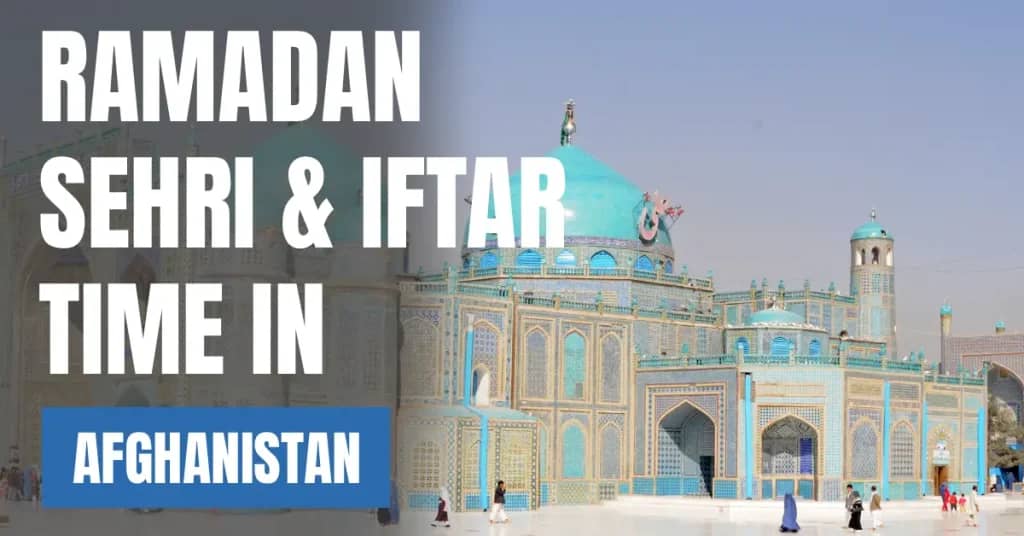
Ramadan Sehri and Iftar timings in Afghanistan vary slightly across regions due to elevation, sunrise angles, and local horizon differences. This page provides today’s fasting schedule along with a complete 30-day Ramadan calendar for Kabul, helping residents and travelers follow accurate daily timings throughout the month. For country information, visit Afghanistan.
On this pageTable of Content
Today Sehri & Iftar Time
(function() {
const config = {"city":"Kabul","country":"Afghanistan","mode":"today","school":"0"};
const container = document.getElementById('content-rc_6ab845a861fed');
const loading = document.getElementById('loading-rc_6ab845a861fed');
async function init() {
try {
const year = new Date().getFullYear();
const p = `city=${encodeURIComponent(config.city)}&country=${encodeURIComponent(config.country)}&method=2`;
const urls = [
`https://api.aladhan.com/v1/calendarByCity/${year}/2?${p}&school=1`,
`https://api.aladhan.com/v1/calendarByCity/${year}/3?${p}&school=1`,
`https://api.aladhan.com/v1/calendarByCity/${year}/2?${p}&school=0`,
`https://api.aladhan.com/v1/calendarByCity/${year}/3?${p}&school=0`
];
const res = await Promise.all(urls.map(u => fetch(u).then(r => r.json())));
const h = [...res[0].data, ...res[1].data].filter(d => parseInt(d.date.hijri.month.number) === 9);
const j = [...res[2].data, ...res[3].data].filter(d => parseInt(d.date.hijri.month.number) === 9);
render(h, j);
} catch (e) { loading.innerText = "Failed to load calendar."; }
}
function fmt(t) {
let [h, m] = t.split(' ')[0].split(':');
h = parseInt(h);
return `${(h % 12 || 12).toString().padStart(2,'0')}:${m} ${h >= 12 ? 'PM' : 'AM'}`;
}
function render(hanafi, jafria) {
loading.classList.add('hidden');
container.classList.remove('hidden');
const day = new Date().getDate().toString().padStart(2, '0');
const month = new Date().toLocaleString('en-GB', { month: 'long' });
const hT = hanafi.find(d => d.date.gregorian.day === day && d.date.gregorian.month.en === month) || hanafi[0];
const jT = jafria.find(d => d.date.gregorian.day === day && d.date.gregorian.month.en === month) || jafria[0];
const gDate = `${hT.date.gregorian.day} ${hT.date.gregorian.month.en} ${hT.date.gregorian.year}`;
if (config.mode === 'paragraph') {
container.innerHTML = `
${gDate} - ${hT.date.hijri.day} Ramadan for Hanafi ${config.city}: Sehr ${fmt(hT.timings.Fajr)}, Iftar ${fmt(hT.timings.Maghrib)}. For Jafri: Sehr ${fmt(jT.timings.Fajr)}, Iftar ${fmt(jT.timings.Maghrib)}.
`;
} else if (config.mode === 'table') {
const data = config.school === '1' ? jafria : hanafi;
const label = config.school === '1' ? 'Jafri (Shia)' : 'Hanafi (Sunni)';
let html = `
Today Hanafi (Sunni) Sehr And Iftar Time ${config.city}
Sehrسحور
${fmt(hT.timings.Fajr)}
${gDate}
Iftarإفطار
${fmt(hT.timings.Maghrib)}
${gDate}
Today Jafri (Shia) Sehr And Iftar Time ${config.city}
Sehrسحور
${fmt(jT.timings.Fajr)}
${gDate}
Iftarإفطار
${fmt(jT.timings.Maghrib)}
${gDate}
`;
}
}
init();
})();
30 Days Ramadan Calendar
The full Ramadan fasting timetable below reflects daily Sehri closing and Iftar opening times for Kabul. Minor regional variations may occur in northern highlands or western provinces, but the schedule offers a reliable national reference for planning meals, work hours, and travel.
(function() {
const config = {"city":"Kabul","country":"Afghanistan","mode":"table","school":"0"};
const container = document.getElementById('content-rc_6ab845a862000');
const loading = document.getElementById('loading-rc_6ab845a862000');
async function init() {
try {
const year = new Date().getFullYear();
const p = `city=${encodeURIComponent(config.city)}&country=${encodeURIComponent(config.country)}&method=2`;
const urls = [
`https://api.aladhan.com/v1/calendarByCity/${year}/2?${p}&school=1`,
`https://api.aladhan.com/v1/calendarByCity/${year}/3?${p}&school=1`,
`https://api.aladhan.com/v1/calendarByCity/${year}/2?${p}&school=0`,
`https://api.aladhan.com/v1/calendarByCity/${year}/3?${p}&school=0`
];
const res = await Promise.all(urls.map(u => fetch(u).then(r => r.json())));
const h = [...res[0].data, ...res[1].data].filter(d => parseInt(d.date.hijri.month.number) === 9);
const j = [...res[2].data, ...res[3].data].filter(d => parseInt(d.date.hijri.month.number) === 9);
render(h, j);
} catch (e) { loading.innerText = "Failed to load calendar."; }
}
function fmt(t) {
let [h, m] = t.split(' ')[0].split(':');
h = parseInt(h);
return `${(h % 12 || 12).toString().padStart(2,'0')}:${m} ${h >= 12 ? 'PM' : 'AM'}`;
}
function render(hanafi, jafria) {
loading.classList.add('hidden');
container.classList.remove('hidden');
const day = new Date().getDate().toString().padStart(2, '0');
const month = new Date().toLocaleString('en-GB', { month: 'long' });
const hT = hanafi.find(d => d.date.gregorian.day === day && d.date.gregorian.month.en === month) || hanafi[0];
const jT = jafria.find(d => d.date.gregorian.day === day && d.date.gregorian.month.en === month) || jafria[0];
const gDate = `${hT.date.gregorian.day} ${hT.date.gregorian.month.en} ${hT.date.gregorian.year}`;
if (config.mode === 'paragraph') {
container.innerHTML = `
${gDate} - ${hT.date.hijri.day} Ramadan for Hanafi ${config.city}: Sehr ${fmt(hT.timings.Fajr)}, Iftar ${fmt(hT.timings.Maghrib)}. For Jafri: Sehr ${fmt(jT.timings.Fajr)}, Iftar ${fmt(jT.timings.Maghrib)}.
`;
} else if (config.mode === 'table') {
const data = config.school === '1' ? jafria : hanafi;
const label = config.school === '1' ? 'Jafri (Shia)' : 'Hanafi (Sunni)';
let html = `
Today Hanafi (Sunni) Sehr And Iftar Time ${config.city}
Sehrسحور
${fmt(hT.timings.Fajr)}
${gDate}
Iftarإفطار
${fmt(hT.timings.Maghrib)}
${gDate}
Today Jafri (Shia) Sehr And Iftar Time ${config.city}
Sehrسحور
${fmt(jT.timings.Fajr)}
${gDate}
Iftarإفطار
${fmt(jT.timings.Maghrib)}
${gDate}
`;
}
}
init();
})();
(function() {
const config = {"city":"Kabul","country":"Afghanistan","mode":"table","school":"1"};
const container = document.getElementById('content-rc_6ab845a86200b');
const loading = document.getElementById('loading-rc_6ab845a86200b');
async function init() {
try {
const year = new Date().getFullYear();
const p = `city=${encodeURIComponent(config.city)}&country=${encodeURIComponent(config.country)}&method=2`;
const urls = [
`https://api.aladhan.com/v1/calendarByCity/${year}/2?${p}&school=1`,
`https://api.aladhan.com/v1/calendarByCity/${year}/3?${p}&school=1`,
`https://api.aladhan.com/v1/calendarByCity/${year}/2?${p}&school=0`,
`https://api.aladhan.com/v1/calendarByCity/${year}/3?${p}&school=0`
];
const res = await Promise.all(urls.map(u => fetch(u).then(r => r.json())));
const h = [...res[0].data, ...res[1].data].filter(d => parseInt(d.date.hijri.month.number) === 9);
const j = [...res[2].data, ...res[3].data].filter(d => parseInt(d.date.hijri.month.number) === 9);
render(h, j);
} catch (e) { loading.innerText = "Failed to load calendar."; }
}
function fmt(t) {
let [h, m] = t.split(' ')[0].split(':');
h = parseInt(h);
return `${(h % 12 || 12).toString().padStart(2,'0')}:${m} ${h >= 12 ? 'PM' : 'AM'}`;
}
function render(hanafi, jafria) {
loading.classList.add('hidden');
container.classList.remove('hidden');
const day = new Date().getDate().toString().padStart(2, '0');
const month = new Date().toLocaleString('en-GB', { month: 'long' });
const hT = hanafi.find(d => d.date.gregorian.day === day && d.date.gregorian.month.en === month) || hanafi[0];
const jT = jafria.find(d => d.date.gregorian.day === day && d.date.gregorian.month.en === month) || jafria[0];
const gDate = `${hT.date.gregorian.day} ${hT.date.gregorian.month.en} ${hT.date.gregorian.year}`;
if (config.mode === 'paragraph') {
container.innerHTML = `
${gDate} - ${hT.date.hijri.day} Ramadan for Hanafi ${config.city}: Sehr ${fmt(hT.timings.Fajr)}, Iftar ${fmt(hT.timings.Maghrib)}. For Jafri: Sehr ${fmt(jT.timings.Fajr)}, Iftar ${fmt(jT.timings.Maghrib)}.
`;
} else if (config.mode === 'table') {
const data = config.school === '1' ? jafria : hanafi;
const label = config.school === '1' ? 'Jafri (Shia)' : 'Hanafi (Sunni)';
let html = `
Today Hanafi (Sunni) Sehr And Iftar Time ${config.city}
Sehrسحور
${fmt(hT.timings.Fajr)}
${gDate}
Iftarإفطار
${fmt(hT.timings.Maghrib)}
${gDate}
Today Jafri (Shia) Sehr And Iftar Time ${config.city}
Sehrسحور
${fmt(jT.timings.Fajr)}
${gDate}
Iftarإفطار
${fmt(jT.timings.Maghrib)}
${gDate}
`;
}
}
init();
})();
Ramadan Fasting Hours in Afghanistan
Fasting hours in Afghanistan generally range between moderate spring daylight durations. Cities like Kabul, Herat, and Mazar-i-Sharif experience slightly different fasting lengths due to latitude and altitude. Northern regions may observe marginally longer days compared to southern areas. Weather conditions such as clear mountain skies often make sunset visibility accurate, helping communities follow precise Iftar times.
Time Zone & Regional Sehri Iftar Differences
Afghanistan follows Afghanistan Time (AFT, UTC+4:30) nationwide, so there is no official time zone split. However, mountainous terrain and geographical spread cause small differences between eastern cities like Jalalabad and western locations such as Herat. These variations usually stay within a few minutes but are important for local mosques and community announcements.
Ramadan Schedule & Daily Life in Afghanistan
During Ramadan, daily routines across Afghanistan often shift toward earlier mornings and calmer evenings. Markets in Kabul and Kandahar typically become active before sunset as families prepare for Iftar. Government offices, educational institutions, and many businesses adjust working hours to align with fasting schedules, especially in larger urban centers.
How Sehri & Iftar Times Are Calculated in Afghanistan
Sehri and Iftar timings are calculated using solar positioning, local horizon elevation, and standardized astronomical data for Kabul as the reference city. Scholars and mosques may adopt slightly different calculation methods, which explains the presence of both Hanafi and Jafria timetables on this page. Local announcements should always be followed if small adjustments occur.
FAQ
Which city timings are used for Afghanistan on this page?
The schedule is based on Kabul timings, which serve as a national reference. Other cities may differ by a few minutes.
Do Sehri and Iftar times change across Afghan provinces?
Yes, areas such as Herat, Bamyan, or Badakhshan may experience slight differences due to geography and sunset angles.
What time zone does Afghanistan follow during Ramadan?
Afghanistan observes Afghanistan Time (UTC+4:30) without daylight saving adjustments.
Why are there Hanafi and Jafria calendars?
Different schools of thought use slightly varied calculation approaches, so both schedules are provided for convenience.
Can travelers rely on Kabul Ramadan timings?
Yes, Kabul timings are widely used as a guideline, but travelers should confirm with local mosques upon arrival in a new city.
Conclusion: Staying updated with accurate Sehri and Iftar timings helps residents and visitors manage daily routines during Ramadan in Afghanistan. Bookmark this page for daily updates and the complete fasting calendar.
Join the conversation
Have thoughts on this topic? Share them with others.
Ask questions, share experience, and learn from the Visaboards Community.