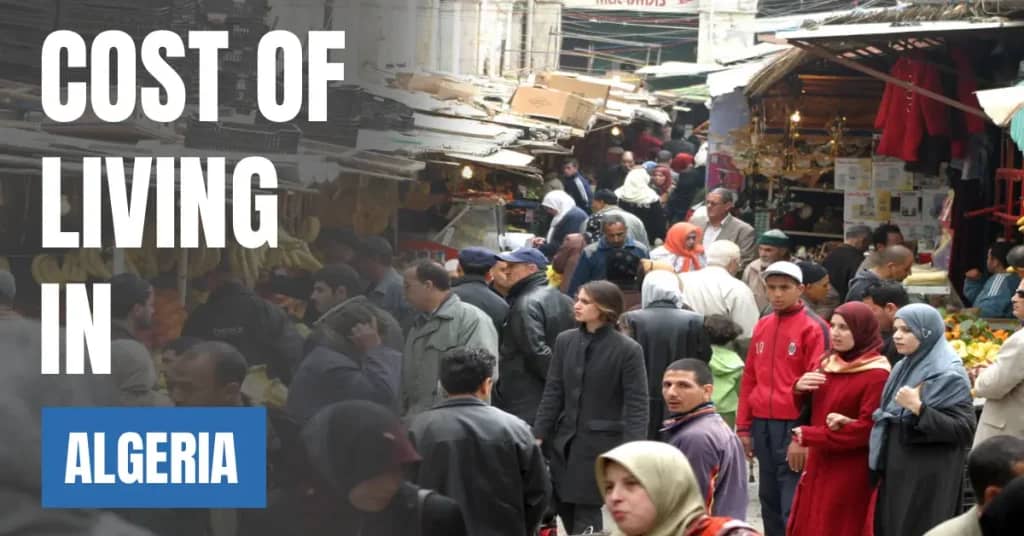
The cost of living in Algeria remains relatively low by regional and international standards, but affordability looks very different for someone earning a local salary than for an expat paid from abroad. Housing, imported goods, private healthcare, and international education can raise a household budget quickly, while subsidised fuel, public transport, local food, and public services remain comparatively inexpensive.
On this pageTable of Content
Prices also move unevenly. Algeria’s Office National des Statistiques reported that consumer prices in Algiers were 5.2% higher in April 2026 than in April 2025, even though its rolling annual inflation measure was 1.2%. Fresh fruit, vegetables, meat, poultry, eggs, and potatoes showed particularly large month-to-month movements during early 2026. For that reason, grocery figures in this guide should be treated as current planning ranges rather than fixed prices.
To learn more about the country, you can explore the Algeria country page here: Algeria.
Also Explore: Cost of Living in ComorosCost of Living in Algeria at a Glance
A single renter will generally need around 60,000 to 110,000 DZD per month including rent, depending mainly on the city, housing type, and lifestyle. A family of four can reasonably plan for approximately 180,000 to 280,000 DZD per month including rent, before expensive international-school tuition or major car costs.
| Expense | Typical 2026 Planning Range |
|---|---|
| Single person, excluding rent | 40,000 to 65,000 DZD/month |
| Single person, including rent | 60,000 to 110,000 DZD/month |
| Couple, including rent | 110,000 to 170,000 DZD/month |
| Family of four, including rent | 180,000 to 280,000 DZD/month, excluding international school |
| One-bedroom apartment | About 15,000 to 35,000 DZD/month in many markets, higher for furnished or premium housing |
| Furnished studio in Algiers or Oran | About 25,000 to 55,000 DZD/month |
| Basic household utilities | About 3,000 to 7,000 DZD/month |
| Home fibre internet | 2,000 to 4,200 DZD/month |
| Mobile data | About 1,000 to 2,500 DZD/month for common larger packages |
| Inexpensive restaurant meal | About 300 to 800 DZD |
| Algiers Metro single ticket | 50 DZD |
| Petrol | 47 DZD/litre |
| Private short doctor consultation | About 1,900 to 2,000 DZD in recent Algiers and Oran datasets |
| National minimum wage | 24,000 DZD/month from 1 January 2026 |
The ranges above combine official 2026 tariffs with current consumer-price databases. Numbeo’s Algeria dataset had 1,201 entries from 89 contributors in the preceding 12 months as of June 2026, while some city-level Expatistan estimates use fewer than five contributors. These figures are therefore best used for budgeting, not as official national averages.
How Much Does It Cost to Live in Algeria Per Month?
A single person who already owns a home or does not pay market rent may spend roughly 40,000 to 65,000 DZD per month. With rent, a more realistic planning range is around 60,000 to 110,000 DZD. Furnished accommodation in Algiers, frequent dining out, taxis, private healthcare, or imported products can push the total higher.
For a couple, approximately 110,000 to 170,000 DZD is a practical moderate range. A family of four should generally budget around 180,000 to 280,000 DZD before international education. Current Expatistan estimates put total monthly costs at approximately 255,751 DZD for a family of four in Algiers and 239,187 DZD in Oran, although the site explicitly warns that these city estimates are based on limited data.
Housing and Rent in Algeria
Rent is one of the biggest variables in an Algerian budget. Long-term local accommodation can be inexpensive, but a newcomer looking for a furnished apartment in a central, secure, or expat-oriented area may pay substantially more than a national average suggests.
Recent Expatistan data for Algiers places a furnished 45 m² studio at approximately 29,416 DZD per month in a normal area and 54,488 DZD in an expensive area. An 85 m² furnished property is estimated at around 43,838 DZD in a normal area and 87,423 DZD in an expensive area.
In Oran, the same dataset estimates a furnished 45 m² studio at approximately 24,847 DZD in a normal area and 44,063 DZD in an expensive area. An 85 m² furnished home is around 39,347 DZD in a normal area and 71,011 DZD in a more expensive location.
Broader Numbeo data produces lower nationwide rent averages, which illustrates why a single national figure can be misleading. Location, furnishings, lease length, property quality, and whether accommodation is marketed to foreign residents all matter.
Groceries and Food Prices
Local staples, vegetables, bread, and many locally produced foods can be inexpensive, while meat, cheese, imported groceries, and out-of-season produce can take a larger share of the budget. Fresh-food prices can also change sharply from month to month.
| Grocery Item | Indicative Price |
|---|---|
| Milk, 1 litre | About 100 to 130 DZD |
| White bread, 500 g | About 20 to 50 DZD |
| Rice, 1 kg | About 180 to 200 DZD |
| Eggs, 12 | About 180 to 250 DZD |
| Chicken fillets, 1 kg | About 600 to 950 DZD |
| Beef, 1 kg | About 1,800 to 2,300 DZD |
| Apples, 1 kg | About 330 to 450 DZD |
| Tomatoes, 1 kg | About 85 to 120 DZD |
| Potatoes, 1 kg | About 80 to 100 DZD |
These figures are based primarily on recent Numbeo and Expatistan observations and should be read as market estimates rather than regulated retail prices.
A single person cooking most meals at home might budget around 20,000 to 30,000 DZD per month for groceries. A family of four can reasonably plan for around 60,000 to 90,000 DZD, depending on meat consumption, imported products, shopping habits, and household size.
Restaurants and Eating Out
Eating out can be relatively affordable. A simple local meal may cost around 300 to 800 DZD, while a fast-food combo is commonly around 500 to 700 DZD. A moderate meal for two can often fall around 2,500 to 5,000 DZD, although premium restaurants can cost considerably more.
Coffee is inexpensive by international standards. Recent Algiers data places a cappuccino at roughly 296 DZD in expat-oriented locations, while Oran was around 243 DZD in the same dataset.
Utilities
Basic electricity, gas, water, heating, cooling, and related household utilities are generally inexpensive compared with Europe or North America. A moderate apartment can often budget around 3,000 to 7,000 DZD per month, although air-conditioning use, apartment size, insulation, and season can increase the bill.
Expatistan estimated utilities for two people in an 85 m² Algiers apartment at approximately 6,607 DZD per month and around 4,050 DZD in Oran. The limited sample means these should be treated as indicative figures.
Internet and Mobile Costs
Home internet is inexpensive and increasingly fast where fibre is available. Algérie Télécom currently lists IDOOM Fibre plans ranging from 2,000 DZD per month for up to 15 Mbps to 4,200 DZD for up to 1.2 Gbps. Higher-speed options include 120 Mbps for 2,600 DZD, 300 Mbps for 3,000 DZD, and 500 Mbps for 3,600 DZD. Availability depends on the line and location.
Mobile data is also inexpensive. Ooredoo’s current internet-focused packages include 50 GB for 1,500 DZD and 120 GB for 2,500 DZD for four weeks. Mobilis also sells smaller daily and weekly data passes, while Algérie Télécom’s 4G service offers 150 GB for 1,500 DZD per month.
Transportation Costs
Public transport is inexpensive, but it is not generally free. In Algiers, a single Metro journey costs 50 DZD, 10 Metro journeys cost 400 DZD, a 24-hour Metro pass costs 150 DZD, and a combined Metro and Tramway single journey costs 70 DZD.
Fuel remains unusually cheap. From 1 January 2026, petrol is priced at 47 DZD per litre, diesel at 31 DZD per litre, and automotive LPG at 12 DZD per litre. The government stated that the state continues to absorb a substantial part of the real fuel cost.
A public-transport user may spend only 1,000 to 3,000 DZD per month on routine commuting. Car ownership is different. Fuel is cheap, but purchasing a vehicle, maintenance, insurance, parking, and repairs can substantially increase total transport spending.
Healthcare Costs in Algeria
Healthcare in Algeria should not simply be described as free. Salaried workers registered with the CNAS social insurance system can receive reimbursement for medical care, hospitalisation, diagnostic procedures, medicines, dental care, rehabilitation, and other covered treatment. The standard reimbursement rate for benefits in kind is generally 80%, with 100% coverage in certain legally defined cases.
Recent consumer data places a short private-doctor consultation at roughly 1,900 DZD in Algiers and 2,000 DZD in Oran. Actual specialist and private-clinic charges vary considerably.
Foreign residents should check whether their employment places them within Algeria’s social-security system. CNAS states that people performing paid work in Algeria for an employer are considered salaried employees for social-insurance purposes, subject to the applicable registration rules.
Education and Childcare
Public national education is free. Algeria’s education law provides free education at all levels in public institutions and makes schooling compulsory from ages 6 to 16. In 2026, the Ministry of National Education also stated that the right to education extends to foreign children present in Algeria under the applicable conditions.
Private and international education is a different expense. Current crowd data suggests that private preschool and international-school costs vary enormously by city and institution. Nationwide Numbeo data implies roughly 446,000 DZD per year for an international primary school when its June 2026 euro figure is converted using the September 2026 official exchange rate, while its Algiers estimate is substantially higher. These figures have broad ranges and should be checked directly with schools.
International university students should also not assume that public education means zero tuition. Under the Study in Algeria open-enrolment system, official 2025-2026 annual fees for international students range from approximately US$1,500 for some bachelor’s programmes to US$5,000 for some doctoral programmes, with selected specialist schools and medical programmes carrying different charges.
Salaries and the 2026 Minimum Wage
Algeria’s national guaranteed minimum wage increased to 24,000 DZD per month from 1 January 2026. The presidential decree defines this as the minimum for the statutory 40-hour working week, equivalent to 173.33 hours per month.
The latest readily accessible official ONS wage survey refers to 2022, when the average monthly net salary, excluding agriculture and public administration, was 43,500 DZD. The figure was 61,300 DZD in the public sector and 35,200 DZD in the domestic private sector. Because this is older data, it should not be presented as the official 2026 average salary.
For a more current but non-official indication, Numbeo’s June 2026 crowd data implied an average net salary of about 40,800 DZD per month when converted using the Bank of Algeria’s 1 September 2026 euro exchange rate. The two datasets serve different purposes, and neither proves that the current national average salary is exactly within that range.
What Salary Is Needed to Live Comfortably in Algeria?
A single renter in a major city should generally target around 80,000 to 120,000 DZD net per month for a moderate lifestyle with some financial flexibility. This is a budgeting estimate, not an official salary threshold. A family may need around 200,000 to 300,000 DZD or more, especially with a larger apartment, car ownership, private healthcare, or private education.
The gap between local wages and independent-renter budgets is important. The 24,000 DZD minimum wage is far below the estimated cost of maintaining a private urban apartment and normal monthly expenses. Housing shared with family, subsidised services, lower-cost areas, and multiple earners can therefore make a major difference to local household affordability.
Taxes and Social-Security Deductions
Salary income of 30,000 DZD per month or less is fully exempt from Algeria’s IRG income tax. Special relief applies between 30,001 and 35,000 DZD, while higher taxable income enters a progressive structure whose annual marginal rates range up to 35%.
Employee social-security contributions are generally 9% of the contribution base, while employers pay 25% and social welfare organisations account for another 0.5% of gross payroll under the general system.
For illustration, a worker earning the 24,000 DZD statutory minimum would normally fall below the IRG income-tax threshold, but a 9% employee social-security contribution would equal about 2,160 DZD, leaving roughly 21,840 DZD before any other applicable adjustments or deductions.
Realistic Monthly Budget Examples
The following examples are planning budgets, not official cost-of-living statistics. They assume long-term housing rather than hotels, mostly local groceries, normal household bills, and no major debt repayments.
| Expense | Budget Single | Moderate Single | Couple | Family of Four |
|---|---|---|---|---|
| Rent | 18,000 DZD | 30,000 DZD | 45,000 DZD | 60,000 DZD |
| Utilities | 4,000 DZD | 5,000 DZD | 6,000 DZD | 8,000 DZD |
| Groceries | 20,000 DZD | 28,000 DZD | 45,000 DZD | 75,000 DZD |
| Transport | 2,000 DZD | 4,000 DZD | 8,000 DZD | 12,000 DZD |
| Internet and mobile | 3,000 DZD | 4,000 DZD | 5,000 DZD | 6,000 DZD |
| Healthcare and personal costs | 3,000 DZD | 5,000 DZD | 8,000 DZD | 12,000 DZD |
| Dining and leisure | 5,000 DZD | 12,000 DZD | 15,000 DZD | 20,000 DZD |
| Childcare and school supplies | 0 DZD | 0 DZD | 0 DZD | 20,000 DZD |
| Estimated Total | 55,000 DZD | 88,000 DZD | 132,000 DZD | 213,000 DZD |
The family example assumes public schooling or modest education-related costs. One or more children in an international school can add tens of thousands of dinars per month when annual tuition is spread over the year. Car finance, premium accommodation, domestic help, regular international travel, and private medical insurance are also excluded.
Cost Differences Between Algiers, Oran and Other Areas
Algiers generally has the greatest concentration of premium housing, international schools, foreign businesses, and higher-end services. Oran can be slightly cheaper overall, although the difference is not consistent across every expense.
| Furnished Housing Example | Algiers | Oran |
|---|---|---|
| 45 m² studio, normal area | 29,416 DZD | 24,847 DZD |
| 45 m² studio, expensive area | 54,488 DZD | 44,063 DZD |
| 85 m² home, normal area | 43,838 DZD | 39,347 DZD |
| 85 m² home, expensive area | 87,423 DZD | 71,011 DZD |
Expatistan’s September 2026 comparison estimates Oran to be about 4% cheaper overall than Algiers. However, that comparison is based on only 10 prices from fewer than five contributors, so the percentage should not be treated as a definitive citywide cost difference.
Smaller cities and towns can offer lower rent, but public transport options, private healthcare, international education, and specialised services may also be more limited.
How Does Algeria Compare With Nearby Countries?
Algeria is inexpensive within North Africa, although it is not automatically the cheapest destination in every category. Numbeo’s 2026 city index gives Algiers a cost-of-living score of 29.2, compared with 30.7 for Tunis, 35.2 for Casablanca, and 23.2 for Cairo. Algiers therefore ranks below Tunis and Casablanca on this index but above Cairo.
Low headline prices do not necessarily mean strong local affordability. Numbeo’s local purchasing-power index for Algiers was only 36.3 in its 2026 ranking, highlighting the importance of comparing living costs with earnings rather than looking only at prices.
Costs New Residents Often Overlook
- Furnished housing premiums: apartments targeted at short-term or foreign tenants can cost considerably more than broad national rent averages.
- Upfront housing costs: deposits, advance rent, furnishing, appliances, and moving expenses can make the first month much more expensive than later months.
- International schooling: this can become one of the largest expenses for an expat family.
- Private healthcare: CNAS reimbursement does not mean every healthcare expense is zero, particularly for private treatment or people outside the insured system.
- Summer cooling: electricity costs can rise with sustained air-conditioning use.
- Car ownership: petrol is heavily affordable, but the vehicle itself, insurance, parts, maintenance, and parking are separate costs.
- Residence documentation: foreign residents may face medical certificates, fiscal stamps, document preparation, and other administrative costs.
Cost of Living Versus Residency Financial Requirements
A personal monthly budget should not be confused with a legal immigration threshold. Algeria’s Ministry of the Interior requires foreigners applying for a resident card to provide documents appropriate to their situation, such as a work permit, university registration, proof of business activity, or evidence of means of subsistence if they do not intend to work. The official guidance does not state a fixed nationwide monthly income amount for this proof of means.
The ordinary residence-card documentation also includes a passport, medical certificate, accommodation lease, photographs, and a fiscal stamp. The Ministry’s Arabic guidance currently lists the ordinary stamp at 6,000 DZD, while a qualifying 10-year resident card carries a 30,000 DZD fiscal stamp.
This means a budget such as 80,000 or 100,000 DZD per month may be useful for personal planning, but it should never be presented as Algeria’s official residence-permit income requirement unless the authorities publish such a figure for the applicant’s specific immigration category.
Is Algeria Affordable for Expats and New Residents?
For an expat earning a strong foreign salary, Algeria can be a low-cost place to live, particularly because of inexpensive fuel, public transport, local food, telecommunications, and many public services. For someone dependent on a typical local salary, affordability is more challenging because private urban rent can consume a large share of earnings.
The most important question is therefore not simply whether Algeria is cheap. It is whether your expected income comfortably covers your specific housing, education, healthcare, transport, and lifestyle choices.
Practical Conclusion
A realistic 2026 budget for a single renter in Algeria is approximately 60,000 to 110,000 DZD per month. A comfortable single-person budget in Algiers may be closer to 80,000 to 120,000 DZD, while a family of four can reasonably plan around 180,000 to 280,000 DZD before costly international schooling.
Algeria’s 24,000 DZD minimum wage and comparatively modest local salary levels are important context. Low fuel, transport, telecommunications, and local-food prices help, but housing and private services can create a significant affordability gap. New residents should therefore build their budget around a specific city and actual rental options instead of relying on a single national dollar estimate.
Sources and Methodology
This information was reviewed on 3 September 2026. Official government, statistical, tax, social-security, transport, education, immigration, fuel, telecommunications, and central-bank sources were prioritised. Consumer databases were used mainly where official authorities do not publish current market rents, restaurant prices, or household grocery baskets.
Methodology prioritizes official sources, separates costs including rent from costs excluding rent, uses realistic ranges, and treats crowdsourced market databases as estimates rather than absolute facts.
For international comparisons and conversions, the Bank of Algeria reported on 1 September 2026 an official reference rate of approximately 133.2368 DZD per US dollar and 154.4948 DZD per euro. Exchange rates change, so foreign-currency equivalents should always be recalculated when planning a move.
- Journal Officiel de la République Algérienne, Presidential Decree No. 26-01 on the 2026 national minimum wage.
- Office National des Statistiques, Consumer Price Index for March and April 2026.
- Office National des Statistiques, national salary survey, 2022 results.
- Bank of Algeria, official daily exchange rates.
- Direction Générale des Impôts, salary income tax rules and IRG bands.
- CNAS, employee contribution rates and health-insurance reimbursement rules.
- Ministry of the Interior, foreign resident-card requirements.
- Ministry of National Education, public education rules and access for foreign children.
- Ministry of Higher Education and Scientific Research, Study in Algeria fees and international-student system.
- Algiers Metro operator, current Metro and combined Metro-Tramway fares.
- Algérie Télécom, current IDOOM Fibre and 4G tariffs.
- Ooredoo Algeria and Mobilis, current mobile-data tariffs.
- Algerian public fuel-price announcement, January 2026.
- Numbeo, Algeria and city-level 2026 consumer-price data.
- Expatistan, September 2026 Algiers and Oran price estimates and comparison.
Frequently Asked Questions
How much does it cost to live in Algeria per month?
A single renter should generally budget around 60,000 to 110,000 DZD per month including rent. Someone who does not pay market rent may spend closer to 40,000 to 65,000 DZD. In Algiers, furnished housing and a more international lifestyle can push costs above these ranges. A family of four may need roughly 180,000 to 280,000 DZD before expensive international schooling.
Is Algeria expensive to live in?
Algeria is relatively inexpensive by international standards, especially for fuel, public transport, telecommunications, local food, and many everyday services. However, it can feel much less affordable on a local salary. Private rent, imported products, international schools, and private healthcare can make a significant difference, so affordability depends heavily on income and housing arrangements.
How much is rent in Algeria?
A basic one-bedroom apartment may cost around 15,000 to 35,000 DZD per month in many markets. Furnished apartments in desirable parts of Algiers or Oran can cost much more. Recent furnished-market estimates put a 45 m² studio at roughly 25,000 to 55,000 DZD, with larger premium accommodation reaching 70,000 to 90,000 DZD or more.
What salary is comfortable in Algeria?
For a single person renting independently in a major city, around 80,000 to 120,000 DZD net per month is a reasonable comfort-oriented planning target. A family may need 200,000 to 300,000 DZD or more. These are cost-of-living estimates rather than official salary standards, and private schooling, premium housing, or car expenses can increase the amount substantially.
What is the minimum wage in Algeria in 2026?
Algeria’s guaranteed national minimum wage is 24,000 DZD per month from 1 January 2026. It is based on the statutory 40-hour working week, equivalent to 173.33 hours per month. This replaced the previous minimum-wage level and is an important update when comparing salaries with current living costs.
Is healthcare free in Algeria?
Healthcare should not be described as universally free. People insured through CNAS can receive reimbursement for covered treatment, with the standard reimbursement rate generally 80% and 100% in certain cases. Private treatment and expenses outside the covered system can still require out-of-pocket payment. Foreign residents should confirm their own CNAS or insurance eligibility.
Is public transport free in Algeria?
No. Public transport is generally inexpensive rather than free. In Algiers, a single Metro journey costs 50 DZD, 10 journeys cost 400 DZD, and a combined Metro and Tramway journey costs 70 DZD. Regular commuters can therefore keep transportation costs relatively low compared with many international cities.
How much does a family of four need in Algeria?
A family of four can reasonably plan for around 180,000 to 280,000 DZD per month including rent for a moderate lifestyle. The total may be lower with inexpensive housing and public schooling, or much higher with a large furnished apartment, private healthcare, a car, and international-school tuition. Current Algiers crowd estimates are close to the upper part of this range.
Is education free in Algeria?
Education in public national-education institutions is free, and compulsory schooling generally covers ages 6 to 16. Algeria’s education authorities have also stated that foreign children present in the country can access the right to education under applicable conditions. Private schools, international schools, and some international university programmes charge separate tuition.
Does Algeria have a minimum income requirement for residency?
The Ministry of the Interior requires applicants who do not intend to work to provide evidence of means of subsistence when applying for a foreign resident card. However, its published guidance does not specify a single fixed monthly income figure that applies to every applicant. Personal cost-of-living budgets should therefore not be presented as official immigration thresholds.
Join the conversation
Have thoughts on this topic? Share them with others.
Ask questions, share experience, and learn from the Visaboards Community.