
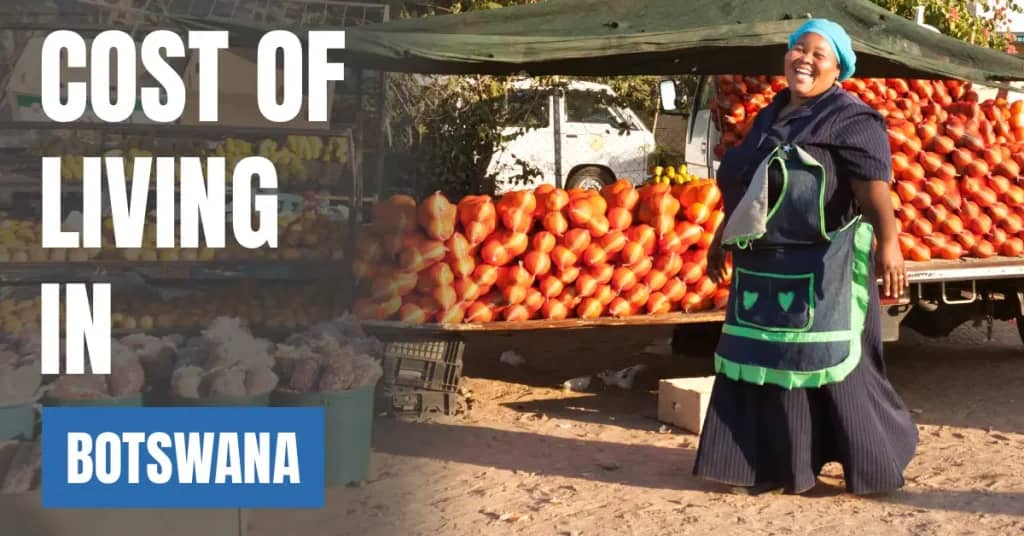
The cost of living in Botswana in 2026 is manageable by international standards, but affordability depends heavily on income, housing choice, transport and whether a household uses private healthcare or private education. For a single person renting modest accommodation, a practical monthly budget can start near P7,000, while a more moderate lifestyle in Gaborone is closer to P10,000 to P12,000 or more. A family of four can require roughly P22,000 or more before substantial private-school fees, car finance or other major expenses.
On this pageTable of Content
Prices also need to be viewed against Botswana’s recent inflation. Statistics Botswana reported annual inflation of 9.3% in August 2026, compared with an average annual inflation rate of 2.7% in 2025. Imported tradable inflation reached 13.0%, while inflation was 9.0% in cities and towns and 10.2% in rural villages. This means older cost-of-living figures can become outdated quickly, particularly for imported food, fuel, household goods and other tradable products. :contentReference[oaicite:2]{index=2}
Cost of Living in Botswana at a Glance
A single renter in Botswana should generally budget around P7,000 to P12,000 per month including modest rent, although lifestyle choices can push costs considerably higher. Gaborone has the best available consumer-price data and should be treated as the main benchmark rather than assuming the same prices apply everywhere in the country.
| Expense | Typical 2026 Planning Cost | Notes |
|---|---|---|
| 1-bedroom rent outside central Gaborone | About P2,900 per month | Observed range around P2,000 to P4,160 |
| 1-bedroom rent in central Gaborone | About P4,200 per month | Observed range around P3,000 to P7,280 |
| Basic utilities, 85 m2 apartment | About P825 per month | Electricity, water and related household utilities |
| Home internet | About P555 per month | 60 Mbps or faster benchmark, with wide provider variation |
| Mobile plan | About P290 per month | Typical plan with calls and 10 GB or more data |
| Inexpensive restaurant meal | About P150 | Gaborone benchmark |
| Meal for two, mid-range restaurant | About P400 | Three courses, excluding drinks |
| Fast-food meal | About P80 | Chain or equivalent meal |
| Local minibus trip | P9 | Government-approved 2026 fare |
| Shared taxi | P10 per passenger per trip | Government-approved 2026 fare |
| Public healthcare consultation for citizens | Generally P5 | Some categories are exempt |
| Private or international primary school | Often P30,000 to P50,000+ annually | Varies significantly by school and grade |
The consumer-price figures above are mainly based on Gaborone market data. Numbeo’s May 2026 Gaborone dataset contained 273 entries from 15 contributors, so the figures are useful planning benchmarks rather than official fixed prices. :contentReference[oaicite:3]{index=3}
How Much Does It Cost to Live in Botswana Per Month?
A budget-conscious single renter may manage on approximately P7,000 per month, while a more moderate single-person budget is around P10,850 using the assumptions in this guide. Couples may need about P15,900 and a family of four about P22,700 before substantial private schooling or expensive vehicle costs.
These estimates include rent. This distinction matters because published cost-of-living figures often mix totals excluding housing with totals that include rent. Housing can easily be one of the largest monthly expenses, particularly for newcomers seeking furnished accommodation, secure developments or short leases.
Current September 2026 consumer-cost sources also show that a typical Gaborone lifestyle is substantially more expensive than a bare rent-and-groceries calculation. One current dataset estimates essentials at about US$668 per month for a single person, including an outside-centre apartment, bills, food and local transport, while another September dataset estimates a broader single-person cost at about US$860 including rent. Differences mainly reflect methodology and what each source counts as discretionary spending. :contentReference[oaicite:4]{index=4}
Housing and Rent in Botswana
In Gaborone, a one-bedroom apartment typically costs around P2,900 outside the centre and P4,200 in central areas, although individual properties can be much more expensive.
Recent Gaborone benchmarks show:
- 1-bedroom apartment in the city centre: about P4,213, with reported prices from P3,000 to P7,280.
- 1-bedroom apartment outside the city centre: about P2,903, with reported prices from P2,000 to P4,160.
- 3-bedroom apartment in the city centre: about P6,417.
- 3-bedroom apartment outside the centre: about P4,333.
These are consumer-submitted benchmarks, not asking prices for every part of the market. Live property listings can be substantially higher. For example, recent Botswana rental listings include modern two-bedroom apartments in Gaborone around P9,000 per month, with furnished or premium units higher still. :contentReference[oaicite:5]{index=5}
Renters should therefore check current listings in the exact neighbourhood they intend to live in rather than relying solely on a national average. Deposits, furnishing, security features, parking, agency arrangements and lease length can also change the effective cost.
Is Francistown Cheaper Than Gaborone?
Francistown can offer lower housing costs, but city-level data are much thinner than for Gaborone. One 2026 dataset places a one-bedroom apartment at approximately P3,200 in central Francistown and P2,600 outside the centre, while broader cost estimates place total living costs below Gaborone in many scenarios. These figures should be treated cautiously because the number of observations is limited. :contentReference[oaicite:6]{index=6}
What About Maun and Kasane?
Maun and Kasane require more individual research. Tourism employment, limited housing stock, furnished rentals and seasonal demand can make particular properties expensive even when a generic country model suggests low living costs. Several online datasets explicitly use national proxies or modelling rather than sufficiently large local samples for these towns, so precise citywide averages should not be presented as established facts. :contentReference[oaicite:7]{index=7}
Grocery Prices in Botswana
A single person who cooks regularly can reasonably allow around P1,500 to P2,500 per month for groceries, depending on diet and reliance on imported products.
Recent Gaborone price benchmarks include:
| Grocery Item | Typical Price |
|---|---|
| Milk, 1 litre | About P20 |
| Fresh white bread, 500 g | About P11 |
| Rice, 1 kg | About P25 |
| Eggs, 12 | About P33 |
| Chicken fillets, 1 kg | About P62 |
| Beef, 1 kg | About P67 |
| Bananas, 1 kg | About P19 |
| Tomatoes, 1 kg | About P22 |
| Bottled water, 1.5 litres | About P12 |
These September 2026 market estimates broadly support the earlier Gaborone data, although individual supermarkets and brands vary. Botswana’s 13.0% imported-tradable inflation in August 2026 is particularly relevant for households that buy imported foods and consumer goods. :contentReference[oaicite:8]{index=8}
Restaurant and Eating-Out Costs
An inexpensive restaurant meal in Gaborone costs around P150, while a mid-range three-course meal for two is approximately P400.
- Inexpensive restaurant meal: about P150.
- Meal for two at a mid-range restaurant: about P400.
- Fast-food combo meal: about P80.
- Regular cappuccino: about P32.
- Soft drink: about P10 to P12.
Dining frequently can therefore change a single person’s budget significantly. A household cooking most meals at home will spend much less than an expatriate household relying heavily on restaurants, food delivery or imported supermarket brands. :contentReference[oaicite:9]{index=9}
Utilities in Botswana
Basic household utilities for an 85 m2 apartment in Gaborone are around P825 per month as a current benchmark, although actual bills can vary from roughly P500 to P2,000.
Electricity consumption can rise substantially when air conditioning is used heavily during hot periods. Household size, property construction, appliances and water use also matter. Botswana Power Corporation publishes electricity tariffs, but the monthly bill depends on consumption rather than a single fixed household charge. :contentReference[oaicite:10]{index=10}
Internet and Mobile Costs
A practical combined allowance for home internet and one mobile plan is around P700 to P1,000 per month.
Recent Gaborone benchmarks put an unlimited 60 Mbps or faster broadband connection around P555 per month and a mobile plan with calls and at least 10 GB of data around P290. Reported ranges are much wider, so users with premium fibre packages, several mobile lines or heavy data requirements should budget more. :contentReference[oaicite:11]{index=11}
Transportation Costs in Botswana
Local public transport remains inexpensive by international standards, with a local minibus fare of P9 and a shared taxi fare of P10 per passenger per trip under the government’s April 2026 rates.
The government-approved schedule also placed a special taxi trip at P36. Long-distance fares were set at 38 thebe per kilometre on bitumen roads and 41 thebe per kilometre on gravel or sandy roads. These rates followed a controversial higher fare increase that was rescinded in April 2026. :contentReference[oaicite:12]{index=12}
Owning a vehicle changes the budget considerably. In addition to fuel, newcomers should consider insurance, registration, maintenance, tyres, repairs and the purchase or finance cost of the vehicle. Current consumer data put new compact and mid-sized cars well above P250,000 in many cases. :contentReference[oaicite:13]{index=13}
Healthcare Costs in Botswana
Botswana’s public healthcare system is heavily subsidised, but it should not simply be described as free for everyone. The government operates health posts, clinics, primary hospitals, district hospitals and referral hospitals. :contentReference[oaicite:14]{index=14}
Official Ministry of Health information lists a general consultation fee of P5 for citizens at public hospitals and clinics, with children under five and people over 65 exempt from the standard consultation charge. Government information for non-citizens is not entirely consistent across webpages. One national government summary lists a P50 subsidised consultation charge for non-citizens, while specific health programmes and services may list P30, P40, P50 or different specialist charges. New residents should therefore check the applicable facility and service rather than assuming one universal foreign-patient fee. :contentReference[oaicite:15]{index=15}
Private healthcare, medical aid and specialist treatment can create much higher expenses. Expats who prefer private care should include insurance or a separate healthcare allowance in their monthly planning rather than basing their budget solely on the subsidised public consultation fee.
Education and Childcare Costs
Government education is highly subsidised and described by Botswana officials as almost free, but cost sharing, school charges, uniforms, supplies and other expenses can still apply. Private and international schooling is a much larger household cost. :contentReference[oaicite:16]{index=16}
For 2026, Gaborone International School lists primary tuition of about P35,700 to P37,000 annually for Standards 1 to 7, before certain additional charges. Other Gaborone private schools can charge more. Hibiscus Schools, for example, lists 2026 primary fees of approximately P17,000 to P17,700 per term. :contentReference[oaicite:17]{index=17}
Consumer-price data put private full-day preschool around P1,758 per month and international primary-school tuition around P34,563 annually on average in Gaborone, but the range is very broad. Families should therefore obtain an actual fee schedule from their chosen school before relocating. :contentReference[oaicite:18]{index=18}
Salaries in Botswana
Salary levels vary sharply by occupation, sector and citizenship, and average wage data should not be confused with the salary needed for a comfortable expatriate lifestyle.
The latest detailed official earnings data currently available from Statistics Botswana are older than the 2026 consumer-price data. In the first quarter of 2024, average cash earnings for wage earners were P6,093 per month. Formal-sector average monthly earnings were approximately P7,143, with substantial differences between industries. :contentReference[oaicite:19]{index=19}
A May 2026 crowdsourced Gaborone dataset reported an average monthly net salary of approximately P6,137, although countrywide crowdsourced salary estimates differ considerably and sample sizes are small. :contentReference[oaicite:20]{index=20}
For affordability planning, a renter living alone in Gaborone is likely to find a take-home salary near P6,000 restrictive once rent, food, utilities and transport are included. A net income around P11,000 can cover the moderate single-person example in this guide, while P13,000 to P15,000 gives more room for savings, healthcare, transport and unexpected expenses. These are budget-planning estimates, not statutory salary recommendations.
What Is the Minimum Wage in Botswana in 2026?
Botswana does not currently have one universal P4,000 statutory private-sector minimum wage. Minimum wages remain sector-specific, while the government continues to work toward broader wage reform.
For example, the government stated in late 2025 that cleaners and security guards covered by the relevant statutory instrument had a minimum rate of P9.06 per hour, equivalent to about P2,120.04 per month in normal pay. Agricultural and domestic-sector minimum wages had previously been raised to P1,500 per month effective February 2024. :contentReference[oaicite:21]{index=21}
The government’s P4,000 objective should not be mistaken for a private-sector rate already in force. In July and September 2026, official reporting confirmed that the P4,000 target had been achieved for the lowest-paid public-sector workers but that implementation across the private sector had been delayed because of economic conditions. The lowest-paid public officer was reported in July 2026 as receiving about P4,000 including a basic salary of P2,895 and a housing and upkeep allowance of about P1,105. :contentReference[oaicite:22]{index=22}
Botswana’s new Employment and Labour Relations Act came into effect on 1 September 2026, consolidating three earlier labour laws, but this does not mean the P4,000 private-sector target automatically became the statutory minimum wage. :contentReference[oaicite:23]{index=23}
Taxes and Everyday Affordability
Income tax is progressive, and from 1 July 2026 Botswana introduced a new top personal income-tax rate of 27.5% on annual taxable income above P400,000. Lower resident bands remained unchanged. :contentReference[oaicite:24]{index=24}
| Resident Annual Taxable Income | 2026 Rate Structure |
|---|---|
| P0 to P48,000 | 0% |
| P48,001 to P84,000 | 5% on the excess over P48,000 |
| P84,001 to P120,000 | P1,800 plus 12.5% of the excess over P84,000 |
| P120,001 to P156,000 | P6,300 plus 18.75% of the excess over P120,000 |
| P156,001 to P400,000 | P13,050 plus 25% of the excess over P156,000 |
| Above P400,000 | 27.5% marginal rate on income above the threshold |
Botswana does not impose a mandatory national social-security contribution comparable with payroll systems in many other countries. :contentReference[oaicite:25]{index=25}
The standard VAT rate is 14%. This is worth clarifying because an older BURS VAT summary webpage still displays 12%, while the 2026 tax framework, the 2026/27 budget material and current professional tax guidance confirm the 14% standard rate. Botswana’s new VAT legislation became effective on 1 July 2026. :contentReference[oaicite:26]{index=26}
Realistic Monthly Budgets for Botswana
The following examples are planning budgets based mainly on current Gaborone housing, grocery, utility, communications and transport prices. They are not official minimum-living-cost figures. Rent is included in every total.
| Expense | Budget-Conscious Single | Moderate Single | Couple | Family of Four |
|---|---|---|---|---|
| Rent | P2,500 | P4,200 | P6,000 | P7,000 |
| Utilities | P700 | P900 | P1,100 | P1,500 |
| Groceries | P1,600 | P2,200 | P3,600 | P6,000 |
| Transport | P400 | P600 | P1,200 | P2,000 |
| Internet and mobile | P700 | P850 | P1,000 | P1,200 |
| Healthcare or insurance allowance | P400 | P600 | P1,000 | P1,500 |
| Dining and leisure | P700 | P1,500 | P2,000 | P2,500 |
| Basic school and child-related allowance | Not applicable | Not applicable | Not applicable | P1,000 |
| Estimated Monthly Total | P7,000 | P10,850 | P15,900 | P22,700 |
The budget-conscious single-person example assumes modest housing outside premium areas, home cooking and public transport. The moderate single-person example uses approximately the current central Gaborone one-bedroom benchmark and includes more leisure spending.
The family budget assumes government or low-cost schooling rather than international education. Two children attending private or international schools can add several thousand pula per month. At schools charging roughly P35,000 to P50,000 or more per child each year, education alone can add approximately P6,000 to P8,000 or more per month for two children when annual costs are spread across the year. :contentReference[oaicite:27]{index=27}
Cost Differences by City and Area
Gaborone is the easiest Botswana city to budget for because it has the largest amount of current price data. Central areas, modern developments and furnished apartments usually cost more than outer residential areas.
Francistown can be cheaper for basic rent, while reliable cost datasets for Maun and Kasane are much thinner. Tourism-oriented areas may also have unusual housing and food-price patterns that do not follow simple population-based assumptions. Anyone moving outside Gaborone should obtain actual rental listings, local transport information and supermarket prices before fixing a budget.
How Does Botswana Compare With South Africa and Namibia?
Current cross-country comparisons are useful only as rough guidance because the available 2026 samples are small.
September 2026 Expatistan data estimated Botswana’s overall cost of living around 8% higher than South Africa, but the source explicitly warns that the comparison has limited data. Housing was shown as cheaper in Botswana while many food items were higher. :contentReference[oaicite:28]{index=28}
A Gaborone versus Windhoek comparison placed Gaborone around 8% to 9% cheaper overall, with housing notably cheaper, but that comparison was based on only 16 prices supplied by seven people. It should therefore be treated as directional rather than a precise relocation calculation. :contentReference[oaicite:29]{index=29}
Costs New Residents Often Overlook
- Rental deposits and furnishing: moving into an unfurnished property can require substantial upfront spending.
- Vehicle ownership: fuel is only one component. Insurance, maintenance, tyres, registration, repairs and finance costs can exceed public-transport spending by a wide margin.
- Private medical cover: subsidised public consultation fees do not represent the cost of private treatment or medical insurance.
- School extras: tuition may exclude registration, development levies, books, uniforms, transport, meals and extracurricular activities.
- Imported products: imported-tradable inflation was 13.0% in August 2026, making an import-heavy lifestyle more vulnerable to price increases.
- Cooling and electricity: air-conditioning can increase utility bills considerably during hot periods.
- Short-term accommodation: serviced or furnished accommodation can cost far more than long-term local rental benchmarks.
Cost of Living Versus Botswana Residence Permit Financial Requirements
A realistic monthly living budget is not the same as an immigration financial requirement. Botswana’s official residence-permit guidance requires immigrant applicants to provide evidence of support or maintenance during residence and a bank statement, but the published government page does not state one universal minimum bank balance that every immigrant must hold. :contentReference[oaicite:30]{index=30}
This means a figure such as P10,000 or P20,000 per month should not be presented as an official immigration requirement simply because it is a reasonable living-cost estimate. Immigration officers assess the documentation required for the relevant residence category.
Is Botswana Affordable for Expats and New Residents?
Botswana can be affordable for newcomers with professional or foreign-sourced incomes, but local-wage affordability is more challenging. Housing outside premium developments, public transport and home cooking can keep spending relatively low. On the other hand, private schooling, imported groceries, furnished housing, frequent restaurant use, a financed vehicle and private medical care can rapidly move a household into a much higher budget range.
The gap between wages and living costs deserves particular attention. Official wage-earner earnings averaged P6,093 in the first quarter of 2024, while current rental and consumer-price evidence shows that a person renting alone in Gaborone can easily require more than that for a moderate lifestyle. At the same time, inflation accelerated sharply to 9.3% by August 2026. :contentReference[oaicite:31]{index=31}
Conclusion
Botswana’s cost of living in 2026 is best understood through household circumstances rather than a single national average. A frugal single renter may plan around P7,000 per month including rent, while a moderate single-person budget near P11,000 is more realistic for someone renting alone in Gaborone. Couples can plan around P16,000, and a family of four may need P23,000 or more before major private-school, vehicle or premium-housing costs.
Housing, imported goods and education are among the most important variables. Public transport and subsidised healthcare can remain relatively inexpensive, but these low headline prices should not hide the cost of owning a car, using private healthcare or educating children privately.
Because Botswana’s inflation reached 9.3% in August 2026, anyone planning a move should recheck rent, fuel, food, school and utility prices shortly before making financial commitments.
Sources and Methodology
This guide was reviewed on 24 September 2026. It prioritises Botswana government departments, Statistics Botswana, official health and immigration information, current tax legislation and government reporting. Consumer-price and rental databases were used where official retail-price series do not provide the practical item-by-item costs needed for relocation planning.
Crowdsourced price databases are estimates rather than official tariffs. Gaborone has substantially more data than Francistown, Maun or Kasane. Where samples were small, the article identifies the limitation rather than presenting the figures as precise national averages. Multiple sources were compared where possible, and current inflation data were used to assess whether older consumer estimates remained plausible.
- Statistics Botswana, Consumer Price Index and August 2026 inflation data. :contentReference[oaicite:32]{index=32}
- Statistics Botswana, labour and earnings statistics. :contentReference[oaicite:33]{index=33}
- Government of Botswana and Ministry of Health, public healthcare information. :contentReference[oaicite:34]{index=34}
- Government of Botswana, residence permit requirements. :contentReference[oaicite:35]{index=35}
- Botswana government reporting on 2026 public-transport fares. :contentReference[oaicite:36]{index=36}
- Botswana government reporting on minimum wages and the P4,000 wage objective. :contentReference[oaicite:37]{index=37}
- KPMG and current 2026 tax-law reporting for the new 27.5% top personal income-tax rate and VAT framework. :contentReference[oaicite:38]{index=38}
- Numbeo Gaborone consumer-price data, May 2026. :contentReference[oaicite:39]{index=39}
- September 2026 Gaborone consumer-price datasets used as a freshness cross-check. :contentReference[oaicite:40]{index=40}
- Property24 Botswana, current rental listings. :contentReference[oaicite:41]{index=41}
- Gaborone International School and Hibiscus Schools, 2026 fee schedules. :contentReference[oaicite:42]{index=42}
- Expatistan regional comparisons, used only with explicit sample-size limitations. :contentReference[oaicite:43]{index=43}
Frequently Asked Questions
How much does it cost to live in Botswana per month?
A budget-conscious single renter can plan on about P7,000 per month including modest rent, while a more moderate Gaborone lifestyle is closer to P10,000 to P12,000 or more. Couples may need around P16,000 and a family of four roughly P23,000 before substantial private-school fees, car finance or premium housing.
How much is rent in Gaborone in 2026?
A one-bedroom apartment averages roughly P2,900 per month outside central Gaborone and P4,200 in the centre. Three-bedroom apartments are around P4,300 outside the centre and P6,400 centrally in current consumer data. Premium, furnished and newer properties can cost substantially more than these benchmarks.
Is Botswana expensive for expats?
Botswana can be relatively affordable for expats earning professional or foreign-sourced incomes, especially when using modest housing and local services. Costs rise quickly with private schooling, furnished accommodation, imported groceries, private healthcare and car ownership. A newcomer should therefore build a household-specific budget instead of relying on a single national cost-of-living figure.
What salary is enough to live comfortably in Botswana?
There is no universal comfortable salary, but a single person renting alone in Gaborone may need about P11,000 net per month for the moderate budget in this guide. Around P13,000 to P15,000 provides more room for savings and unexpected expenses. Families generally need significantly more, especially when paying private-school tuition or vehicle finance.
What is the minimum wage in Botswana in 2026?
Botswana does not have one universal P4,000 private-sector statutory minimum wage. Rates remain sector-specific. Cleaners and security guards were reported at P9.06 per hour under the applicable statutory instrument, while agricultural and domestic workers had a P1,500 monthly minimum. The government’s P4,000 target has been implemented for the lowest-paid public employees but not universally across the private sector.
Is healthcare free in Botswana?
Public healthcare is heavily subsidised rather than universally free. Botswana citizens generally pay about P5 for a standard public consultation, with some groups and services exempt. Charges for non-citizens vary by service and official government webpages list different amounts. Expats using private hospitals, specialists or medical insurance should budget considerably more than the public consultation fee.
How much does public transport cost in Botswana?
Under the government’s April 2026 fare schedule, a local minibus trip costs P9 and a shared taxi costs P10 per passenger per trip. A special taxi trip is P36. Long-distance transport is charged by distance. Someone commuting mainly by public transport can therefore spend far less than a resident who owns, finances and maintains a private vehicle.
How much does a family of four need in Botswana?
A practical starting budget for a family of four is around P22,700 per month including rent, utilities, groceries, transport, communications, healthcare allowance and modest leisure spending. This assumes government or low-cost schooling. Private or international education for two children can add roughly P6,000 to P8,000 or more per month when annual tuition is spread across the year.
Are public schools free in Botswana?
Government education is heavily subsidised and officials describe it as almost free, but cost sharing and school-related expenses can still apply. Families may pay for uniforms, supplies, development fees or other charges. Private and international schools are much more expensive, with many Gaborone primary-school fees running into tens of thousands of pula per child each year.
How much money is required for a Botswana residence permit?
Botswana’s official residence-permit guidance requires immigrant applicants to show proof of support or maintenance and provide a bank statement, but it does not publish one universal minimum bank balance for every applicant. A monthly cost-of-living estimate should therefore not be presented as an official immigration threshold. Requirements depend on the applicant’s residence category and circumstances.
Join the conversation
Have thoughts on this topic? Share them with others.
Ask questions, share experience, and learn from the Visaboards Community.