
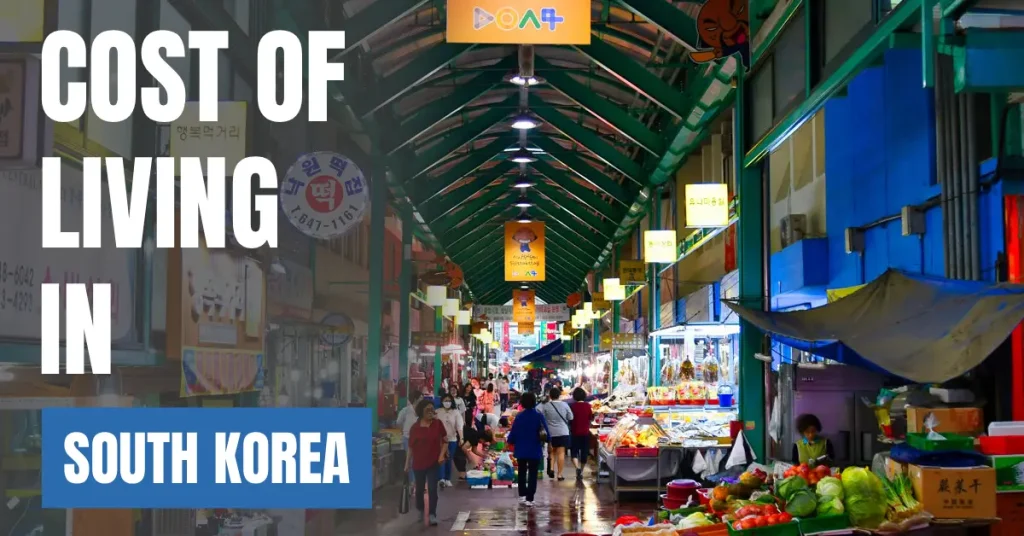
Cost of Living in South Korea 2026: Rent, Salaries and Monthly Expenses
The cost of living in South Korea in 2026 depends mainly on housing, location, household size, and lifestyle. Seoul is generally more expensive than smaller cities, particularly for rent, but South Korea also has efficient public transportation, extensive healthcare coverage, and a wide choice of restaurants and accommodation.
On this pageTable of Content
A single person renting independently can use approximately KRW 1.5 million to KRW 2.8 million per month as an initial planning range, including rent. A family of four may need KRW 4 million to KRW 7 million or more, depending on accommodation, childcare, schooling, and transportation. These are illustrative budgets rather than official household spending averages.
One important difference between South Korea and many other countries is its housing deposit system. A rental property may have an affordable monthly payment but require a substantial deposit before moving in. Foreign residents must also understand National Health Insurance eligibility and contributions.
This guide examines everyday living costs, rental prices, food, utilities, transportation, healthcare, education, salaries, and realistic monthly budgets using 2026 consumer data and government information.
Also Explore: Cost of Living in KiribatiCost of Living in South Korea at a Glance
The following figures use the South Korean won (KRW) and combine June 2026 consumer-price observations with illustrative monthly budgeting estimates. Housing deposits, tuition, relocation costs, and exceptional expenses are not automatically included in monthly totals.
| Expense | Estimated Cost (KRW) | Notes |
|---|---|---|
| Single person, excluding rent | 900,000–1,500,000/month | Illustrative allowance for everyday expenses |
| Single renter, including rent | 1,500,000–2,800,000/month | Depends on city and apartment |
| Family of four, including rent | 4,000,000–7,000,000+/month | International schooling can add substantially more |
| One-bedroom apartment, national city-center average | About 816,000/month | June 2026 crowdsourced average |
| One-bedroom apartment, national outside-center average | About 571,000/month | June 2026 crowdsourced average |
| One-bedroom apartment, central Seoul | About 1,288,000/month | June 2026 crowdsourced average |
| Groceries for one | 300,000–500,000/month | Illustrative home-cooking budget |
| Inexpensive restaurant meal | About 10,000 | Reported national average |
| Basic utilities, 85 m² apartment | About 265,000/month | Electricity, heating, cooling, water and waste |
| Home broadband | About 31,000/month | Reported national average |
| Mobile phone plan | About 54,000/month | Calls and 10 GB or more of data |
| Local transport ticket | About 1,500 | Route and operator dependent |
| Seoul Climate Card, standard monthly fare | 62,000 | Covered subway and bus services |
| Reported average net monthly salary | About 3,193,000 | Crowdsourced estimate, not an official wage average |
| 2026 statutory minimum wage | 10,320/hour | Equivalent to 2,156,880/month at 209 hours |
Sources: Numbeo South Korea, Numbeo Seoul, Minimum Wage Council, and Seoul Metropolitan Government.
How Much Does It Cost to Live in South Korea Per Month?
A single renter may spend approximately KRW 1.5 million to KRW 2.8 million monthly, including ordinary housing and living expenses. This range assumes independent accommodation rather than a premium apartment, and it excludes major one-time rental deposits.
Students using dormitories or shared accommodation may spend significantly less. The South Korean government's Study in Korea portal gives an indicative monthly student living-cost range of KRW 750,000 to KRW 1 million, although university location and accommodation arrangements can change actual expenses.
Monthly costs should be separated into:
- Costs excluding rent: Groceries, restaurant meals, utilities, transportation, phone service, internet, healthcare contributions, and personal expenses.
- Costs including rent: All recurring living costs plus the monthly payment for accommodation.
- Initial relocation costs: Rental deposits, furniture, administrative fees, and moving expenses, which require funds beyond the monthly budget.
For example, someone spending KRW 1.1 million monthly before rent would spend KRW 1.8 million in total with KRW 700,000 rent. If the same person moved to an apartment costing KRW 1.3 million, the total would rise to KRW 2.4 million, even without any change in lifestyle.
Housing is therefore one of the most important factors determining whether a South Korean salary is sufficient.
Housing and Rent Prices in South Korea
Rent varies considerably between Seoul and other cities. Properties near major business districts, universities, subway stations, and popular residential neighborhoods often command higher rents.
How Much Is Rent in South Korea?
June 2026 Numbeo data placed the national average monthly rent for a one-bedroom apartment at approximately KRW 816,000 in central locations and KRW 571,000 outside city centers. Seoul's reported averages were significantly higher.
| Apartment Type | South Korea Average | Seoul Average |
|---|---|---|
| One bedroom, city center | KRW 816,000 | KRW 1,288,000 |
| One bedroom, outside center | KRW 571,000 | KRW 872,000 |
| Three bedrooms, city center | KRW 2,092,000 | KRW 3,571,000 |
| Three bedrooms, outside center | KRW 1,339,000 | KRW 1,867,000 |
Source: Numbeo Seoul and Numbeo South Korea, June 2026.
These are reported averages across different properties and rental arrangements, not guaranteed current offers. Furnished accommodation, short-term rentals, and low-deposit options may have higher monthly costs.
Understanding Jeonse and Wolse Rental Systems
South Korea uses two important housing rental structures: jeonse and wolse. Understanding their financial implications is essential before signing a lease.
- Jeonse: A system involving a large refundable lump-sum deposit, often with no ordinary monthly rent. The deposit is intended to be returned according to the lease terms.
- Wolse: A monthly rental system typically involving both a deposit and a recurring rental payment.
The Seoul Metropolitan Government's rental guidance explains that wolse deposits can commonly equal approximately 10 to 20 times monthly rent, although actual contracts vary.
For example, a property charging KRW 800,000 per month could require several million won upfront. A deposit equal to 10 months of rent would be KRW 8 million, while 20 months would equal KRW 16 million. These calculations illustrate deposit exposure and do not represent a mandatory deposit amount for every property.
Housing Deposits and Rental Fraud Risks
Large rental deposits present a financial risk if a landlord cannot return the money. Foreign residents should verify property ownership, relevant property records, existing claims, and contract conditions before transferring substantial funds.
Seoul provides multilingual housing consultation services for international residents, including assistance aimed at preventing jeonse-related scams and resolving lease concerns.
Other expenses may include brokerage fees, building management charges, furniture, moving costs, and utilities. Tenants should confirm which charges are included in the advertised rent.
Buying Property in South Korea
Property purchases require significantly more capital than monthly rental accommodation. June 2026 Numbeo observations placed the national city-center apartment purchase benchmark at approximately KRW 20.7 million per square meter, compared with approximately KRW 36.4 million in Seoul.
These are broad consumer-market estimates, not valuations of specific properties. Foreign purchasers must also check applicable acquisition, financing, reporting, tax, and local regulatory requirements. Buying a property does not automatically confer residence rights.
Food and Grocery Costs in South Korea
Food prices vary according to shopping location, product type, season, and household preferences. Imported goods, certain fruits, beef, and specialty products can be relatively expensive, while local supermarkets, markets, and affordable restaurant options may help control spending.
A single person preparing most meals at home can use KRW 300,000 to KRW 500,000 per month as an initial grocery allowance. This is an illustrative budget rather than a measured national average.
Typical Grocery Prices in South Korea
| Item | Approximate Price (KRW) |
|---|---|
| Milk, 1 liter | 2,900 |
| White bread, 500 g | 3,920 |
| Rice, 1 kg | 4,455 |
| Eggs, 12 | 4,173 |
| Chicken fillets, 1 kg | 11,715 |
| Beef, 1 kg | 34,706 |
| Local cheese, 1 kg | 19,418 |
| Apples, 1 kg | 11,044 |
| Bananas, 1 kg | 4,573 |
| Tomatoes, 1 kg | 7,884 |
| Potatoes, 1 kg | 5,191 |
| Bottled water, 1.5 liters | 1,525 |
Source: Numbeo South Korea, updated June 12, 2026.
The reported grocery figures show why food expenses can differ substantially between households. Someone purchasing local ingredients and cooking regularly may spend considerably less than a person frequently buying imported products or prepared meals.
Residents can manage expenses by comparing local markets, neighborhood supermarkets, larger retailers, and online delivery prices. Seasonal produce and bulk purchases may be economical, but storage space and food waste should also be considered.
Restaurant and Eating Out Costs
South Korea offers a wide range of dining options, from inexpensive Korean meals to high-end restaurants. Frequent restaurant meals, food delivery, and café visits can become a substantial monthly expense.
| Restaurant Expense | Approximate Cost (KRW) |
|---|---|
| Inexpensive restaurant meal | 10,000 |
| Mid-range restaurant meal for two | 60,000 |
| Fast-food combination meal | 8,500 |
| Regular cappuccino | 5,167 |
| Soft drink, 330 ml | 2,153 |
Source: Numbeo's June 2026 countrywide consumer observations.
For example, buying a KRW 10,000 lunch on 22 working days would cost KRW 220,000 per month. Adding a KRW 5,000 coffee each working day would raise the combined monthly amount to KRW 330,000, excluding breakfast, dinner, delivery charges, and other purchases.
University cafeterias and workplace meal arrangements can sometimes reduce costs. The government-run Study in Korea portal lists university cafeteria meals at approximately KRW 5,000 to KRW 15,000.
Utilities and Household Bills
Utilities are an important part of the monthly budget, particularly for larger apartments. Electricity, heating, cooling, water, and waste-related costs depend on the property, season, household size, and building arrangements.
Numbeo's June 2026 country data reported approximately KRW 265,000 per month for basic utilities in an 85-square-meter apartment. The observed range was approximately KRW 178,000 to KRW 361,000.
Why Utility Bills Can Change Throughout the Year
- Summer: Air-conditioning can increase electricity expenses.
- Winter: Heating requirements can significantly raise energy costs.
- Apartment size: Larger properties generally require more energy.
- Building management: Apartment management charges may cover some shared services but exclude personal utility consumption.
- Insulation: Older and less efficient properties may generate higher heating and cooling bills.
New residents should ask landlords or agents for recent winter and summer bills and clarify whether apartment management fees are separate from basic utilities.
Internet and Mobile Phone Costs
South Korea has extensive digital infrastructure, making broadband and mobile connectivity important everyday services. Actual prices depend on the provider, contract, data allowance, installation requirements, and promotional terms.
| Service | Approximate Monthly Cost |
|---|---|
| Broadband internet, unlimited 60 Mbps or higher | KRW 31,000 |
| Mobile phone plan, calls and 10 GB or more | KRW 54,000 |
| Combined example | KRW 85,000 |
These are rounded June 2026 consumer-price averages. Budget mobile plans and different broadband packages may cost less, while premium packages can cost more.
Foreign residents should check whether a Korean phone number, local bank account, identification details, or residence documentation is needed to activate certain services.
Transportation Costs in South Korea
Public transportation is generally a practical alternative to owning a car, especially in Seoul and other large cities. Subway systems, buses, and rail connections allow many residents to commute without paying for parking, vehicle financing, insurance, or maintenance.
How Much Does Public Transportation Cost?
June 2026 national consumer data reported an average one-way local transportation ticket of KRW 1,500 and a monthly pass benchmark of KRW 62,000. Actual fares depend on the city, route, transfer rules, and distance.
| Transport Expense | Approximate Cost |
|---|---|
| One-way local public transport journey | KRW 1,500 |
| Regular monthly transport pass benchmark | KRW 62,000 |
| Taxi starting fare, national benchmark | KRW 4,500 |
| Taxi kilometer benchmark | KRW 900 |
| Gasoline, 1 liter | KRW 1,740 |
Source: Numbeo South Korea.
Seoul Climate Card and Transport Discounts
Seoul's Climate Card offers a flat-rate public transportation option for eligible journeys. The standard monthly subway and bus price is KRW 62,000, with other rates depending on eligibility and the selected plan.
The Seoul Metropolitan Government specifies that coverage is not universal. Certain routes, including the Sinbundang Line, GTX, express services, and some journeys outside the covered area, are excluded.
Seoul also introduced Climate Card Plus arrangements integrating flat-rate and reimbursement concepts in 2026. Travelers should check the current pass type and applicable restrictions rather than assuming every service is covered by the original pass.
For most residents with good public transport access, a monthly commuting allowance of KRW 60,000 to KRW 120,000 may be a useful starting point. Frequent taxi journeys, intercity travel, and private car ownership can increase the total.
Is Public Transportation Free in South Korea?
No. Ordinary subway and bus travel generally requires payment, although eligible groups can receive concessions or reimbursements through particular programs. A monthly flat-rate card is not equivalent to universally free transportation.
Tourists also have access to certain short-term Seoul transport passes, but their coverage and eligibility differ from ordinary resident commuting arrangements.
Healthcare Costs and National Health Insurance
South Korea has a National Health Insurance system that covers eligible residents, including many foreign nationals. However, healthcare is not completely free, and coverage depends on enrollment, applicable contributions, and the specific treatment.
Do Foreign Residents Need Health Insurance?
Many foreign employees working at covered workplaces must enroll in National Health Insurance through employment. Other qualifying foreign residents generally become subject to mandatory enrollment after six months of residence, although visa-specific rules, exceptions, and exclusions may apply.
The National Health Insurance Service provides separate guidance for employed and self-employed foreign subscribers.
How Much Does Health Insurance Cost in 2026?
For employment-based subscribers, the standard National Health Insurance contribution rate in 2026 is 7.19% of the relevant monthly wage, generally shared equally between employer and employee.
For illustration, on a monthly insured salary of KRW 3 million:
- Total National Health Insurance contribution at 7.19%: KRW 215,700.
- Employee's 50% share: KRW 107,850.
- Employer's 50% share: KRW 107,850.
Long-term care insurance and other statutory deductions are separate considerations. The NHIS 2026 contribution announcement also identified a foreign regional subscriber average premium of KRW 158,630, including the long-term care component. This is not a universal flat premium charged to every foreign resident.
Self-employed or regional insurance contributions can depend on applicable income, property, and other assessment rules, subject to relevant minimum-premium and eligibility provisions.
Is Healthcare Free in South Korea?
No. Eligible insured patients generally receive covered treatment subject to applicable cost-sharing rules. Non-covered services and certain treatments may require substantial out-of-pocket payment.
Foreign residents should check whether their insurance covers their particular medical needs, whether dependents qualify, and whether supplementary private insurance is appropriate.
Health insurance premiums and actual treatment costs should be budgeted separately. A low consultation bill does not mean the entire healthcare system is free.
Education and Childcare Costs in South Korea
Education expenses vary greatly by institution and family circumstances. Government schools, private institutions, international schools, and universities have different fee structures and enrollment conditions.
Public and International Schools
Ordinary public elementary and secondary education is generally tuition-free within the applicable public education system. However, foreign children should confirm eligibility, language support, school placement, and any additional fees.
Families choosing international schools may face much higher costs.
Numbeo's June 2026 dataset reported average annual international primary school tuition of approximately KRW 30.8 million per child nationwide. For two children, that would equal approximately KRW 61.6 million per year before any additional school-related charges.
Some schools charge separately for enrollment, uniforms, transport, meals, facilities, and activities.
Childcare and Private Kindergarten
Numbeo's national dataset reported an average monthly private full-day preschool or kindergarten price of approximately KRW 1.23 million per child, with substantial variation. Seoul's sampled average was higher, around KRW 2.37 million.
These commercial price observations should not be confused with government-supported childcare fees. Subsidies and public childcare arrangements depend on eligibility, age, residence status, and the specific program.
University Tuition Fees
The government's Study in Korea portal provides the following undergraduate annual tuition benchmarks:
| University Category | Approximate Annual Tuition |
|---|---|
| National undergraduate average | KRW 6,820,244 |
| National and public universities | KRW 4,265,842 |
| Private universities | KRW 7,625,336 |
| Metropolitan-area universities | KRW 7,654,030 |
| Non-metropolitan universities | KRW 6,316,885 |
These are published benchmarks rather than guaranteed tuition charges for the 2026 academic year at every institution. Medicine, engineering, arts, and specialized programs can have different costs, while scholarships may substantially reduce fees.
Average Salary and Minimum Wage in South Korea
South Korea has a statutory minimum wage, but actual salaries vary significantly by occupation, industry, experience, region, and employer. Housing assistance, bonuses, meals, transport allowances, and insurance can also influence the value of an employment package.
What Is the Average Salary in South Korea?
Numbeo reported a countrywide average monthly net salary of approximately KRW 3.19 million in its June 2026 consumer dataset.
This is a crowdsourced estimate of reported after-tax earnings, not an official nationwide employee wage survey. It should not be treated as the guaranteed salary for a particular position.
What Is South Korea's Minimum Wage in 2026?
The statutory minimum wage for 2026 is KRW 10,320 per hour, applicable from January 1 through December 31, 2026.
The Minimum Wage Council gives the following official equivalents:
| Minimum Wage Measure | 2026 Amount |
|---|---|
| Hourly minimum wage | KRW 10,320 |
| Eight-hour daily equivalent | KRW 82,560 |
| Monthly equivalent, 209 hours | KRW 2,156,880 |
The monthly equivalent assumes the specified 209-hour calculation, including the relevant paid weekly rest-hour convention. Actual pay, overtime, employment conditions, and deductions depend on the worker's circumstances.
The government has also announced a minimum wage of KRW 10,700 per hour for 2027, equivalent to KRW 2,236,300 per month using 209 hours. This future rate does not replace the 2026 wage during the current calendar year.
Source: Korea.net, September 22, 2026.
What Salary Is Needed to Live Comfortably?
A single person renting independently in a moderate-cost neighborhood may use KRW 2.5 million to KRW 3.5 million in monthly take-home income as a practical planning target, particularly if regular savings are important.
In central Seoul, a higher take-home income may be needed for independent housing, dining out, recreation, and savings. Families with children may require substantially more, especially when international schooling is involved.
These are illustrative affordability targets, not official income thresholds. Gross salaries must be adjusted for taxes, health insurance, pension contributions, and other applicable payroll deductions.
Taxes and Payroll Deductions
Employees in South Korea should distinguish gross salary from net take-home income. Income tax, local income tax, National Health Insurance, pension contributions, employment insurance, and other applicable deductions can reduce disposable income.
South Korea uses progressive individual income tax rates. Depending on taxable-income brackets, national income tax rates range from 6% to 45%, before applicable local income tax. Personal deductions, credits, residency status, and tax treaties can change the final calculation.
For covered employment, National Health Insurance's standard 2026 contribution rate is 7.19%, shared equally between employee and employer. This means the ordinary employee health insurance portion is 3.595% of the applicable wage before other related contributions.
Foreign residents should also check National Pension participation rules and whether relevant social security agreements affect their contributions. A job advertisement quoting KRW 3 million gross monthly salary does not mean an employee will receive the entire amount after deductions.
Realistic Monthly Budgets for South Korea
The following examples are illustrative monthly spending plans rather than observed national averages. All totals include the rent and recurring expenses shown, but exclude initial housing deposits, international relocation, tuition unless specified, and major unexpected expenses.
Budget 1: Budget-Conscious Single Person
This example assumes a modest room or small apartment outside a premium area, home cooking, public transportation, and limited leisure spending.
| Expense | Monthly Cost (KRW) |
|---|---|
| Rent | 500,000 |
| Utilities and management allowance | 130,000 |
| Groceries | 320,000 |
| Transportation | 65,000 |
| Internet and mobile | 65,000 |
| Healthcare allowance | 110,000 |
| Dining and leisure | 100,000 |
| Personal and miscellaneous | 110,000 |
| Estimated Monthly Total | 1,400,000 |
Lower-cost shared accommodation or university housing may reduce spending, while a higher insurance assessment or utility bill could increase it.
Budget 2: Moderate Single Person in Seoul
This example assumes independent apartment living, a relatively convenient location, regular groceries, public transport, and occasional dining out.
| Expense | Monthly Cost (KRW) |
|---|---|
| Rent | 1,000,000 |
| Utilities and management allowance | 200,000 |
| Groceries | 400,000 |
| Transportation | 85,000 |
| Internet and mobile | 85,000 |
| Healthcare allowance | 130,000 |
| Dining and leisure | 250,000 |
| Personal and miscellaneous | 200,000 |
| Estimated Monthly Total | 2,350,000 |
For an employed resident, healthcare deductions may already be reflected in net salary. In that case, the insurance allowance should be adjusted to avoid double-counting.
Budget 3: Couple Sharing an Apartment
This example assumes two adults sharing accommodation and household services, with moderate grocery, transportation, and leisure expenses.
| Expense | Monthly Cost (KRW) |
|---|---|
| Rent | 1,200,000 |
| Utilities and management | 250,000 |
| Groceries | 650,000 |
| Transportation | 160,000 |
| Internet and mobile | 120,000 |
| Healthcare allowance | 220,000 |
| Dining and leisure | 300,000 |
| Personal and miscellaneous | 250,000 |
| Estimated Monthly Total | 3,150,000 |
Shared accommodation and utilities may reduce the average expense per person. Different work locations or private transport needs can change the calculation.
Budget 4: Family of Four
This example assumes two adults and two children, a three-bedroom apartment outside central Seoul, household groceries, regular transport, and a modest education-related allowance.
| Expense | Monthly Cost (KRW) |
|---|---|
| Rent | 1,800,000 |
| Utilities and management | 350,000 |
| Groceries | 1,000,000 |
| Transportation | 250,000 |
| Internet and mobile | 150,000 |
| Healthcare allowance | 300,000 |
| Education and childcare allowance | 400,000 |
| Dining and leisure | 400,000 |
| Personal and miscellaneous | 350,000 |
| Estimated Monthly Total | 5,000,000 |
International education can dramatically increase this budget. For example, two children attending schools charging KRW 30 million each per year would generate KRW 60 million in annual tuition, equivalent to KRW 5 million per month when averaged over 12 months. That would be KRW 4.6 million more than the example's KRW 400,000 education allowance, raising its illustrative monthly equivalent to KRW 9.6 million before other school fees.
Cost of Living in Different South Korean Cities
Seoul typically has higher housing costs than many smaller cities, but individual neighborhoods and accommodation types matter more than a city name alone.
Seoul
Seoul offers major employment opportunities, universities, extensive subway connections, international schools, healthcare facilities, and entertainment. It also has some of the country's highest apartment rents and large housing deposit requirements.
Residents may save on transportation by choosing an apartment near convenient subway connections, even if the monthly rent is slightly higher.
Busan
Busan is a large coastal city with commercial districts, universities, and public transport. Housing can be more affordable than comparable accommodation in central Seoul, although desirable coastal neighborhoods and modern apartments can command premium prices.
Incheon
Incheon is connected to the Seoul metropolitan region and has employment, airport-related industries, and residential developments. Some districts may offer lower housing prices, but commuting costs and travel times must be considered.
Daegu
Daegu may appeal to residents looking for urban facilities without necessarily paying central Seoul housing prices. Summer cooling expenses, job location, and neighborhood transport access are relevant budgeting factors.
Daejeon
Daejeon is known for its research institutions, universities, and transport connections. It may offer a practical alternative for students, researchers, and professionals whose work is located in the region.
City comparisons should be based on actual available rental properties, commuting requirements, insurance arrangements, and household needs. Reliable standardized rental samples are more comprehensive for Seoul than for every smaller city.
How Does South Korea Compare With Nearby Countries?
South Korea is not automatically cheaper than Japan. The comparison depends on the particular expense, city, housing arrangement, and exchange-rate conditions.
Numbeo's 2026 Eastern Asia rankings reported the following cost-of-living indices:
| Country | Cost of Living Index | Cost of Living Plus Rent Index |
|---|---|---|
| South Korea | 61.6 | 41.3 |
| Japan | 47.5 | 32.8 |
| Taiwan | 49.7 | 33.9 |
| China | 30.5 | 21.5 |
Source: Numbeo Eastern Asia 2026 Cost of Living Index.
These figures suggest South Korea was more expensive overall than Japan, Taiwan, and China in this particular dataset. However, category comparisons can produce different results.
For instance, the June 2026 South Korea and Japan comparison reported higher average prices in South Korea for certain groceries, including milk, bread, eggs, and beef, while rice was more expensive in Japan in the same comparison.
Disposable income is equally important. Two countries with similar rents may offer very different affordability outcomes if salaries, tax deductions, healthcare contributions, and household benefits differ.
Hidden Costs New Residents Often Overlook
Relocating to South Korea can require significantly more money than the first month's living expenses.
- Rental deposits: Wolse and jeonse arrangements may require substantial upfront capital.
- Brokerage and contract costs: Property agents and administrative procedures may involve fees.
- Building management charges: These may be separate from advertised monthly rent.
- Furniture and appliances: Some rentals are only partially furnished.
- Health insurance: Contributions and treatment co-payments can increase expenses.
- Seasonal heating and cooling: Winter and summer bills may be higher than mild-season estimates.
- International school fees: Tuition, transportation, registration, and uniforms can be expensive.
- Visa and residence documentation: Immigration procedures and renewals may involve fees.
- International transfers: Currency conversion charges and exchange-rate changes can affect savings.
- Travel home: International airfare should be budgeted separately from ordinary living expenses.
New arrivals should prepare a separate relocation reserve rather than attempting to cover deposits and setup expenses from their ordinary monthly spending budget.
Cost of Living Versus Visa Financial Requirements
Monthly affordability and immigration financial eligibility are different issues. A foreign national may have enough money to pay rent and living expenses but still need to meet specific financial documentation requirements for a particular visa.
Student visas, employment visas, family residence categories, and other long-term permissions have different requirements. Financial evidence may include bank statements, scholarship documents, employer sponsorship, or proof of financial support, depending on the category and consular jurisdiction.
For example, South Korea's embassy guidance for student applicants in Pakistan describes bank statements, financial guarantees, and supporting documentation for D-2 applicants. Requirements can differ for other applicants and residence categories.
A bank-balance requirement is not a monthly household living cost. Nor is a government student living-cost estimate automatically sufficient to satisfy every visa's financial conditions.
Applicants should verify the latest category-specific requirements through the Korea Visa Portal and the Korean embassy or consulate responsible for their application.
Is South Korea Affordable for Expats, Students and Families?
South Korea can offer good living standards for residents with sufficient income and suitable housing. However, affordability varies considerably across different groups.
Students
Students using university dormitories, shared apartments, and subsidized dining options may be able to control expenses. The government's KRW 750,000 to KRW 1 million monthly student estimate is a useful reference, but tuition and some exceptional expenses are additional.
Single Professionals
Single professionals can benefit from public transport and a wide selection of housing. However, a central Seoul apartment and large deposit requirements may consume a substantial share of available income.
Couples
Couples can share rent, internet, utilities, and household expenses. Whether one or both partners earn income significantly affects affordability.
Families
Families should pay particular attention to accommodation size, schooling, childcare, medical insurance, and transport. International school tuition can transform an otherwise moderate household budget into a high-cost arrangement.
Foreign Employees
Foreign employees should compare complete compensation packages, not only advertised salaries. Employer-provided housing, meals, transportation, insurance, or education benefits can materially reduce household spending.
Conclusion: Is South Korea Expensive in 2026?
South Korea offers reliable infrastructure, extensive transport connections, and diverse housing and lifestyle choices, but it is not necessarily a low-cost destination. Seoul housing, large rental deposits, certain groceries, and international education can make relocation expensive.
A single renter may use KRW 1.5 million to KRW 2.8 million per month as an initial living-cost planning range, while a family of four may need KRW 4 million to KRW 7 million or more. These figures include ordinary recurring housing costs but exclude major upfront deposits and expensive private education unless specifically budgeted.
The general statutory minimum wage in 2026 is KRW 10,320 hourly, while the reported consumer-survey average monthly net salary is around KRW 3.19 million. The difference between earnings and actual disposable income remains central to affordability.
Before moving, compare specific rental listings, upfront deposits, employer benefits, expected take-home pay, healthcare contributions, and education requirements. A realistic city-specific budget provides a much more reliable picture than a single nationwide average.
Sources and Methodology
This article was reviewed in October 2026 using publicly available government guidance, South Korean health insurance information, official minimum wage announcements, government education resources, Seoul transport and housing guidance, and 2026 consumer-price databases.
The main national consumer-price data were last updated by Numbeo on June 12, 2026 and were based on 1,909 entries from 203 contributors over the preceding 12 months. These voluntary observations may not adequately represent every region, income group, rental arrangement, or household.
Rent and consumer prices fluctuate. Data sources can also use different definitions, including gross versus net salary, national versus city samples, and costs with or without rent. The monthly budgets presented here are illustrative calculations rather than official expenditure statistics.
Sources Used
- VisaBoards: Original South Korea Cost of Living Guide
- Numbeo: South Korea Consumer Prices, June 2026
- Numbeo: Seoul Consumer Prices, June 2026
- Minimum Wage Council: Official 2026 Minimum Wage
- Korea.net: 2027 Minimum Wage Announcement
- Seoul Metropolitan Government: Wolse and Jeonse
- Seoul Metropolitan Government: Climate Card
- Seoul Metropolitan Government: Climate Card Plus
- National Health Insurance Service: Guidance for Foreigners
- National Health Insurance Service: Contribution Rates
- National Health Insurance Service: 2026 Premium Information
- Study in Korea: Monthly Living Expenses
- Study in Korea: Tuition and Education Expenses
- Embassy of the Republic of Korea: Visa Financial Documentation
- Numbeo: Eastern Asia 2026 Comparison
- Numbeo: South Korea and Japan Comparison
Frequently Asked Questions
How much does it cost to live in South Korea per month?
A single person renting independently may need approximately KRW 1.5 million to KRW 2.8 million monthly, including ordinary housing, utilities, groceries, transportation, communications, and personal spending. Students in dormitories or shared accommodation may spend less. Seoul is usually more expensive than many smaller cities. These figures are illustrative planning ranges and do not include major upfront housing deposits or unusual medical and education expenses.
How much is rent in South Korea in 2026?
June 2026 consumer data reported average one-bedroom rents of approximately KRW 816,000 in city centers and KRW 571,000 outside central areas nationwide. In Seoul, corresponding averages were around KRW 1.29 million and KRW 872,000. Actual rents vary by neighborhood, building, furnishing, and deposit arrangement. Tenants should also budget for potentially substantial wolse or jeonse deposits.
What salary is enough to live comfortably in South Korea?
A single renter may use KRW 2.5 million to KRW 3.5 million in monthly take-home income as an illustrative target for a moderate lifestyle, depending on the city and housing arrangement. Central Seoul apartments, private transport, and frequent dining can require more. Families generally need higher household incomes, particularly with children in international schools. Net pay and employer benefits matter more than gross salary alone.
What is the minimum wage in South Korea in 2026?
The official minimum wage is KRW 10,320 per hour in 2026, equivalent to KRW 2,156,880 per month using the government's standard 209-hour calculation. The rate applies from January 1 through December 31, 2026. A higher minimum wage of KRW 10,700 per hour has already been announced for 2027, but that future rate does not apply during 2026.
Is healthcare free in South Korea for foreigners?
No. South Korea's National Health Insurance system covers many qualifying foreign residents, but premiums and patient cost-sharing usually apply. Covered foreign employees generally enroll through their workplace, while other eligible foreign residents are often subject to enrollment rules after six months. The standard employment-based National Health Insurance contribution rate in 2026 is 7.19%, ordinarily shared equally between employee and employer. Individual eligibility and charges vary.
How much money does a student need in South Korea?
The government's Study in Korea portal estimates typical monthly student living expenses at approximately KRW 750,000 to KRW 1 million. Actual costs depend on university location, dormitory availability, food, and personal spending. Tuition is separate, with published undergraduate averages of approximately KRW 4.27 million annually at national and public universities and KRW 7.63 million at private universities. Scholarships can reduce these expenses.
Is public transportation free in South Korea?
No. Ordinary public transportation generally requires payment. June 2026 consumer data reported a typical one-way local ticket of approximately KRW 1,500. Seoul's standard Climate Card monthly fare is KRW 62,000 for covered services, with discounts or alternative arrangements for eligible users. Coverage restrictions apply to certain routes and services, so travelers should verify their journeys before purchasing a pass.
What is the difference between jeonse and wolse housing?
Jeonse typically involves paying a substantial refundable deposit instead of regular monthly rent. Wolse normally requires a smaller deposit plus monthly rental payments. Both systems can create significant upfront expenses. Deposits depend on the property and agreement, and tenants should verify ownership, contractual conditions, and repayment risks before transferring funds. Monthly rent alone does not reveal the full financial commitment.
How much does a family of four need in South Korea?
A family of four can use approximately KRW 4 million to KRW 7 million or more as an initial monthly budget including ordinary housing expenses. This guide's moderate family example totals KRW 5 million. International schooling may increase that amount substantially, potentially adding several million won per month for two children. Childcare, healthcare, commuting arrangements, and the chosen city also affect the budget.
Is South Korea cheaper than Japan?
Not necessarily. Numbeo's 2026 Eastern Asia dataset placed South Korea above Japan in its overall cost-of-living and combined cost-plus-rent indices. Certain everyday goods, including milk, bread, and beef, were also more expensive in South Korea in its June comparison. However, some categories were cheaper, and results depend on the cities being compared. Salary levels and purchasing power also affect overall affordability.
What are the cheapest cities to live in South Korea?
Cities such as Daegu, Daejeon, and some parts of Busan or Incheon may offer more affordable housing alternatives to central Seoul. However, prices depend on the actual neighborhood, apartment, and proximity to transport and employment. Reliable comparable rental data are limited for some smaller cities. A lower advertised rent may not reduce total spending if commuting or other household costs increase.
Do foreigners need proof of funds to live in South Korea?
Financial documentation depends on the visa category and consular requirements. Student visa applicants may need bank statements, scholarships, or financial guarantees, while employment and other residence categories have different conditions. Monthly living-cost estimates are not universal visa financial thresholds. Applicants should verify the specific requirements with the Korean embassy or consulate handling their application and the official Korea Visa Portal.
Join the conversation
Have thoughts on this topic? Share them with others.
Ask questions, share experience, and learn from the Visaboards Community.