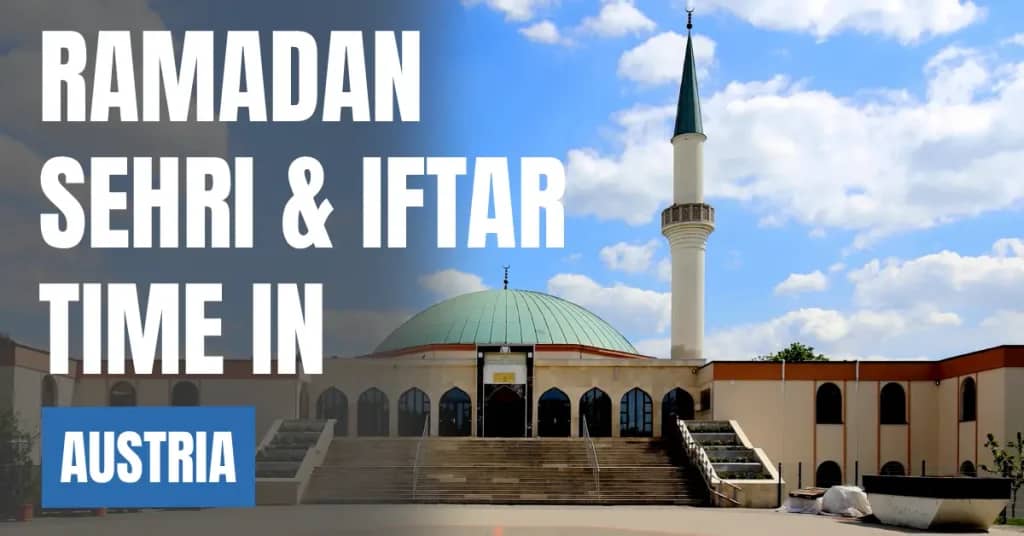
Ramadan in Austria is observed by Muslim communities across cities such as Vienna, Graz, Linz, and Salzburg. Located in Central Europe, Austria experiences large seasonal daylight changes, which directly affect fasting hours.
On this pageTable of Content
This page provides today’s Sehri and Iftar time in Vienna along with the complete 30-day Ramadan calendar. You’ll also find information about fasting duration, time zones, and regional timing differences within Austria.
Today Sehri & Iftar Time
(function() {
const config = {"city":"Capital City","country":"Austria","mode":"today","school":"0"};
const container = document.getElementById('content-rc_6ab845c04c60d');
const loading = document.getElementById('loading-rc_6ab845c04c60d');
async function init() {
try {
const year = new Date().getFullYear();
const p = `city=${encodeURIComponent(config.city)}&country=${encodeURIComponent(config.country)}&method=2`;
const urls = [
`https://api.aladhan.com/v1/calendarByCity/${year}/2?${p}&school=1`,
`https://api.aladhan.com/v1/calendarByCity/${year}/3?${p}&school=1`,
`https://api.aladhan.com/v1/calendarByCity/${year}/2?${p}&school=0`,
`https://api.aladhan.com/v1/calendarByCity/${year}/3?${p}&school=0`
];
const res = await Promise.all(urls.map(u => fetch(u).then(r => r.json())));
const h = [...res[0].data, ...res[1].data].filter(d => parseInt(d.date.hijri.month.number) === 9);
const j = [...res[2].data, ...res[3].data].filter(d => parseInt(d.date.hijri.month.number) === 9);
render(h, j);
} catch (e) { loading.innerText = "Failed to load calendar."; }
}
function fmt(t) {
let [h, m] = t.split(' ')[0].split(':');
h = parseInt(h);
return `${(h % 12 || 12).toString().padStart(2,'0')}:${m} ${h >= 12 ? 'PM' : 'AM'}`;
}
function render(hanafi, jafria) {
loading.classList.add('hidden');
container.classList.remove('hidden');
const day = new Date().getDate().toString().padStart(2, '0');
const month = new Date().toLocaleString('en-GB', { month: 'long' });
const hT = hanafi.find(d => d.date.gregorian.day === day && d.date.gregorian.month.en === month) || hanafi[0];
const jT = jafria.find(d => d.date.gregorian.day === day && d.date.gregorian.month.en === month) || jafria[0];
const gDate = `${hT.date.gregorian.day} ${hT.date.gregorian.month.en} ${hT.date.gregorian.year}`;
if (config.mode === 'paragraph') {
container.innerHTML = `
${gDate} - ${hT.date.hijri.day} Ramadan for Hanafi ${config.city}: Sehr ${fmt(hT.timings.Fajr)}, Iftar ${fmt(hT.timings.Maghrib)}. For Jafri: Sehr ${fmt(jT.timings.Fajr)}, Iftar ${fmt(jT.timings.Maghrib)}.
`;
} else if (config.mode === 'table') {
const data = config.school === '1' ? jafria : hanafi;
const label = config.school === '1' ? 'Jafri (Shia)' : 'Hanafi (Sunni)';
let html = `
Today Hanafi (Sunni) Sehr And Iftar Time ${config.city}
Sehrسحور
${fmt(hT.timings.Fajr)}
${gDate}
Iftarإفطار
${fmt(hT.timings.Maghrib)}
${gDate}
Today Jafri (Shia) Sehr And Iftar Time ${config.city}
Sehrسحور
${fmt(jT.timings.Fajr)}
${gDate}
Iftarإفطار
${fmt(jT.timings.Maghrib)}
${gDate}
`;
}
}
init();
})();
30 Days Ramadan Calendar
The Ramadan calendar below displays the full 30 days Sehri and Iftar schedule for Vienna, Austria. Timings are based on precise astronomical sunrise and sunset calculations for the capital.
Both commonly followed calculation methods are available below for reference. You may follow the schedule preferred by your local mosque or Islamic center.
(function() {
const config = {"city":"Capital City","country":"Austria","mode":"table","school":"0"};
const container = document.getElementById('content-rc_6ab845c04c630');
const loading = document.getElementById('loading-rc_6ab845c04c630');
async function init() {
try {
const year = new Date().getFullYear();
const p = `city=${encodeURIComponent(config.city)}&country=${encodeURIComponent(config.country)}&method=2`;
const urls = [
`https://api.aladhan.com/v1/calendarByCity/${year}/2?${p}&school=1`,
`https://api.aladhan.com/v1/calendarByCity/${year}/3?${p}&school=1`,
`https://api.aladhan.com/v1/calendarByCity/${year}/2?${p}&school=0`,
`https://api.aladhan.com/v1/calendarByCity/${year}/3?${p}&school=0`
];
const res = await Promise.all(urls.map(u => fetch(u).then(r => r.json())));
const h = [...res[0].data, ...res[1].data].filter(d => parseInt(d.date.hijri.month.number) === 9);
const j = [...res[2].data, ...res[3].data].filter(d => parseInt(d.date.hijri.month.number) === 9);
render(h, j);
} catch (e) { loading.innerText = "Failed to load calendar."; }
}
function fmt(t) {
let [h, m] = t.split(' ')[0].split(':');
h = parseInt(h);
return `${(h % 12 || 12).toString().padStart(2,'0')}:${m} ${h >= 12 ? 'PM' : 'AM'}`;
}
function render(hanafi, jafria) {
loading.classList.add('hidden');
container.classList.remove('hidden');
const day = new Date().getDate().toString().padStart(2, '0');
const month = new Date().toLocaleString('en-GB', { month: 'long' });
const hT = hanafi.find(d => d.date.gregorian.day === day && d.date.gregorian.month.en === month) || hanafi[0];
const jT = jafria.find(d => d.date.gregorian.day === day && d.date.gregorian.month.en === month) || jafria[0];
const gDate = `${hT.date.gregorian.day} ${hT.date.gregorian.month.en} ${hT.date.gregorian.year}`;
if (config.mode === 'paragraph') {
container.innerHTML = `
${gDate} - ${hT.date.hijri.day} Ramadan for Hanafi ${config.city}: Sehr ${fmt(hT.timings.Fajr)}, Iftar ${fmt(hT.timings.Maghrib)}. For Jafri: Sehr ${fmt(jT.timings.Fajr)}, Iftar ${fmt(jT.timings.Maghrib)}.
`;
} else if (config.mode === 'table') {
const data = config.school === '1' ? jafria : hanafi;
const label = config.school === '1' ? 'Jafri (Shia)' : 'Hanafi (Sunni)';
let html = `
Today Hanafi (Sunni) Sehr And Iftar Time ${config.city}
Sehrسحور
${fmt(hT.timings.Fajr)}
${gDate}
Iftarإفطار
${fmt(hT.timings.Maghrib)}
${gDate}
Today Jafri (Shia) Sehr And Iftar Time ${config.city}
Sehrسحور
${fmt(jT.timings.Fajr)}
${gDate}
Iftarإفطار
${fmt(jT.timings.Maghrib)}
${gDate}
`;
}
}
init();
})();
(function() {
const config = {"city":"Capital City","country":"Austria","mode":"table","school":"1"};
const container = document.getElementById('content-rc_6ab845c04c63b');
const loading = document.getElementById('loading-rc_6ab845c04c63b');
async function init() {
try {
const year = new Date().getFullYear();
const p = `city=${encodeURIComponent(config.city)}&country=${encodeURIComponent(config.country)}&method=2`;
const urls = [
`https://api.aladhan.com/v1/calendarByCity/${year}/2?${p}&school=1`,
`https://api.aladhan.com/v1/calendarByCity/${year}/3?${p}&school=1`,
`https://api.aladhan.com/v1/calendarByCity/${year}/2?${p}&school=0`,
`https://api.aladhan.com/v1/calendarByCity/${year}/3?${p}&school=0`
];
const res = await Promise.all(urls.map(u => fetch(u).then(r => r.json())));
const h = [...res[0].data, ...res[1].data].filter(d => parseInt(d.date.hijri.month.number) === 9);
const j = [...res[2].data, ...res[3].data].filter(d => parseInt(d.date.hijri.month.number) === 9);
render(h, j);
} catch (e) { loading.innerText = "Failed to load calendar."; }
}
function fmt(t) {
let [h, m] = t.split(' ')[0].split(':');
h = parseInt(h);
return `${(h % 12 || 12).toString().padStart(2,'0')}:${m} ${h >= 12 ? 'PM' : 'AM'}`;
}
function render(hanafi, jafria) {
loading.classList.add('hidden');
container.classList.remove('hidden');
const day = new Date().getDate().toString().padStart(2, '0');
const month = new Date().toLocaleString('en-GB', { month: 'long' });
const hT = hanafi.find(d => d.date.gregorian.day === day && d.date.gregorian.month.en === month) || hanafi[0];
const jT = jafria.find(d => d.date.gregorian.day === day && d.date.gregorian.month.en === month) || jafria[0];
const gDate = `${hT.date.gregorian.day} ${hT.date.gregorian.month.en} ${hT.date.gregorian.year}`;
if (config.mode === 'paragraph') {
container.innerHTML = `
${gDate} - ${hT.date.hijri.day} Ramadan for Hanafi ${config.city}: Sehr ${fmt(hT.timings.Fajr)}, Iftar ${fmt(hT.timings.Maghrib)}. For Jafri: Sehr ${fmt(jT.timings.Fajr)}, Iftar ${fmt(jT.timings.Maghrib)}.
`;
} else if (config.mode === 'table') {
const data = config.school === '1' ? jafria : hanafi;
const label = config.school === '1' ? 'Jafri (Shia)' : 'Hanafi (Sunni)';
let html = `
Today Hanafi (Sunni) Sehr And Iftar Time ${config.city}
Sehrسحور
${fmt(hT.timings.Fajr)}
${gDate}
Iftarإفطار
${fmt(hT.timings.Maghrib)}
${gDate}
Today Jafri (Shia) Sehr And Iftar Time ${config.city}
Sehrسحور
${fmt(jT.timings.Fajr)}
${gDate}
Iftarإفطار
${fmt(jT.timings.Maghrib)}
${gDate}
`;
}
}
init();
})();
Ramadan Fasting Hours in Austria
Fasting hours in Austria vary significantly depending on the season. When Ramadan falls in late spring or summer (May–July), daylight can last up to 16–17 hours in Vienna and northern regions.
In winter months (November–January), fasting hours are much shorter, averaging between 8 and 10 hours. The variation is due to Austria’s higher latitude within Europe.
Time Zone & Regional Sehri Iftar Differences
Austria follows Central European Time (CET, UTC +1) and Central European Summer Time (CEST, UTC +2) during daylight saving periods. Clock changes can affect Sehri and Iftar times by one hour during the summer season.
Although Austria operates within a single time zone, sunrise and sunset times may vary slightly between eastern cities like Vienna and western regions such as Innsbruck due to geographic positioning.
Ramadan Schedule & Daily Life in Austria
Ramadan is not a public holiday in Austria. Workplaces, schools, and public institutions continue regular operations. However, Austria recognizes Islam as an official religion, and Muslim communities are well-established.
Mosques and Islamic centers in Vienna and other cities organize community Iftar events and evening prayers. Many families adjust their routines around Sehri and Iftar while maintaining normal daily commitments.
How Sehri & Iftar Times Are Calculated in Austria
Sehri ends at astronomical dawn (Fajr), and Iftar begins precisely at sunset (Maghrib). These times are determined using solar angle calculations based on Vienna’s latitude, longitude, and applicable time zone.
Because Austria observes daylight saving time, annual Ramadan schedules must account for clock adjustments when applicable.
FAQ
1. What time zone does Austria follow during Ramadan?
Austria follows CET (UTC +1) and switches to CEST (UTC +2) during daylight saving time.
2. How long are fasting hours in Austria?
Fasting hours range from around 8–10 hours in winter to 16–17 hours in summer, depending on when Ramadan occurs.
3. Does daylight saving time affect Sehri and Iftar times in Austria?
Yes. During summer, clocks move forward by one hour, which shifts both Sehri and Iftar timings accordingly.
4. Is Ramadan a public holiday in Austria?
No, Ramadan is not a public holiday, and regular business and school schedules continue.
5. Should I follow Vienna’s Ramadan calendar if I live elsewhere in Austria?
It is best to follow the Ramadan timetable for your specific city, as sunrise and sunset times may vary slightly across regions.
Conclusion
Ramadan in Austria is observed by established Muslim communities across the country. Due to long summer days and shorter winter daylight hours, fasting durations vary significantly. Always follow accurate local Sehri and Iftar timings for your city.