
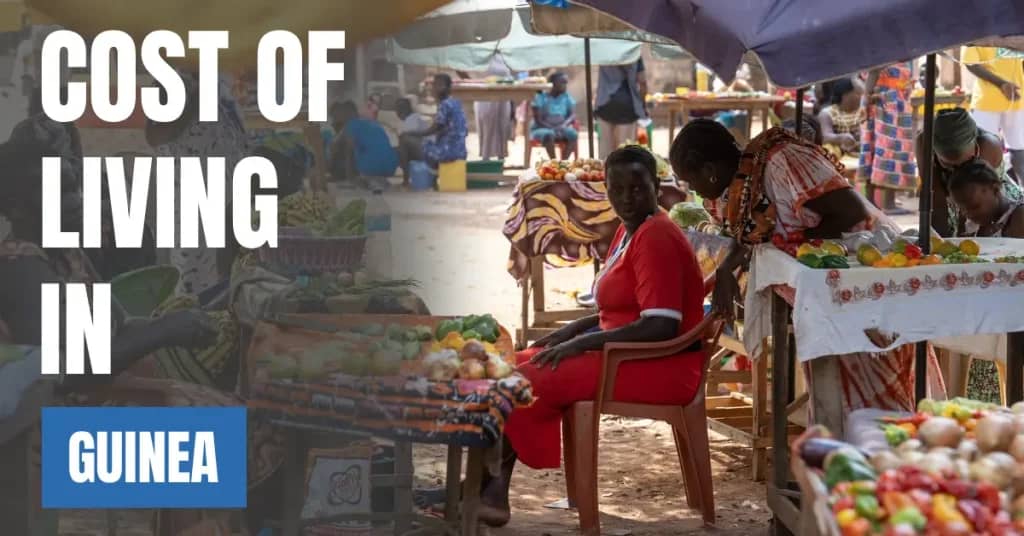
Cost of Living in Guinea 2026: Rent, Food, Salaries and Monthly Expenses
The cost of living in Guinea in 2026 depends heavily on where you live, the type of accommodation you rent and whether you rely on local goods or imported products. Guinea can be affordable for households using local markets and shared transportation, but housing, electricity backup, private healthcare and international schooling can make life in Conakry considerably more expensive.
On this pageTable of Content
For a single person renting modest accommodation, an illustrative monthly budget is approximately GNF 5,000,000 to GNF 12,000,000, including rent. People choosing furnished apartments in desirable Conakry neighbourhoods may spend considerably more. Families requiring larger housing, private schools or expatriate-level services should plan for significantly higher expenses.
This guide covers housing, groceries, transport, utilities, internet, healthcare, education, salaries and practical monthly budgets. It also explains why low national wages do not necessarily translate into inexpensive urban living.
Cost of Living in Guinea at a Glance
Guinea's main affordability advantage is access to local food and relatively inexpensive shared transportation. Its main cost pressures are urban housing, imported products and services needed to compensate for infrastructure limitations.
| Expense | Estimated Cost in GNF | Notes |
|---|---|---|
| Budget single person, including rent | 5,000,000 to 7,500,000 monthly | Modest accommodation and predominantly local spending |
| Moderate single person, including rent | 9,000,000 to 12,000,000 monthly | Private apartment and more discretionary spending |
| Couple, including rent | 11,000,000 to 18,000,000 monthly | Shared housing costs, excluding dependants |
| Family of four, including rent | 18,000,000 to 30,000,000 monthly | Excludes expensive international schooling |
| Single person, excluding rent | 2,500,000 to 6,000,000 monthly | Food, basic utilities, transport and personal expenses |
| Furnished studio in a normal Conakry area | About 2,500,000 monthly | Limited-sample market estimate |
| Furnished studio in an expensive Conakry area | About 8,100,000 monthly | Location and building quality affect prices |
| Groceries for one person | 1,500,000 to 3,000,000 monthly | Depends on diet and shopping habits |
| Local transport | 200,000 to 800,000 monthly | Shared transport, with occasional taxi use |
| Utilities and communication | 500,000 to 2,000,000 monthly | Electricity, water, mobile and internet needs vary |
| Statutory monthly minimum wage | 550,000 | Rate established on June 1, 2022, still listed in 2026 |
Important: Most household ranges above are illustrative planning budgets, not official national averages. Market observations vary widely, and data from Conakry cannot be applied directly to every region.
How Much Does It Cost to Live in Guinea Per Month?
A budget-conscious single renter may need approximately GNF 5 million to GNF 7.5 million per month, including rent. A person seeking more comfortable private accommodation, dependable communications and greater flexibility for dining or taxis may require GNF 9 million to GNF 12 million or more.
A couple sharing accommodation may plan around GNF 11 million to GNF 18 million monthly. A family of four might need GNF 18 million to GNF 30 million for a moderate lifestyle before premium international school fees and unusually expensive housing.
These budgets assume that most meals are prepared at home, transport costs remain controlled and households do not require luxury accommodation. They are not measurements of what the typical Guinean household actually spends.
For context, the June 2026 Livingcost estimate for Conakry placed a single person's monthly expenses at approximately US$1,050 with rent and US$541 without rent. Its family-of-four estimate was approximately US$2,385 with rent. A separate October 2026 Expatistan estimate was substantially higher, but explicitly warned that it relied on only a few price observations.
These differences show why a single published average should not determine a relocation budget. Housing standards, sample composition, exchange-rate assumptions and the inclusion of imported goods can produce very different totals.
Housing and Rent Prices in Guinea
Housing is often the biggest expense for newcomers to Guinea, particularly in Conakry. Rental costs depend on neighbourhood, furnishing, building security, access to reliable water and electricity, and proximity to workplaces or schools.
How Much Is Rent in Conakry?
A furnished studio in an ordinary Conakry location was listed at approximately GNF 2.5 million per month in Expatistan's October 2026 observations, while a comparable studio in an expensive location was approximately GNF 8.14 million.
| Accommodation | Indicative Monthly Rent |
|---|---|
| Furnished studio, normal area | GNF 2,500,000 |
| Furnished studio, expensive area | GNF 8,140,000 |
| Furnished 85 m² apartment, normal area | GNF 6,500,000 |
| Furnished 85 m² apartment, expensive area | GNF 19,220,000 |
These are market observations from a small dataset, not guaranteed asking prices or nationally representative averages. Larger properties with security, generators and reliable services may be far more expensive than basic local accommodation.
What Affects Rental Prices?
- Location: Central and business-oriented neighbourhoods may command substantial premiums.
- Furnishing: Furnished housing can cost more than an unfurnished property.
- Utilities: Backup electricity, water storage and maintenance arrangements may increase the rent or create additional monthly expenses.
- Security: Compounds with guards and controlled access can have higher recurring costs.
- Lease terms: Advance payments, security deposits and agency commissions can increase the initial cash required.
Prospective tenants should confirm which services are included, inspect the property and obtain clear written terms before paying. Asking several landlords or agents for comparable quotations is more useful than relying only on national cost-of-living averages.
Buying Property in Guinea
Property ownership requires careful examination of land rights, title documentation, registration and applicable legal restrictions. Buyers should obtain independent legal advice and verify records through the appropriate authorities before transferring funds. Purchase prices are too property-specific to summarize responsibly using one national figure.
Groceries and Food Prices in Guinea
Groceries can remain relatively affordable for households buying rice, local vegetables, seasonal fruit, fish and other locally available foods. Imported packaged goods, specialist dietary products and supermarket purchases can cost considerably more.
For a single person, a practical starting allowance is approximately GNF 1.5 million to GNF 3 million per month. A family of four may budget around GNF 4.5 million to GNF 7 million for basic household food, potentially more if imported products are purchased frequently.
Indicative Grocery Prices in Conakry
| Item | Indicative Price |
|---|---|
| Milk, 1 litre | GNF 19,200 |
| Eggs, 12 | GNF 18,400 |
| Tomatoes, 1 kg | GNF 14,900 |
| Potatoes, 1 kg | GNF 12,700 |
| Apples, 1 kg | GNF 39,300 |
| Boneless chicken breast, 500 g | GNF 40,100 |
These rounded October 2026 observations come from Expatistan and are subject to its small-sample warning. Local market prices can differ from supermarket prices, sometimes substantially.
Food prices are also affected by transport costs, seasonal supply, imported-product availability and inflation. The World Bank reported that overall inflation eased to 3.2% in 2025 from 5.1% in 2024. This does not mean every grocery item became cheaper.
Restaurants and Eating Out in Guinea
Eating out can be inexpensive at local food vendors, but restaurant prices vary sharply by establishment and neighbourhood. International-style restaurants and business-district dining can be substantially more expensive.
Expatistan's October 2026 Conakry observations listed a basic business-district lunch with a drink at approximately GNF 103,700 and a fast-food combo at approximately GNF 73,800.
Residents who eat local meals occasionally and prepare most food at home can keep their expenses relatively controlled. Daily restaurant meals, food delivery and imported beverages can quickly increase the monthly budget.
For illustrative planning, a single person might reserve GNF 200,000 to GNF 800,000 monthly for eating out and leisure, while a household using restaurants frequently should expect to spend more.
Utilities: Electricity, Water and Cooking Gas
Utilities in Guinea should be budgeted according to consumption and the reliability of the property's infrastructure. The advertised electricity or water bill may not represent the full cost of maintaining a comfortable home.
Expatistan's October 2026 observations listed approximately GNF 368,600 in utilities for one person occupying a 45 m² studio and around GNF 1.4 million for two people occupying an 85 m² apartment.
Actual expenses may be higher when a property requires:
- Generator fuel and servicing during electricity interruptions.
- Backup batteries or solar equipment.
- Water tanks, pumps, filters or delivered drinking water.
- Air conditioning or additional cooling.
- Repairs and shared-building maintenance.
A renter should ask whether backup power is included, who pays for generator fuel and how electricity and water consumption are measured.
Internet and Mobile Phone Costs
Internet and mobile communication costs depend on location, provider, speed and data consumption. Mobile services may be sufficient for everyday communication, while remote work can require a more dependable fixed or mobile broadband connection.
Expatistan's October 2026 observations showed approximately GNF 702,400 per month for an 8 Mbps internet connection in Conakry. This is a limited market observation, not a universal national tariff.
For basic phone use, residents can choose prepaid or recurring mobile packages. Heavy video calling, streaming, uploads and other professional activities may require additional data or a second connection.
People moving to Guinea for remote employment should test actual connectivity at their intended property before signing a long lease. Download speed, upload speed, outages and power availability are all relevant.
Transportation Costs in Guinea
Shared taxis and minibuses are among the main lower-cost transport options in Guinea. Urban travel is not universally free, and the country should not be treated as having a single standardized public-transport fare or nationwide monthly pass.
Local reporting from August 2026 indicated that taxi journeys in Conakry commonly cost approximately GNF 5,000 to GNF 30,000 depending on distance and arrangements, with shared taxis playing an important role in daily mobility.
Monthly Transportation Budget
A person relying mostly on shared transportation might set aside approximately GNF 200,000 to GNF 800,000 per month. Frequent private taxis, hired drivers or personal vehicle use can push transportation expenses much higher.
Vehicle owners should also allow for:
- Fuel and changing pump prices.
- Repairs and replacement parts.
- Insurance and registration.
- Parking and security.
- Increased travel time during congestion.
- Additional maintenance during difficult road conditions or the rainy season.
Transport availability and route convenience can vary significantly outside Conakry. Newcomers should investigate their actual commute rather than assuming inexpensive fares automatically mean inexpensive daily travel.
Healthcare Costs in Guinea
Healthcare in Guinea is not universally free. Public and private services operate alongside one another, while medicine, laboratory tests, consultations and hospital treatment may involve direct household payments.
The World Health Organization's Guinea country profile reports healthcare expenditure of approximately US$59.30 per person in 2023. This is a national health-spending statistic, not the price of an individual appointment.
World Bank data using WHO health expenditure information also documents substantial out-of-pocket healthcare spending. People considering relocation should not assume that a low-cost consultation guarantees affordable treatment overall.
Public and Private Healthcare
Public facilities are important sources of healthcare, although service availability and equipment differ by location. Private clinics may offer different waiting times or service arrangements, but patients should check qualifications, diagnostic capacity, fees and emergency capabilities.
Costs can arise from:
- Medical consultations and specialist appointments.
- Diagnostic tests and imaging.
- Prescription medicines.
- Hospital stays and surgical procedures.
- Maternity care and paediatric services.
- Emergency transport and treatment.
- Medical evacuation when appropriate treatment is unavailable locally.
For expatriates, health insurance should be examined carefully for local hospital networks, exclusions, reimbursement rules, emergency coverage and medical evacuation benefits.
Some publicly supported health services or targeted programmes may reduce specific costs for eligible patients, but eligibility and service availability should be confirmed locally. The existence of a public facility does not imply that every treatment is provided without charge.
Education and Childcare Costs
Education expenses differ significantly between public schools, private Guinean schools and international schools. Families should verify both tuition and additional charges before selecting accommodation near a school.
Public Schools
Public schooling can involve lower direct tuition costs, but families may still face expenses for uniforms, learning materials, transport, meals and other school-related needs. Availability, classroom conditions and the language of instruction should be investigated at the individual school.
Private Schools
Private-school fees depend on school location, curriculum, facilities and grade level. Charges may include admission, tuition, examinations, transport and supplies.
International Schools
International schools can be a major cost for expatriate families. Their fees may be substantially higher than local private-school costs, and the older assumption that international education generally costs only a few thousand US dollars annually should not be used without verification.
Families should request current fee schedules directly from shortlisted schools. Childcare, school transport, uniforms, activities and deposits should be added to the monthly equivalent of annual tuition.
Salaries and Average Income in Guinea
There is no single reliable salary that represents every Guinean worker. Earnings differ widely between informal employment, entry-level positions, public service, professional occupations and international organizations.
Livingcost's June 2026 Conakry dataset estimated monthly after-tax salary at around US$170, while other crowdsourced platforms can report very different salary figures. These estimates are based on different samples and definitions and should not be treated as official nationwide earnings.
For relocation planning, the practical question is whether a specific employment offer covers rent, household expenses, taxes, healthcare and any dependants. A salary that supports a modest shared-housing lifestyle may not cover an expatriate-standard apartment.
What Is the Minimum Wage in Guinea in 2026?
The statutory minimum wage reported for Guinea in 2026 is GNF 550,000 per month. It took effect on June 1, 2022, under the decree increasing the Salaire Minimum Interprofessionnel Garanti (SMIG) from GNF 440,000.
WageIndicator continued to list GNF 550,000 in its June 2026 update. The rate is associated with Decree D/2022/270/PRG/CNRD/SGG.
The statutory figure is far below the cost of renting an independent apartment in many Conakry neighbourhoods. For example, a monthly rent of GNF 2.5 million is more than four times the statutory minimum wage.
This comparison highlights a major affordability problem: a minimum-wage worker cannot realistically be assumed to afford the independent urban housing used in typical expatriate cost-of-living calculations.
Actual household arrangements, shared accommodation, family support and informal income can differ greatly. The legal minimum wage is not an adequate measure of the overall cost of maintaining an independent household.
Taxes and Take-Home Pay
Guinea's employment income and payroll obligations can affect the amount workers retain from their gross salaries. Actual deductions depend on employment status, applicable law, contractual arrangements and any relevant exemptions.
Employees should request a written salary breakdown showing gross pay, applicable income tax, social-security deductions and expected net pay. Employers should also clarify responsibility for health insurance, transport, housing allowances and other benefits.
Foreign workers must distinguish between income taxation, work authorization and immigration permission. A favourable gross salary does not automatically mean that employment or residence is legally authorized.
Realistic Monthly Budget Examples for Guinea
The following examples are constructed planning budgets expressed in Guinean francs. They illustrate how costs add together rather than claim to represent official consumer expenditure statistics.
Budget-Conscious Single Person
| Expense | Monthly Cost |
|---|---|
| Shared or modest housing | 2,000,000 GNF |
| Utilities | 350,000 GNF |
| Groceries | 1,500,000 GNF |
| Transportation | 350,000 GNF |
| Internet and mobile | 350,000 GNF |
| Healthcare allowance | 250,000 GNF |
| Dining and miscellaneous | 500,000 GNF |
| Total, including rent | 5,300,000 GNF |
Assumptions: modest housing, home cooking, shared transport and limited discretionary spending. Excludes major medical emergencies, relocation costs and international insurance.
Moderate Single Person
| Expense | Monthly Cost |
|---|---|
| Private apartment | 5,000,000 GNF |
| Utilities | 700,000 GNF |
| Groceries | 2,000,000 GNF |
| Transportation | 600,000 GNF |
| Internet and mobile | 700,000 GNF |
| Healthcare allowance | 400,000 GNF |
| Dining and leisure | 1,000,000 GNF |
| Total, including rent | 10,400,000 GNF |
Assumptions: independent accommodation, mixed local and supermarket shopping, regular communications and occasional restaurant meals. Does not include premium security services or international medical coverage.
Couple
| Expense | Monthly Cost |
|---|---|
| Accommodation | 6,500,000 GNF |
| Utilities | 1,000,000 GNF |
| Groceries | 3,000,000 GNF |
| Transportation | 900,000 GNF |
| Internet and mobile | 800,000 GNF |
| Healthcare allowance | 600,000 GNF |
| Dining and miscellaneous | 1,400,000 GNF |
| Total, including rent | 14,200,000 GNF |
Assumptions: two adults sharing a furnished apartment, no children, moderate consumption and some discretionary expenses.
Family of Four
| Expense | Monthly Cost |
|---|---|
| Family accommodation | 9,000,000 GNF |
| Utilities and backup services | 1,700,000 GNF |
| Groceries | 5,500,000 GNF |
| Transportation | 2,000,000 GNF |
| Internet and mobile | 900,000 GNF |
| Healthcare allowance | 1,000,000 GNF |
| School supplies and local education allowance | 1,500,000 GNF |
| Dining, clothing and miscellaneous | 2,000,000 GNF |
| Total, including rent | 23,600,000 GNF |
Assumptions: two adults and two children, moderate family accommodation, locally oriented spending and no expensive international-school tuition. Premium schooling, security, vehicles and international insurance could increase this total substantially.
Cost of Living by City and Region
Conakry generally presents the greatest exposure to high-priced furnished housing, international services and imported goods. Living elsewhere may reduce some housing expenses, but service availability and transport requirements can offset part of the savings.
Conakry
Conakry has the broadest selection of international-oriented housing, private services and commercial facilities. Its rental market varies greatly, and traffic, reliable power, water arrangements and proximity to work can strongly influence affordability.
Kankan
Kankan offers a different housing and consumption market from the capital. Some locally arranged accommodation may be less expensive, although national online cost databases provide insufficient observations for a dependable citywide monthly total.
Labé
Labé may appeal to people seeking a smaller urban environment. Local food and housing arrangements can differ from Conakry, but transport availability, property quality and access to specialized services should be checked directly.
Nzérékoré
Nzérékoré has its own regional market conditions. Local products may be accessible, while transport needs, seasonal access and the availability of particular goods or services can affect overall costs.
Published city-by-city comparisons for Guinea remain limited. Claims that any particular regional city is a fixed percentage cheaper than Conakry would be unreliable without comparable current data.
Is Guinea Cheaper Than Nearby Countries?
Guinea can be less expensive than some neighbouring markets for particular local goods and housing arrangements, but reliable evidence does not support a universal claim that it is cheaper than Ghana, Senegal or Nigeria in every category.
For example, a household using local accommodation and markets in Guinea may have a very different budget from an internationally employed household renting a serviced apartment in Conakry. Likewise, comparing Conakry with Dakar, Accra or Lagos requires similar accommodation standards and spending baskets.
Exchange rates, imported-goods prices, transportation systems, school fees and infrastructure-related expenses complicate comparisons.
A useful comparison should therefore evaluate the same household size, housing standard and monthly expenses in each location rather than ranking entire countries using one crowd-reported average.
Hidden Costs New Residents Often Overlook
Some of the most significant relocation expenses are not visible in simple grocery and rent comparisons.
- Advance rent and deposits: These can create large initial cash requirements.
- Backup electricity: Fuel, generator maintenance and battery systems may add to monthly costs.
- Water reliability: Storage tanks, filtration and drinking-water purchases may be necessary.
- Medical insurance: International coverage and evacuation benefits may carry substantial premiums.
- International education: Tuition, registration, uniforms and transportation can substantially increase family budgets.
- Import costs: Familiar branded products and specialist equipment may cost more or be difficult to obtain.
- Vehicle expenses: Maintenance, fuel, drivers and travel delays can increase commuting costs.
- Immigration administration: Visa, residence and employment documentation may involve separate fees.
- Currency movements: Changes in exchange rates can affect imported goods and foreign-currency obligations.
A relocation budget should include emergency savings and initial setup costs in addition to recurring monthly living expenses.
Cost of Living Versus Residency Financial Requirements
The amount needed for everyday living is not necessarily the amount required to obtain permission to enter, work or reside in Guinea.
Guinea's official electronic visa service is operated through the country's border police. Depending on nationality and application category, applicants may need documents such as a valid passport, return ticket, yellow fever certificate and supporting evidence for employment, studies or another permitted purpose.
The official visa portal also refers to a repatriation guarantee and supporting authorization for some activities.
Applicants should check current requirements directly through Guinea's official visa service and the relevant authorities before making financial commitments.
It would be misleading to treat a personal monthly budget such as GNF 10 million as an official minimum income requirement for residency. No single universal residency-financial threshold was established by the sources reviewed for this article.
Is Guinea Affordable for Expats and New Residents?
Guinea can be affordable for newcomers willing to live modestly, use local markets and accept the practical limitations of some services. It can become expensive when reliable infrastructure, premium accommodation, private vehicles and international-standard education or healthcare are priorities.
The difference between locally oriented living and expatriate-oriented living is especially important in Conakry. A household using local transport and modest accommodation may spend a fraction of what a household in a guarded villa with a generator, driver and international school spends.
Before accepting a job offer, newcomers should compare net salary with housing costs, benefit packages, healthcare coverage, commuting arrangements and potential family expenses.
The statutory minimum wage is not a realistic benchmark for maintaining a self-funded expatriate lifestyle.
Conclusion: How Much Money Do You Need to Live in Guinea?
A practical starting budget for one person is approximately GNF 5 million to GNF 7.5 million per month for a modest lifestyle, or GNF 9 million to GNF 12 million for more comfortable private accommodation, both including rent.
A couple may need roughly GNF 11 million to GNF 18 million, while a family of four might budget GNF 18 million to GNF 30 million before premium schooling and other expatriate-level expenses.
The most important step is to verify housing conditions and prices before relocating. Food and shared transportation may be manageable, but accommodation, utilities, healthcare and schooling can significantly change the total cost.
Because Guinea's available price datasets contain limited observations and major differences in spending patterns, readers should treat published totals as planning guides rather than guaranteed costs.
Sources and Methodology
This article was reviewed in October 2026. It combines Guinea-specific market observations, international institutional information, wage references and the existing VisaBoards guide.
The primary currency used is the Guinean franc (GNF). Where original sources published values in US dollars, those figures are identified separately rather than converted using an unverified fixed exchange rate.
Rental and consumer prices change with location, demand, inflation and exchange rates. Crowdsourced databases may use small or uneven samples, and their reported costs can differ substantially. Sample household budgets are illustrative calculations assembled from published reference prices and reasonable expenditure assumptions, not official household-survey averages.
The following sources were used:
- World Bank: Guinea Country Overview and Economic Developments
- World Bank: Macro Poverty Outlook for Guinea, April 2026
- Expatistan: Cost of Living in Conakry, October 2026
- Livingcost: Cost of Living in Conakry, June 2026
- WageIndicator: Statutory Minimum Wage in Guinea
- World Health Organization: Guinea Country Information
- World Bank: Out-of-Pocket Healthcare Expenditure in Guinea
- Government of Guinea: Official Electronic Visa Information
- Guinée Information: Conakry Housing, Transport and Food Prices, August 2026
- VisaBoards: Existing Cost of Living in Guinea Guide, March 2026
Frequently Asked Questions
How much does it cost to live in Guinea per month?
A single person may need approximately GNF 5 million to GNF 7.5 million monthly for a modest lifestyle including rent, or GNF 9 million to GNF 12 million for more comfortable private accommodation. Costs depend on housing, transport, food and service requirements. These are planning estimates, not official national averages, and households requiring premium accommodation can spend significantly more.
How much is rent in Conakry in 2026?
October 2026 market observations list approximately GNF 2.5 million monthly for a furnished studio in a normal area of Conakry and around GNF 8.14 million in an expensive area. Larger furnished apartments may cost considerably more. These estimates are based on limited observations, so tenants should obtain current property-specific quotations and check the inclusion of utilities and security services.
What salary is needed to live comfortably in Guinea?
A single renter seeking a moderate lifestyle might target enough net income to cover roughly GNF 9 million to GNF 12 million in monthly expenses, including accommodation. This is a planning benchmark rather than an official salary recommendation. A couple or family may require more, especially if international schooling, private healthcare or secure furnished housing is necessary.
What is the minimum wage in Guinea in 2026?
The statutory minimum wage listed for Guinea in 2026 is GNF 550,000 per month. The rate took effect on June 1, 2022, when the government increased the minimum from GNF 440,000. This amount is substantially below the cost of many independent rental properties in Conakry and should not be confused with a comfortable living wage.
Is healthcare free in Guinea?
No, healthcare is not universally free in Guinea. Public healthcare facilities exist, but patients may still face charges for consultations, medicines, diagnostics or hospital services. Some targeted programmes may subsidize specific services for eligible groups. Expatriates should consider suitable medical coverage, confirm clinic access and review emergency evacuation benefits before relocating.
Is public transportation free in Guinea?
No, public transportation is not generally free in Guinea. Shared taxis and minibuses are commonly used, with prices depending on distance, route and local arrangements. Conakry taxi fares reported in August 2026 ranged from approximately GNF 5,000 to GNF 30,000 for certain journeys. Regular commuters should calculate their actual route expenses rather than assume a nationwide fixed fare.
How much does a family of four need in Guinea?
A family of four might plan approximately GNF 18 million to GNF 30 million monthly for a moderate lifestyle, including rent but excluding expensive international schooling. Housing size, transportation, healthcare and children's education can substantially affect the final amount. Families using serviced accommodation, private vehicles and international schools may require a much larger budget.
How much do groceries cost in Guinea?
A single person can use approximately GNF 1.5 million to GNF 3 million monthly as an initial grocery allowance. A family of four may need about GNF 4.5 million to GNF 7 million for a mainly local food basket. Costs increase when households buy imported goods or shop primarily at premium supermarkets. Seasonal supply and location also affect prices.
Is Conakry more expensive than other cities in Guinea?
Conakry generally has higher exposure to premium furnished rental housing, imported goods and international services. However, reliable nationwide city-by-city price data is limited, so exact percentage differences cannot be established confidently. Kankan, Labé and Nzérékoré may offer different housing arrangements, but transport and access to essential services should also be considered.
Is Guinea cheaper than Ghana or Senegal?
Guinea may be cheaper for certain local goods or types of housing, but it is not reliably cheaper in every category. Comparing Conakry with Accra or Dakar requires equivalent accommodation quality, family size and spending habits. Imported goods, infrastructure costs, exchange rates and schooling can change the result. Broad affordability rankings should therefore be treated cautiously.
Do foreigners need proof of income to live in Guinea?
Immigration documentation depends on nationality and the type of entry, work or residence permission requested. Guinea's official visa service lists supporting requirements for different applicants, including employment-related documents in relevant cases. A general cost-of-living budget is not an official proof-of-income threshold. Applicants should verify current requirements directly with the Guinean authorities.
What are the biggest hidden expenses when moving to Guinea?
New residents should plan for advance rent, deposits, electricity backup, water storage, healthcare insurance, medical emergencies, transportation and immigration expenses. Families may also face substantial private or international schooling costs. These charges are not always reflected in simple cost-of-living tables, and some require significant cash payments before or shortly after moving.
Join the conversation
Have thoughts on this topic? Share them with others.
Ask questions, share experience, and learn from the Visaboards Community.