
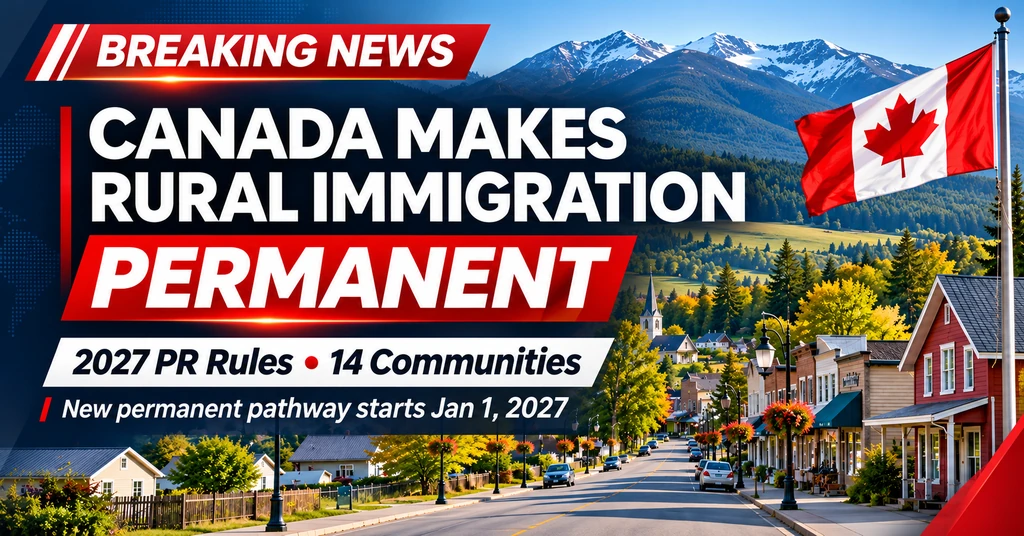
Canada has officially announced that its Rural Community Immigration Pilot (RCIP) will become a permanent immigration program starting January 1, 2027, creating a continuing pathway to Canadian permanent residence for eligible skilled workers and international graduates willing to work and settle in smaller communities.
On this pageTable of Content
The announcement was made on November 9, 2026, by Lena Metlege Diab, Canada's Minister of Immigration, Refugees and Citizenship, in Pictou County, Nova Scotia.
The new Rural Community Immigration Program will initially build on the existing network of 14 participating communities across six Canadian provinces, with plans to expand to additional communities in the future.
Unlike Canada's Express Entry system, the rural immigration pathway relies on eligible job offers from designated employers and recommendations from participating communities. Applicants do not compete through the standard Express Entry Comprehensive Ranking System (CRS).
The announcement is particularly relevant to skilled workers already living in Canada, foreign professionals considering Canadian employment, international graduates, and families interested in settling outside Canada's largest metropolitan areas.
However, becoming permanent does not mean the program is open to everyone. Applicants must meet specific employment, language, education, work experience, and settlement requirements.
This guide explains what changes in 2027, who qualifies, which 14 communities participate, how to find eligible employers, and how to apply for permanent residence.
Canada Announces Permanent Rural Immigration Program for 2027
On November 9, 2026, Immigration, Refugees and Citizenship Canada (IRCC) confirmed that the Rural Community Immigration Pilot would transition into a permanent economic immigration program.
The decision follows Canada's efforts to address persistent labour shortages in rural and remote communities while maintaining more predictable immigration levels.
Many smaller Canadian communities experience workforce shortages, population aging, and difficulty attracting qualified employees. These challenges can affect healthcare services, local businesses, education, and economic development.
Under the permanent program, participating communities will continue working with designated local employers to identify vacancies that cannot be adequately filled by the existing local workforce.
Eligible foreign workers can then pursue permanent residence after obtaining a qualifying job offer and community recommendation.
According to IRCC, the permanent program will retain three important features:
- Community-driven recruitment: Local communities identify priority sectors and occupations based on their economic needs.
- Designated employers: Employers must meet community requirements before participating in the immigration pathway.
- Employer accountability: Participating employers are subject to training, monitoring, and program compliance requirements.
The program is intended to attract newcomers who can contribute economically and establish long-term lives in participating communities.
Official announcement: Canada creates a permanent immigration pathway to help rural communities.
What Changes Under Canada's Rural Immigration Program in 2027?
The most important development is the transition from a temporary pilot framework into a permanent immigration program.
The previous Rural Community Immigration Pilot began in January 2025 and will close on January 1, 2027.
The new permanent Rural Community Immigration Program will open on the same date.
Rural Immigration Pilot vs Permanent Program
| Feature | Rural Community Immigration Pilot | Permanent Rural Community Immigration Program |
|---|---|---|
| Program type | Time-limited immigration pilot | Permanent economic immigration program |
| Applications | Existing pilot rules and deadlines | Opens January 1, 2027 |
| Participating communities | 14 | Existing 14 expected to continue |
| Future expansion | Limited pilot participation | Additional communities planned |
| Job offer | Required | Required |
| Community recommendation | Required | Required |
| Permanent residence | Available to qualifying applicants | Available to qualifying applicants |
| CRS ranking | Not required | Not required |
The permanent program will continue using the employer- and community-led approach established under the pilot.
Although this represents a significant policy development, it should not be interpreted as an automatic relaxation of immigration eligibility requirements.
What Happens to Existing RCIP Applicants?
Applicants who receive a community recommendation dated December 31, 2026, or earlier must apply for permanent residence before their recommendation expires.
IRCC has confirmed that it will continue processing permanent residence applications already received under the pilot.
Eligible applicants may also qualify for a work permit while their permanent residence applications are being processed.
Applicants without a valid pilot recommendation should investigate the permanent program opening January 1, 2027.
Official guidance: Rural Community Immigration Pilot transition.
Canada Rural Immigration Permanent Residence Targets for 2027–2029
Canada has established specific admission targets for the Rural Community Immigration Program under its 2027–2029 Immigration Levels Plan.
| Year | Planned PR Admissions | Low Range | High Range |
|---|---|---|---|
| 2027 | 5,500 | 4,000 | 6,500 |
| 2028 | 6,000 | 5,000 | 7,000 |
| 2029 | 6,500 | 4,000 | 7,000 |
| Total planned | 18,000 | — | — |
These figures are national permanent resident admission targets, rather than the number of available jobs, community recommendation certificates, or guaranteed approvals.
Importantly, the targets include remaining admissions under the Rural Community Immigration Pilot and the former Rural and Northern Immigration Pilot, alongside future admissions through the permanent program.
The 2028 and 2029 targets are also subject to future adjustments.
Canada's overall permanent resident admission target is 380,000 annually for 2027, 2028, and 2029.
The allocation reflects Canada's intention to continue economic immigration while directing opportunities toward regions with specific labour market needs.
Official source: Canada's 2027–2029 Immigration Levels Plan.
How Successful Was Canada's Previous Rural Immigration Pilot?
The government's announcement included early results showing substantial employer participation.
Between January 2025 and August 2026:
- More than 1,950 employers were vetted and designated by participating communities.
- These employers issued more than 4,700 job offers and community recommendations.
- Newcomers supported sectors including healthcare, education, and sales and services.
These figures do not mean 4,700 people had already received permanent residence.
Earlier, the Rural and Northern Immigration Pilot, which operated from 2019 to 2024, involved more than 2,800 employers and resulted in over 12,500 candidates and accompanying family members being admitted to smaller Canadian communities.
Together, these programs provided the foundation for Canada's decision to establish a permanent rural immigration pathway.
List of 14 Communities Under Canada's Rural Immigration Program
The federal government expects the 14 communities participating in the existing pilot to continue under the permanent program.
These communities are located in Nova Scotia, Ontario, Manitoba, Saskatchewan, Alberta, and British Columbia.
| Province | Participating Community |
|---|---|
| Nova Scotia | Pictou County |
| Ontario | North Bay |
| Ontario | Sudbury |
| Ontario | Timmins |
| Ontario | Sault Ste. Marie |
| Ontario | Thunder Bay |
| Manitoba | Steinbach |
| Manitoba | Altona/Rhineland |
| Manitoba | Brandon |
| Saskatchewan | Moose Jaw |
| Alberta | Claresholm |
| British Columbia | West Kootenay |
| British Columbia | North Okanagan Shuswap |
| British Columbia | Peace Liard |
Ontario accounts for five participating communities, followed by Manitoba and British Columbia with three each.
These are geographically diverse communities, with differences in population, employment opportunities, climate, housing markets, and access to services.
Will Canada Add More Rural Immigration Communities?
Yes. IRCC has announced plans to expand the program to additional communities.
However, as of November 10, 2026, the government has not announced a final list of new communities or a specific expansion timetable.
Future participating communities will be selected according to criteria related to labour shortages, economic development, newcomer settlement capacity, and administrative readiness.
The government has indicated that eligible rural communities may include those with populations below 200,000 that meet specified remoteness criteria.
Applicants should wait for official announcements before assuming that a particular city or region will qualify.
Canada Rural Immigration Program Eligibility Requirements for 2027
To qualify for permanent residence under the Rural Community Immigration Program, an applicant generally needs:
- A valid job offer from a designated employer in a participating community.
- A valid recommendation certificate issued by that community.
- At least one year of qualifying related work experience within the previous three years, unless exempt.
- Results from an approved English or French language test.
- An eligible Canadian educational credential or equivalent foreign qualification.
- Sufficient settlement funds, unless exempt.
Meeting these requirements does not guarantee permanent residence approval. Applicants must also meet applicable immigration admissibility and documentation requirements.
1. Job Offer From a Designated Employer
A qualifying job offer is central to the RCIP application process.
Applicants cannot simply select any employer in rural Canada. Their job offer must come from an employer designated by the participating community.
Communities determine which sectors and occupations qualify based on local employment needs.
A genuine job opportunity with an employer that is not designated for the program will not, by itself, satisfy RCIP requirements.
2. Community Recommendation
After the applicant receives an eligible job offer, the designated employer submits the community recommendation application directly to the relevant community.
The community reviews the applicant's eligibility, the job offer, and whether the occupation aligns with its priorities.
If the application is approved, the applicant receives a recommendation certificate that can support their permanent residence application.
Community recommendation and federal permanent residence approval are separate decisions.
3. Work Experience Requirements
Applicants generally need at least 1,560 hours of qualifying paid work experience within the previous three years.
This is equivalent to one year of full-time employment calculated at 30 hours per week.
Qualifying experience can come from eligible full-time or part-time employment.
However, certain types of experience are excluded, including unpaid internships, volunteer work, and self-employment.
Applicants must also satisfy rules connecting their previous work experience to the National Occupational Classification (NOC) and Training, Education, Experience and Responsibilities (TEER) category of the job offer.
| Job Offer TEER | Qualifying Previous Work Experience |
|---|---|
| TEER 0 or 1 | TEER 0, 1, 2 or 3 |
| TEER 2 | TEER 1, 2, 3 or 4 |
| TEER 3 or 4 | TEER 2, 3 or 4 |
| TEER 5 | Same five-digit NOC code |
Special exceptions apply to certain nursing and healthcare occupations.
Applicants should review their actual job duties and NOC classification rather than relying only on job titles.
Official guidance: IRCC work experience requirements.
4. IELTS, CELPIP and Language Requirements
Applicants must demonstrate English or French proficiency using an approved language test.
The minimum required Canadian Language Benchmark (CLB) or French NCLC level depends on the TEER category of the qualifying job offer.
| Job Offer TEER Category | Minimum Language Level |
|---|---|
| TEER 0 or 1 | CLB/NCLC 6 |
| TEER 2 or 3 | CLB/NCLC 5 |
| TEER 4 or 5 | CLB/NCLC 4 |
Approved English tests include IELTS General Training, CELPIP-General, and PTE Core.
Approved French tests include TEF Canada and TCF Canada.
Applicants must meet the applicable minimum in all four language abilities: reading, writing, listening, and speaking.
Their test results must be less than two years old when applying.
Helpful tool: Use the free Visaboards CLB Calculator to convert your IELTS, CELPIP, PTE Core, TEF Canada, or TCF Canada results into Canadian language benchmark levels.
This can help you understand whether your scores meet the relevant RCIP language threshold. The calculator provides an estimate, while IRCC's official conversion tables determine the applicable requirement.
For example, a candidate applying for an eligible TEER 2 occupation needs at least CLB 5 in each language ability. An applicant seeking an eligible TEER 1 position needs at least CLB 6.
5. Education and Educational Credential Assessment
Applicants must demonstrate that they hold a qualifying educational credential.
A Canadian high school diploma or recognized Canadian post-secondary qualification can satisfy the educational requirement.
Applicants educated outside Canada generally need an Educational Credential Assessment (ECA) from a designated organization.
The ECA must normally be less than five years old on the date of application and demonstrate that the foreign qualification is equivalent to at least an eligible Canadian secondary or post-secondary credential.
Some regulated professions, including certain medical, architectural, and pharmacy occupations, have additional professional assessment requirements.
Applicants should also understand that an ECA does not automatically authorize them to practise a regulated profession in Canada. Occupational licensing may be a separate requirement.
6. Settlement Funds Requirements
Most applicants need to demonstrate that they can financially support themselves and their accompanying family after arriving in Canada.
However, applicants already working in Canada with a valid work permit do not need to provide proof of settlement funds under the published RCIP rules.
The official settlement fund table currently displayed by IRCC was last updated on July 29, 2025.
| Family Size | Minimum Settlement Funds (CAD) |
|---|---|
| 1 | $10,507 |
| 2 | $13,080 |
| 3 | $16,080 |
| 4 | $19,524 |
| 5 | $22,143 |
| 6 | $24,975 |
| 7 | $27,806 |
| Each additional person | +$2,831 |
These amounts may be updated, so applicants preparing for 2027 should check the current IRCC table before submitting their applications.
Family size calculations can include spouses, common-law partners, and dependent children even when some family members will not accompany the principal applicant.
Applicants should also consider costs beyond minimum settlement funds, including travel, housing deposits, transportation, and initial household expenses.
Helpful tools: The Visaboards Budget & Moving Abroad Planner can help applicants estimate their relocation budget, while the Salary & Cost of Living Comparison Calculator can help compare employment offers and living expenses.
These planning tools are not substitutes for IRCC's official settlement funds requirements.
Official guidance: RCIP proof of funds.
7. Can International Graduates Apply Without Work Experience?
Certain international graduates may qualify for an exemption from the standard one-year work experience requirement.
Eligible graduates must have studied at a publicly funded post-secondary institution in the recommending community and meet the applicable study, residence, graduation, and credential conditions.
The exemption can apply to graduates of eligible programs lasting at least two years or qualifying master's degree and higher programs lasting two years or less.
Different physical presence requirements apply to each category.
Applicants must generally have completed their qualification no more than 18 months before applying.
Some programs do not qualify, including certain distance-learning programs, language-focused programs, and programs funded by scholarships requiring a return to the applicant's home country.
This is an exemption from the work experience requirement, not an exemption from all other eligibility rules. An eligible job offer and community recommendation remain necessary.
How to Apply for Canada's Rural Immigration Program in 2027
Applicants interested in the new permanent program can prepare through the following process.
Step 1: Choose a Participating Community
Start by reviewing the 14 participating communities.
Consider factors such as employment opportunities in your occupation, regional priorities, housing costs, local services, climate, and long-term settlement plans.
A community that offers an eligible job may be a better fit than one that appears attractive geographically but has no openings in your profession.
Step 2: Find an Eligible Job With a Designated Employer
Each participating community is responsible for identifying designated employers and publishing information about qualifying employment opportunities.
Applicants should consult the community's official immigration website or employer lists.
Important: A job listed as being located in a participating city is not automatically eligible for RCIP.
The employer must have the necessary designation, and the job must satisfy community and federal program requirements.
Step 3: Prepare a Canadian-Style CV
Applicants pursuing Canadian employment should prepare a professional, relevant CV or résumé that clearly demonstrates their qualifications, work experience, and suitability for the advertised occupation.
The CV should reflect the actual duties of the position and avoid inaccurate claims about professional licensing or work authorization.
Applicants can use the free Visaboards ATS CV Builder to organize their professional experience into an application-ready CV.
Using a CV builder does not guarantee employment or employer designation.
Step 4: Obtain a Qualifying Job Offer
Once a designated employer selects an eligible applicant, the employer may provide a qualifying job offer.
Applicants should carefully review the job title, NOC classification, duties, employment conditions, work location, and salary.
They should also confirm that the offer is legitimate and that the employer is authorized to participate in the relevant community program.
Step 5: Obtain a Community Recommendation
Under the published process, the employer submits the applicant's community recommendation request directly to the community.
The community assesses whether the position and applicant meet the relevant requirements.
If the recommendation is approved, the applicant receives a certificate.
A recommendation is an essential step, but it does not itself grant permanent residence.
Step 6: Prepare Documents and Apply for Permanent Residence
After receiving a valid community recommendation, the applicant can proceed with the federal permanent residence application.
Depending on individual circumstances, documents may include:
- Passport and identity records.
- Valid community recommendation certificate.
- Qualifying employment offer.
- Language test results.
- Educational credentials and ECA, where required.
- Work experience and employer reference letters.
- Settlement funds evidence, where required.
- Civil status and family documents.
- Police certificates, medical examinations, and biometrics as instructed.
Applicants must follow the correct IRCC application process and pay the applicable fees.
The permanent program officially opens on January 1, 2027.
Official application information: Rural Community Immigration Program.
Which Jobs Are Eligible Under Canada's Rural Immigration Program?
One of the most important features of RCIP is that eligible occupations are determined according to local labour market requirements.
IRCC has identified healthcare, education, sales, and services among the sectors supported through the pilot.
Other locally prioritized industries may include skilled trades, manufacturing, transportation, or business services, depending on the community.
However, there is no guarantee that an occupation qualifying in one community will also qualify in another.
For example, two participating communities may have different priorities even if they are located in the same province.
Applicants should check the following information before applying:
- Whether their occupation appears on the community's current priority occupation list.
- Whether the employer has been designated.
- Whether the specific job offer meets RCIP conditions.
- Whether the applicant meets the federal language, education, and work experience requirements.
- Whether the community is currently accepting recommendation applications.
Healthcare professionals and other workers in regulated occupations may also need provincial registration or licensing before they can legally perform their duties.
Where to Find Designated Employers for Canada RCIP
The safest starting point is IRCC's official community directory.
IRCC connects applicants to the relevant websites of participating communities, where employer designation and eligible employment opportunities can be checked.
Applicants can review community information for Pictou County, North Bay, Sudbury, Timmins, Sault Ste. Marie, Thunder Bay, Steinbach, Altona/Rhineland, Brandon, Moose Jaw, Claresholm, West Kootenay, North Okanagan Shuswap, and Peace Liard.
Employer lists and eligible occupations may change according to community needs.
Therefore, an employer's previous participation does not guarantee that it currently has an eligible position available.
Official resource: Find a designated employer and community recommendation.
Applicants should be cautious about immigration scams, fake job offers, and requests for payments in exchange for guaranteed permanent residence.
No employer or recruitment agent can guarantee approval by IRCC.
Canada Rural Immigration Application Fees and Processing Times
Applicants should budget for both government immigration fees and other application-related expenses.
These may include:
- Permanent residence processing and right of permanent residence fees.
- Biometrics, where applicable.
- Language testing.
- Educational credential assessment.
- Medical examinations.
- Police certificates and translations.
- Travel and settlement expenses.
The official RCIP program page lists application fees beginning at approximately CAD $1,590, but applicants should verify the live IRCC fee schedule because the amount payable depends on the application and family composition.
Processing times can vary according to application volumes, document completeness, background checks, and IRCC operations.
Applicants should avoid relying on an assumed or guaranteed processing period.
For updated fee information and processing guidance, consult the official IRCC website.
Can You Apply for Canada Rural Immigration From Outside Canada?
Yes. The rural immigration program can provide a route for eligible candidates living outside Canada, provided they satisfy the program requirements.
For example, a qualified professional living in Pakistan, India, Bangladesh, the Philippines, Nigeria, or another country may explore designated employers in participating communities.
However, living outside Canada does not remove the requirement for a valid job offer and community recommendation.
Candidates should also consider practical issues such as occupational licensing, interviews, relocation costs, and whether the employer is willing to hire internationally.
A person does not become eligible solely by expressing an intention to settle in rural Canada.
Can You Bring Your Spouse and Children?
Canada's rural immigration pathway can allow eligible applicants to include qualifying family members in their permanent residence applications.
Applicants must correctly declare their spouse or common-law partner and dependent children, even where certain family members are not accompanying them.
The inclusion of family members can affect documentary requirements, government fees, and settlement funds calculations.
Families considering relocation should also research housing affordability, schooling, healthcare access, transport, and employment opportunities for accompanying partners.
A job offer that looks financially attractive may have a different practical value once household expenses are considered.
The Visaboards Salary & Cost of Living Comparison Calculator can help applicants compare the financial implications of different locations and employment offers.
Canada Rural Immigration vs Express Entry vs Provincial Nominee Program
Canada offers several economic immigration pathways, but they operate differently.
| Feature | Rural Community Immigration Program | Express Entry | Provincial Nominee Program |
|---|---|---|---|
| Main purpose | Address participating rural communities' labour needs | Select eligible skilled immigrants through federal programs | Address provincial or territorial immigration priorities |
| Job offer | Required from designated employer | Depends on program and circumstances | Depends on nomination stream |
| Community recommendation | Required | Not required | Not generally required under standard PNP streams |
| CRS score | Not used for RCIP selection | Used to rank candidates | Used for Express Entry-linked nominations, not all PNP streams |
| Geographic focus | Participating rural communities | Federal economic immigration, generally outside Quebec | Relevant nominating province or territory |
| Selection model | Employer and community-led | Federal eligibility and invitation system | Provincial or territorial nomination process |
What if You Do Not Have a Rural Canada Job Offer?
Applicants without a designated employer job offer may want to explore alternative pathways rather than assuming RCIP will be available to them.
Express Entry is one possibility for candidates meeting its eligibility requirements.
Applicants can use the free Visaboards Canada CRS Calculator to estimate their Express Entry ranking score.
Visitors can also explore the Visaboards immigration and relocation tools directory for resources that may help them compare other skilled immigration pathways.
Important distinction: CRS points do not determine eligibility for RCIP. These tools are useful when researching alternative immigration routes, not as official rural community immigration assessments.
Is Canada's Permanent Rural Immigration Program a Good Opportunity?
The program may be especially relevant to people who have professional experience in occupations prioritized by participating communities and are genuinely interested in living in smaller Canadian population centres.
Potential advantages include access to a dedicated permanent residence pathway, opportunities to meet specific labour shortages, and the possibility of establishing long-term community connections.
However, applicants should also consider important limitations.
Participation depends on finding a designated employer willing to offer a qualifying job. Community recommendation capacity, eligible occupations, housing availability, and employment opportunities may differ considerably by region.
In some locations, access to specialist healthcare services, public transportation, or employment opportunities for accompanying family members may be more limited than in large metropolitan areas.
Applicants should evaluate the entire settlement opportunity rather than focusing only on obtaining permanent residence.
Frequently Asked Questions About Canada Rural Immigration Program 2027
1. Is Canada's Rural Community Immigration Program permanent in 2027?
Yes. On November 9, 2026, the Canadian government announced that the Rural Community Immigration Pilot would transition into a permanent economic immigration program. The permanent program is scheduled to open on January 1, 2027.
2. When does the new permanent RCIP open?
The permanent Rural Community Immigration Program opens on January 1, 2027. The existing pilot closes on the same date, with transitional arrangements for applicants holding earlier community recommendations.
3. Can I apply for rural immigration without a job offer?
No. Applicants need a qualifying job offer from a designated employer in a participating community, along with a valid community recommendation and other required qualifications.
4. Is IELTS required for Canada Rural Immigration Program?
An approved English or French language test is required. Applicants may use IELTS General Training or another accepted test such as CELPIP-General, PTE Core, TEF Canada, or TCF Canada. IELTS specifically is not mandatory if the applicant takes another approved test.
5. What IELTS or CLB score is required for RCIP?
The minimum language threshold depends on the job offer's TEER category. TEER 0 or 1 requires CLB/NCLC 6, TEER 2 or 3 requires CLB/NCLC 5, and TEER 4 or 5 requires CLB/NCLC 4.
You can check your converted score using the Visaboards CLB Calculator.
6. Do I need a CRS score for Canada Rural Immigration?
No. The Rural Community Immigration Program does not use the Express Entry CRS ranking system. Applicants must instead meet RCIP eligibility conditions and obtain a qualifying job offer and community recommendation.
7. Can applicants from Pakistan, India, or Bangladesh apply?
Yes. Eligible foreign nationals can explore the program regardless of whether they are currently living in Canada, provided they meet the applicable requirements, obtain a qualifying job offer and recommendation, and are admissible to Canada.
8. Which Canadian provinces participate in RCIP?
The 14 communities expected to participate in the permanent program are located in Nova Scotia, Ontario, Manitoba, Saskatchewan, Alberta, and British Columbia.
9. Can international graduates qualify without one year of work experience?
Some international graduates who completed eligible programs at publicly funded institutions in the recommending community may qualify for a work experience exemption. They must still satisfy the other program requirements.
10. Can I bring my family under RCIP?
Eligible spouses, common-law partners, and dependent children may be included in permanent residence applications, subject to applicable requirements. Family size can affect settlement funds and fees.
11. How much settlement money is required for RCIP?
The amount depends on family size. The official table displayed by IRCC on November 10, 2026, lists CAD $10,507 for one person and CAD $13,080 for two people, with higher amounts for larger families. Applicants already working in Canada with a valid work permit are exempt from this proof-of-funds requirement. The figures may be updated.
12. Can I apply to any rural community in Canada?
No. The program is restricted to designated participating communities. Applicants must obtain qualifying employment and a recommendation through one of those communities.
13. Is the Rural Immigration Program the same as Canada's Express Entry system?
No. RCIP is a separate employer- and community-led permanent residence pathway. Express Entry manages applications under specific federal economic immigration programs and uses CRS-based invitations.
14. Will more communities join Canada's permanent rural immigration program?
The government has confirmed plans for expansion, but the additional communities and implementation dates have not yet been announced.
15. What happens if I already received an RCIP recommendation in 2026?
Applicants whose recommendations are dated December 31, 2026, or earlier must submit their permanent residence applications before their recommendation certificates expire. IRCC will continue processing applications already received under the pilot.
Final Takeaways
Canada's decision to make the Rural Community Immigration Pilot permanent marks an important development in its economic immigration policy.
Starting January 1, 2027, the permanent Rural Community Immigration Program will provide an ongoing pathway to permanent residence for eligible skilled workers and international graduates who can contribute to participating communities.
The program is expected to begin with 14 existing communities, while further expansion is planned.
Canada has established a target of 5,500 admissions under the rural immigration category for 2027, increasing to 6,000 in 2028 and 6,500 in 2029. These targets include remaining admissions from previous rural immigration pilots and are not guarantees of individual approval.
For prospective applicants, the most important preparation steps are to identify suitable participating communities, understand local priority occupations, find legitimate designated employers, and prepare the necessary language, education, work experience, and financial documents.
The program may create meaningful opportunities, but success will depend on meeting both community-specific and federal immigration requirements.
Applicants should verify the latest rules and availability through official IRCC and community websites before making major immigration or financial decisions.
Official Canadian Government Sources
- IRCC announcement: Permanent Rural Immigration Program, November 9, 2026
- Official Rural Community Immigration Program
- RCIP Eligibility Requirements
- Find Participating Communities and Designated Employers
- 2027–2029 Immigration Levels Plan
Disclaimer: This article provides general immigration information based on official sources available as of November 10, 2026. It is not legal or immigration advice. Program rules, fees, admissions targets, priority occupations, and community participation can change. Always consult IRCC and the relevant participating community for the latest requirements.
Join the conversation
Have thoughts on this topic? Share them with others.
Ask questions, share experience, and learn from the Visaboards Community.